
To outline a screenplay, decide the ending first, set your act breaks as page targets, split each act into sequences, then list every scene on one line: where it happens, who is in it, and what changes by the end. A finished feature outline is a scene list you can write from on Monday morning, usually two to ten pages long.
Outlining is one stage of the longer process in the idea to first draft guide. Here we stay on that one stage, with a worked example we wrote for the purpose: SLACK WATER, an 80-page drama outlined in full, all 28 scenes.
What a screenplay outline is
A screenplay outline is the list of scenes in the order the audience will see them, each with enough detail that you know what to write. It sits between the beat sheet, which checks the shape of the story on a single page, and the script itself. A treatment is something else: prose written to persuade a reader. If you're unsure which document to build first, the beat sheet vs outline vs treatment comparison settles the order. The short version is beats, then outline, then treatment if anyone asks for one.
An outline is for you. Nobody buys it, so it can be ugly, abbreviated and full of question marks. What it can't be is vague.
The four levels of an outline
Every outline, whatever template you use, works at four levels of detail. You build them from the top down and you fix problems at the highest level where they show up.
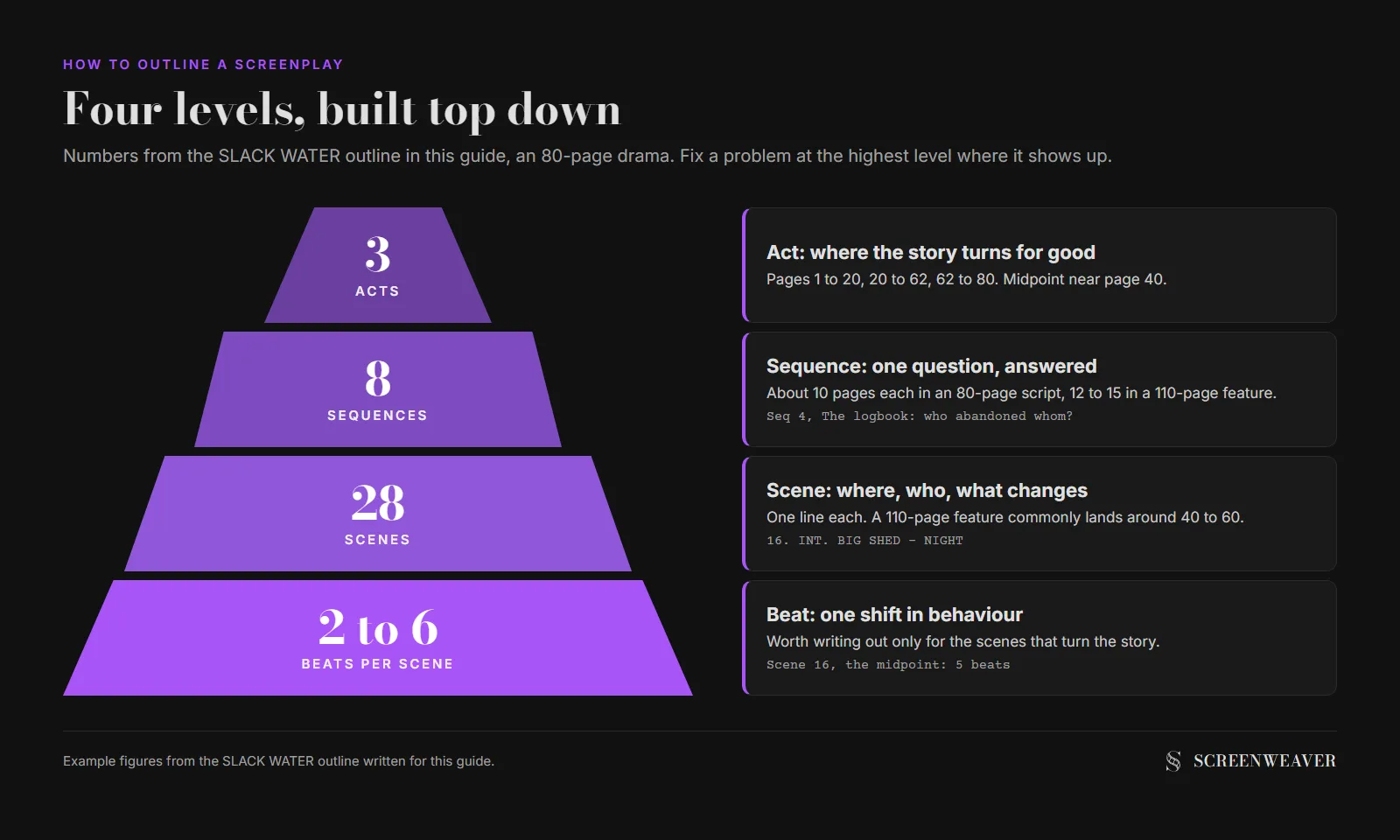
The four levels, with the numbers from our SLACK WATER outline. ScreenWeaver diagram.
| Level | What it answers | In a 110-page feature | In our 80-page example |
|---|---|---|---|
| Act | Where the story turns for good | 3 (sometimes more in TV) | 3 |
| Sequence | Which question this stretch of story asks and answers | 8, about 12 to 15 pages each | 8, about 10 pages each |
| Scene | Where we are, who is there, what changes | Roughly 40 to 60 | 28 |
| Beat | Each shift in behaviour inside a scene | Several per scene | 2 to 6 per scene |
The sequence row comes from the 8-sequence approach, and it's the level most first outlines skip. Acts are too big to write from and scenes are too small to judge, so the sequence is where you can actually see the second act sagging.
Step 1: Write the ending and the premise in two sentences
Start with the last scene. If you don't know where the story lands, every choice before it is a guess, and the outline turns into a list of events that could go anywhere. Write two sentences: who wants what, and how it ends.
For our example:
Nell, a tidal surveyor, comes home to sell her dead father's boatyard in a week, and finds a half-built boat he left for the brother she hasn't spoken to in eleven years. She sells the yard but keeps the boat, and takes it out to sea with her brother at dawn.
Expect the second sentence to change several times before you write anything else. That's why it comes first: here it costs one line to change, later it costs a sequence.
Step 2: Set the act breaks as page targets
Pick a length and mark where the acts turn. One page of a correctly formatted script runs about a minute on screen, so page targets are running-time targets. For an 80-page script we used:
- Act one: pages 1 to 20, ending when Nell commits to finishing the boat
- Act two: pages 20 to 62, with the midpoint near page 40
- Act three: pages 62 to 80
Treat them as targets. A break that lands on page 24 is fine. A break that lands on page 35 of an 80-page script means act one is doing too much. If you want the arithmetic done for other lengths, the beat sheet calculator maps the major turns to page numbers.
Step 3: Split each act into sequences, each with its own question
Give every sequence a name and a question it answers by its last scene. Act two is where this pays off, because "the middle" turns into four smaller stories with their own endings.
| Seq | Pages | Name | Question it answers |
|---|---|---|---|
| 1 | 1 to 10 | The call | Will Nell come home at all? |
| 2 | 10 to 20 | The offer | Can she sell the yard in seven days? |
| 3 | 20 to 31 | One boat, two people | Can she and Owen work side by side? |
| 4 | 31 to 41 | The logbook | Who actually abandoned whom? |
| 5 | 41 to 51 | Pressure | What gives when the deadline moves? |
| 6 | 51 to 62 | Cracked | Is the boat worth losing the sale? |
| 7 | 62 to 71 | The tide table | Is there another way to float it? |
| 8 | 71 to 80 | Slack water | Does it float, and what does Nell keep? |
If two sequences answer the same question, one of them is padding. That's the fastest structural check there is.
Step 4: List every scene on one line
Now the real outline. Each line has a scene heading, the people in it and one sentence saying what changes, written with a verb that belongs to a character. "Nell finds the build log" is an outline line. "The truth comes out" isn't, because it doesn't tell you who is in the room or what they do.
Here is SLACK WATER in full. The story and names are ours, written for this article.
| # | Scene | What changes | Pages |
|---|---|---|---|
| ACT ONE | |||
| 1 | EXT. SURVEY LAUNCH, NORTH SEA - DAWN | Nell logs a depth to the centimetre and ignores four calls from the same island number | 1 to 2 |
| 2 | INT. LAUNCH WHEELHOUSE - DAY | A voicemail: her father Tom has died. She asks her boss for seven days, not eight | 2 to 4 |
| 3 | EXT. FERRY DECK - DUSK | Nell spots the boatyard crane from the water before she can see the town | 4 to 5 |
| 4 | INT. HALLORAN BOATYARD OFFICE - NIGHT | Unpaid invoices in a biscuit tin. She decides to sell, in one line | 5 to 10 |
| 5 | INT. HARBOUR HOTEL BAR - NIGHT | Dev, the hotel owner, offers to buy, on one condition: the sheds empty by Friday | 10 to 13 |
| 6 | INT. BIG SHED - NIGHT | Under a tarp, a half-planked wooden hull. Chalked on the transom: FOR OWEN | 13 to 15 |
| 7 | EXT. SLIPWAY - DAWN | Nell reads the tide table: the hull is too heavy for the road, so it leaves by water on Friday's 06:10 spring tide | 15 to 17 |
| 8 | INT. BIG SHED - DAY | Owen, gone eleven years, is already inside measuring the hull. Nell agrees to finish it with him, then sell | 17 to 20 |
| ACT TWO | |||
| 9 | INT. BIG SHED - DAY | They fight over every plank. Owen works exactly like their father did | 20 to 23 |
| 10 | INT. CHANDLERY - DAY | The bronze fastenings cost more than Nell has. Owen pays cash and won't say where it came from | 23 to 25 |
| 11 | EXT. HARBOUR WALL - NIGHT | Nell accuses Owen of leaving her to nurse Dad alone. He doesn't defend himself | 25 to 28 |
| 12 | INT. BIG SHED - NIGHT | One side planked. Nell signs Dev's heads of terms on the workbench | 28 to 31 |
| 13 | INT. TOM'S COTTAGE - DAY | Clearing the cottage, Nell finds her father's build log | 31 to 34 |
| 14 | INT. TOM'S COTTAGE - CONTINUOUS | The log puts Owen at the yard every winter for six years. Nell is the one who never came | 34 to 37 |
| 15 | EXT. BOATYARD - DUSK | Nell watches Owen steam a plank alone and doesn't go in | 37 to 38 |
| 16 | INT. BIG SHED - NIGHT | MIDPOINT. She puts the log on the hull. Dad asked Owen not to tell her. Her anger changes target | 38 to 41 |
| 17 | INT. HARBOUR HOTEL BAR - DAY | Dev moves the deadline to Thursday: his builders arrive early | 41 to 44 |
| 18 | INT. BIG SHED - DAY | Nell's boss calls: she's needed back Thursday. She says yes | 44 to 46 |
| 19 | INT. BIG SHED - NIGHT | Storm. The roof leaks onto fresh varnish. Owen sleeps in the hull to hold the tarp down | 46 to 49 |
| 20 | INT. BIG SHED - DAWN | Nell brings coffee. The first joke between them in the film | 49 to 51 |
| 21 | EXT. SLIPWAY - DAY | Test fill: one seam weeps. Owen says caulk it, Nell says it won't hold | 51 to 54 |
| 22 | INT. BOATYARD OFFICE - NIGHT | Nell signs the contract. Dev's crew clears the shed Thursday at 08:00, boat or no boat | 54 to 58 |
| 23 | EXT. FERRY RAMP - DAWN | Owen leaves on the first ferry. LOW POINT | 58 to 62 |
| ACT THREE | |||
| 24 | INT. TOM'S COTTAGE - DAY | Packing up, Nell finds Tom's pencil marks on an old tide table and reruns the numbers: Wednesday's 23:40 tide is enough if the hull goes out light | 62 to 65 |
| 25 | INT. TOM'S COTTAGE - DAY | Nell calls Owen on the mainland: "Wednesday, twenty to midnight. I need hands" | 65 to 67 |
| 26 | EXT. BOATYARD - NIGHT | The island turns up: the chandler, the barman, the ferry crew. Dev watches from the road | 67 to 71 |
| 27 | EXT. SLIPWAY - NIGHT | The launch at the top of the tide. The weak seam takes water, they bail, the wood swells shut | 71 to 77 |
| 28 | EXT. ESTUARY - DAWN | Nell and Owen sail past the yard Dev now owns. She kept the boat, not the yard | 77 to 80 |
That's about 900 words for a whole feature. Some writers go further and add a short paragraph under each line. Fine, as long as the one-line version still exists, because that's the one you'll reread.
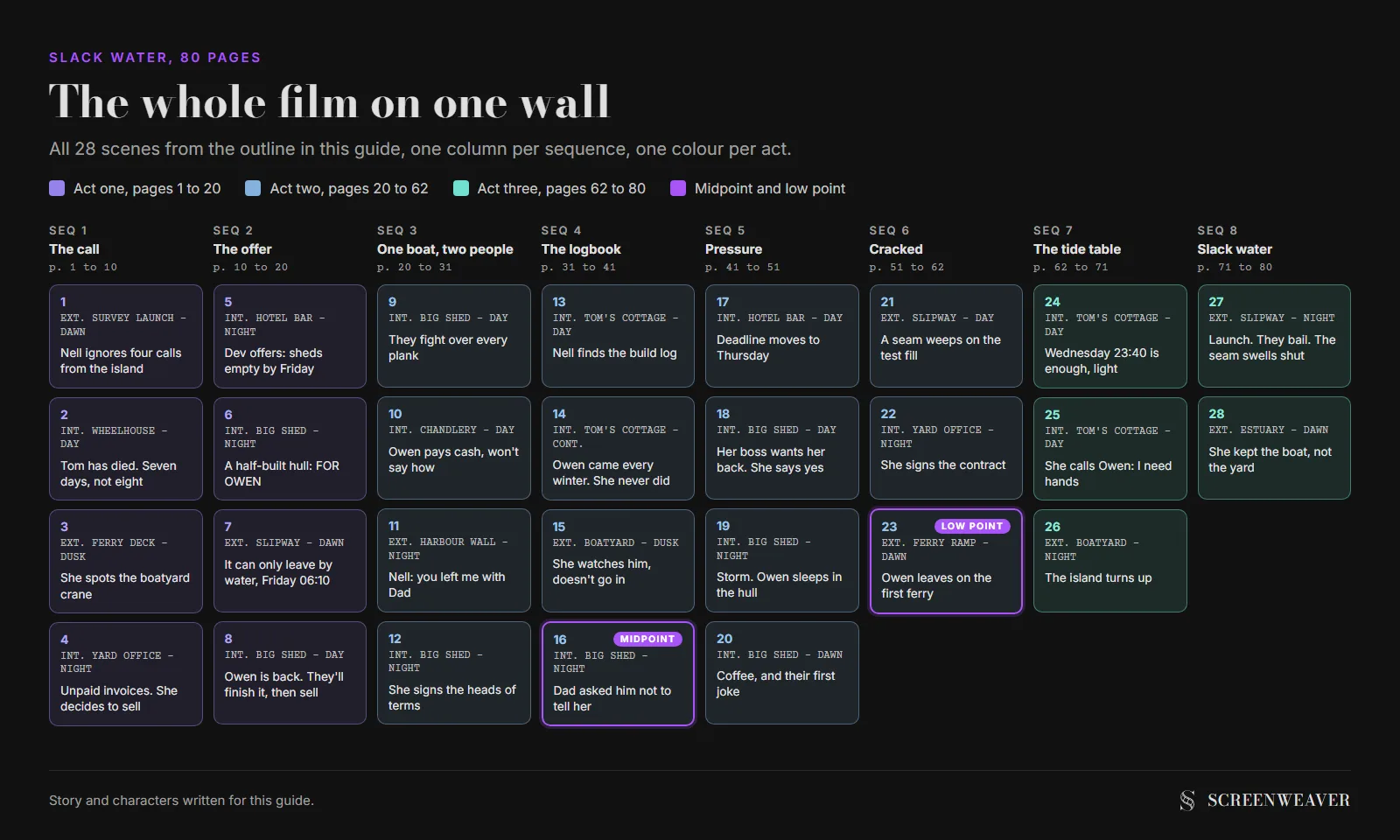
The same 28 scenes as cards, one colour per act. Seeing the whole film at once makes the uneven sequences obvious. ScreenWeaver diagram.
Laid out like this, padding is easy to spot. A funeral scene after the voicemail would be the obvious addition to sequence 1, and it would change nothing the voicemail hasn't already changed, so it has no card. Cards against list is mostly a question of how your head works, and the beat boards vs outlines comparison goes into that choice.
Try it free
Try Screenweaver for free on your script
It is free. Import your existing project, get a clearer view of your outline, and regain control of your story structure in minutes.
Start FreeStep 5: Beat the scenes that turn the story
You don't need beats for every scene. Do it for the act breaks, the midpoint, the low point and the climax, the scenes where the story changes direction. A beat is one shift in what a character is doing. Scene 16, the midpoint, breaks down like this:
- Nell puts the build log on the hull without a word.
- Owen recognises it and doesn't touch it.
- "Every winter?" He says Dad asked him not to tell her.
- Her anger moves from Owen to their father.
- She picks up a plane and starts working on his side of the hull.
Five beats, five changes of behaviour, and the last one sets up the relationship the rest of act two runs on. If you can't find at least two beats in a scene you've marked as a turning point, it isn't turning anything yet.
Step 6: Test the outline before you write a page
Run these checks on the finished list. Each takes a few minutes and each one is cheaper here than in draft.
- Read only the "what changes" column. If a line could be deleted without breaking the next one, cut the scene or give it a job.
- Swap the connectors. Trey Parker and Matt Stone of South Park describe a rule for their own scripts: if the joins between story beats read "and then", rewrite them as "but" or "therefore". Scene 21 to scene 22 reads "the seam weeps, therefore Nell signs". Scene 9 to scene 10 needs a "but", or one of them goes.
- Add up the pages per sequence. Ours run 10, 10, 11, 10, 10, 11, 9 and 9. A sequence twice the length of its neighbours is usually two sequences, or one with padding.
- Check every sequence answers its question. Sequence 5 asks what gives when the deadline moves. Scene 18 answers it: Nell's job wins, for now.
- Find the protagonist's decisions. Nell decides in scenes 4, 8, 12, 18, 22 and 25. A stretch of six scenes with no decision from her would be a stretch where the story happens to her.
Common outlining mistakes
Outlining without a beat sheet
You get a list of events with no shape and find out on page 55 that the story has no engine. Even a 15-line beat sheet first saves this.
Writing the outline like a draft
Twenty pages of outline with dialogue in it is a first draft in a format nobody can use. Keep the line short and the scene in your head.
Lines without a character
"Tension builds at the yard" is a mood. Who does what? If you can't say, you'll stare at that scene in draft too.
Never touching it again
The outline is a working document. When scene 19 dies in the draft, change the outline the same day, or the next 40 pages will be written against a plan that no longer exists.
Treating page targets as rules
A midpoint on page 43 of an 80-page script is fine. What matters is that you can name the scene where it happens.
Tools that help with an outline
The screenplay outline builder is our free browser tool. You fill in a title, genre, number of acts, main characters, goal, conflict and ending, and it writes an outline skeleton with a setup, escalation and turn under each act, ready to copy. It's a good way to do steps 1 and 2 before you start the scene list.
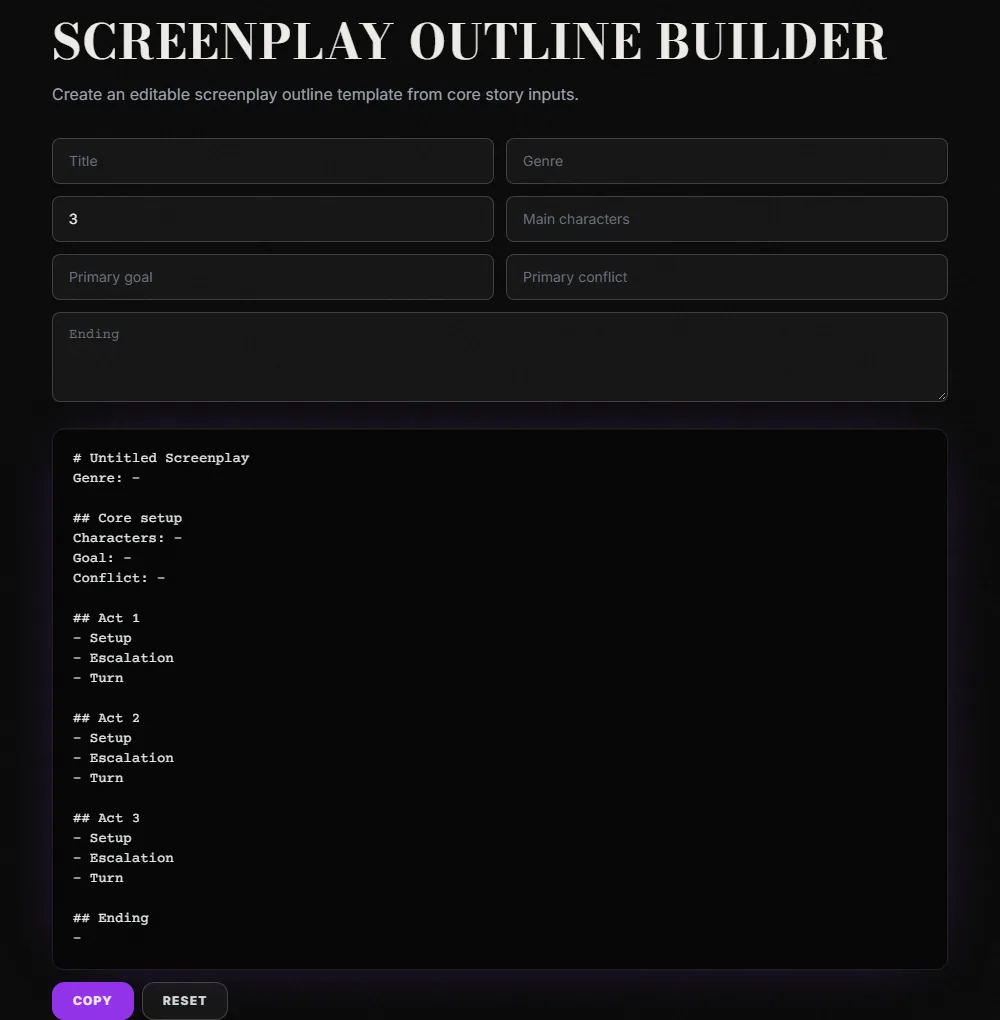
Our Screenplay Outline Builder, captured 22 October 2026 from screenweaver.ai/tools/screenplay-outline-builder.
Inside ScreenWeaver, the Script tab has a card view above the script editor. For a feature it shows three tracks, Sequence, Story Beat and Scene, and parent cards stretch across the cards they contain. Story beats can carry up to three labels, from a built-in set that includes Inciting Incident, Plot Point 1, Midpoint, Low Point and Climax, or your own. Episodic projects add Episode and Act tracks. In the app a story beat sits between sequence and scene, so it's the structural sense of the word: the Midpoint beat holds the scene that delivers it. Here is SLACK WATER's fourth sequence set up that way.
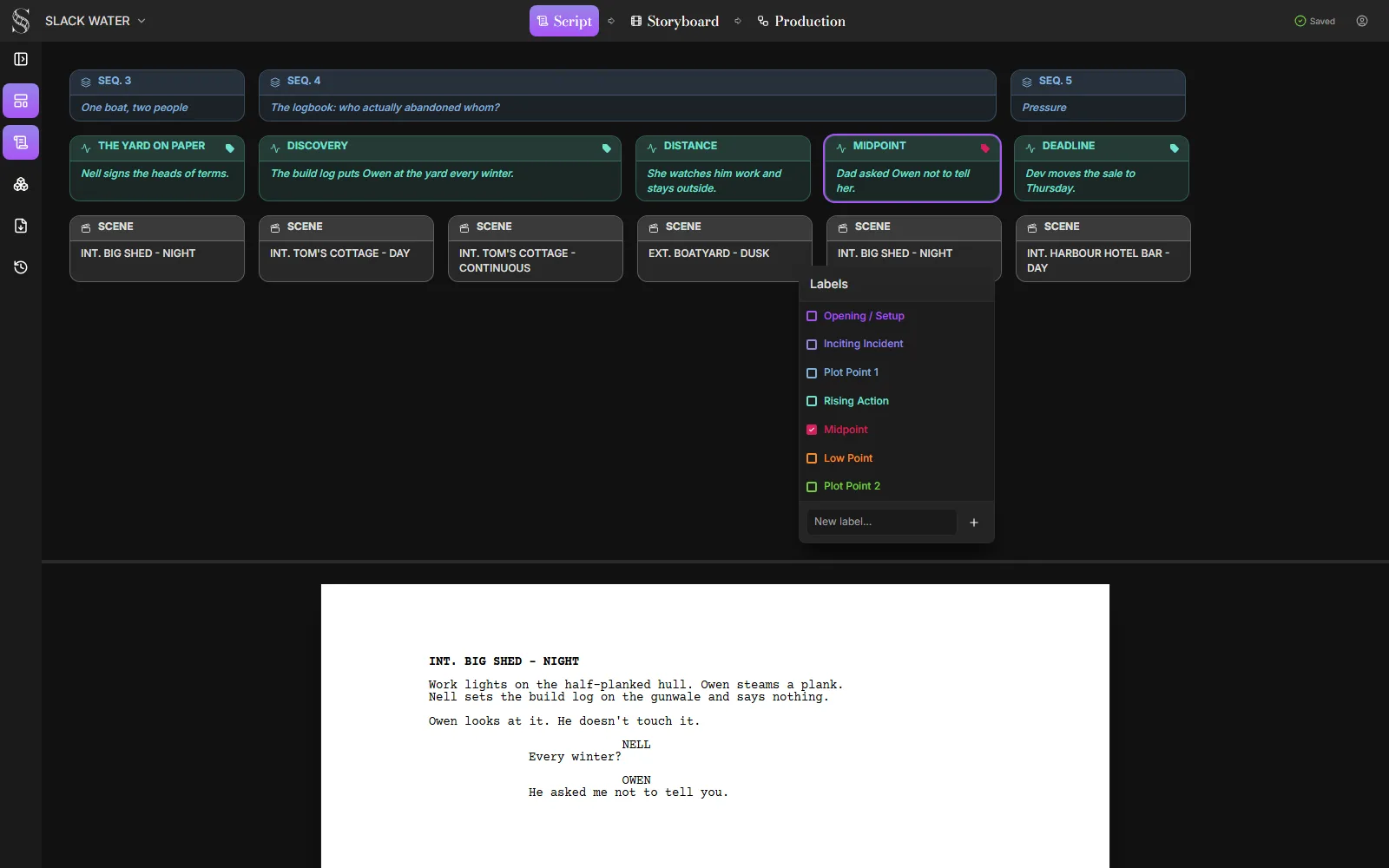
ScreenWeaver's card view, reconstructed from the app's interface with our SLACK WATER example. ScreenWeaver is our product.
To see the same levels on screen inside the app, lesson 3.2 of our free screenwriting course, What Is an Outline?, walks through the Outline view on video.
If you want a model to suggest structure for you to rewrite, the guide to outlining with AI covers where that helps and where it flattens the story, and the AI screenplay outline tool page explains how ScreenWeaver handles it.
FAQ
What is a screenplay outline? A screenplay outline is the list of a script's scenes in screen order, each with a location, the characters in it and what changes during it. Writers use it to plan the draft. It isn't usually sent to anyone, unlike a treatment.
How long should a screenplay outline be? For a feature, a one-line-per-scene outline runs one to three pages. With a short paragraph per scene it usually lands between three and ten. Our SLACK WATER outline is about 900 words for 28 scenes.
How many scenes should a feature outline have? A 110-page feature commonly has somewhere around 40 to 60 scenes, depending on genre and how long the scenes run. Shorter scripts and dialogue-heavy dramas have fewer. Our 80-page example has 28, averaging just under three pages each.
Should I outline before writing a screenplay? For a feature, yes, unless you draft fast and rewrite hard on purpose. On a short film of ten pages or less you can often go from beats straight to pages, because the whole story fits in your head.
What's the difference between an outline and a beat sheet? A beat sheet is one page that checks the story's shape: a line per major turn. An outline breaks those turns into every scene you'll write. You build the beat sheet first and the outline from it.
Can AI write a screenplay outline for me? It can draft one from a premise, and the result is usually generic. Treat it as something to argue with: keep the scenes that change something, and rewrite the rest with your own characters' decisions.
Final Step
Build your next script with Screenweaver
Move from ideas to production-ready pages faster with timeline-native writing and AI-assisted story flow.
Try Screenweaver