
You have a beat sheet. It has boxes. Some boxes say "stuff happens." Your act breaks are labeled "end of act one" without a turn. A friend says the pilot "reads fine" but cannot tell you what act three does that act two did not already do. That is not a voice problem. That is white space without rent.
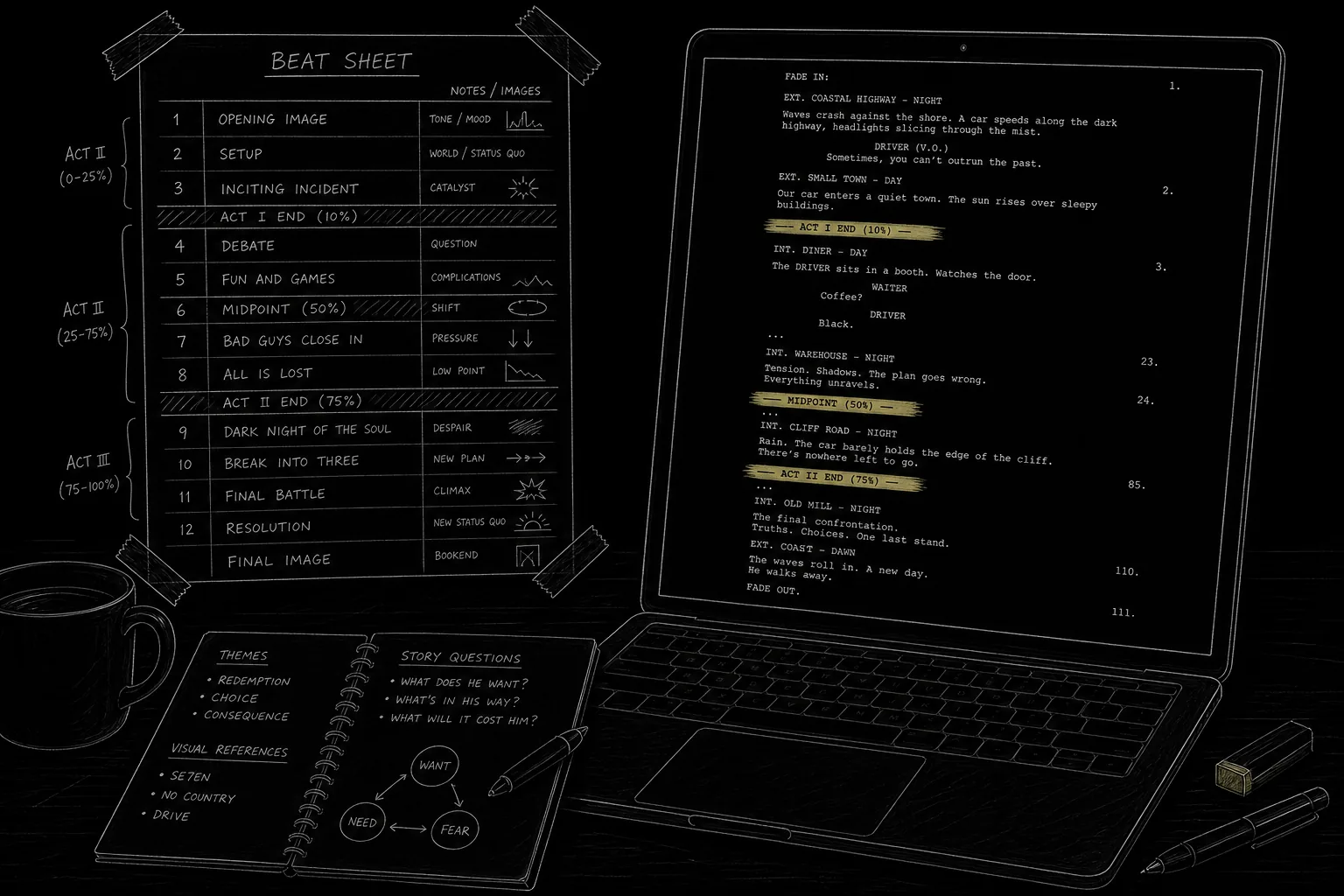
A TV pilot beat sheet is not a homework grid for producers who love spreadsheets. It is a pressure map. Act breaks are where the audience decides whether to stay. In 2026, streamers argue about whether act breaks matter on the screen. Development still reads for act shape on the page because act shape is how writers prove they can run a room machine. White space at an act break is expensive. You pay for it with a turn, a reveal, a commitment, or a laugh that changes the stakes.
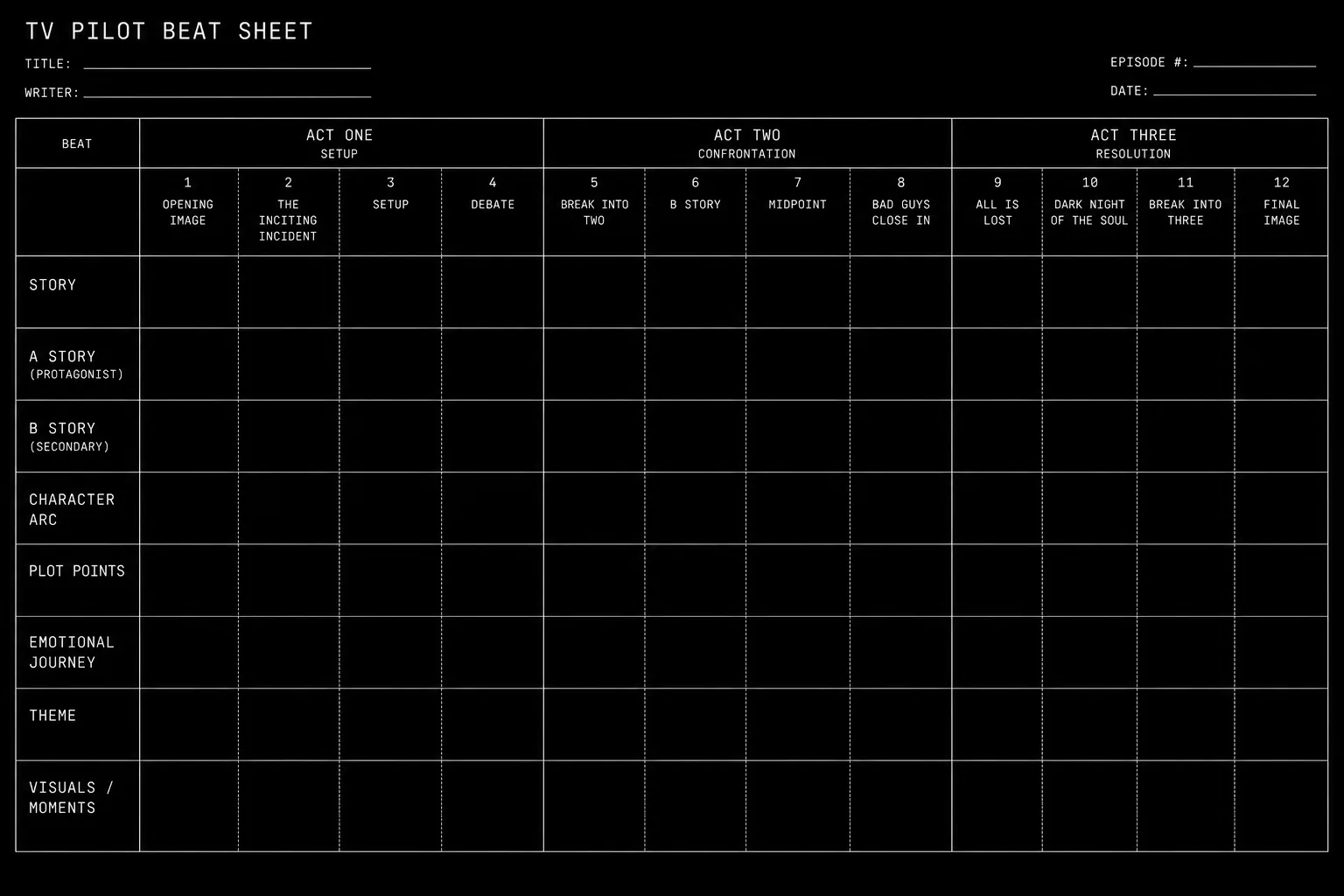
This guide builds a pilot beat sheet around act breaks that earn their space: what each act must do, how to write act outs you can defend, and how to connect beat placement to page reality. Use it alongside the outline for a 60-minute drama pilot when you are still choosing the spine, and with cold opens that hook in the first three pages when your teaser is eating your act one budget. When you want percentage checks against a sixty-minute shape, run your spine through the beat sheet calculator as a second opinion, not as a replacement for story sense.
An act break is a promise. White space is the receipt. If you cannot name the promise, do not print the receipt.
Beat Sheets vs Outlines: Different Jobs
An outline argues the hour works. A beat sheet names the turns in language tight enough that you cannot hide. Outlines drift into paragraphs. Beat sheets force lines like "Mara sees the security footage; she knows her partner lied" instead of "tension rises."
For pilots, the beat sheet should include act boundaries as first-class citizens, not as footer labels you add after the story is "done." If you build beats without act function, you get a beautiful middle and a soft ending that coverage calls "reads short." The fix is rarely "add six pages." The fix is act outs that move obligation.
The Act Function Table (Hour Drama Pilot)
| Module | Story job in pilot | Act-out test (must be true) | Common failure |
|---|---|---|---|
| Teaser / cold open | Hook; tone; often inciting image | Raises a question or stakes spike | Pretty mood, no question |
| Act one | World, cast, disruption | Protagonist cannot return to status quo | Introduces everyone, no turn |
| Act two | Complication, resistance | New information or commitment | Repeats act-one emotion |
| Act three | Midpoint, reversal | Plan breaks or truth re-frames | Investigation without reversal |
| Act four | Escalation, cost | Lowest point or forced choice | Filler confrontations |
| Act five | Climax, pilot resolution | Series question deepens, not closes | Solves series in pilot |
| Tag | Series promise, tone button | Image or line that launches episode two | Epilogue that deflates |
The table is for hour drama pilots with broadcast-shaped modules. Half-hours compress the middle. Premium hours may merge acts on screen but still read better with act-shaped pressure on the page. Adjust the module names to your lane; do not adjust the rule that an act out must turn obligation.
Building the Beat Sheet: Order of Operations
Step zero is the series question. Write it where you will see it when you lie to yourself in act four. "Can she keep investigating without becoming what she hunts?" "Will this family business survive the siblings?" If the beat sheet does not feed that question, cut the beat.
Name the protagonist's pilot arc in one line. Not their biography. Their change across the hour. "From refusing to lead to taking the chair anyway." Every act should pressure that arc.
Draft the teaser as a beat line, not a mood board. What do we see? What do we not understand yet? If the teaser could be moved to minute twenty without damage, it is not a teaser.
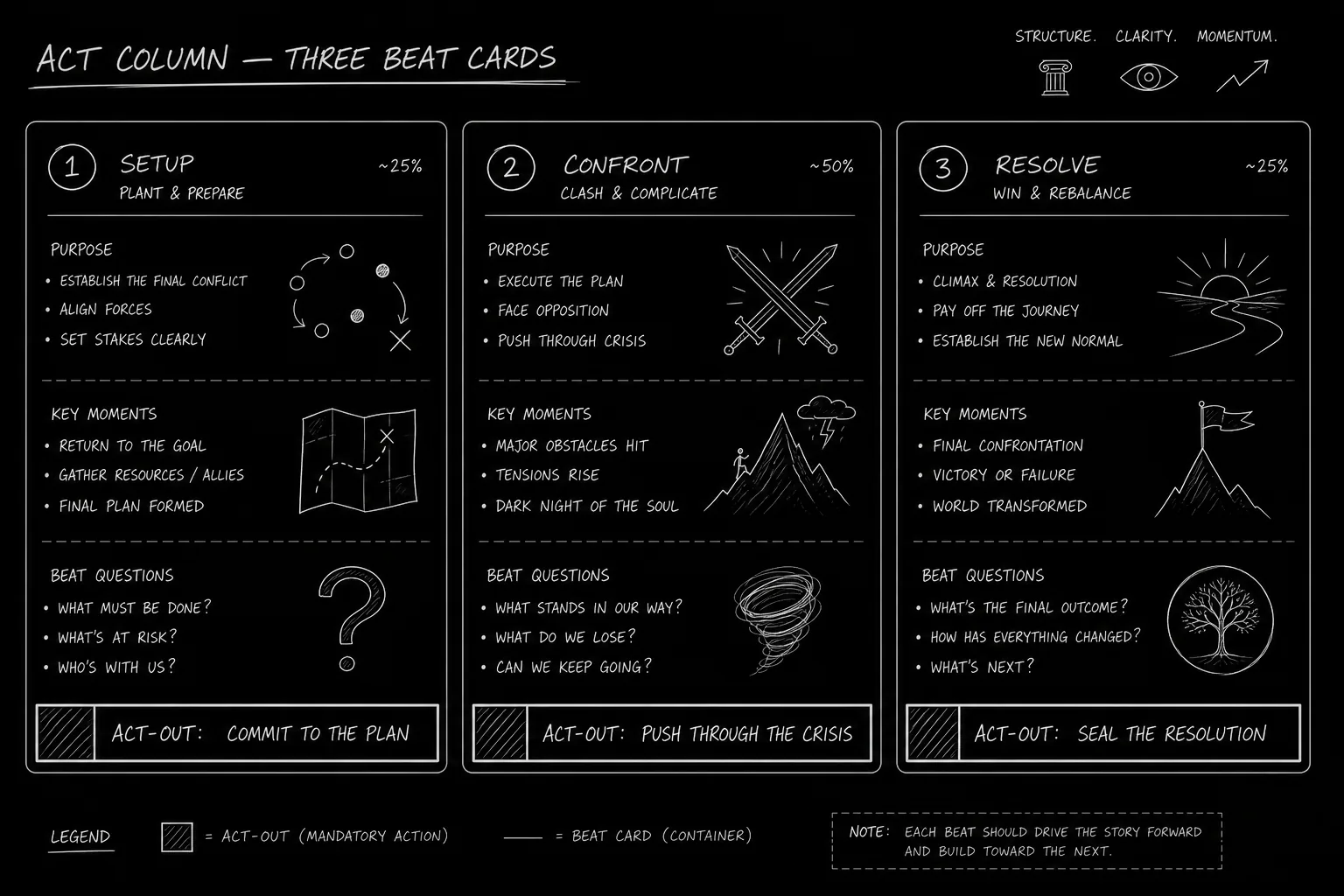
For each act, write three beats maximum before you expand. Beat one: enter the act's problem. Beat two: complicate. Beat three: act out. If you need seven beats to explain an act, the act is doing two jobs. Split or combine acts at outline level, not by adding fog.
Write the act out as its own line in bold on your working doc. Read only the act outs down the page. Do they escalate? Do any two act outs do the same emotional work? Duplicate act outs are why pilots feel longer on paper and shorter in the heart.
Assign page budgets after the beat sheet works. Beats are story. Pages are production. When beats are right, page bands from pilot page-count guides become useful audits instead of torture devices. A TV pilot beat sheet generator gives you a module-by-module grid to audit against, teaser through tag.
Relatable Scenario: The Beat Sheet That Was Only Plot
Devon builds a beat sheet for a medical hour pilot. Every box is a case event. Patient arrives. Tests run. Diagnosis shifts. Devon is proud of the research. The read is flat.
The missing layer was obligation. Devon's protagonist had no personal act outs. The act breaks were medical, not character. A fix: act one ends when the protagonist lies to protect a resident, not when the MRI results arrive. Act three ends when the lie is recorded on a phone, not when the disease is named. Same case. Different rent on white space.
Relatable Scenario: Two Act Outs, Same Note
Samira's hour pilot beat sheet reads well in the room. On the page, act two and act three both end with "hero doubts the partner." Coverage says the middle sags. Samira adds jokes. Wrong medicine.
Samira highlighted act outs in yellow and read them back-to-back. Same emotional note, different furniture. She merged the doubt beats into act two's out: the partner walks out after the doubt. Act three's out became new information: the partner was investigating the hero off-book. The middle woke up without new pages at first. When pages did rise, they rose with turns, not with chatter.
Relatable Scenario: The Premium Hour That Refused Act Labels
Chris writes a streamer hour and refuses act labels on principle. The beat sheet is "continuous." Development likes the voice. The note is "shape the middle."
Chris keeps the continuous tone on the page but builds an internal beat sheet with act functions anyway. Teaser beat, five act outs, tag. When drafting, Chris hides labels in revision mode comments, then exports clean pages. The story feels fluid. The pressure map is honest. The middle stops sagging because act three now has a midpoint reversal that act two was missing.
Granular Workflow: From Beat Sheet to First Draft
Transfer beats to scene list one line each. Scene list lines start late and end early. If a beat needs three scenes, the beat sheet was probably under-specific.
Mark POV per scene. Even ensembles have a pilot driver. If POV drifts without intention, act breaks feel soft because the audience does not know who to track.
Write the cold open last if you keep stalling. Some writers need act one to know what the teaser promises. Others need the teaser first. Pick a method and stop rewriting the first three pages forever.
Draft act by act, not page by page. Finish act one before you tinker with act four fantasies. Act four problems are often act one setup problems wearing a disguise.
After act two, run the beat sheet calculator on a sixty-minute template. Percentages are not pages. They catch a midpoint living too early or too late in your gut.
Read act outs aloud with a finger on the beat sheet. If the spoken act out does not match the written line, fix the beat sheet before you add scenes.
Lock pagination before sending. Act break page numbers in your cover line should match the PDF. Mismatched pagination is a trust leak.
Try it free
Try Screenweaver for free on your script
It is free. Import your existing project, get a clearer view of your outline, and regain control of your story structure in minutes.
Start FreeHalf-Hour Beat Sheets: Compression Without Weak Turns
Half-hour pilots punish duplicate act outs faster than hours. You have fewer pages to recover from a soft act two. Beat sheets for half-hours should name the A-story turn and the B-story turn per act, even if B is only three beats total.
Multi-cam half-hours often put the act out on a button line. Single-cam half-hours might put the act out on a visual reveal. Either way, the white space must follow a turn. "They keep talking" is not an act out. "She opens the door; the missing brother is on the porch" is an act out.
Using Tools Without Letting Tools Write the Pilot
The beat sheet calculator helps when you know your lane. It hurts when you treat percentages as scripture. A pilot is not a Save the Cat poster. It is a job interview for serial pressure.
Use the calculator after you have act outs that work in prose. Plug the spine in. See where your midpoint lands relative to a working hour. If the calculator screams early midpoint and your gut agrees, adjust beats before you draft forty pages of setup.
Room Reality: Beat Sheets in Staffed Life
In a staffed room, beat sheets are spoken before they are printed. Writers pitch act outs across a whiteboard. The showrunner cuts a beat with one sentence: "We already did that in act two." Your spec beat sheet is a proof you can survive that room before you have a parking pass.
When you walk in with a pilot sample, executives sometimes ask act questions out loud. "What is your act three out?" If you hesitate, they hear missing punctuation. If you answer in one clean line, they hear a writer who has broken an episode before. Your private beat sheet is rehearsal for that sentence.
Beat sheets also travel to production as living documents. Script coordinators compare draft pages to board beats. If your pilot sells, the beat sheet you used to sell it becomes the reference when your act four swells in production drafts. Building act outs you can defend now saves you from defending padding later.
Page-to-Beat Audit After the First Draft
After draft one, export PDF and mark the page where each act out lands. Compare to your beat sheet lines. If the act three out moved four pages late because you fell in love with a scene, decide whether the scene is earning its rent or stealing the break.
A page-to-beat audit table on your wall can be handwritten. Act one out: target page twelve, actual page fifteen. Ask why. Sometimes the why is good: a set-piece needed air. Sometimes the why is fear: you delayed a turn because the turn is hard to write. Fear-driven lateness is how pilots read short in the middle while the footer looks fine.
Read the draft once without fixing anything, only noting where you felt the urge to stop for a break. Human pause urges often map to natural act outs. If you felt an urge at page twenty and your act two out is on page twenty-six, the audience felt dead air you created on purpose.
Ensemble Pilots Without Losing the Driver
Ensemble beat sheets fail when every character gets an equal act out. Pick a pilot driver. Other characters can have act outs that complicate the driver, not compete for identical emotional notes.
A family ensemble might give the sibling B-story a turn in act two, but act two's primary out should still pressure the protagonist's pilot arc. If three act outs in a row are three different characters learning the same lesson, combine lessons or reassign beats.
When you introduce a character in act one, assign them a function line on the beat sheet. "Introduce cousin as the one who can forge documents" is useful. "Introduce cousin" is how act one becomes a census.
The Trench Warfare Section: Beat Sheet and Act Break Mistakes
Wrong: beat sheets that are only plot events. Fix: add character obligation to every act out.
Wrong: act outs that are mood. "Tension rises" is not a beat. Fix: name the event.
Wrong: solving the series in the pilot. Fix: resolve a chapter; deepen the engine.
Wrong: seven characters introduced in act one. Fix: core cast first; earn the rest.
Wrong: act four padding to fix act two. Fix: midpoint and act-two out.
Wrong: teaser that belongs in act one. Fix: question, stakes, or tone spike.
Wrong: tag that explains the theme. Fix: image or line that launches episode two.
Wrong: ignoring B-story act contribution. Fix: B-story act out ties to A or theme.
Wrong: beat sheet never updated after draft discoveries. Fix: revise beats, then scenes.
Wrong: white space without a turn. Fix: earn the break or merge acts.
Beat sheets are arguments. Act breaks are the punctuation. Readers hear missing punctuation before they quote your theme.
Before You Send: The Cover Line That Helps Coverage
One sentence: lane, page count, act-shaped hour, series question in plain language. Example: "Hour network drama pilot, fifty-eight pages, act breaks marked, series question: can she expose the firm without burning her sister?" That line is not cute. It is navigation.
External craft anchors still matter. The <a href="https://www.nytimes.com/2023/03/15/arts/television/pilot-season-streaming.html" rel="nofollow">New York Times reporting on how pilot season shape shifted under streaming</a> is a useful reminder that buyers change habits while act-shaped readability stays a hiring signal.
Your pilot beat sheet is the spine you defend in the room. Act breaks that earn white space are how you prove you understand television as a machine, not only as a voice. Build the turns first. Let the pages follow.
Final Step
Build your next script with Screenweaver
Move from ideas to production-ready pages faster with timeline-native writing and AI-assisted story flow.
Try Screenweaver