
To make a scene more visually interesting, storyboard it exactly as written: sketch ten rough frames and look at them. If every frame shows the same angle, the same size, the same people in a row, the scene is flat because nothing changes visually. This article fixes that with one running example, a family singing around a piano.
The piano scene that dies on the page
Here's the scene. Interior, living room, evening. The Halloran family gathers around the upright piano. Ruth plays. Everyone sings an old song, meant to show the family reunited after a hard year. On the page it's six lines of action, a lyric excerpt, and the note "they all smile."
I've written this scene. You probably have too. It reads fine in the outline, survives three drafts untouched, and then a smart reader asks the fatal question: what are we actually looking at for two minutes?
The standard advice at this point is "write more visually." Useless. Nobody wakes up and decides to write less visually. The advice fails because you can't fix a flatness you can't see, and prose hides flatness beautifully. Six people singing sounds like a scene. The words carry feeling the frame doesn't.
Board the scene as written and the problem stops being abstract
So don't argue with the scene. Board it. Sketch ten frames of the scene exactly as it exists on the page. Stick figures are fine. Boxes with arrows are fine. If you can't draw at all, an AI storyboard generator will give you the ten frames from your action lines in a few minutes, which is honestly how I do it now.
Then lay the ten frames side by side and look.
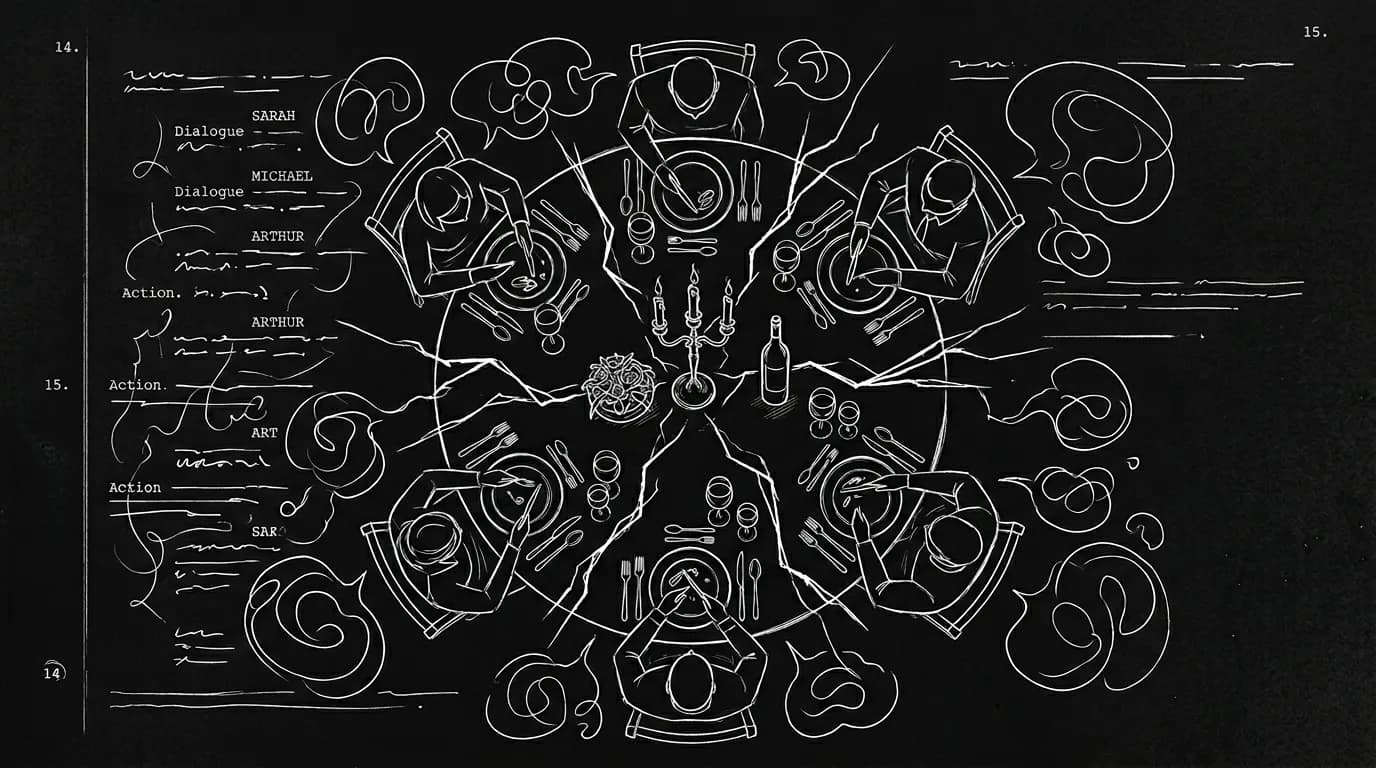
For the piano scene as written, here's what you get: frame one, six people at a piano, medium wide. Frame two, the same. Frames three through ten, the same. Same size, same angle, same six faces pointed at the same instrument. You could shuffle the frames and nobody would notice. That's the definition of a flat scene, and now it's not a vague note from a reader, it's ten nearly identical drawings staring back at you.
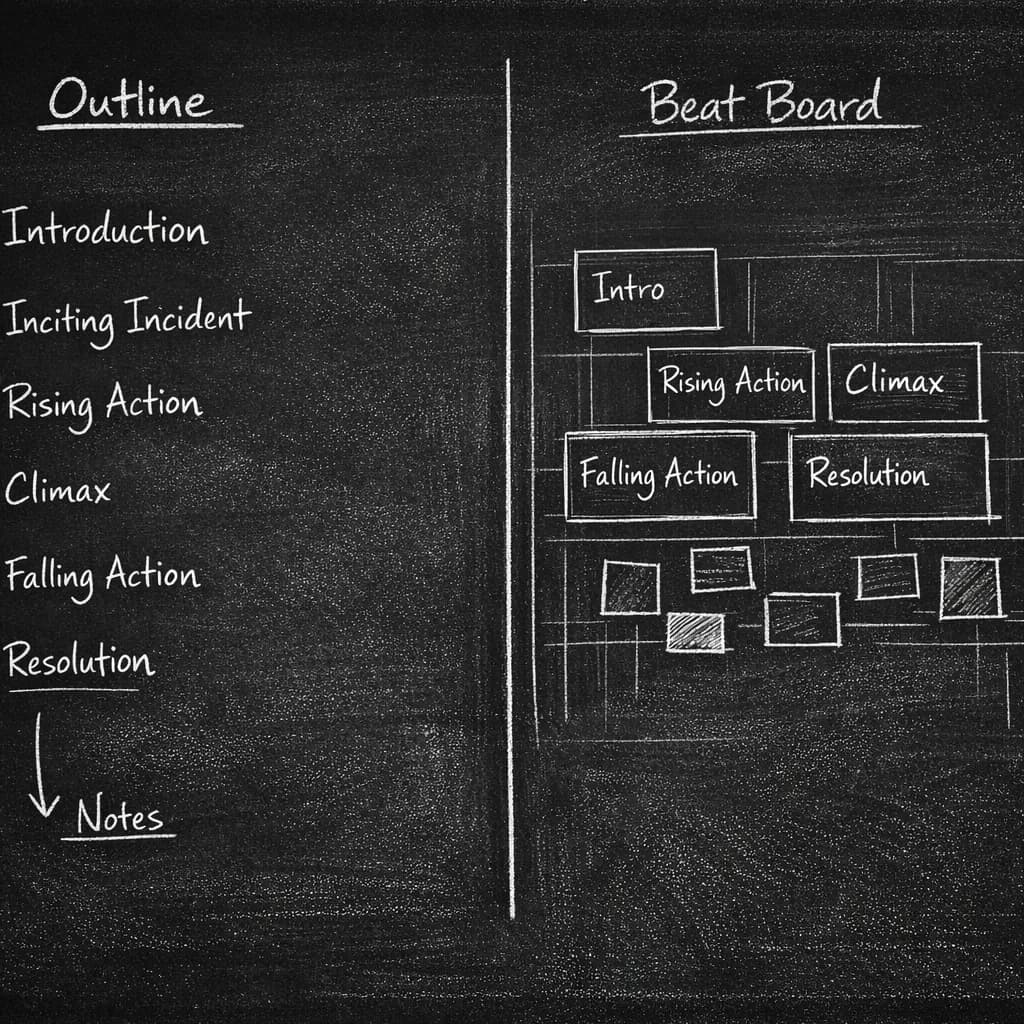
This is the whole trick. A storyboard is a diagnostic before it's a production document. The same logic drives beat boards versus outlines at the story level: the moment you force words into images, the missing images announce themselves.
Now the levers, each one applied to the piano scene.
Blocking and business give the frames a reason to differ
The scene is flat because everyone wants the same thing and does the same thing. So break the unanimity with bodies.
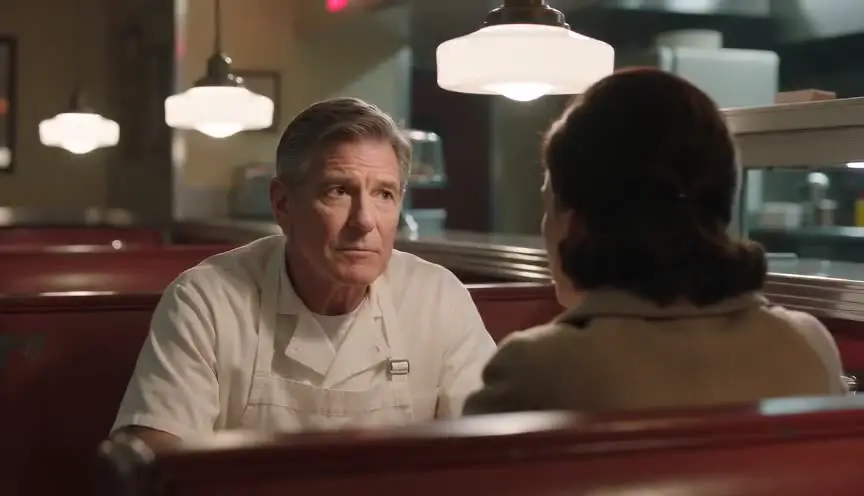
Uncle Pete refuses to sing. He stands in the doorway with his coat still on, holding his keys. Now frame four has a composition problem in the best sense: five people clustered in light, one figure separate, and the camera suddenly has two places to be.
Add business, the small physical tasks actors do while a scene plays. The youngest kid is under the piano, lying on her back, watching the pedals move. Ruth's sister keeps almost joining on the harmony and stopping. Someone's phone buzzes face-down on the lid and three people glance at it. None of this needs dialogue. All of it changes what the frames contain.
Watch what the boards do now. Frame under the piano, looking up. Frame on the keys and the pedals. Frame on the doorway. The scene hasn't changed its plot at all. It has changed what there is to photograph.
One hard light source sorts the room into drama
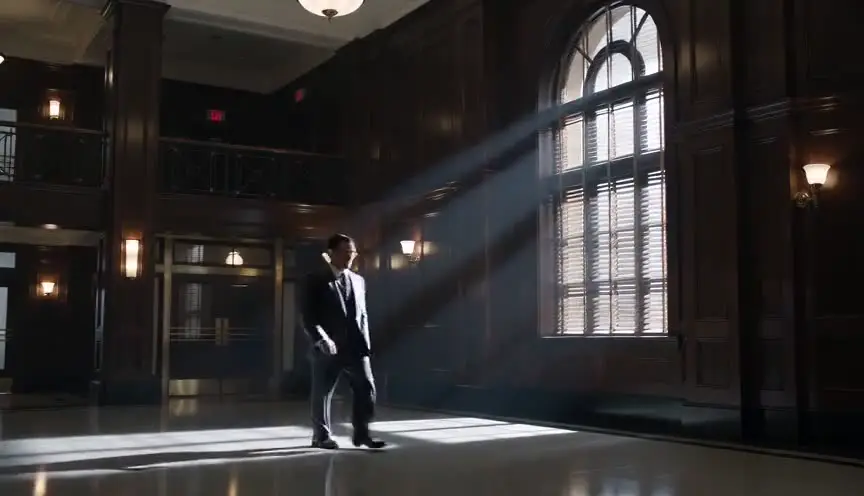
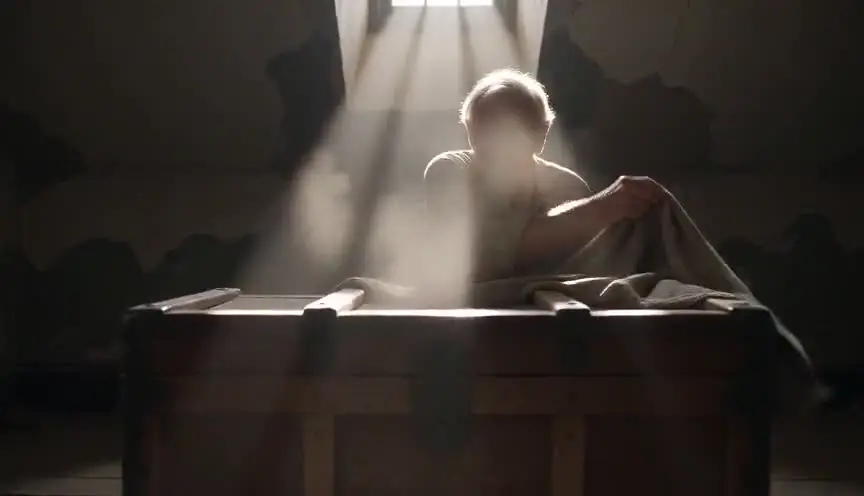
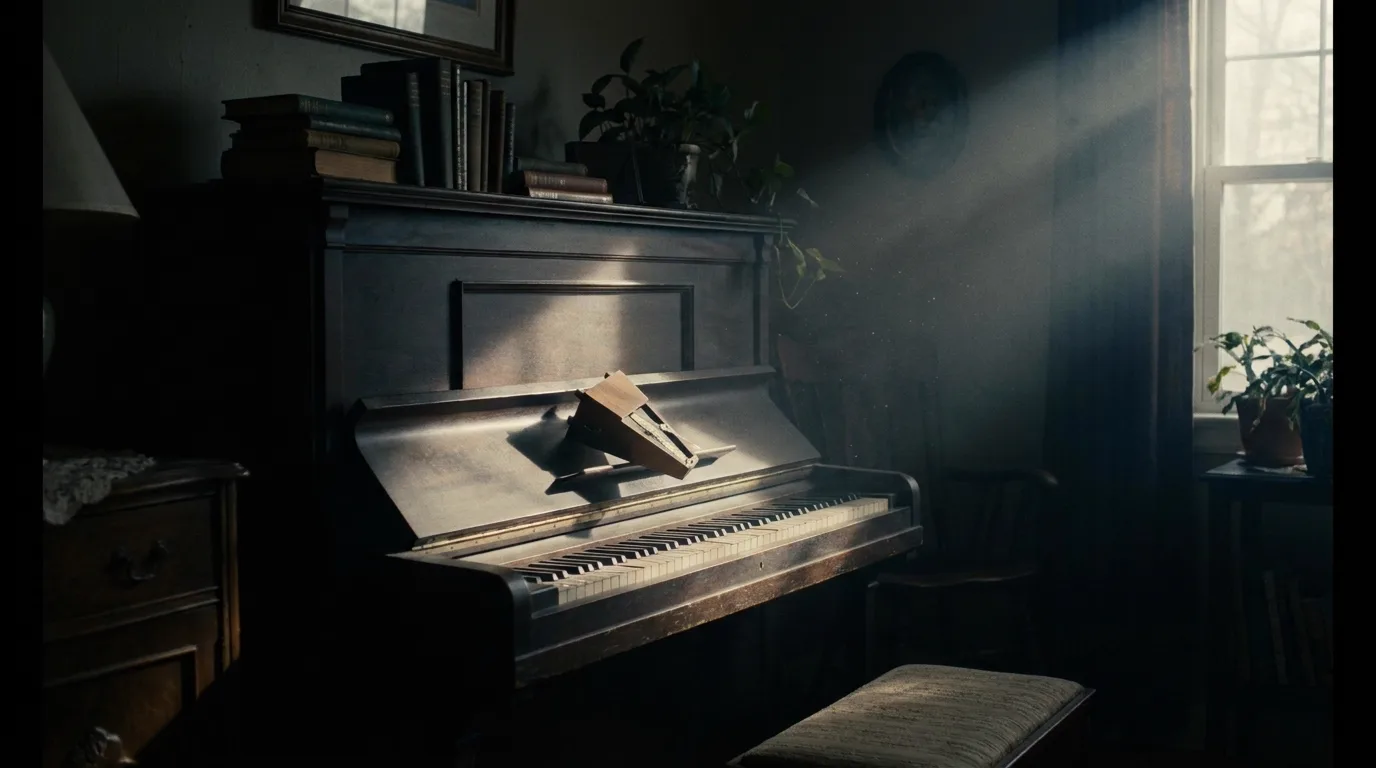
As written, the scene has television lighting: everything evenly visible, nothing meant. Give the room one dominant hard source instead. A single window with low sun, or one warm lamp on the piano, and let the rest fall off into darkness.
Now placement means something. Whoever sits inside the beam is presented to us. Whoever sits outside it is hiding, or excluded, or watching. Put Uncle Pete in the dark by the door and the frame states the family situation before anyone sings a note. This is the working end of mise-en-scène: arrangement inside the frame doing narrative work that dialogue would do worse.
You don't need to write lighting instructions like a gaffer. One clean line in the action does it: "The last of the sun comes through the west window and lands on the piano. Everything else in the room is going blue." A reader sees the scene. A boarder can draw it. A cinematographer will thank you.
Geography can change halfway through the scene
Flat scenes tend to happen in one spatial arrangement, held for the duration. You have two cheap fixes.
Move the second half. The song ends, and instead of the scene ending with it, Ruth follows Pete out to the porch, and the real conversation happens there with the second verse bleeding through the wall behind them. One scene, two rooms, and the boards get a whole new set of frames at the midpoint.
Or reveal the space differently. Open the scene on the kid under the piano and stay there for a full frame or two before showing the room. Open on the hallway, singing heard off, and arrive late. Where the camera starts teaches the audience what the scene is about, and starting anywhere except "wide on six people" is usually an improvement. This is also the honest fix for the single-room problem generally, which is covered in depth in how to keep a single-room dinner scene from going dead: same disease, same medicine.
The drama is on the face of the one not singing
Here's the lever that transforms the piano scene most. In any scene with a performance inside it, the performers are rarely the drama. The watchers are.
Six people singing is spectacle. One person not singing is story. Board it: frame seven is a slow push on Pete's face in the doorway while the song continues off-screen, and suddenly the scene has a protagonist. What is he remembering? Why won't he cross the threshold? The audience leans in on the silent face precisely because everyone else is occupied.
This works for any flat gathering. Wedding toast: watch the ex. School recital: watch the parent who said the kid would fail. If you're trying to show a character's inner shift during the scene, this is also where it lives, and the techniques in visualizing internal realizations on screen stack directly on top of it. Prose can write "Pete softened." A camera needs his hand letting go of the keys in his pocket. Never write an interior line the lens can't see; that trap has its own guide in the unfilmable action line.
Entrances and exits reset the scene while it runs
A scene with fixed personnel flatlines because its social chemistry is constant. Change who's in the room mid-scene and every relationship recalculates on camera.
Ruth's daughter arrives late, mid-song, still in her work clothes, and everyone keeps singing while making room, and the way each person makes room is characterization for free. Or the reverse: grandmother quietly leaves during the second verse, and only the kid under the piano notices her go. An entrance or exit gives the boards an axis of change that costs nothing: someone crosses the frame, the composition reorganizes, the scene has a before and after.
Try it free
Try Screenweaver for free on your script
It is free. Import your existing project, get a clearer view of your outline, and regain control of your story structure in minutes.
Start FreeA prop with history beats a page of dialogue
Last lever, and the one that gives the scene its ending. Put an object in the room that carries a person who isn't there.
The metronome on the piano lid belonged to Ruth's father, dead eleven months. Nobody has touched it since. It sits there through the whole scene, in focus in two frames, and at the end of the song Pete finally crosses the room, picks it up, winds it, and sets it ticking. Nobody says anything. Scene over.
That's a visual ending that no line of dialogue could buy. The prop only works because it was planted in the boards early: frame two holds it in the foreground, out of anyone's attention, so frame ten can pay it off. Objects with history are the cheapest special effect in screenwriting, and boarding is how you check they're actually visible rather than buried in an action line nobody pictured.
The ten-frame self-test for any flat scene
Board ten frames of the scene as written, then score it honestly:
- Are at least 4 different shot sizes present (wide, medium, close-up, insert)?
- Do at least 3 frames place the camera somewhere new, rather than pointing the same setup at a new subject?
- Could a stranger put the frames back in order without reading the script?
- Does the blocking change at least twice (someone moves, arrives, or leaves)?
- Is there one frame where the most interesting face is not the person acting or speaking?
- Does light or darkness mean something in at least one frame?
- Is there an object in an early frame that pays off in a late one?
- Does the final frame look meaningfully different from the first?
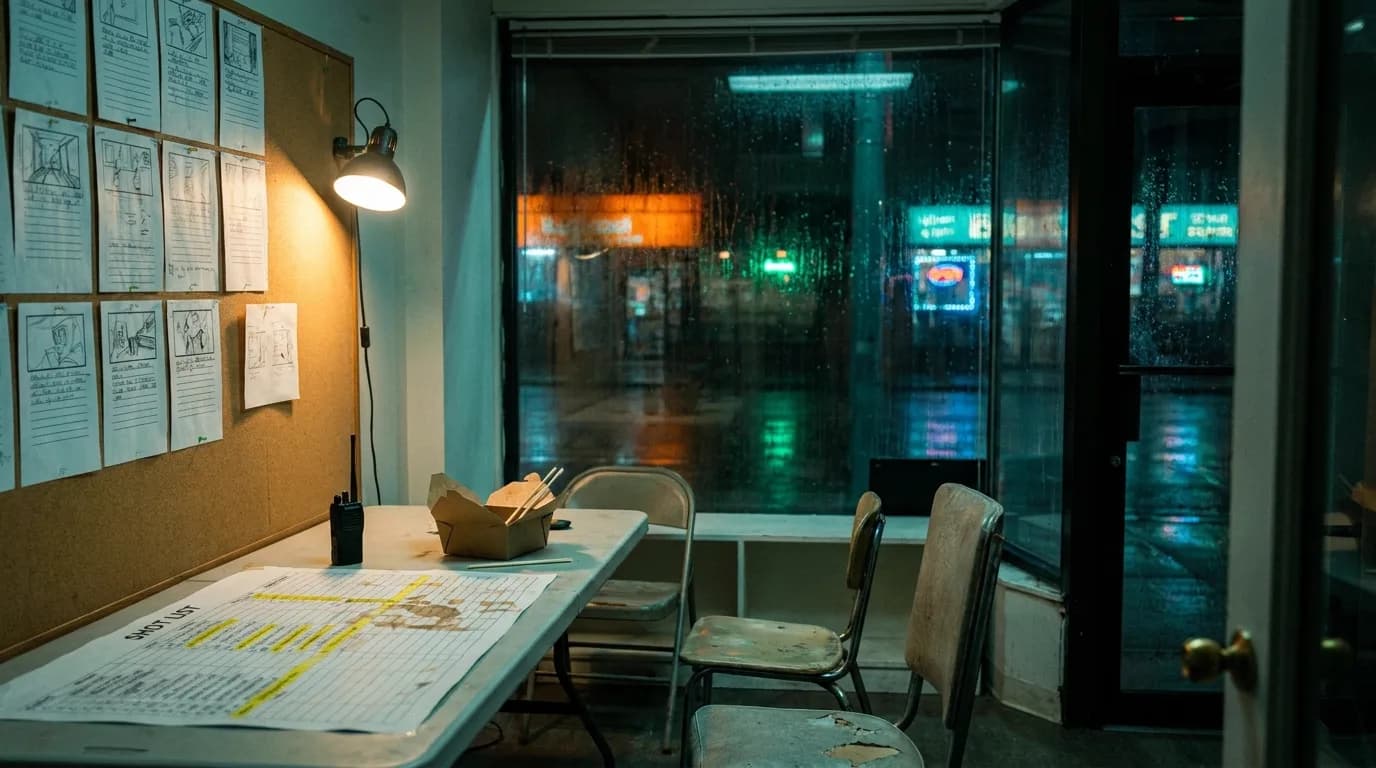
Five or more unchecked boxes means the scene is flat, and now you know exactly which lever to pull, because each box maps to one section above. Fix the scene on the page, board it again, and when it passes, those same frames become the start of your shot list. The conversion from boards to a shootable plan is its own step, covered in what a shot list is and how to build one.
Here's the piano scene before and after, in board terms:
| Frame | As written | After the levers |
|---|---|---|
| 1 | Wide, six people at piano | Under the piano, pedals moving, feet beyond |
| 2 | Wide, six people at piano | Medium on Ruth's hands, metronome foreground |
| 4 | Wide, six people at piano | Pete in the dark doorway, coat on, keys in hand |
| 6 | Wide, six people at piano | Daughter enters mid-song, room reshuffles |
| 7 | Wide, six people at piano | Slow push on Pete, song off-screen |
| 10 | Wide, they all smile | Pete winds the metronome, sets it ticking |
Same family. Same song. Same two minutes. A completely different scene.
FAQ
How do I make a scene more visually interesting without changing the story?
Board the scene as written, then change what the frames contain rather than what happens: blocking, business, light, camera position, who watches whom, and a planted prop. In the piano example, nothing about the plot changes (family sings a song), yet every frame changes. Story is what happens; visual interest is mostly how the room, the bodies, and the light present it.
Do I need to know how to draw to storyboard my scene?
No. Stick figures and labeled boxes diagnose flatness just as well as clean drawings, because the test is about variety between frames, not the quality of any one frame. If you want presentable boards, generate them from your action lines with an AI storyboard tool and treat the output as a diagnostic first, a deliverable second.
How many frames should I sketch for one scene?
Ten is a good working number for a two-to-three-page scene: enough to expose repetition, few enough to finish in one sitting. A very short scene might need six; a long set piece might need twenty. The number matters less than the discipline of boarding the scene exactly as written before improving anything.
What's the fastest single fix for a flat scene?
Give the drama to a watcher instead of a performer. Find the person in the scene with the least reason to be comfortable and point the camera at them while the main action continues around them. It requires no new sets, no new dialogue, and one new line of action, and it reliably turns spectacle into story.
Isn't visual style the director's job, not the writer's?
Shot-by-shot coverage is the director's job. Writing a scene that contains visual difference (blocking that changes, light that means something, an object that pays off) is yours, because a director can't shoot contrast that isn't on the page. Write the behavior and the space; leave the lens choices out.
My scene passes the checklist but still feels dull. What now?
Then the problem is probably dramatic, not visual: nobody in the scene wants anything, or everyone wants the same thing. Give one character a quiet agenda that conflicts with the group's (Pete not singing is exactly this) and re-board. Visual levers amplify tension that exists; they can't fabricate tension from unanimity.
Final Step
Build your next script with Screenweaver
Move from ideas to production-ready pages faster with timeline-native writing and AI-assisted story flow.
Try Screenweaver