
A webtoon becomes an anime one of two ways. A studio licenses it, rebuilds it as a screenplay, storyboards it in 16:9, animates it over a year or more, and you need a hit before anyone calls. Or you keep the rights, feed the episodes into an AI pipeline that turns panels into shots, and produce a pilot yourself in weeks. This guide covers both, and where the second one is honest about its limits.
If you only want the hands-on version, the webtoon to animation with AI walkthrough is the practical half of this article. And if you want a tool that converts your webtoon to anime from the panels themselves, we are building one: convert webtoon to anime in ScreenWeaver (coming soon, waitlist open).
Why webtoons adapt better than almost anything else
A webtoon is already a shot list. Every panel was composed by the artist to be read one at a time on a phone, in order, with a deliberate pause between panels. That is closer to a storyboard than a novel will ever be, and it is why adaptation studios love the format.
The properties that matter for the adaptation, whoever does it:
| Property of a webtoon | What it gives the adaptation |
|---|---|
| One panel per beat, in strict reading order | A ready-made shot order. Nobody has to invent coverage |
| Characters drawn hundreds of times, on-model | A free character bible: every angle, every expression already exists |
| Dialogue in speech bubbles, action in gutters | The script is 70% written. The remaining 30% is what happens between panels |
| A fixed palette and line style per series | An art direction that already tested on a large audience |
| Chapters of 60 to 90 panels, released weekly | Natural episode boundaries and a proven cliffhanger rhythm |
What a webtoon does not have is time. Panels have no duration, a scroll has no cut, and a speech bubble does not tell you how long the line takes to say. Every adaptation, studio or AI, spends most of its effort on exactly that gap.
The studio path: how a webtoon gets a real anime
The adaptations you have seen all followed roughly the same route.
Solo Leveling started as a web novel by Chugong in 2016, became a WEBTOON series illustrated by DUBU in 2018, and its anime by A-1 Pictures premiered on Crunchyroll in January 2024, about six years after the webtoon launched. Lookism by Park Tae-joon ran for years before Studio Mir's Netflix adaptation arrived in December 2022, and the series passed one billion views on WEBTOON's English platform in January 2026 according to Anime News Network. Tower of God, The God of High School and Noblesse were all adapted in 2020 as part of a Crunchyroll and WEBTOON push that treated the platform as a farm system for anime.
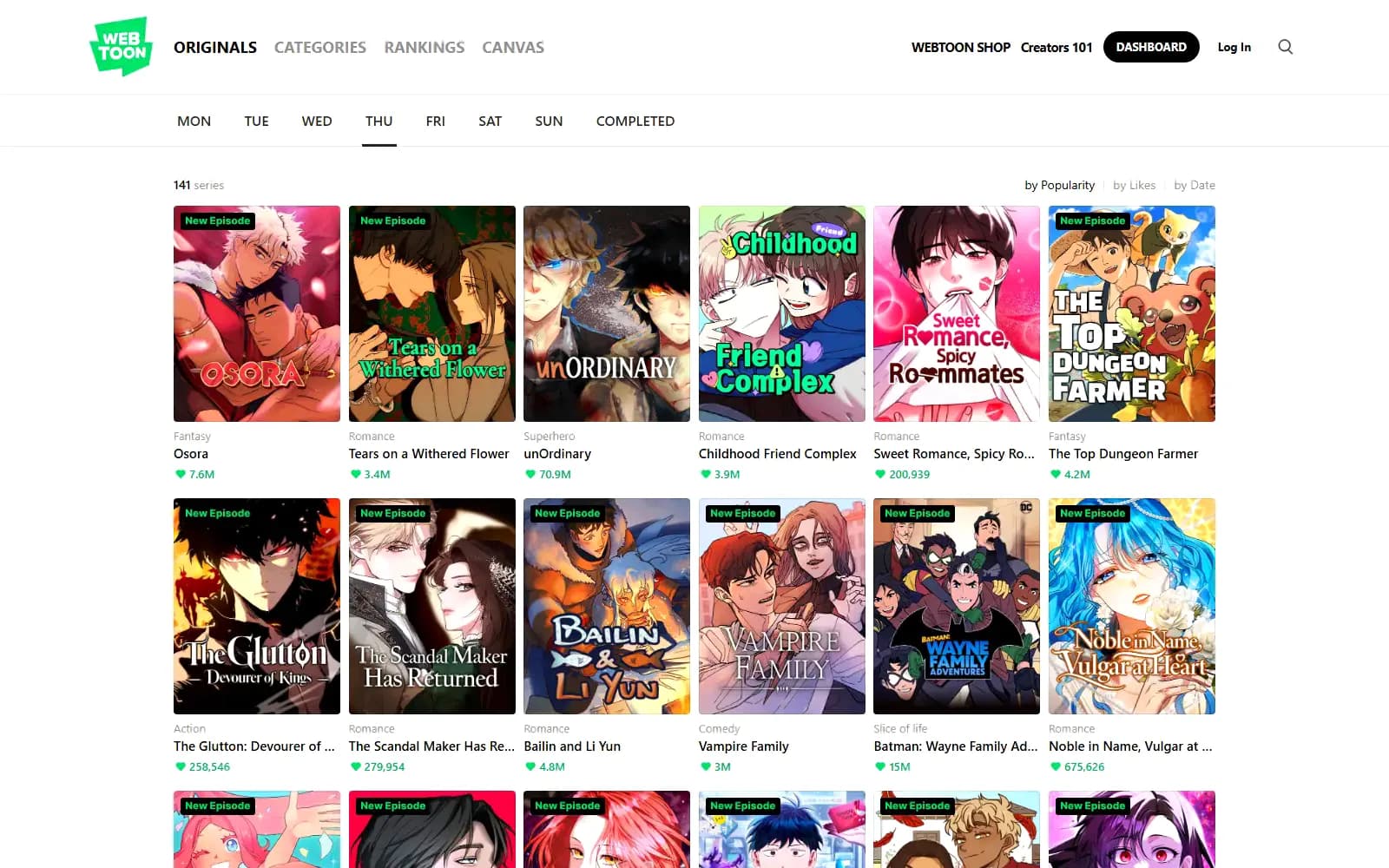
WEBTOON's Originals catalogue, captured 3 September 2026. The Thursday tab alone lists 141 series. The handful that got an anime had audiences in the hundreds of millions of views first.
The pattern behind those titles:
- Audience first. Every adapted series had a very large readership before a studio committed. The reader numbers are the pitch.
- Licensing through the platform. WEBTOON Entertainment (and Kakao for Kakao Webtoon titles) holds or brokers the adaptation rights. A creator on Originals does not usually sell the anime rights themselves.
- A production committee in Japan or a streamer in the US funds it. This is where a year or two disappears.
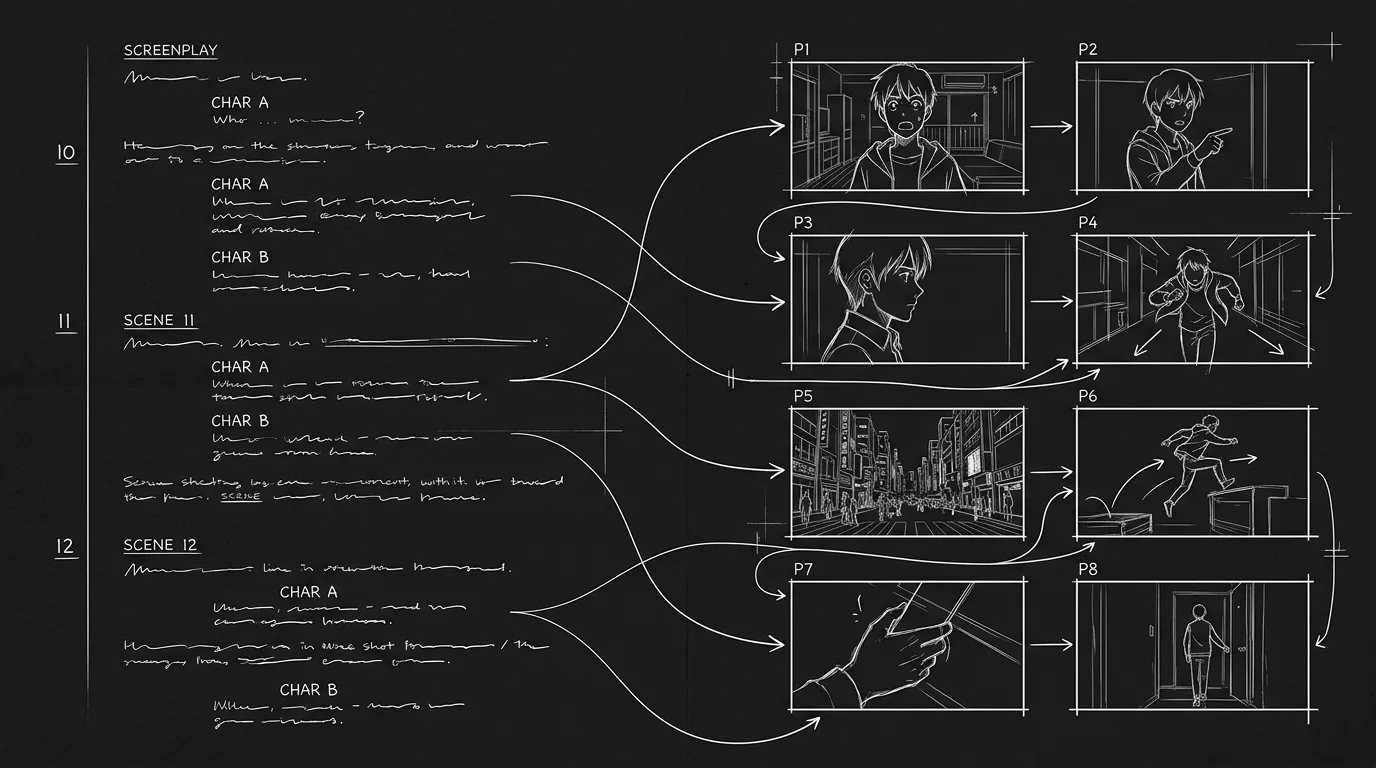
- A series composition writer rebuilds the story as scripts, deciding what a 22-minute episode covers. A 90-panel chapter is rarely one episode; two to four chapters per episode is common.
- Storyboards (e-konte) are drawn from scratch in 16:9. The webtoon's vertical panels are reference, not the board.
- Character designs are redrawn for animation: simplified line count, colour-separated layers, model sheets with turnarounds. The webtoon art is the source, never the final design.
- Animation, voice, music, compositing. Twelve to twenty-four episodes, a full studio, a broadcast slot.
Realistic timeline from the first serious conversation to a first episode airing: two to four years. Realistic odds for any given series: very low. The scripting codes of manga and anime explain why the Japanese script and storyboard documents look nothing like what a webtoon artist has in hand.
The AI path: what it changes and what it doesn't
The AI path does not compete with A-1 Pictures. It competes with nothing happening at all, which is the outcome for almost every webtoon.
What changes:
| Step | Studio path | AI path |
|---|---|---|
| Rights | Licensed away, years of negotiation | You keep them. It is your series |
| Script | Rewritten from scratch by a series composer | Extracted from the bubbles and gutters, then edited by you |
| Storyboard | Drawn by hand in 16:9 | Generated per panel, reframed to 16:9, edited by you |
| Character design | Redrawn for animation | Reference sheets built from your own panels, locked as references |
| Art style | Reinterpreted by the studio | Kept from the source, applied to every generated frame |
| Motion | Hand-drawn or CG animation | Image-to-video generation from the storyboard frames |
| Voice | Professional cast in a booth | AI voices, or your own recorded cast |
| Time to a 3-minute pilot | Not a thing studios make | Days to weeks |
| Time to a full episode | Months per episode, in a batch | Weeks, mostly spent on retries and editing |
What does not change:
- Someone still has to decide the timing. How long the beat lasts, where the cut falls, which panel becomes two shots and which three panels become one. That is directing, and the tool does not do it for you.
- Motion is still the hard part. Current video models handle a slow push on a face, a walk, weather and hair beautifully. They do not handle a choreographed fight across five panels in one generation. You break it down, as animators always have.
- Style drift is the enemy. A webtoon reader knows the characters' faces better than you do. Anything off-model reads as wrong immediately. Reference discipline is most of the work.
The second point is the one most first attempts miss. Anime does not move like a video model: it holds poses on twos and threes, and a smooth generated glide over a cel-shaded face looks rotoscoped. How to write, board and retime for that is the core of the anime method we use on original series, and it applies unchanged once your panels have become a script.
Try it free
Try Screenweaver for free on your script
It is free. Import your existing project, get a clearer view of your outline, and regain control of your story structure in minutes.
Start FreeIn ScreenWeaver
Turn a panel into an anime shot
Your own panel goes in as a reference, an Image node redraws it as a widescreen anime frame, and a Video node animates it. Click the nodes to see how they are set.
Click a node to see its settings, drag it to move it.


Which path is yours
| You are | Take this path |
|---|---|
| A creator with a large Originals audience and a platform contract | Studio path, through the platform. Use the AI path to make a pilot that shows the tone you want, then hand it over |
| A Canvas or independent creator with a few thousand readers | AI path. Nobody is going to license it, and a pilot changes what your series is |
| A small studio pitching adaptations | AI path for the pitch reel, studio path for the delivery |
| An author who owns a finished series and wants it animated | AI path, episode by episode, with a real editor in the loop |
| A rights holder testing whether a property has an animation audience | AI pilot first. It costs less than a meeting |
The four documents any adaptation produces
Whether a studio does it or you do, a webtoon adaptation produces the same four things. Building them in this order saves the most rework.
- A scene breakdown. The chapter's panels grouped into scenes with a location and a time of day. Webtoons rarely state either, so you infer them.
- A cast and style reference. Every recurring character with a front, three-quarter and profile, plus a page of environment and palette references, all cut from the panels themselves. The character consistency sheet formats this for AI generation.
- A storyboard in the target aspect ratio. Panel by panel, with a shot size, a duration and a note on what moves. The whole method is in webtoon to storyboard.
- A shot list for production. Every board frame with its generation prompt, its references and its retry budget. That is where the cost actually lives.
ScreenWeaver's pipeline is built in that order: Script, then Storyboard, then Production, in one workspace. The webtoon-specific import, where you upload the episode instead of a screenplay and the breakdown, cast and style come out of the panels, is the next piece of that pipeline. Until it ships, the AI storyboard generator takes a scene breakdown and the character references and does the rest.
What a first pilot should be
Not episode one. Episode one of any webtoon is exposition, and exposition is where AI motion looks most like a slideshow.
Pick the chapter readers screenshot. The fight, the confession, the reveal. Sixty to ninety seconds. One location if you can. Three characters at most. Make that, and you will learn more about whether your series survives the jump than any amount of planning.
For page-based comics, albums and manga rather than vertical scroll, the equivalent guide is how to turn a comic into an animated series.
FAQ
Can I turn my webtoon into an anime myself?
Yes, with the caveat that "anime" means a style and a production tradition, and what you can make yourself is an animated adaptation in that style. Extract the script from the bubbles, build character references from your panels, storyboard in 16:9, generate motion shot by shot from those frames, then edit with voice and music. A 60-second pilot is a realistic first project.
Do I need to sell my rights to get a webtoon animated?
For the studio path, in practice yes: the platform or a production committee licenses the adaptation rights. For the AI path you keep everything. If you are on a platform Originals contract, check what it says about derivative works before you publish an adaptation.
How long does a webtoon anime adaptation take?
The studio path runs two to four years from a serious conversation to a first episode. Solo Leveling's webtoon launched in 2018 and its anime premiered in January 2024. An AI pilot of one chapter can be made in days to weeks, most of it spent on retries and editing.
Why do so few webtoons get anime adaptations?
Because the studio path needs a proven audience in the hundreds of millions of views, a licensing deal, a funding committee and a studio slot. Thousands of series are released every week on WEBTOON alone. The bottleneck is capacity and money, not source material.
Does the anime keep the webtoon's art style?
Studios reinterpret it: characters are redrawn with simpler lines for animation and colour layers. The AI path can keep the original style closer, because every generated frame uses the artist's own panels as references, but the motion still shifts the look slightly.
What is the difference between a webtoon and a manhwa?
Manhwa is the Korean word for comics generally. A webtoon is a digital, vertically scrolling comic, usually in colour, read on a phone. Most modern Korean series are both. For adaptation the distinction that matters is the vertical scroll, which decides how the panels translate into shots.
Final Step
Build your next script with Screenweaver
Move from ideas to production-ready pages faster with timeline-native writing and AI-assisted story flow.
Try Screenweaver