
The Biological Computing Co. (TBC), a San Francisco company that grows neurons in a lab, launched TBC mischief 1 on 30 October 2026. It is an image-to-video model built on Wan 2.2, live on fal and OpenRouter, and it costs $0.005 per second at 480p. At that rate, a rough motion pass over a 100-shot storyboard costs $2.50, and that changes how a filmmaker can spend a draft budget.
The launch came as a press release on tbc.co dated 30 October, timed, TBC says, to Mischief Night. We read the release, the fal model page and the OpenRouter video API on 2 November, priced a draft pass with the published rates, and listed what TBC has not shown yet.
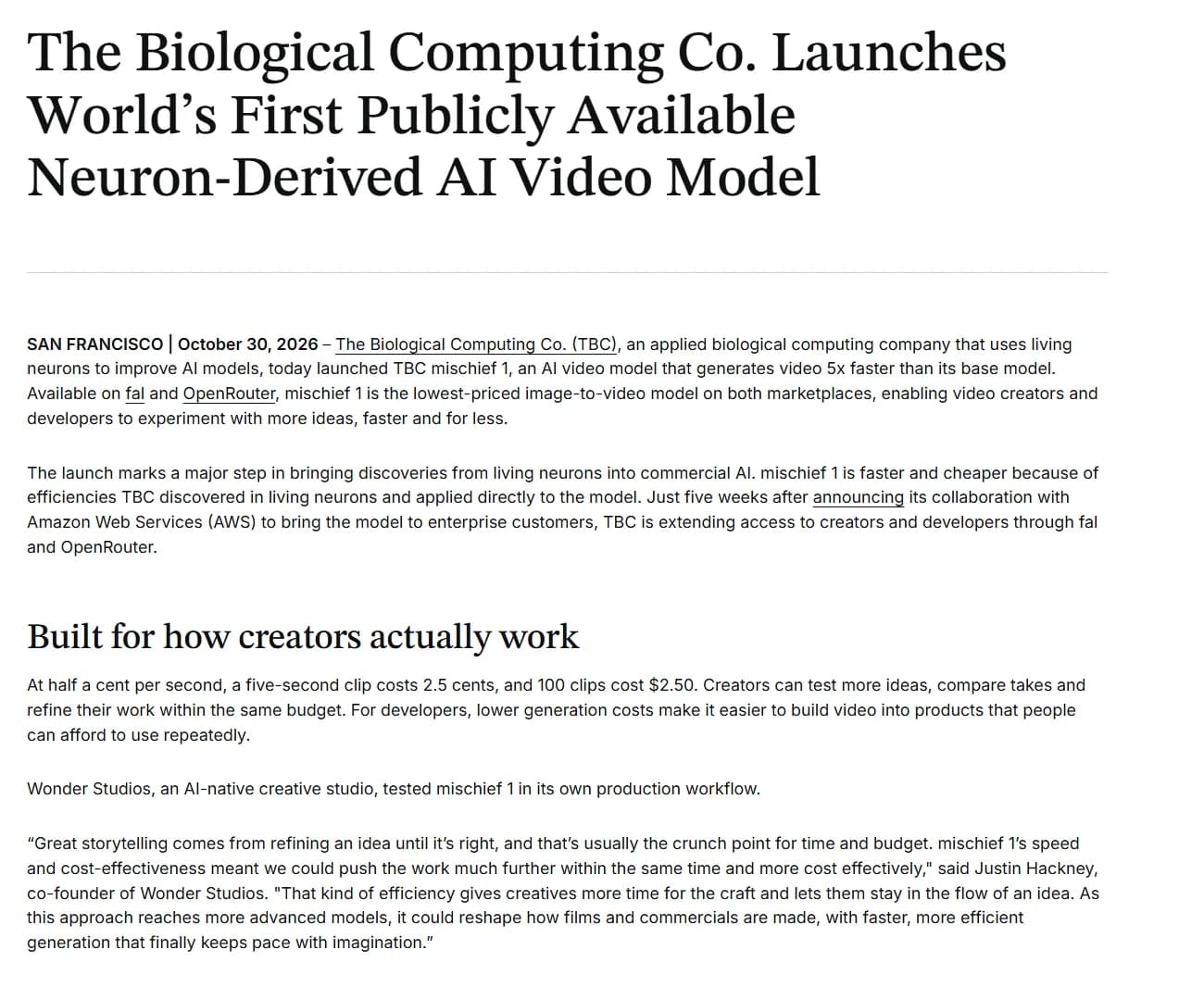
What TBC announced
mischief 1 is not a new model trained from scratch. TBC took Wan 2.2, the open-weight video model Alibaba released in 2025, and applied what it calls neuron-derived efficiencies to it. The company's claims, all from the release:
- It generates video 5 times faster than its base model.
- It matches the base model's quality.
- It is the lowest-priced image-to-video model on both fal and OpenRouter.
- The added software is less than 0.1% of the base model's parameter count.
TBC's explanation of the method stays high level. It grows neurons in the lab, measures how they process information, and turns the principles it finds into software that runs on ordinary AI hardware. The neurons stay in the lab. TBC contrasts this with the usual tricks for speeding up inference, quantization, distillation and caching, and says its gains come "from a different source".
No paper, benchmark or method description came with the launch. The 5x figure and the quality claim are TBC's own, with nothing we could check them against. One studio, Wonder Studios, is quoted as having tested the model in production. It is a single quote, with no numbers attached.
TBC says it announced a collaboration with Amazon Web Services five weeks earlier to bring the model to enterprise customers, and OpenRouter's catalog lists the model under a slug dated 23 October.
The specs, as the marketplaces list them
The release gives a price and little else. The fal page and the OpenRouter API fill in the rest:
| Spec | TBC mischief 1 |
|---|---|
| Mode | Image to video: a start frame plus a text prompt |
| Resolution | 480p (854 x 480) or 720p (1280 x 720) |
| Clip length | 5 seconds on fal; 3 or 5 seconds on OpenRouter |
| Aspect ratio | 16:9 listed on OpenRouter |
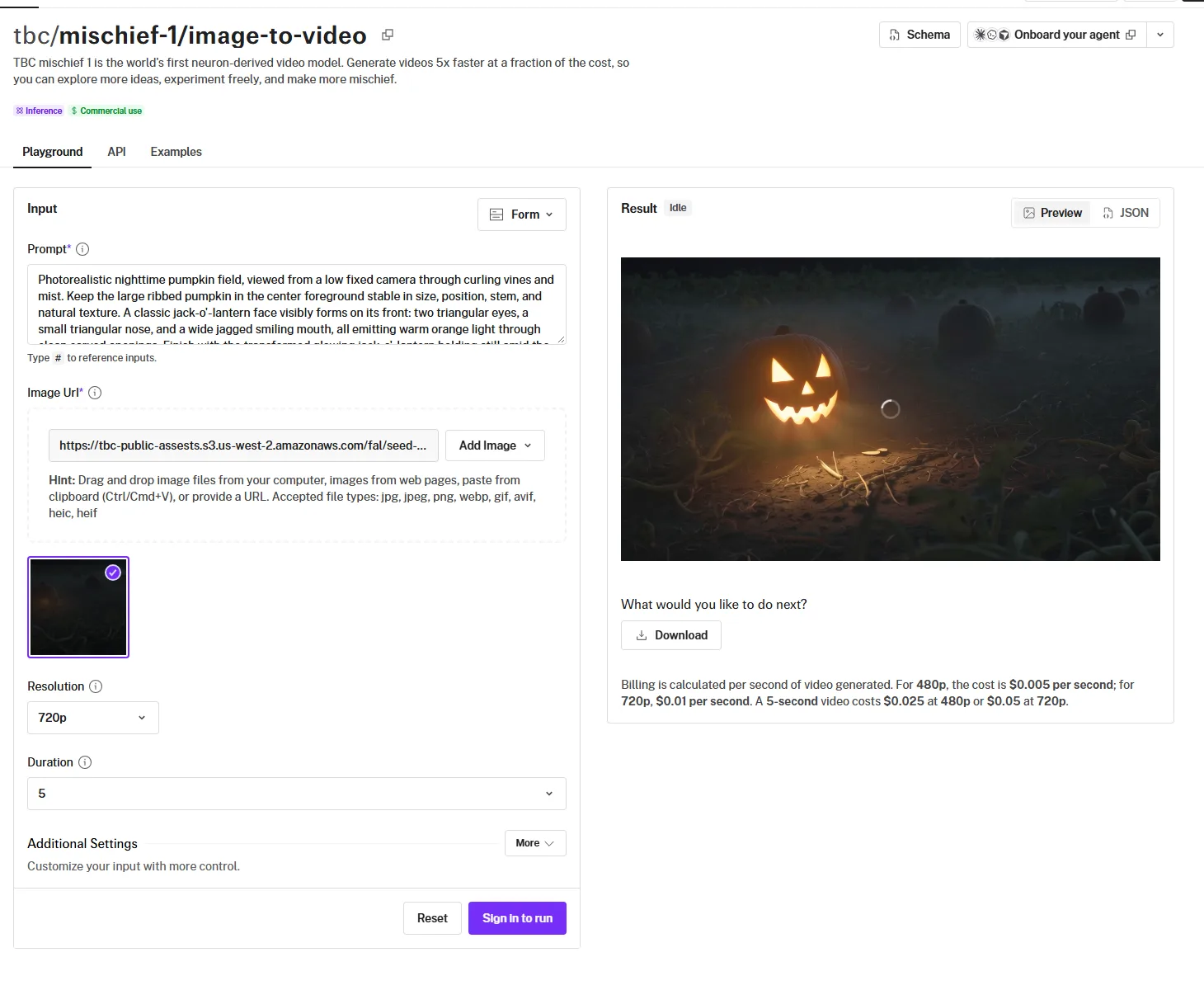
| Price on fal | $0.005/s at 480p, $0.01/s at 720p |
| Seed | A seed parameter on OpenRouter; fal returns the seed in its output |
| Audio | Not mentioned anywhere |
| Licence | fal tags it "Commercial use"; no licence text published |
OpenRouter routes the model through a single provider, Ambient, and the per-call cost comes back in the response rather than on the page. We priced everything below from fal's rates.
What half a cent buys a filmmaker
A 5-second shot at 480p costs $0.025. TBC does the obvious math in its release: 100 clips for $2.50. The more useful question is what that does to a real production budget.
Most of the money in AI video goes on takes you throw away while you find out whether the camera move works and whether the cut to the next shot holds. We broke that down in AI video model pricing compared, where the cost per second you keep runs well above any list price once rerolls are counted.
A model this cheap moves those throwaway takes to a separate, nearly free pass. Here is a 100-shot draft at one take per shot, next to the cheapest 480p tiers we priced on 1 November:
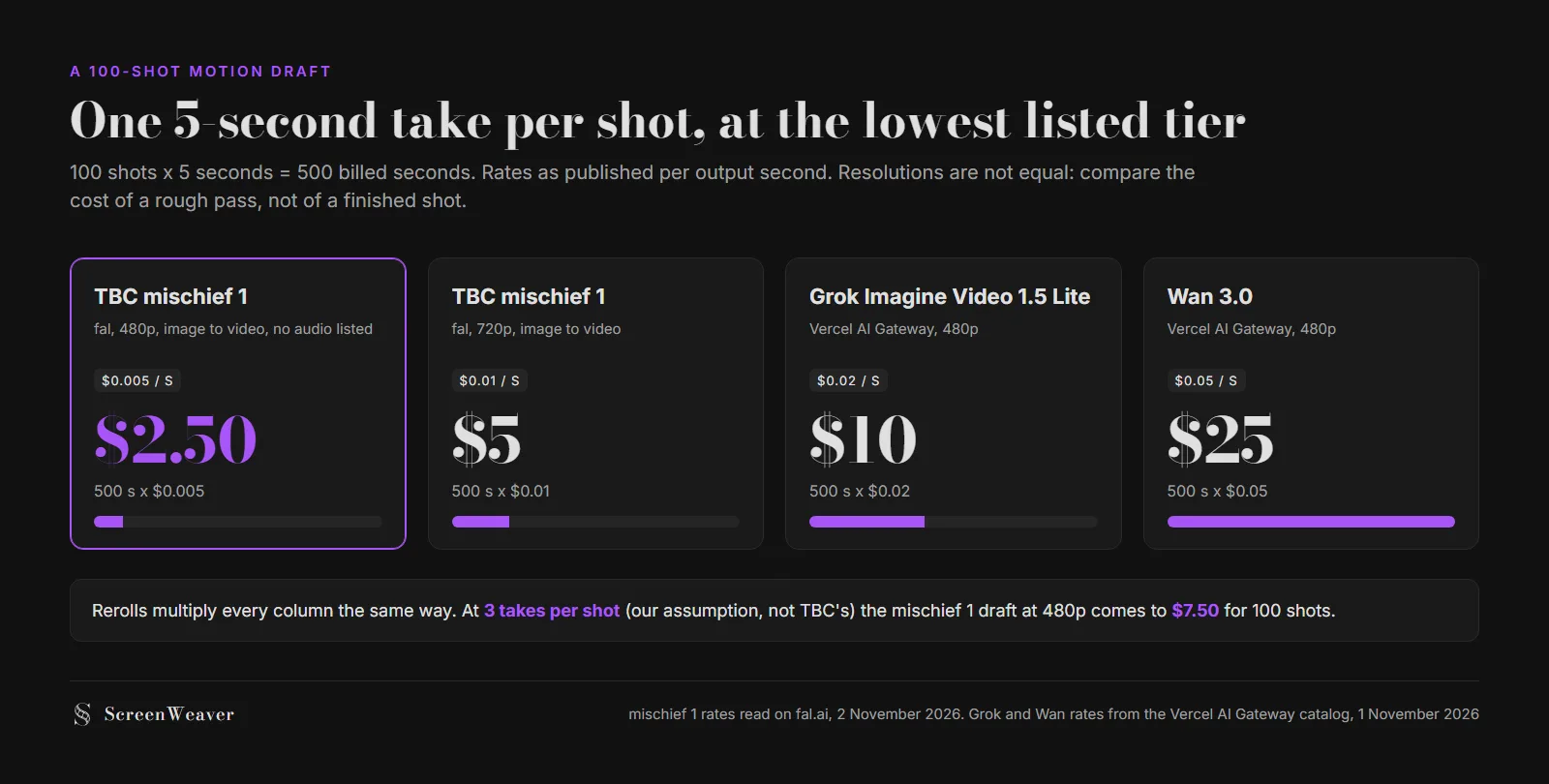
Three takes per shot is our assumption. Even at that rate the draft costs $7.50 for 100 shots. On Lost Garden episode 2, generation came to about $1.47 per finished second, so a full draft pass of that size costs about as much as five seconds of final footage. If you want to run your own numbers, the AI video cost calculator takes shot count, length and rerolls.
The comparison has limits. A 480p Wan 2.2 derivative and Wan 3.0 are not the same model, and none of these cards say anything about quality. They price a rough pass and nothing more.
Try it free
Try ScreenWeaver for free on your script
It is free. Import your existing project, get a clearer view of your outline, and regain control of your story structure in minutes.
Start FreeWhere it fits in a pipeline
Image to video means every generation starts from a frame. That is the useful constraint here: the frame should come from your storyboard, not from a lucky prompt.
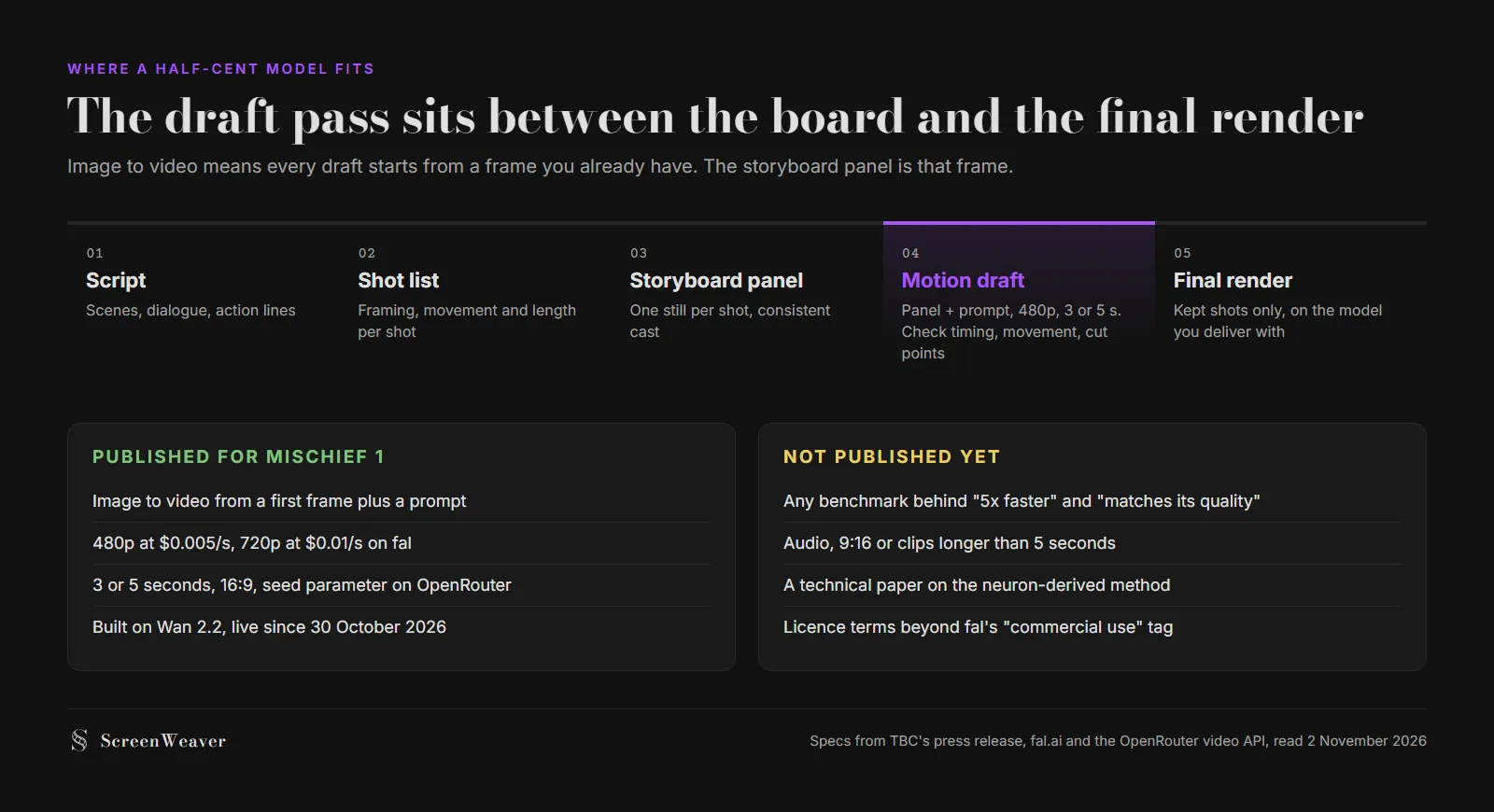
With a board, a 480p draft does the job an animatic used to do. You see whether the dolly in shot 14 is too slow, whether the reaction in shot 15 needs two more seconds, and which panels need redrawing before you spend real money. Then you render only the kept shots on the model you plan to deliver with.
Two things stop it from doing more than that today. Clips top out at 5 seconds and come only in 16:9 on OpenRouter, so a vertical series or a long take needs another model. And nothing in the launch mentions audio, so dialogue scenes get drafted silent.
What we don't know yet
- Whether "matches its quality" holds outside TBC's own tests. TBC published no benchmark and no side-by-side against plain Wan 2.2.
- What the neuron-derived method actually changes in the model. TBC describes it as proprietary software and has not published a paper.
- Licence terms. fal says "Commercial use", but Wan 2.2's own licence and any TBC terms on top are not spelled out on either marketplace.
- Character consistency across shots. The fal page shows no reference-image input, though OpenRouter lists
input_references. Holding a face across a scene is still the hard part, which we cover in our character drift guide. - Which newer base models come next. TBC says it is applying the process to newer open-weight video models with "greater efficiency gains", without naming them.
Our take: drafts yes, final shots later
For drafts, it is worth an afternoon. At these prices the risk is a few dollars, and an image-to-video model that starts from your panel is exactly what a motion test needs. For final shots, wait for independent tests and a clear licence.
We have not added mischief 1 to ScreenWeaver. The Production canvas runs Wan 3.0, Seedance, Veo, Kling, MiniMax H3 and Grok Imagine Video from storyboard panels. If you are building the board those drafts start from, the AI storyboard generator turns a script into storyboard panels.
FAQ
What is TBC mischief 1? An image-to-video model from The Biological Computing Co., launched on 30 October 2026. It is built on the open-weight Wan 2.2 model and modified with what TBC calls neuron-derived efficiencies, discovered by studying living neurons in a lab.
How much does TBC mischief 1 cost? On fal, $0.005 per second of video at 480p and $0.01 at 720p. A 5-second clip costs $0.025 at 480p or $0.05 at 720p. OpenRouter returns the cost of each call in the API response.
Does mischief 1 run on real neurons? No. According to TBC, the neurons stay in its lab. The company studies how they process information and turns what it finds into software that runs on standard AI hardware.
Is TBC mischief 1 better than Wan 2.2? TBC says it matches Wan 2.2's quality while generating 5 times faster. It has not published benchmarks or samples to support either claim, so test it on your own shots first.
Can I make vertical or long videos with mischief 1? Not according to the current listings. OpenRouter lists 16:9 only, with 3 or 5 second clips, and fal offers 5 seconds. No audio is mentioned.
From script to shots
Turn your script into a film, shot by shot
Write the scene, get its storyboard, then generate each shot with consistent characters. You direct every step.
Start your film free