
A film budget template is a spreadsheet of every cost line on a production, grouped into above the line, production, post and contingency, where each total is quantity times rate times days or weeks. Download our blank micro-budget template or the filled example; both open in Google Sheets or Excel, with formulas for every total.
This guide is part of our independent filmmaker workflow. The example budgets a whole feature, SLACK WATER, the 80-page drama we outlined scene by scene in the screenplay outline guide. It comes in at $280,235, under the $300,000 ceiling of SAG-AFTRA's Ultra Low Budget agreement.
What counts as a micro-budget film
There's no official number. Wikipedia's entry on low-budget film says no precise figure defines the category and that it varies with genre and country. In a 2014 survey of 542 film professionals, Stephen Follows found an average maximum of $396,000 for a film to still count as micro-budget, and noted that the UK often uses £150,000 because it's the SEIS tax scheme limit.
For a US production with union actors, the number that matters in practice is the SAG-AFTRA tier your film falls into. SAGindie's 2020 notice on the low budget agreements sets three ceilings:
| Agreement | Total budget | Notes from SAGindie |
|---|---|---|
| Ultra Low Budget | Up to $300,000 | Non-episodic, shot entirely in the US |
| Moderate Low Budget | $300,000 to $700,000 | Non-episodic, shot entirely in the US |
| Low Budget Theatrical | $700,000 to $2,000,000 | Initial theatrical release |
The caps come from a 2020 page. Confirm them with SAG-AFTRA before you sign anything, because the agreement you pick sets your cast rate, and your cast rate sets a good part of the rest.
What's in the template
The template has one row per cost and nine columns: section, account number, line item, quantity, rate, unit, units, total and notes. The total is always quantity times rate times units. A line producer on $1,400 a week for nine weeks is quantity 1, rate 1,400, unit "week", units 9.
| Section | Accounts in the template | What goes there |
|---|---|---|
| Above the line | 1100 to 1450 | Writer, producers, director, cast, pension and health, background |
| Production | 2000 to 3300 | Crew, payroll fringes, camera and lighting kit, art department, wardrobe, locations, safety, lodging, transport, catering, expendables, insurance |
| Post-production | 4000 to 4500 | Editor, sound edit and mix, colour, music, VFX cleanup, deliverables |
| Other | 5000 to 5100 | E&O insurance, festival fees |
| Contingency | One row | 10% of the subtotal, as a formula |
The account numbers are ours. Studio budgets use far longer charts of accounts, and you can add rows whenever the script needs one. On a micro budget, though, a short list you actually fill tells you more than a long one left at zero.
The filled example: SLACK WATER
SLACK WATER is the story of Nell, a survey engineer who comes home to an island boatyard after her father dies and finishes his last wooden boat with the brother she hasn't seen in eleven years. It's fictional, and we wrote it for these guides. For the budget we set the shoot on an island off the US coast, so the cast line can use the Ultra Low Budget rate.
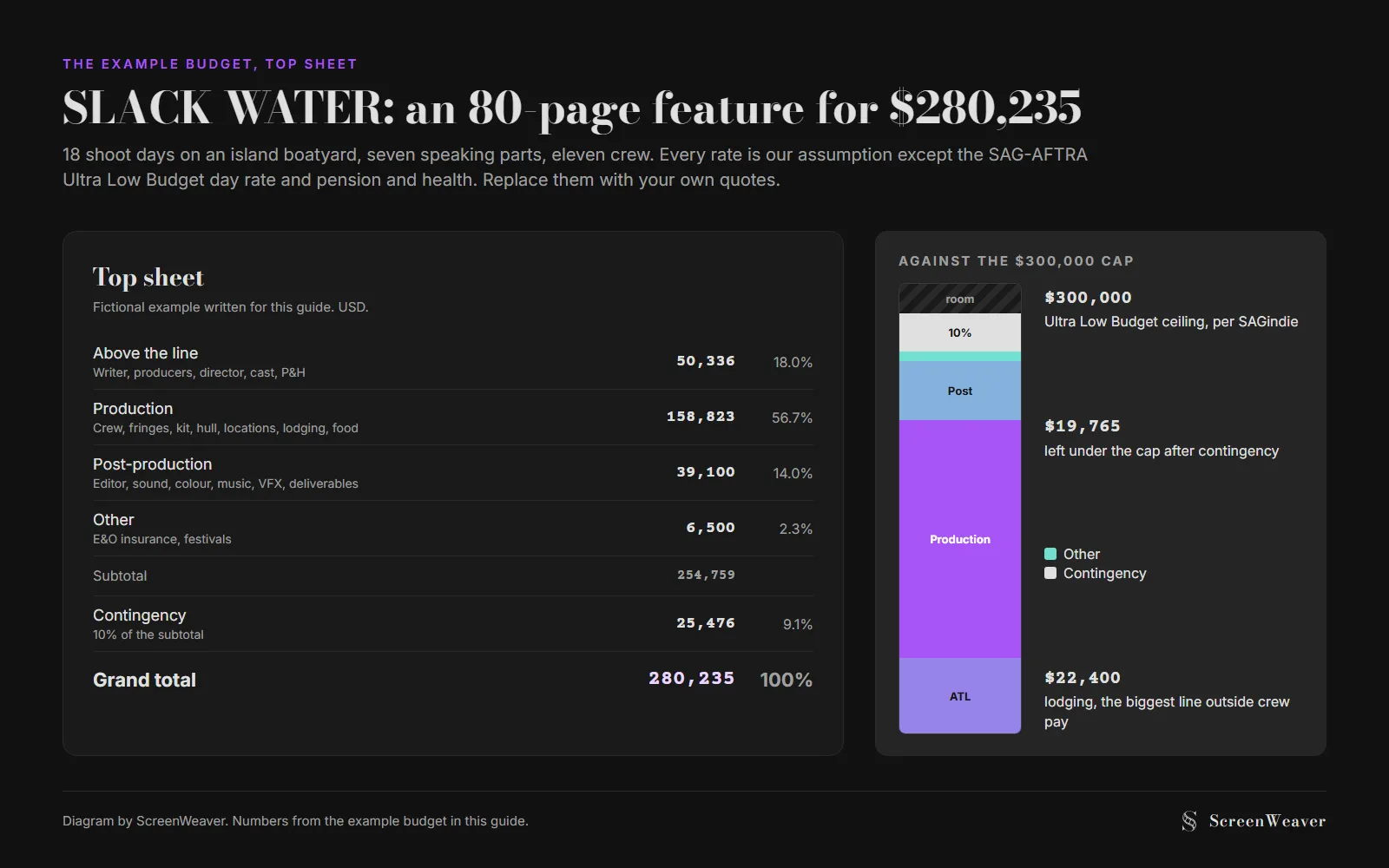
The top sheet is the first page anyone reads, investors included. Production takes 57% of the total. That's what you'd expect on a micro feature, where most of the money pays for the days you spend shooting. Lodging is the surprise. Two rented houses for four weeks cost $22,400, more than the camera, grip and lighting packages together, because the cast and crew can't drive home from an island every night.
How to fill each field
Fill the units before the rates. Days, weeks and performer days come from documents you already made, and getting them wrong costs far more than a rate that's $25 off.
Units: start from the schedule
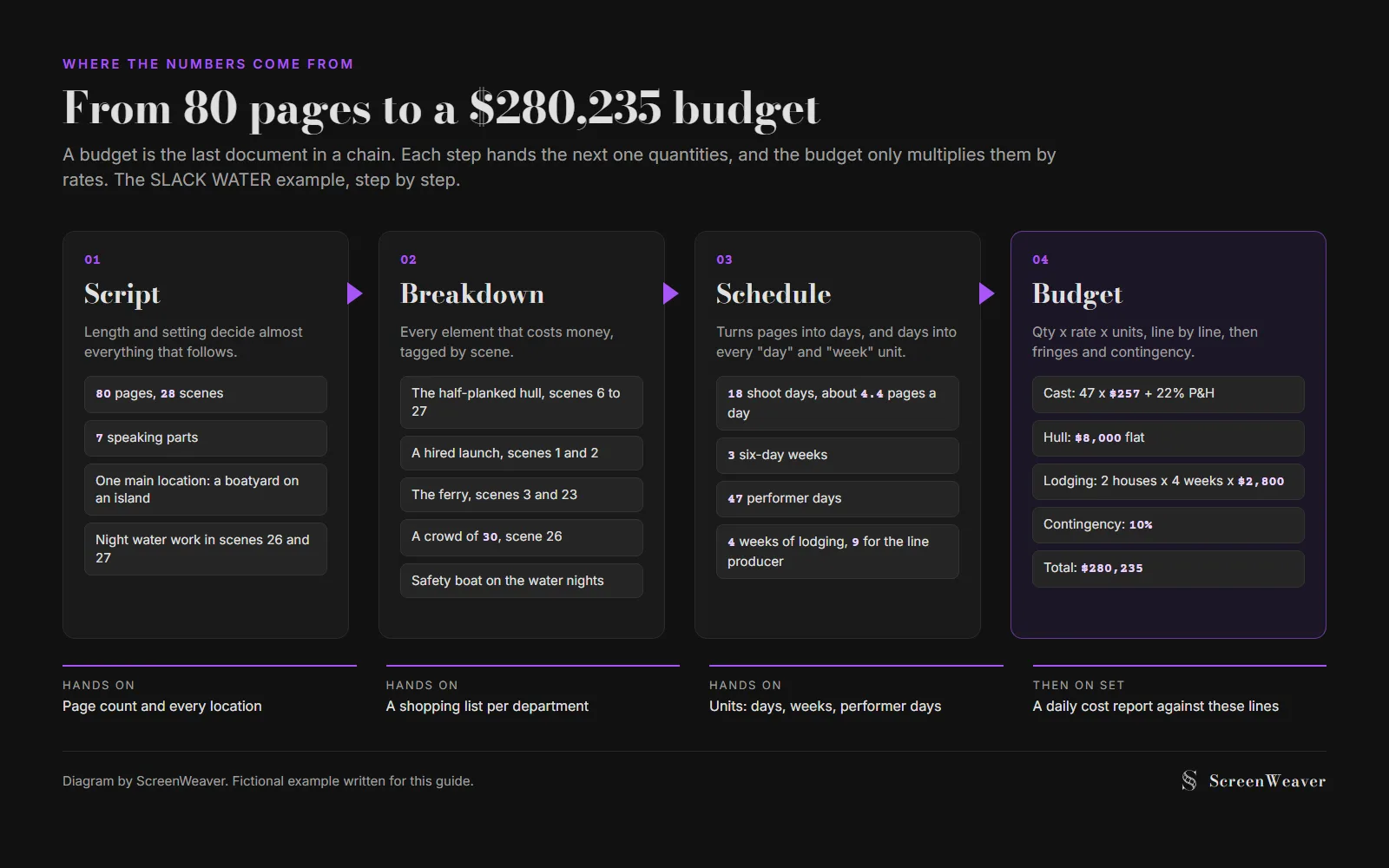
The script breakdown tells you what each scene needs. The stripboard sorts those scenes into shoot days. Our 80 pages become 18 days, about 4.4 pages a day, in three six-day weeks. That's a fast pace that only works because most of the film happens in one boatyard. If you don't have a board yet, the shooting schedule calculator gives a first estimate from page count and complexity.
Add prep and wrap. Our line producer works four weeks of prep, three of shooting and two of wrap, so nine weeks. The production designer starts ten days early because the hull has to exist before day one.
Above the line
Writer, producers and director are flat fees in the example: $5,000, $7,500 and $9,000. If you defer part of those fees, keep the line in the budget with the deferred amount in the notes column, so the paper still shows what the film really costs.
Cast: SAG-AFTRA rates and pension and health
Count performer days with a day out of days report. Ours: Nell works all 18 days, Owen 15, Dev 6, and four day players two days each. That's 47 performer days.
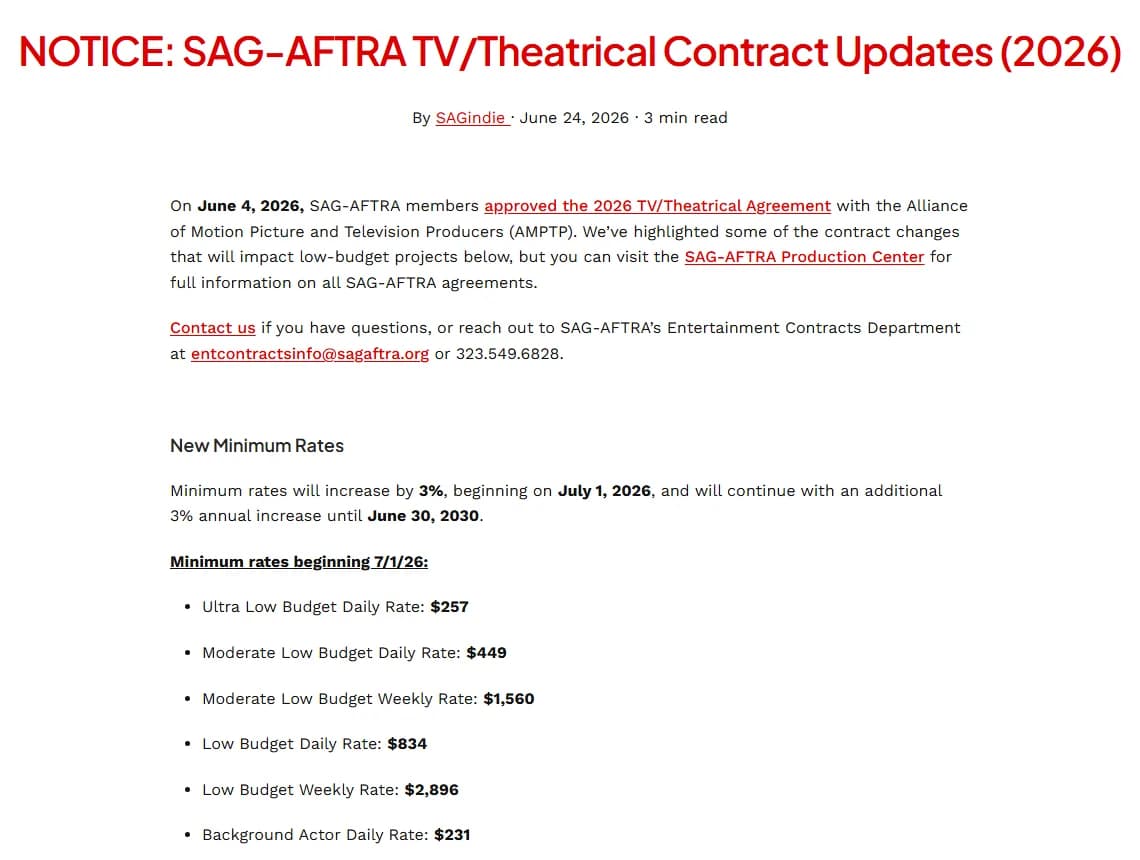
SAGindie's 2026 contract notice puts the Ultra Low Budget day rate at $257 from 1 July 2026, rising 3% a year until 2030. The same page sets the pension and health contribution at 22% for principal performers from 6 September 2026. So the cast line is 47 × $257 = $12,079, plus $2,657 of P&H. In the template, the P&H row is a formula on the cast row, so it follows when you change the days.
Those are minimums. Your lead can ask for more, and a good one often should get it.
For the island crowd in scene 26, we budgeted 30 local volunteers at a $50 meal and travel stipend each. Check the agreement's rules on background before you plan the same thing.
Crew and payroll fringes
One row per role, day rate times days worked. The example's eleven crew run from $175 a day for production assistants to $450 for the director of photography, and the sound mixer's rate includes the sound kit. Those rates are our assumptions for the example. Ask around in your city, because they swing a lot between markets.
If you pay crew through payroll, the employer side adds taxes and fees on top. The template has an 18% placeholder row that calculates from the crew lines. Replace that percentage with your payroll company's real figure as soon as you have it.
Kit, art department and wardrobe
Camera and grip and electric packages are usually rented by the week. Ours are $2,200 and $1,800 a week for three weeks.
The art line is where the script shows up in the budget. SLACK WATER needs a half-planked wooden hull that the characters work on for most of the film, so it gets its own $8,000 line, apart from $3,000 for set dressing and props. Whatever your film's version of the hull is (a car that gets wrecked, a period costume, a dog), give it its own row so nobody can quietly shrink it.
Locations, safety and lodging
Location fees are per day or per week. The boatyard costs $1,250 a week for four weeks, including a prep week to build. The hotel bar, the cottage and the chandlery get $400 a day for eight days in total. Two boat days, a hired launch for scenes 1 and 2 and ferry passage for scenes 3 and 23, are $800 each.
Water and night work get a safety line: a safety boat and a marine coordinator for three nights at $1,100. Don't cut this row to make the total fit.
Then lodging, transport and food. Catering is people times days times a per-head rate: 22 people, 18 days, $22. It's one of the cheapest ways to keep an unpaid or underpaid crew on your side, and one of the first lines people try to cut.
Post-production and deliverables
Post is a separate section because it happens after the money from the shoot is gone. The example has an editor at $1,300 a week for 12 weeks, $9,000 for sound edit and mix, $4,000 for the grade, $5,000 for the composer, $3,000 for VFX cleanup and $2,500 for a DCP and captions.
Insurance
Production insurance and errors and omissions (E&O) insurance are both placeholders in the example, at $5,000 and $4,000. Get real quotes. Distributors generally ask for E&O before they'll take a film, so it sits in the budget even though you won't buy it until the end.
Contingency
The last row is 10% of the subtotal, $25,476 in the example. It's a formula, and it's money you plan to spend: the storm night that costs you a day, the location that cancels, the lens that goes in the sea. If the budget only fits under your cap without contingency, it doesn't fit.
Try it free
Try Screenweaver for free on your script
It is free. Import your existing project, get a clearer view of your outline, and regain control of your story structure in minutes.
Start FreeWhat a shoot day costs
Most lines on a micro budget scale with days. Add one shoot day and you pay another day of crew, fringes, lodging, kit, cast and food. Cut one and you save all of it.
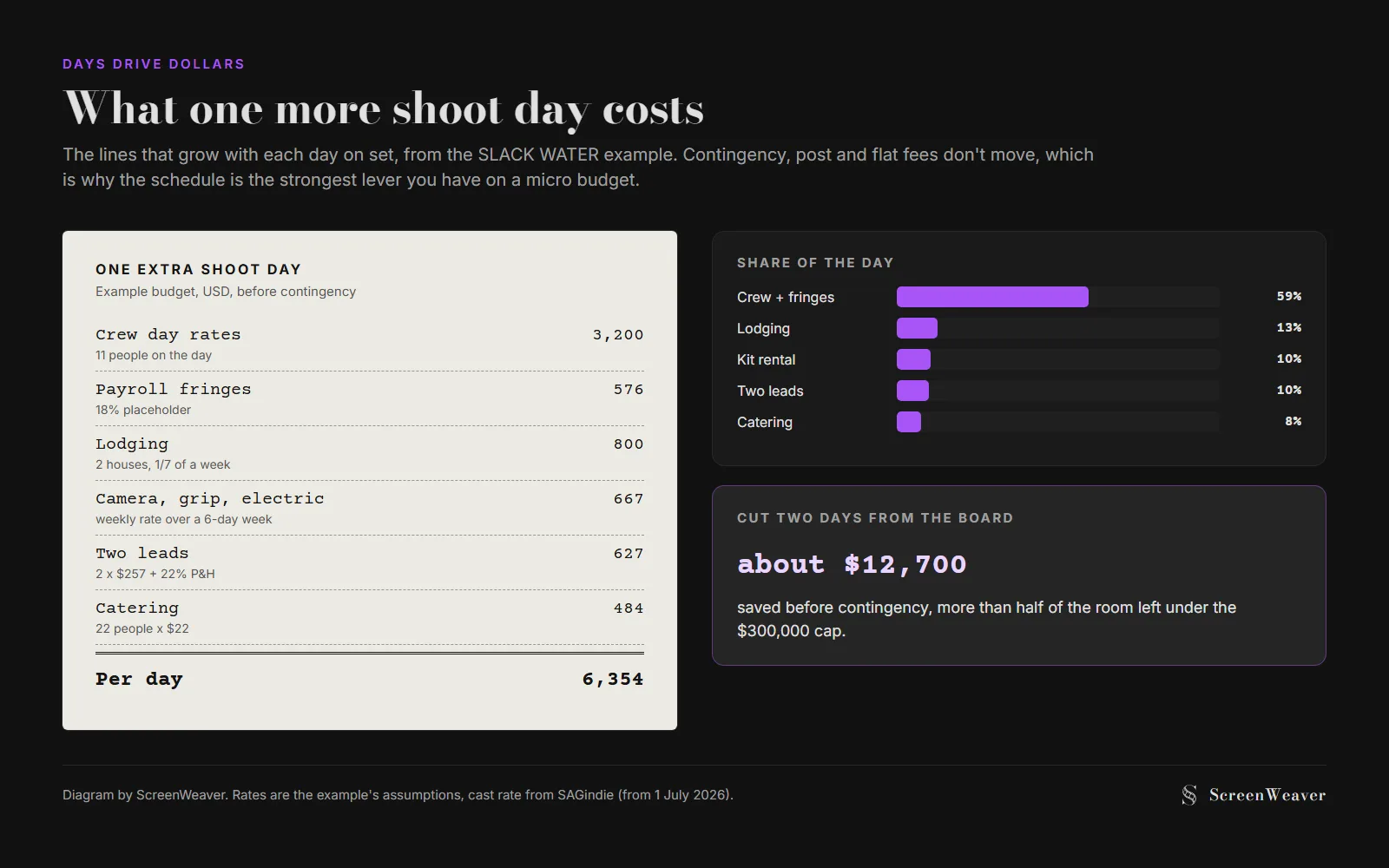
In the example, a day costs about $6,354 before contingency. Two days cut from the board save around $12,700, which is most of the room left under the $300,000 cap. So when the total comes out too high, go back to the schedule before you touch the rates. Merging two locations, writing a night scene as a day scene, or moving a scene from the ferry to the boatyard is usually worth more than squeezing $25 off every crew rate. Our guide to page count and locations on a micro-budget feature covers those script-side levers.
Variants of the template
Non-union cast
Keep the cast rows and set your own day rate. Delete the P&H row, or set its formula to zero. Everything else stays the same.
Deferred pay
Add a "Deferred" column next to the total and move part of each fee into it. Keep both columns on the top sheet: the cash you need now, and what you owe if the film earns money.
Shooting outside the US
The SAG-AFTRA rows don't apply. Swap in the local union or agreed rates, change the currency in the column headers, and check what your country's payroll charges look like. In the UK, the £150,000 SEIS limit from the Follows survey is the number many micro features are planned around.
Short film
The same template works. Most lines shrink to one or two days, lodging often disappears, and post shrinks to a few weeks of editing. A short with friends might only use 15 of the 40 rows.
Scenes made with AI video
If you plan to generate a few shots with AI video instead of shooting them, say an establishing aerial or a storm at sea, give those shots their own account in post, priced in generation credits, not as a VFX lump sum. Our guide to AI film production costs shows how to price them, and the AI video cost calculator gives a per-clip estimate.
Checklist before you send the budget
- Every "day" and "week" unit matches the current stripboard
- Performer days match the day out of days report
- Prep and wrap weeks are counted for the people who work them
- The film's key prop, build or vehicle has its own line
- Every water, height, stunt or night exterior has a safety line
- Lodging and travel are in, if anyone can't sleep at home
- Payroll fringes use your payroll company's figure, not the placeholder
- Insurance lines carry real quotes
- Contingency is in, and the total still sits under your agreement's cap
- Deferred amounts are shown, not hidden
Where the budget sits in prep
The budget comes after the script, the breakdown and the schedule, and it changes every time one of them does. Once you're shooting, it becomes the reference for a daily cost report, and each day's call sheet is what that day of the budget looks like to the crew.
If you write in ScreenWeaver, the characters, locations and objects you set up as story elements give you the lists the breakdown starts from, and they keep the same names on the board and in the budget notes. The film pre-production page covers that side. The budget itself lives in your spreadsheet, on this template.
FAQ
What should a film budget template include? One row per cost, with quantity, rate, unit, number of units and a total for each. Group the rows into above the line (writer, producers, director, cast), production (crew, kit, art, locations, lodging, food, insurance), post-production and other costs, then add a contingency row and a top sheet that sums each section.
How much does a micro-budget feature cost? There's no fixed figure. A 2014 survey of 542 film professionals by Stephen Follows gave an average maximum of $396,000 for micro-budget, and the UK often plans around £150,000. In the US, many micro features aim to stay under the $300,000 ceiling of SAG-AFTRA's Ultra Low Budget agreement. Our example feature comes in at $280,235.
What is the SAG-AFTRA Ultra Low Budget day rate in 2026? According to SAGindie's notice on the 2026 contract, the minimum is $257 a day from 1 July 2026, with 3% increases each year until 2030. Pension and health contributions for principal performers are 22% from 6 September 2026. Confirm with SAG-AFTRA before you budget.
How much contingency should a micro budget have? Our template uses 10% of the subtotal, calculated by formula. Treat it as part of the budget you expect to spend. If the total only fits under your cap after you remove the contingency, cut shoot days or locations instead.
What's the difference between above the line and below the line? Above the line covers the creative people hired before the shoot: writer, producers, director and principal cast. Below the line covers everything that makes the physical production happen, from crew and equipment to locations, food and post-production. Our template splits below the line into production and post so you can see post separately.
Can I use this budget template in Google Sheets or Excel? Yes. Both files are CSV with formulas for every total, the fringes, P&H and the contingency. Open them in Google Sheets with File, Import, or open them directly in Excel. If your Excel uses a semicolon as its list separator, import through Data, From Text/CSV and choose comma as the delimiter.
Final Step
Build your next script with Screenweaver
Move from ideas to production-ready pages faster with timeline-native writing and AI-assisted story flow.
Try Screenweaver