Ottawa International Animation Festival · AI films guide

Can you submit an AI film to Ottawa?AI-assisted, yes. Fully AI-generated, no.

The Ottawa International Animation Festival disqualifies fully AI-generated works and says it is not opposed to AI-assisted ones, as long as some sign of the artist's hand shows. The 2027 call is not out yet. Here are the rules, the odds and a plan, starting with the screenplay in ScreenWeaver.
  • Fully AI-generated: disqualified
  • Entry is free
  • 2027 call not announced
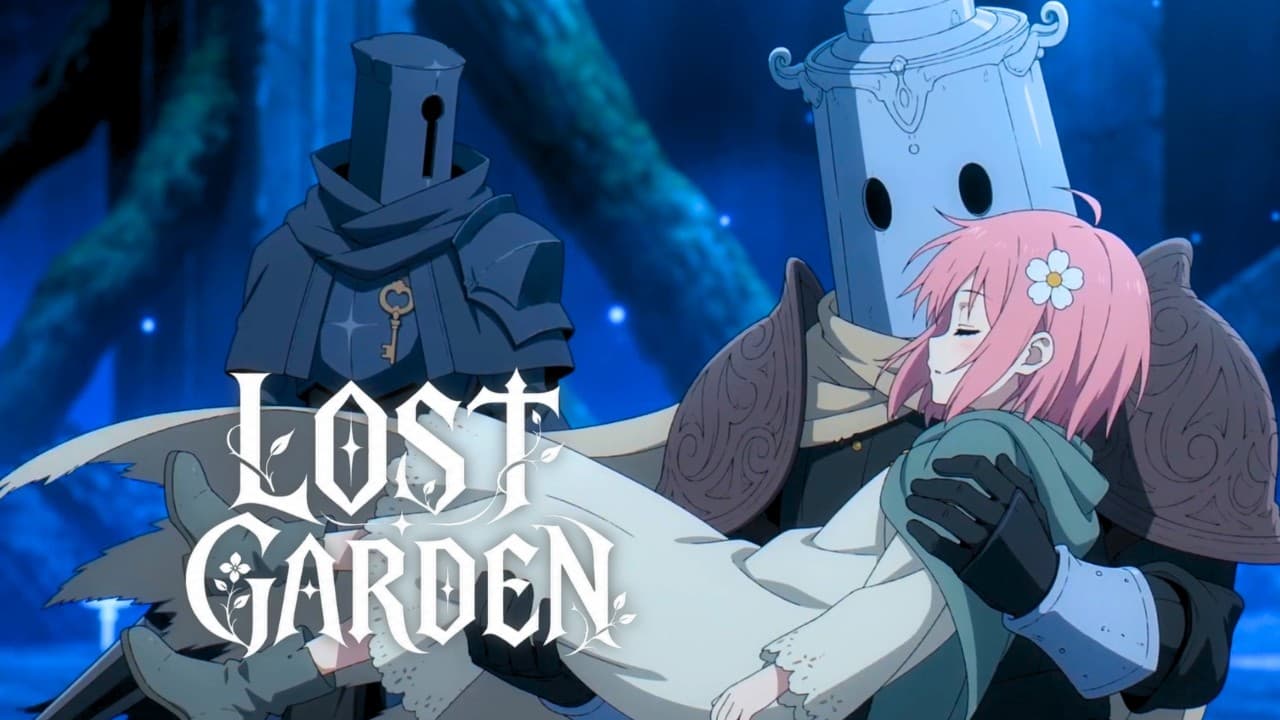
Lost Garden · Episode 2

Independent guide. ScreenWeaver does not organise the Ottawa International Animation Festival and is not affiliated with its organisers. Rules read on 1 October 2026. Official submissions FAQ

Available today in ScreenWeaver: free screenwriting, and a storyboard generated from your screenplay with Storyboard Beta, $9.99 a month.

Rolling out: video generation of each shot, powered by Seedance, with the Filmmaker plan.

OIAF at a glance

What Ottawa asks of an animated film.

OIAF is one of the oldest animation festivals in the world, running since 1976. It has one clear answer on AI, given in its submissions FAQ and repeated on its entries page. The 2027 rules are not published, so this page follows the 2026 text.
Last edition
23 to 27 September 2026, the 50th, in person in Ottawa
2027 call
Not announced. The 2026 call ran from 1 March to 2 June
Entry fee
None. Submitting is free
AI rule
AI-assisted accepted, fully AI-generated disqualified
Eligible films
Completed after 31 May 2025 for 2026, after 31 May 2026 for 2027
Length
Shorts: no minimum, 30 minutes suggested at most. Features: over 40 minutes
Categories
Seven, and one category per film
If selected
Independent films are paid an artist fee, from $124 to $372

Source: the 2026 Submissions FAQ and the Entries page on animationfestival.ca, read on 1 October 2026. The FAQ says films completed after 31 May 2026 stay eligible for the 2027 festival. Dates for 2027 are not announced.

The AI rule, quoted

One sentence that decides everything.

OIAF answers the AI question in its eligibility section, in the same words on two pages. Below is the wording, what it leaves open, and what an AI-assisted film has to show.
  • The rule

    Asked whether a film that uses artificial intelligence or algorithmic imaging is still animation, the FAQ says works must be original and show some level of non-algorithmic human involvement. Then: “Submitted works that are fully AI-generated are not eligible and will be disqualified.” Read in the 2026 FAQ and Entries page on 1 October 2026.

  • What it welcomes

    The same answer says the festival is not opposed to AI-assisted works. Its test is that a submission should show at least some sign of the artist's hand. AI can be in the film. It cannot be the only author.

  • What it does not define

    There is no percentage, no list of allowed tools and no form to declare AI use. Nobody tells you how much hand is enough. When in doubt, write to selections@animationfestival.ca before you submit, which costs nothing.

  • Who applies the rule

    The selection team watches every film. A fully AI-generated work is disqualified, not just left out, so the check happens at the screening of the file itself. Assume a trained eye will see it.

  • Where an AI-assisted film goes

    Seven categories exist: Animated Short, Commissioned Animation, Student Animation, Feature Animation, Young Audiences, Teen Audiences and Platform Animation. You pick one, and the team can move the film to a better fit.

  • Other originality rules

    The work must be original. Repackaging other people's films is grounds for immediate disqualification. Collage and found footage are welcome if every element is licensed, music included. That clause matters for generated films that borrow a style or a score.

The calendar

The 2026 calendar, as a model for 2027.

No 2027 date is announced. If OIAF repeats its 2026 pattern, <b>entries open in March and close at the start of June</b>. Treat these dates as a forecast, not a promise.
  1. 1 Mar 2026

    Entry form opens

    Films are submitted only through the official entry form on the festival's Eventival page, with an account.

  2. 2 Jun 2026

    Deadline

    11:59 PM Eastern. The FAQ gives 31 May and 2 June in different places, so treat 31 May as the safe date.

  3. End Jul 2026

    Results by email

    Everyone is told by the end of July, selected or not. Your screener link must stay live until 31 July.

  4. Late Jul to mid Aug

    Schedule published

    The programme schedule is normally published in that window, once selections are public.

  5. 23 to 27 Sep 2026

    The festival

    The 50th edition, in person in Ottawa, with more than 200 new films on the programme.

What the selectors look for

Four questions, no points.

OIAF publishes no scoring grid. Its FAQ describes what the selection team looks for inside each category, and the four cards below follow that text.
  • Innovation

    Technical, conceptual or aesthetic innovation, and excellence in it. A new use of a tool counts as much as a new drawing style. Say what you tried that was new.

  • Did it do what it set out to do?

    Execution is read against intention. A small ambition fully reached beats a big one half reached. Cut what your idea cannot carry.

  • Original, or a tired cliché?

    Generated images drift toward the familiar. The FAQ asks whether idea and execution are original. A default look is what a selector has met many times.

  • Honest, with a personality

    The text asks for honest work with a distinct personality. In an AI-assisted film, personality is the visible choice: a drawn line, a voice, a rhythm that only you would cut.

OIAF gives no weights and no scores. Films are not judged against other categories: a short meets shorts, a student film meets student films.

Who decides

A team that sees everything and tells little.

OIAF names no jury at the submission stage. It does say how entries are read, and free entry means no filter on who sends a film.
  • Every film is watched

    The FAQ says the selection team views each film as it arrives, whatever a platform's view counter shows. Review starts as soon as films come in, so a finished film should not wait for the last week.

  • Categories are judged apart

    Submissions are divided by category before anyone compares them. Within a category, the team looks for innovation and excellence, not for a house style.

  • No feedback

    The festival does not comment on films and will not say whether yours is good enough. A rejection email gives no reason, so it tells you nothing about your use of AI.

  • Prizes come after selection

    Films in competition go on to Grand Prizes, category awards and craft awards for script, animation technique, sound design and design. There is also the Hélène Tanguay Award, a Public Prize and the CFI Canadian Animation Award.

The categories

Seven categories, one per film.

You choose the category that best describes your film, and the team may move it. Four of the seven matter most to an AI-assisted filmmaker, and under each is the angle we would take.
  • 01

    Animated Short

    Non-commissioned short animation, narrative or experimental, with a suggested maximum of 30 minutes.

    The main door for independent work. Stay under 10 minutes and keep one choice unmistakably yours. A short built on a single visual rule reads as authored.

  • 02

    Platform Animation

    Pilots, episodes and series instalments made for broadcast, streaming, web or studio contexts. One episode per series, under 30 minutes.

    Send the episode that stands alone, not episode 1 by reflex. One episode only, and never the same episode in two categories.

  • 03

    Commissioned Animation

    Work funded and produced for commercial or promotional purposes: commercials, music videos, trailers, title sequences, game art.

    A music video or a title sequence is a compact place to show a generated look with a human layer. Name what the client asked for and what you decided.

  • 04

    Young and Teen Audiences

    Independent or commissioned films made for ages 7 to 12, or 13 to 18. One episode per series, under 30 minutes.

    Fantasy for families suits generated imagery, but it is also where programmers ask hardest who made what. Keep a plain sentence ready about how the film was made.

What the 2026 call shows

Four things the 2026 call gives away.

The 2026 edition was the 50th, with more than 200 new films. Its call is free, short and direct, and it says more about your odds than a prize list would.

  1. 01

    Free entry removes the filter. Anyone can send a film. The FAQ warns that an unfinished film is judged as it is, among hundreds that are finished.

  2. 02

    Selected independent films are paid. The base fee for two screenings runs from $124 under 5 minutes to $372 at 60 minutes or more, following the IMAA schedule. A festival that pays artists asks who the artist is.

  3. 03

    Online release is fine. A film already on YouTube or Vimeo stays eligible, and premiere status does not affect selection. You do not need to hide a film to enter it.

  4. 04

    The categories moved in 2026. Narrative and Non-Narrative shorts merged into Animated Short, the VR competition ended and Animated Series became Platform Animation. The 2027 text may move again, AI wording included.

Page to screen

Lost Garden: the layers you can show.

OIAF wants some sign of the artist's hand. This is the opening of Lost Garden, episode 2, an animated series by the ScreenWeaver team: the screenplay page, then each shot as a storyboard frame and as the final image. The page and the board are the authored layers. What counts as enough is OIAF's call, not ours.

Logline. A newborn knight whose inner light is leaking away crosses a world that has stopped hoping, to find the one blacksmith who can seal his armor.

Screenplay · episode 2 · page 1

INT. UNDERGROUND CAVERN - LOWER PATH - CONTINUOUS

Blue mushrooms the size of houses. LANTERN, a small knight with a lantern for a helm, walks alone.

He presses a hand to his chest. Sparks of light slip between his fingers.

SERRURE

Hold on. You're losing something.

Serrure lifts the edge of the cloak. A gash in the armor. Blue light leaks out like smoke.

SERRURE

That's your energy. What keeps you standing.

He grips Lantern's shoulder. Two knights alone among the crystals.

SERRURE

A suit that leaks goes out. Eventually.

Under the giant mushrooms, the road climbs into the dark.

SERRURE

So. We follow the road.

Serrure points the way. Lantern follows.

CUT TO:

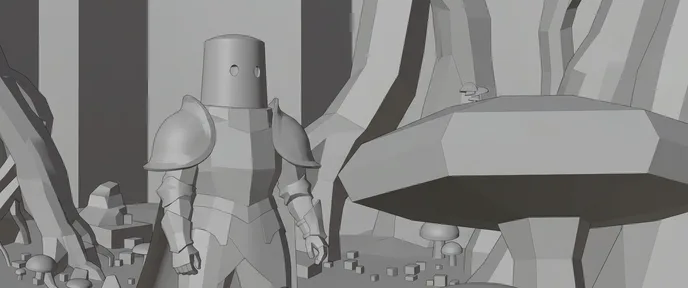
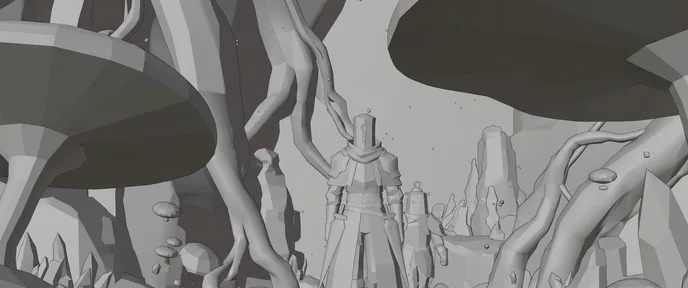
  1. A small knight with a lantern helm stands by a giant glowing blue mushroom in a crystal cavern
    Storyboard frame of the same wide shot, in grey
    01

    Wide · the world

    Wide shot, Lantern alone by a giant glowing blue mushroom, crystal cavern, roots, drifting spores, cold blue light

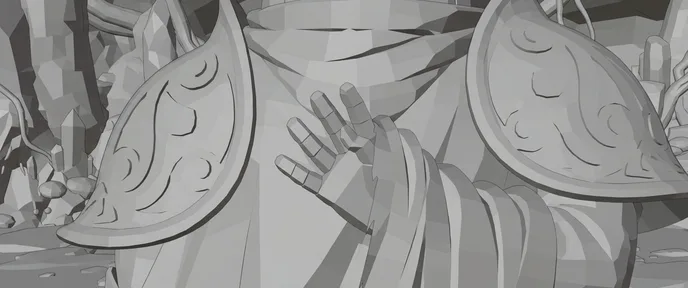
  2. Close-up of an armored chest under a cream cloak, a gloved hand, a spark of light
    Storyboard frame of the chest close-up, in grey
    02

    Close-up · the chest

    Close-up on Lantern's chest, his gloved hand pressed to the cloak, a spark of light escaping between the fingers

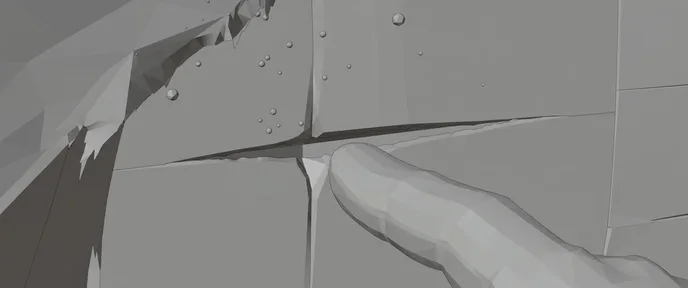
  3. A torn gash in an armor plate leaking bright blue light, a finger pointing at it
    Storyboard frame of the wound insert, in grey
    03

    Insert · the wound

    Extreme close-up, Serrure's finger near a torn gash in the back plate, blue light leaking out like luminous smoke

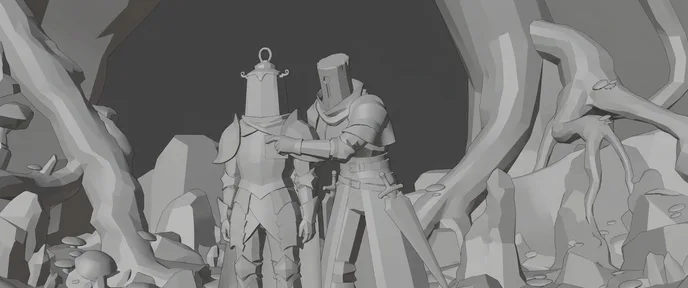
  4. Two armored knights side by side, one with a hand on the other's shoulder, in a crystal cavern
    Storyboard frame of the two-shot, in grey
    04

    Two-shot · the bond

    Medium two-shot among crystals and roots, Serrure's hand on Lantern's shoulder, faceless armors, emotion through posture only

  5. Two small knights walk beneath two giant glowing blue mushrooms
    Storyboard frame of the wide shot, in grey
    05

    Wide · the scale

    Wide low angle, the two knights tiny beneath two giant glowing mushrooms, blue crystals in the foreground, mist

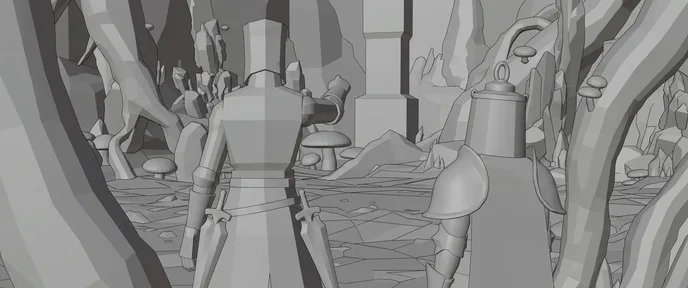
  6. Seen from behind, a tall dark knight points ahead while the small lantern knight looks on
    Storyboard frame of the over-the-shoulder shot, in grey
    06

    Over the shoulder · the road

    Over-the-shoulder from behind, Serrure points ahead into the cavern, Lantern beside him, roots framing the path

Lost Garden, episode 2 is a 21 minute animated series made with Seedance by the ScreenWeaver team. As a single episode under 30 minutes it would belong in Platform Animation. A film built from generated footage is exactly where OIAF asks for a visible human hand, and the screenplay, the storyboard and the edit are where that hand lives. Episode 1 reached the finals of the AI London Festival. Press play to open on the cave scene.

The script

An 8 minute animated short in four movements.

OIAF sets no minimum and suggests 30 minutes at most. Eight minutes holds about 8 screenplay pages and 70 to 110 shots of 4 to 7 seconds, and leaves room for inserts you make yourself.
  1. 0:00 to 0:40

    A signature image

    One frame that could only come from you: a drawn texture, a colour rule, a handmade object.

  2. 0:40 to 2:30

    The law of the world

    What the film is about and the one visual law it keeps. Put your hand-made layer here so it is seen early.

  3. 2:30 to 6:30

    Variations

    Play inside the law. Let one sequence run on rhythm and sound, with no dialogue.

  4. 6:30 to 8:00

    The landing

    Land the idea, not the plot. End on an image that answers the first one, then the credits.

In the credits, list who did what: drawn by, painted by, composed by, edited by, then the generated elements. That is how the human layer becomes visible to a selector.

Month by month

From now to the 2027 form.

Nothing is open today, which gives you time. The plan targets the likely 2027 window, and its core is simple: decide what is yours, then protect it all the way to the final cut.
  1. 01

    October 2026

    Name your human layer

    Read the AI answer and the category list in the FAQ. Pick a category and write one line on what you will make by hand. If you cannot name it, the project is not ready.

  2. 02

    November 2026

    Screenplay and designs

    Write the pages free in ScreenWeaver. Design characters and key props yourself, on paper or in your drawing software, and keep the originals.

  3. 03

    December 2026 to January 2027

    A storyboard in your own hand

    Generate the shot breakdown and storyboard from the screenplay, then redraw or paint over the frames that matter. Keep both versions, the generated one and yours.

  4. 04

    February to April 2027

    Make the film

    Produce scene by scene, with Seedance in ScreenWeaver as video generation reaches your plan. Mix it with what you made: painted backgrounds, hand-animated moments, your own voice or music.

  5. 05

    April 2027

    Edit, sound and subtitles

    Cut to the length your category suggests. Clear every music source. Add English subtitles if the dialogue is not English, since the screener needs them.

  6. 06

    From the call to the deadline

    Submit a finished film

    The 2026 form was open from 1 March to 2 June. If 2027 follows, send a finished film with a working link that stays live until the end of July.

Ways to be disqualified

Eight ways to lose before anyone judges.

OIAF lists its instant rejections in the FAQ. Some are about AI, some are about paperwork, and one is about Edgar Allan Poe. Check each before you send.
  • A fully AI-generated film

    Not eligible and disqualified. A film produced end to end from prompts, with nothing of your own on screen, is the case the rule is written for.

  • A hand nobody can see

    Making the human layer is not enough. It has to be visible in the file the selectors watch: in the design, the movement, the sound, the edit or the credits.

  • Two categories for one film

    You cannot submit the same film to more than one category. Duplicate entries of an episode are disqualified. Several different films, each with its own form, are fine.

  • More than one episode

    A series entry is a single, representative episode. The Young Audiences, Teen Audiences and Platform Animation categories also cap the episode at under 30 minutes.

  • The wrong production date

    A film produced before the cutoff date, or already submitted to an earlier edition of OIAF, is rejected immediately. Check the date of completion before you start the form.

  • Music and footage you do not own

    Found footage and collage are welcome, but every element must be licensed, music included. Generated music is no exception: check the terms of the tool.

  • Banned references

    The FAQ lists Edgar Allan Poe references of any kind, and three overused pieces of music: the Also sprach Zarathustra theme, The Blue Danube and the William Tell Overture. Unusual, but it is in writing.

  • A broken screener

    An incomplete form, or a missing or ineligible link, ends the entry. Non-English films need English subtitles on the screener. Passwords are fine, logins are not.

Why ScreenWeaver

Ottawa wants a hand. Start with the page.

ScreenWeaver is the AI production pipeline for films and series, built on a screenplay you write, a storyboard you control and footage tied to both. For OIAF, that order matters.
  • The screenplay is yours

    You write it in industry format, free. A film that begins on your pages has an author before it has a single generated frame.

  • Control, shot by shot

    Framing, angle, movement and duration are set by you in the storyboard and carried into the footage pipelines. Decisions you made are decisions you can show.

  • An honest limit

    Footage generated with Seedance in ScreenWeaver is generated footage, so it cannot be the whole film for OIAF. Use it where a hand cannot reach, and put your own work where the festival can see it.

  • Start for free today

    Writing on the Screenwriter plan costs $0 and has no end date. Storyboard Beta is $9.99 a month. Shot-by-shot video generation is part of the Filmmaker plan, now rolling out.

Real productions

International festival-recognized films have been written and produced with ScreenWeaver.

ScreenWeaver is already being used as a creative workspace for real AI film productions, from cinematic shorts to animated series pilots selected, nominated, and awarded by international festivals.

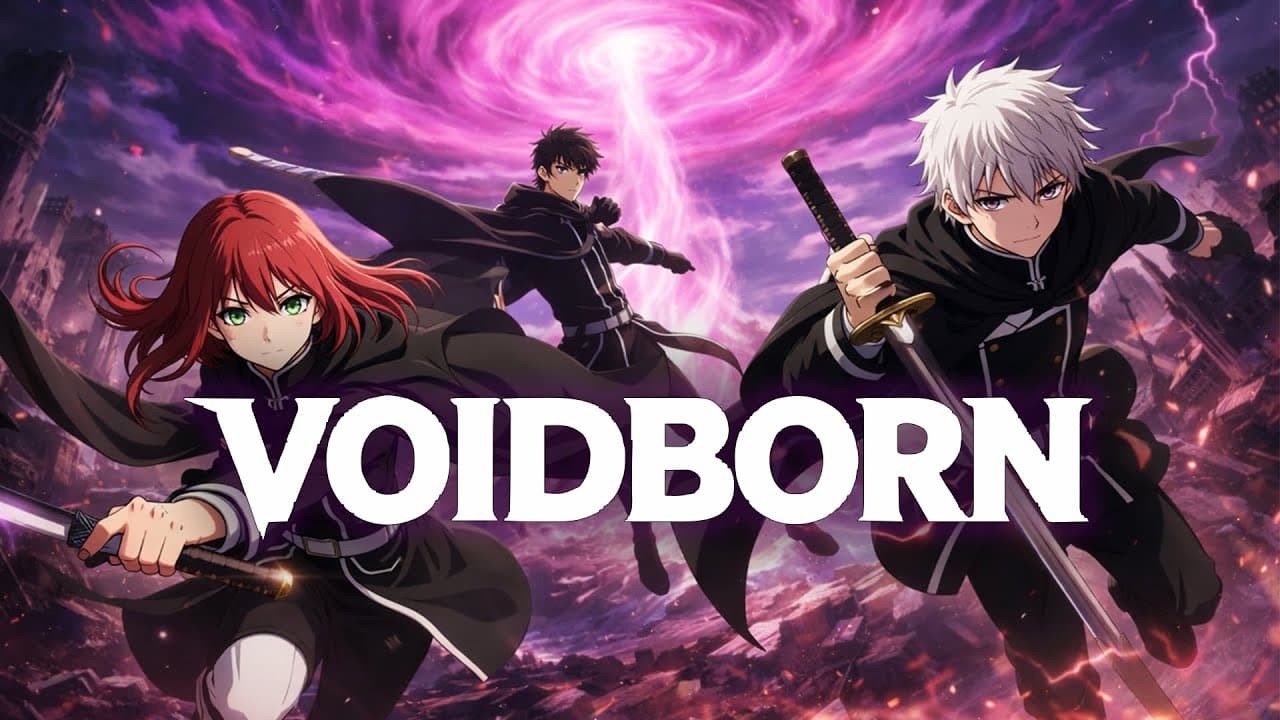
  • Video thumbnail for VOIDBORN

    VOIDBORN

    AI animated / cinematic short

    Festival recognition

    • 1st Place Silver

      Mondial Chroma Awards

    • 2nd Place Dreamina

      Mondial Chroma Awards

    • Award Winner

      Seoul International AI Film Festival

  • Video thumbnail for Les Fils du Vinnana

    Les Fils du Vinnana

    AI short film

    Festival recognition

    • Honorable Mention

      Top Quark Film Festival

    • People's Choice Nominee

      Illuminate Oneness of Humanity

    • Nominee

      ALTFF Supershort

  • Video thumbnail for Lost Garden

    Lost Garden

    AI animated series pilot

    Festival recognition

    • Finalist

      AI London Festival

The pipeline

Write. Board. Produce.

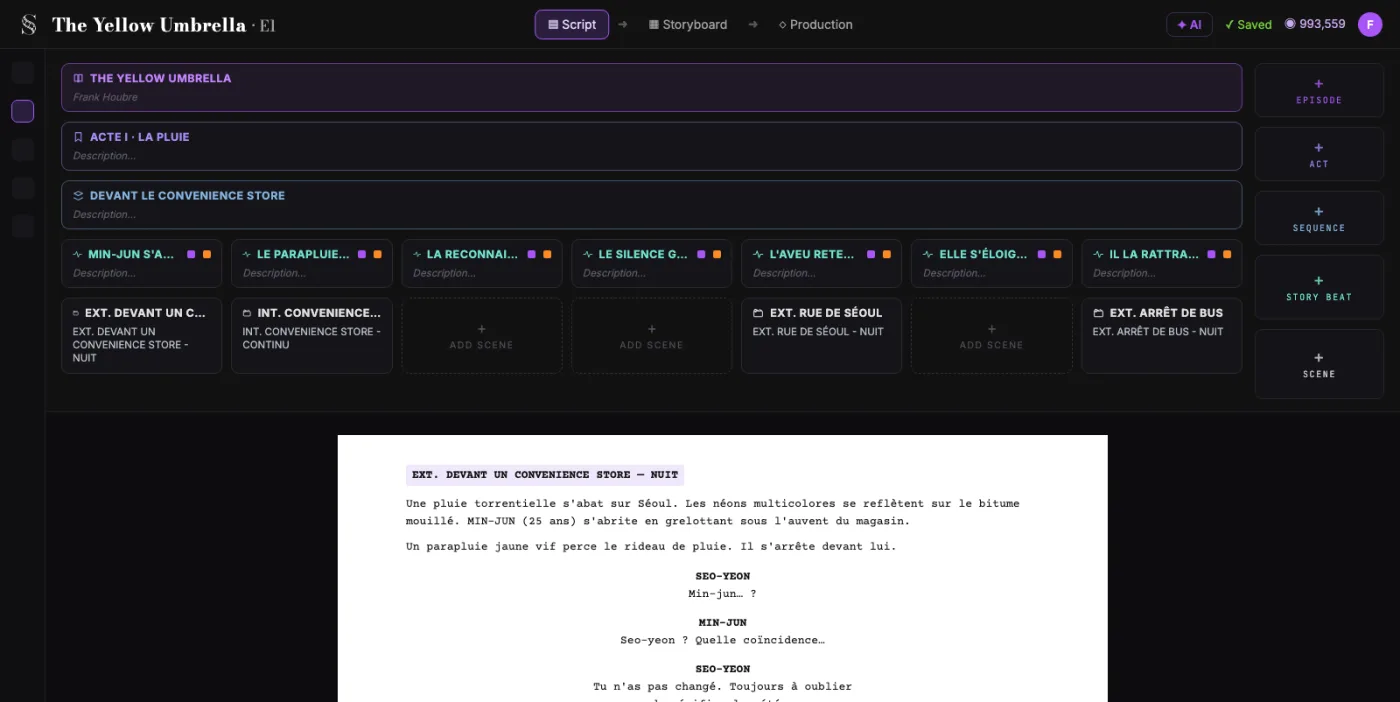
  1. ScreenWeaver screenplay editor: acts, sequences and beats above the formatted script of The Yellow Umbrella

    01The screenplay, enriched

    An industry-standard screenplay editor, and more: a visual outline and beat editor, your writing inspirations (notes, photos, audio) kept next to the page, and an AI researcher to support your writing, not replace it.

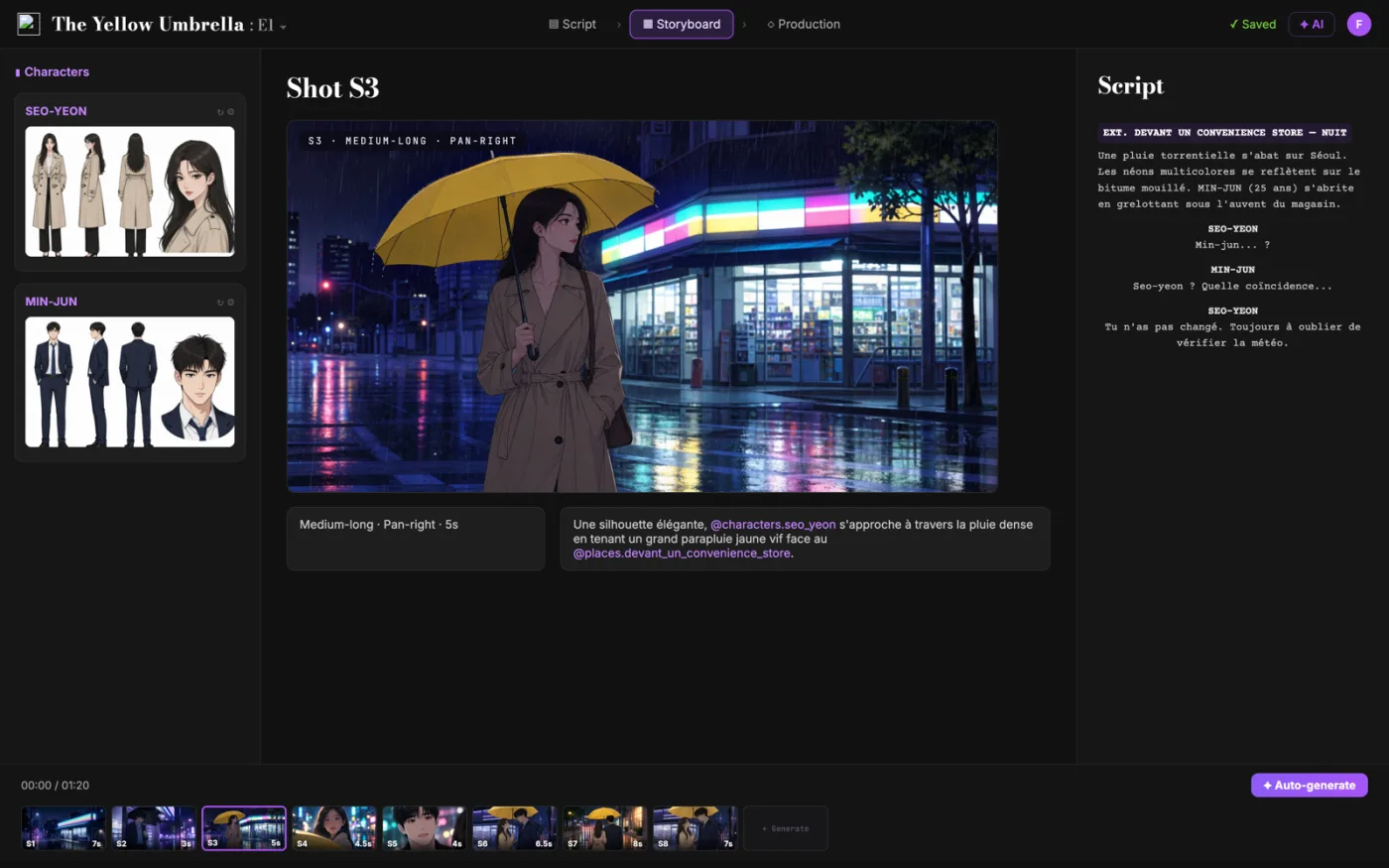
  2. ScreenWeaver storyboard: shot S3 of The Yellow Umbrella with characters, shot settings and the script beside it

    02The storyboard, made easy

    Shot breakdown generated from your screenplay, manual control over every shot (frame, angle, movement, duration), and generative AI previsualization in one click.

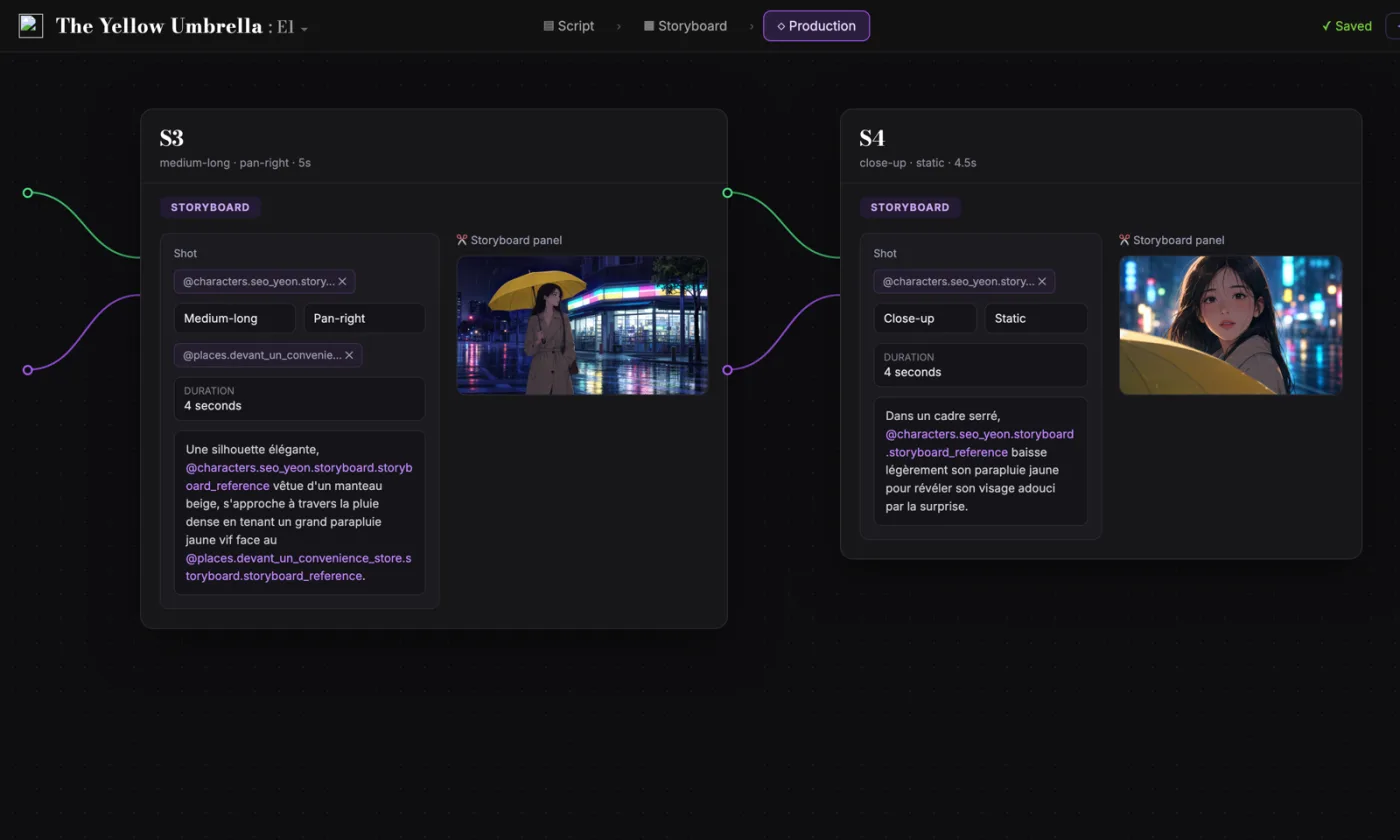
  3. ScreenWeaver production canvas: shots S3 and S4 as connected nodes carrying their storyboard panels and prompts

    03AI production, with finesse

    Footage generation pipelines connected to your screenplay and storyboard. Optimized out of the box, fully editable workflow.

FAQ

Ottawa Animation Festival and AI, your questions

Can you submit an AI film to the Ottawa International Animation Festival?
Only if it is AI-assisted. The FAQ says OIAF is not opposed to AI-assisted works, but fully AI-generated works are not eligible and will be disqualified. The film must show some level of non-algorithmic human involvement.
What counts as fully AI-generated?
OIAF gives no definition and no percentage. The test in the FAQ is whether the film shows some sign of the artist's hand. If you are unsure, write to selections@animationfestival.ca before you submit.
Does it cost anything to submit?
No, entry is free. If the film is selected, you supply an HD copy and cover any cost of getting it to the festival, and independent films are paid an artist fee.
When does the next call open?
Not announced. The 2026 call ran from 1 March to 2 June 2026, 11:59 PM Eastern. According to the 2026 FAQ, films completed after 31 May 2026 are eligible for the 2027 festival.
How long can the film be?
Shorts have no minimum and a suggested maximum of 30 minutes. Features in competition run over 40 minutes. A series entry is one episode, under 30 minutes.
Can I enter a film that is already on YouTube?
Yes. The FAQ says online release does not affect eligibility, and premiere status does not affect selection. The film still has to be completed after the cutoff date.
Can I submit a series?
Yes, as one representative episode. Shows for children or teens go to the Young Audiences or Teen Audiences categories, other series to Platform Animation. Several episodes are not accepted.
Will OIAF tell me why my film was refused?
No. The festival gives no feedback. Everyone receives the result by email by the end of July, selected or not.

Decide what is yours. Then make it.

Write the screenplay free today, and keep a hand-made layer in every stage of the film.