Curious Refuge AI Film Competitions · Guide

How to win a Curious Refuge AI film competition.Horror closes 9 October. Three minutes. $7,000 for first.

The Horror rules as the page states them, how five judges score, what the Feel Good, Sketch Comedy and Animation seasons ask for, and an eight-day plan to 9 October 2026. Write and storyboard in ScreenWeaver, then generate with the video tool you already use.
  • Horror deadline 9 October 2026
  • AI in every shot
  • All audio from Epidemic Sound
Lost Garden · Episode 1

Independent guide. ScreenWeaver does not organise the Curious Refuge competitions and is not affiliated with Curious Refuge or Epidemic Sound. Rules read on 1 October 2026. Official rules

Available today in ScreenWeaver: free screenwriting, plus a storyboard built from your screenplay with Storyboard Beta at $9.99 a month. Both fit in the eight days you have.

Rolling out: video generation of each shot, powered by Seedance, with the Filmmaker plan. Curious Refuge imposes no video tool, but for 9 October you will generate with a tool you already use.

Horror rules on one card

What the open competition asks for.

Curious Refuge is a school for AI filmmakers, and it runs these competitions with Epidemic Sound. The Horror contest is the one open today. It sets no video model, but it does set the sound library.
Prizes
$12,000: $7,000, $3,000, $2,000
Deadline
9 October 2026, 11:59 PM Pacific
Length
3 minutes maximum, up to 2 films
AI rule
AI in every shot, most pixels AI-generated
Sound
Epidemic Sound only, music and effects
Content
Original idea, PG-13, no third-party IP
Required
End card for 3 seconds, public social post
Results
Public vote 21 to 28 Oct, winners 29 Oct

Source: the 2026 AI Horror Film Competition page and its rules page on curiousrefuge.com, read on 1 October 2026. Neither page states an entry fee. The other seasons below come from their own pages on the same site.

Key dates

Eight days to submit, four weeks to the results.

All times are Pacific. The submission form closes at the deadline, and the rules say entries by email are not accepted.
  1. 9 Oct 2026

    Submission deadline

    11:59 PM Pacific, through the official form. Do not wait for the last hour.

  2. 21 Oct, 11 AM

    Audience voting opens

    The community votes for the Audience Favorite, a separate prize from the podium.

  3. 28 Oct, 11 AM

    Audience voting closes

    A week of community voting. The rules already require a public post of your film, so share that link.

  4. 29 Oct 2026

    Winners announced

    First, second, third and the Audience Favorite are announced.

How films are judged

Five lenses, no published weights.

Five judges score the films on creativity, adherence to the AI usage requirements, story, attention to detail and overall impact. Each judge names a 1st, 2nd and 3rd, worth 5, 3 and 1 points, and the totals decide the podium.
  • Creativity

    A scare nobody has staged this way. In three minutes you cannot afford a familiar monster in a familiar corridor. Pick one fear from ordinary life and one unusual place to put it in.

  • Adherence to the AI rules

    AI in every shot, mostly generated pixels, Epidemic Sound for all audio, publicly available tools. The rules check is part of the score, and Curious Refuge may ask for proof of AI generation, so keep your project files.

  • Story

    One character, one threat, one turn. Horror needs rules the viewer understands in ten seconds, so the break of the rule can hurt. Dread is cheaper to generate than gore, and it keeps you inside PG-13.

  • Attention to detail

    Hands, props, signs, a face that drifts between two shots, a sound that does not match the picture, a missing end card. This is where a hurried sprint loses points. Watch the film at full speed on a phone before you submit.

  • Overall impact

    What is left after the end card: one image, one sound, one question. The sum of the four lenses above, felt rather than counted.

The audience decides a separate prize. The Audience Favorite is chosen by public vote, and in the three contests whose results we could read it never went to a podium film.

Who decides

Five judges, then the crowd.

The Horror page names five judges and gives no biography for them. What it does tell you is how their scores add up.
  • Five podiums, added together

    Each judge builds a personal 1-2-3. A film that three judges rank second earns 9 points, more than a film one judge puts first and the others skip. Make the film every judge can respect, not the one that splits the room.

  • Shelby Ward

    A co-founder of Curious Refuge, listed on the Horror panel and on the 2026 Feel Good panel. She has seen a great many AI films this year, so your edge is the idea and the finish, not the tool.

  • Dave Clark

    Named on the Horror panel. The Animation page lists him as chief creative officer of Promise Studios. A producer reading a three-minute film asks what the series would be: leave a door open.

  • The rest of the panel, then the community

    Verena Puhm, Spooky Dan and Chris White complete the Horror panel. After the judges, the community votes from 21 to 28 October for the Audience Favorite, who wins a free course and a t-shirt.

The seasons

One school, five seasons.

Curious Refuge runs themed competitions through the year with the same bones: AI in every shot, original ideas, a required end card. Horror is open now. Under each season, what its page says and the angle we would take.
  • 01

    Horror (open until 9 October)

    Horror or Halloween-themed films, up to 3 minutes, Epidemic Sound for all audio. $12,000 in prizes: $7,000, $3,000 and $2,000.

    PG-13 is the ceiling. One place, one character, one thing that is wrong, and a sound mix that does the frightening. A small cast also means fewer faces to keep consistent.

  • 02

    Feel Good (closed)

    Deadline 10 March, voting 23 to 30 March, winners 9 April 2026. 3 minutes, Epidemic Sound. $10,000: $5,000, $3,000 and $2,000.

    The opposite register with the same craft: warmth takes as many shots as fear. A good rehearsal for the next edition. Its panel included Souki Mansoor of OpenAI and the director Rob Minkoff, so these contests draw real industry names.

  • 03

    Sketch Comedy

    30 to 90 seconds, Epidemic Sound for all audio. $9,000: $6,000, $2,000 and $1,000. The last edition closed on 8 August.

    The shortest format: one premise, one escalation, one button. Video models struggle with comic timing, so write the punchline as an image and cut on it.

  • 04

    Animation

    Up to 5 minutes, an animation aesthetic (anime, stop-motion, 2D, experimental), run with Promise Studios. $13,000: $10,000, $2,000 and $1,000. Royalty-free music is allowed.

    The one season where the sound rule relaxes. Anime and 2D reward a held style, and a held style hides the seams between generations. Fix the palette first.

  • 05

    Holiday

    Holiday editions were run in 2023 with Epidemic Sound and listed again in 2024. No 2026 Holiday contest was listed as open or upcoming on 1 October 2026.

    Treat Horror as the rehearsal: the same three-minute build, the same Epidemic Sound workflow, a different mood. Check the contests page for the announcement.

Past podiums

What the results say.

The previous Horror edition went to The Missing Segment by Sam Lavy, then Morphe by The Garra Sisters and Clinical Calm by Dorothy Pang. The Audience Favorite was Jokhini by Raj Rishi. We read the results, not the scripts, so the lessons below are about how the prizes work.

  1. 01

    The crowd and the panel disagree. In that Horror edition, in the 2026 Feel Good edition (The Birdwatcher, against a podium of In Another Breath, A Little Water Bear and Spring) and in the Animation edition (THE SLIP), the Audience Favorite was never one of the three podium films.

  2. 02

    First place pays far more. In Horror it is $7,000 against $5,000 for second and third together, and in Animation $10,000 against $3,000. Feel Good is the exception, with $5,000 for first and $5,000 for the next two.

  3. 03

    The audience prize is not cash. The Audience Favorite gets a free course and a t-shirt in Horror and Sketch Comedy, and no cash in Feel Good. Put your effort into the panel, whose scoring you can read.

Page, board and frame

Lost Garden: how to stage a reveal.

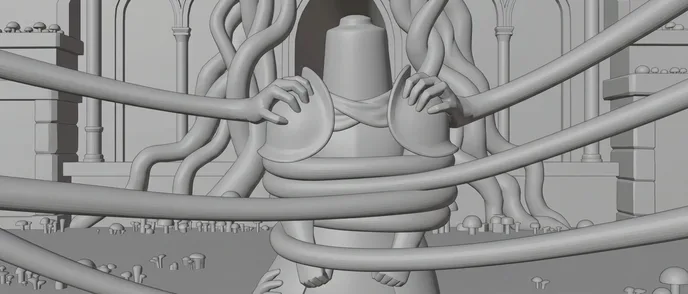
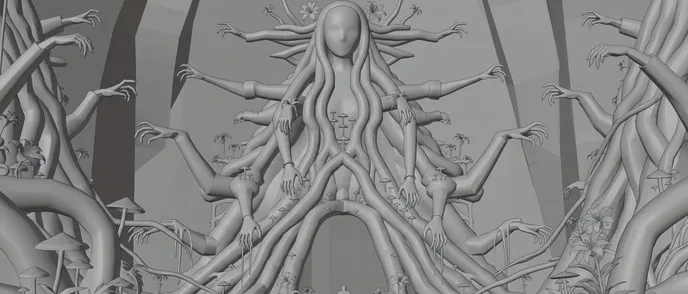
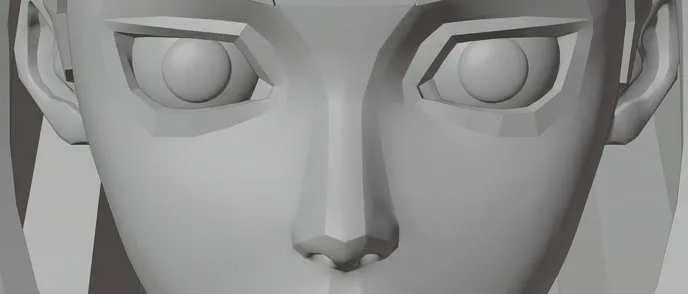
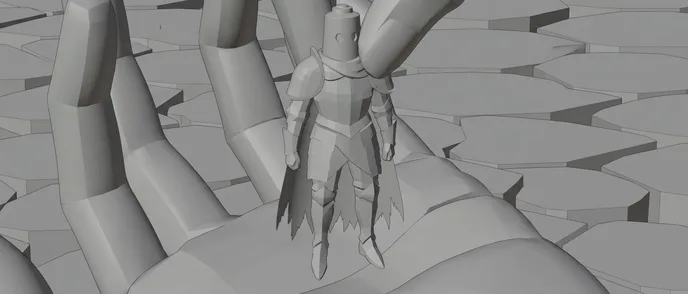
A scene from Lost Garden, episode 1, an animated fantasy series by the ScreenWeaver team. A trapped hero, a giant who stops the roots, eyes that open. It is not horror, but it shows what a three-minute scare needs: one place, one presence, one reveal on a face. Screenplay page first, then each shot as a grey storyboard frame beside its final image.

Logline. A small knight wakes up in a dead world and learns he is the last guardian of a seed that could bring the garden back.

Screenplay · episode 1 · the Source Tree

INT. HEART OF THE ROOTS - NIGHT

Living roots coil around LANTERN and pin him down. A voice stops them.

THE SOURCE TREE

Stop. He is my guest.

A giant woman of roots and white lilies opens her arms over the cavern.

Her eyes open. Blue, and vast.

THE SOURCE TREE

Welcome to you, Lantern Knight.

She lifts him in her palm, like a lamp.

THE SOURCE TREE

Do not be afraid. I will not harm you.

In the dark, a seed of light opens. Inside the flower, a sleeping child.

THE SOURCE TREE

You must find yours. Protect her.

CUT TO:

  1. A small lantern-helmed knight bound by thick roots in a ruined hall
    Storyboard frame of the trap shot, in grey
    01

    Medium · the trap

    Medium shot, Lantern bound by thick living roots in a ruined hall, glowing blue mushrooms on the floor, cold light

  2. A giant woman made of roots and white lilies spreads her many arms in a dark cavern
    Storyboard frame of the wide shot, in grey
    02

    Wide · the Source Tree

    Symmetrical wide shot, a giant woman made of roots, arms spread with many hands, white lilies, blue glyphs

  3. Extreme close-up of a giant pale face with piercing blue eyes
    Storyboard frame of the eyes close-up, in grey
    03

    Extreme close-up · the eyes

    Extreme close-up on the giant's face, piercing blue eyes opening, pale skin, soft light from below

  4. A tiny armored knight stands in the middle of a giant open hand
    Storyboard frame of the palm shot, in grey
    04

    High angle · the palm

    High angle, the tiny knight standing in the center of a giant open palm, stone floor far below

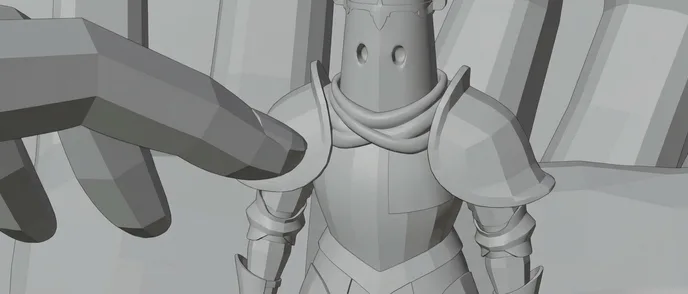
  5. A giant fingertip gently touches the chest of a small armored knight
    Storyboard frame of the touch close-up, in grey
    05

    Close-up · the touch

    Close-up, a giant fingertip gently touches the knight's armored chest, faceless helm, emotion through posture

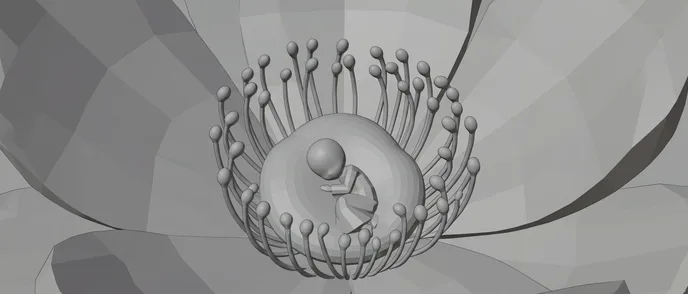
  6. A sleeping pink-haired child curled inside a glowing blue flower
    Storyboard frame of the seed insert, in grey
    06

    Insert · the seed

    Top-down insert, a glowing pale blue flower opening, a sleeping child with pink hair curled inside

Lost Garden, episode 1, 17 minutes, a finalist at the AI London Festival. A horror cut would keep this skeleton in under three minutes. The sound of this film is not Epidemic Sound and it is not a Curious Refuge entry: your own audio must come from that library. The player starts on this scene.

The script

A 3 minute horror film in five movements.

Cut to 2:50. The end card must stay on screen at least 3 seconds, and the page does not say whether it counts in the limit. That is about 3 screenplay pages and 35 shots of 3 to 6 seconds, in one or two locations.
  1. 0:00 to 0:10

    The cold open

    One image that is wrong. Do not explain it.

  2. 0:10 to 0:35

    The ordinary

    Who we follow, in a place they know. Show the rule of the space so you can break it later.

  3. 0:35 to 1:40

    The approach

    The threat gets closer in small steps. Keep the location and the light, and let the sound grow.

  4. 1:40 to 2:25

    The reveal

    Show enough, never more. A face, a shape, an open door. The reveal is one or two shots.

  5. 2:25 to 2:50

    The aftershock

    A last image that changes what we just saw. Then the end card.

Video tools drift toward gore on their own, and PG-13 is the ceiling. Write the scare as a sound and a shadow, then check every shot for anything harder.

Day by day

Eight days from idea to the form.

Today is 1 October and the deadline is 9 October at 11:59 PM Pacific. That is a sprint, so everything stays small: one location, one character, one scare. If the film is not ready, aim at the next season rather than sending a rushed cut.
  1. 01

    1 Oct

    Choose the scare

    Pick one fear and one place: a stairwell, a basement, a parked car. Write the logline in one sentence and count the shots now, about 35.

  2. 02

    2 to 3 Oct

    Write three pages

    One character, almost no dialogue. Write it free in ScreenWeaver, in industry format, and read it aloud with a timer.

  3. 03

    3 to 4 Oct

    Storyboard and references

    Build the shot breakdown and the storyboard from the screenplay. Approve one reference for the character and one for the place. Only publicly available tools are allowed, so choose a model anyone can use today.

  4. 04

    4 to 7 Oct

    Generate every shot

    Shot by shot, the reveal first. AI must appear in every shot, so a live-action plate needs a generated world around it. Keep each prompt, in case you are asked for proof.

  5. 05

    7 to 8 Oct

    Sound from Epidemic Sound

    Start the free 30-day trial now, or use the code on the rules page if you already had one. Every music cue and sound effect comes from that library. Voices can be recorded, modified or generated, but never imitate an existing actor.

  6. 06

    8 to 9 Oct

    End card, post, submit

    Add the end card for at least 3 seconds, post the film publicly with #CuriousRefuge and #EpidemicSound, and send it through the official form. Submit before noon Pacific on the 9th.

Disqualification traps

Eight ways to lose before the judges.

Curious Refuge says it is lenient about technicalities, but it also says it can disqualify for fairness concerns. Do not test that.
  • Music from anywhere else

    All music and sound effects must come from Epidemic Sound. A track from an AI music tool or another library breaks the rule, however good it sounds.

  • A shot without AI

    AI must be used in every shot. Live footage keyed over an AI background can pass, because the world around the footage must be generated. A plain live shot cannot.

  • An old film in a new skin

    Films made earlier and reskinned with AI are disqualified. Make the film for this competition.

  • Likenesses and voices

    No existing actor, no famous living person and no character owned by someone else, and no voice that imitates an actor, without consent. Invent your cast.

  • Borrowed intellectual property

    The idea must be original and unconnected to third-party IP. No sequel to a known film, no studio-owned monster, no famous franchise.

  • Beyond PG-13

    Films should hold a PG-13 rating. Gore is the easiest way to lose it with a horror prompt, so check every generated shot.

  • Tools and channels

    Only publicly available tools, no private betas. Up to 2 films, each 3 minutes at most. Submit through the form, because entries sent by email are not accepted.

  • The end card and the post

    The required end card must show for at least 3 seconds, and the film must be shared on social media with #CuriousRefuge and #EpidemicSound, tagging both companies. You also grant them rights to use it in compilations and marketing.

Why ScreenWeaver

A competition with no imposed video tool.

In ScreenWeaver, screenplay, storyboard and footage sit in one connected project, built for films and series. Curious Refuge cares about the result, not the model, so the planning side is where you gain days.
  • Tool-agnostic, sound aside

    The rules require AI in every shot and the Epidemic Sound library, not one video model. Footage from ScreenWeaver, powered by Seedance, would fit the rules once it ships, with the audio taken from Epidemic Sound.

  • Use the free part today

    With eight days left, write and storyboard in ScreenWeaver now and generate with the tool you already use. The storyboard gives you the shot list that keeps a three-minute film from sprawling.

  • Thirty-five shots, one face

    Characters, locations and references carry from shot to shot in a ScreenWeaver project. That is what protects the judges’ attention-to-detail lens, where a drifting face costs points.

  • Start for free today

    Screenwriter is free for good: $0, no expiry. Storyboard Beta adds the storyboard for $9.99 a month. Video generation comes with the Filmmaker plan, now rolling out, which suits the next season.

Real productions

International festival-recognized films have been written and produced with ScreenWeaver.

ScreenWeaver is already being used as a creative workspace for real AI film productions, from cinematic shorts to animated series pilots selected, nominated, and awarded by international festivals.

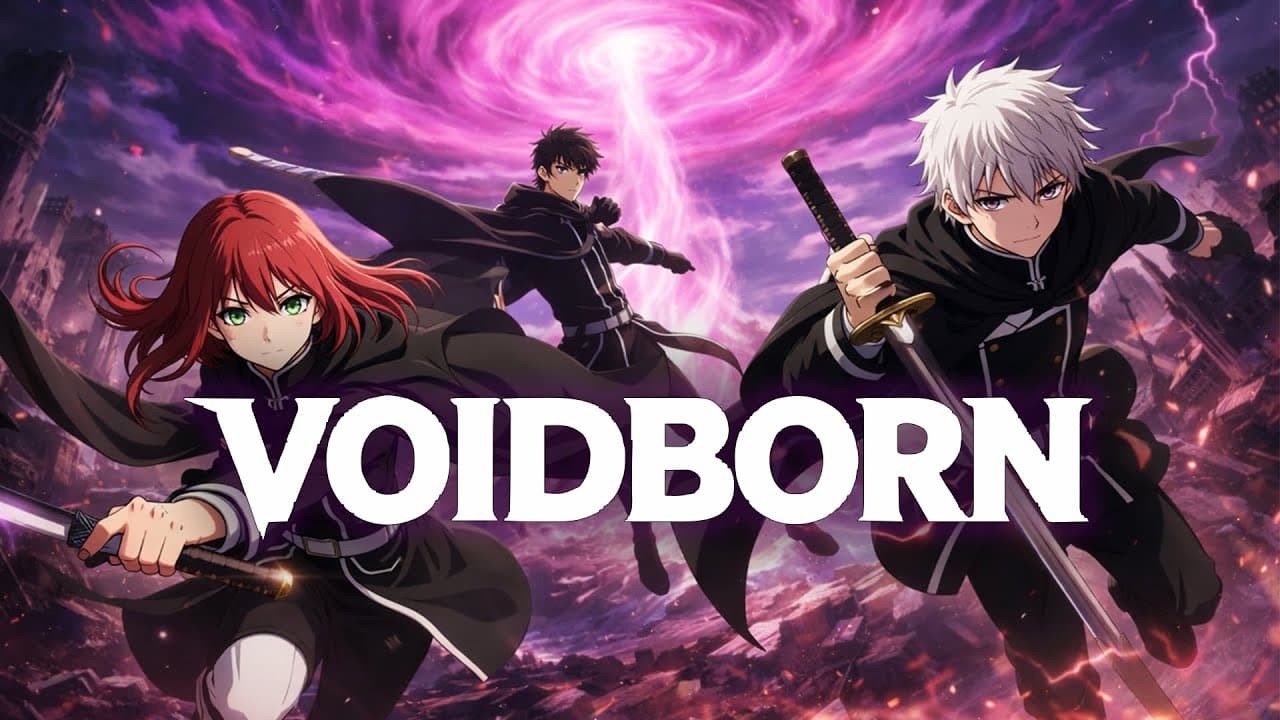
  • Video thumbnail for VOIDBORN

    VOIDBORN

    AI animated / cinematic short

    Festival recognition

    • 1st Place Silver

      Mondial Chroma Awards

    • 2nd Place Dreamina

      Mondial Chroma Awards

    • Award Winner

      Seoul International AI Film Festival

  • Video thumbnail for Les Fils du Vinnana

    Les Fils du Vinnana

    AI short film

    Festival recognition

    • Honorable Mention

      Top Quark Film Festival

    • People's Choice Nominee

      Illuminate Oneness of Humanity

    • Nominee

      ALTFF Supershort

  • Video thumbnail for Lost Garden

    Lost Garden

    AI animated series pilot

    Festival recognition

    • Finalist

      AI London Festival

The pipeline

Write. Board. Produce.

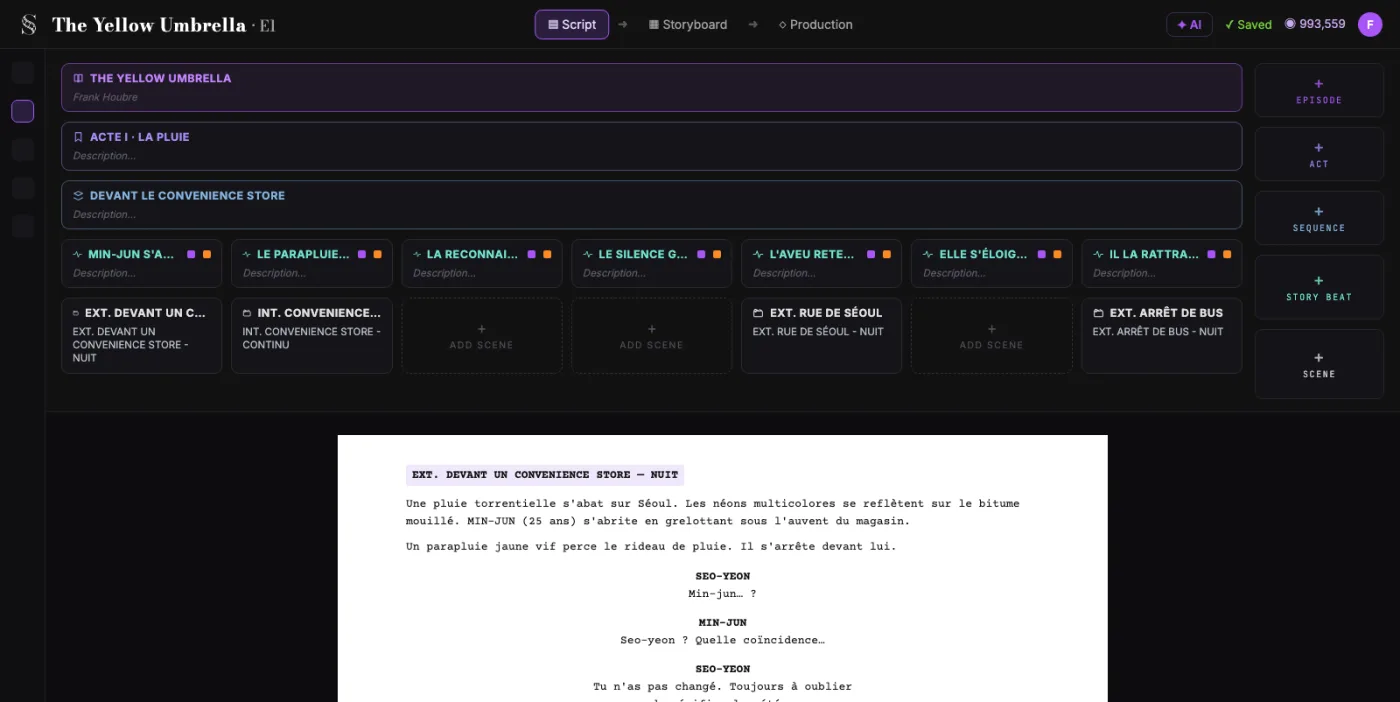
  1. ScreenWeaver screenplay editor: acts, sequences and beats above the formatted script of The Yellow Umbrella

    01The screenplay, enriched

    An industry-standard screenplay editor, and more: a visual outline and beat editor, your writing inspirations (notes, photos, audio) kept next to the page, and an AI researcher to support your writing, not replace it.

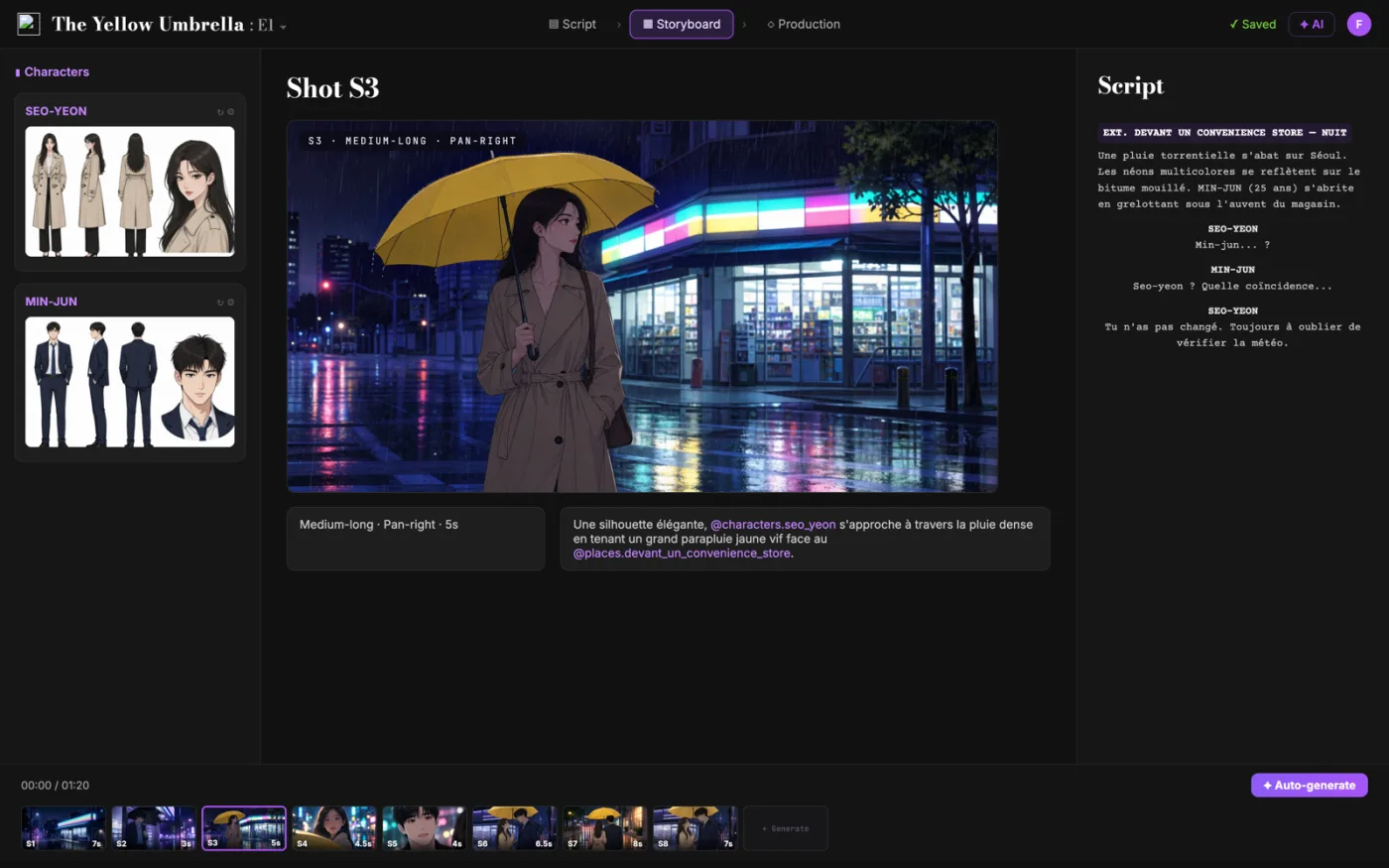
  2. ScreenWeaver storyboard: shot S3 of The Yellow Umbrella with characters, shot settings and the script beside it

    02The storyboard, made easy

    Shot breakdown generated from your screenplay, manual control over every shot (frame, angle, movement, duration), and generative AI previsualization in one click.

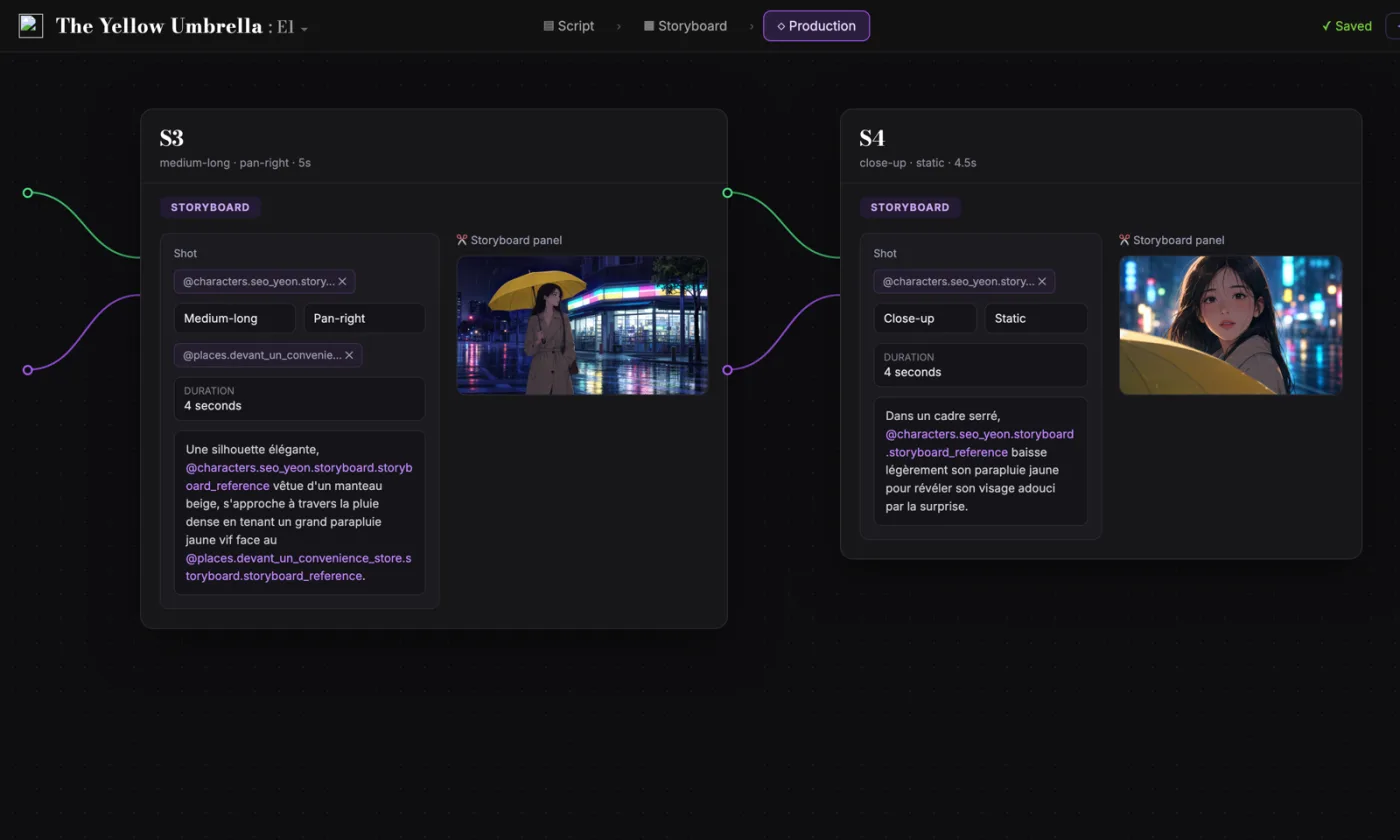
  3. ScreenWeaver production canvas: shots S3 and S4 as connected nodes carrying their storyboard panels and prompts

    03AI production, with finesse

    Footage generation pipelines connected to your screenplay and storyboard. Optimized out of the box, fully editable workflow.

FAQ

The Curious Refuge competitions, your questions

How do you win the Curious Refuge AI Horror Film Competition?
Five judges each name a 1st, 2nd and 3rd, worth 5, 3 and 1 points, judging creativity, adherence to the AI requirements, story, attention to detail and overall impact. First place is $7,000. Follow every technical rule, then put your effort into one clean scare.
Which video tool must I use?
None. The page requires AI in every shot, mostly AI-generated pixels and publicly available tools. The one imposed supplier is Epidemic Sound, for all music and sound effects.
Do I have to use Epidemic Sound?
In Horror, Feel Good and Sketch Comedy, yes: all music and sound effects must come from it, and the page offers a 30-day free trial. The Animation page allows royalty-free music instead.
Does the end card count toward the 3 minutes?
The page does not say. Finish at about 2:50 and the question disappears.
What about the Holiday competition?
No 2026 Holiday contest was listed as open or upcoming on 1 October 2026. Earlier Holiday editions ran in 2023 and 2024. Watch the contests page, and keep your Horror build as the template.
Is there an entry fee?
The pages we read state none. The only cost they mention is the Epidemic Sound subscription, with a 30-day free trial and a code for one more free month if you used the trial before.
Who owns the film?
The rules page gives Curious Refuge and Epidemic Sound the right to use submissions as marketing material and in compilation videos. It does not say more about ownership, so read the full rules before you submit.
How many films can I submit?
Up to 2 original horror or Halloween-themed films, each no longer than 3 minutes. Both must follow every rule.

Eight days. Make the scare small.

Start the screenplay today at no cost. Storyboard it, then generate with the tool you already use.