DISRUPT AI Film Festival 2026 · Guide

How to win the DISRUPT AI Film Festival.Humans and Their Tools. Australia only.

DISRUPT, by TBWA Australia, is free to enter and open only to people based in Australia. The final deadline is 16 October 2026. Here are the rules, the theme, the judging and a plan for the 15 days left.
  • Australian residents only
  • Free entry, AU$10,000 in prizes
  • Deadline 16 October 2026
Voidborn · Episode 0

Independent guide. ScreenWeaver does not organise DISRUPT and is not affiliated with TBWA Australia. Rules read on 1 October 2026. Official site

Available today in ScreenWeaver: free screenwriting, and a storyboard generated from your screenplay with Storyboard Beta, $9.99 a month.

Rolling out: video generation of each shot, powered by Seedance, with the Filmmaker plan.

The rules on one card

What DISRUPT asks for.

DISRUPT calls itself Australia’s first GenAI film festival. This is its second edition. If you do not live in Australia you cannot enter, so check that before you read further. Everyone else can still use the guide below as a model for other festivals.
Who can enter
Australian residents aged 16 or over
Final deadline
16 October 2026, 11:59 PM AEST
Entry fee
Free
Awards
Short, Long, Student and Grand Prix
Running time
Under 3 minutes, or 3 to 15
Prizes
AU$10,000: AU$2,500 per award
2026 theme
Humans and Their Tools
Awards night
18 November 2026, Melbourne, by invitation

Source: the festival site (home, about, FAQ and terms and conditions) and its previous winners page, read on 1 October 2026. The pages disagree on two points: the home page says a film must not be screened in Victoria before 29 October 2026, while the terms say before 18 November 2026 across Australia, and the site mentions Vimeo, YouTube or direct upload while the terms name FilmFreeway and an MP4. Follow the terms and ask daiff-au@tbwa.com.

What the rules say about AI

Human in the loop, in four clauses.

The festival is a celebration of human storytellers who use GenAI, and its rules read that way. Your film is judged on your thinking as much as your tools.
  • GenAI at the core

    The core creative elements of the film must be developed with GenAI tools, in any mix you choose. No tool is preferred. Conventional editing software is allowed to assemble the final cut.

  • Your process, written down

    The entry asks which tools you used, a few example prompts and your role as the human in the loop. It does not need to be technical. Winners may be asked to share what went wrong and what they discovered.

  • Clean of third parties

    No image, video or voice of a real person without that person’s consent, and no third-party brand shown in a way that suggests endorsement. Music must be royalty-free, original, or AI-generated with the rights secured.

  • Honest about ethics

    Entrants must be transparent about any ethical concern in their use of AI, bias and representation included. Few festivals ask this in writing. Prepare two honest sentences about it.

Key dates

Fifteen days left to enter.

The window opened in June. Judging happens after the close, and the winners meet in Melbourne.
  1. 15 Jun 2026

    Submissions opened

    From 9:00 AM AEST. Entry stays free for the whole period.

  2. 16 Oct 2026

    Submissions close

    At 11:59 PM AEST. Final cuts only: works in progress are refused.

  3. After judging

    Winners contacted

    By email, within two weeks of judging. Prizes are paid by electronic transfer.

  4. 18 Nov 2026

    Melbourne gala

    Finalists and winners are screened. A Sydney screening follows. Attendance is by invitation.

How films are judged

Four criteria, no weights.

The terms list originality, creativity, technical execution and alignment with the theme. The FAQ adds human input, emotional impact and craft. The about page says the judges want the power of an original story, not the novelty of GenAI.
  • Originality

    A story only you would tell. Tools that everyone shares make every film look alike, so the idea has to carry the difference. Avoid the obvious robot reading of the theme.

  • Creativity with AI and human input

    Where did you decide, and where did the tool? Show the decisions: the screenplay, the choice of framing, the selected takes. The entry form asks for exactly this.

  • Technical execution

    Craft, in the FAQ’s word. Steady characters, clean motion, readable sound, a final cut with no leftover glitches. In under three minutes, there is nowhere to hide one.

  • Alignment with the theme

    Humans and Their Tools is wide on purpose. It starts from a bone lifted as a hammer, a brush, a camera and a prompt: all tools. The film must be about a person and a tool, not only made with one.

The terms say the judges’ decisions are final, and that a panel of qualified judges scores each entry on its merits. The judges’ names are not published.

Who decides

A panel, a brief and an agency.

No jury names are published. The site and the terms still tell you what the people who decide care about.
  • A panel of qualified judges

    Each entry is judged individually on its merits, and the final counting and decision take place in Melbourne. With names unknown, write for a mixed room: creative, technical and business viewers.

  • A human-first brief

    The founders say the tool matters less than the skill of whoever wields it. The about page says judges reward original storytelling over GenAI capability. A film that merely shows what the tool can do is off brief.

  • TBWA Australia, the promoter

    The festival is an initiative of an advertising agency and sits inside its Disruption philosophy. Expect an eye for a strong idea, clearly told, that works at short length. The agency published a report on the first edition.

The four awards

Choose the award, then the story.

One theme, four prizes of AU$2,500. The award you enter decides the length and the kind of idea. Each card ends with our angle.
  • 01

    Best Short Film

    Under 3 minutes.

    One idea, one human decision. Start on a hand and a tool, the image the theme itself opens with, and let the film turn on who is really using whom.

  • 02

    Best Long Film

    3 to 15 minutes.

    Room for a small arc. Keep a human at the centre, and use the extra minutes for a change in the relationship between a person and their tool, not for more spectacle.

  • 03

    Best Student Film

    Under 3 minutes, from a student currently enrolled at a school or university.

    You need proof of current enrolment. A student film wins when it sounds like a voice from a particular life: a classroom tool, a family craft, a first prompt.

  • 04

    Grand Prix

    One winner across all entries.

    The home page says every entry is considered. The terms say the three category winners enter automatically. Either way, win your category first: it is the one path both texts agree on.

The 2025 winners

What the first edition shows.

The first edition named four winners: Black Box by Pete Majarich (Grand Prix), Erase by Ashanth Phillips (Long Film), Lens Wide Open by Bruce Hunt (Short Film) and Unhold by Apoorva Tandon (Student Film). We have not watched them and do not describe them. The page still holds three useful signals.

  1. 01

    Half the prize money is for films under 3 minutes. The Short and Student awards share that limit. A tight idea has two shots at a prize.

  2. 02

    The festival published a report on the first year. It records the work and the patterns TBWA saw in Australian GenAI craft. Read it before you write.

  3. 03

    The agency’s own framing is human judgment, taste and intent. Anyone can make now, it says, and creativity still depends on people. Put those three words at the centre of your statement.

A scene about machines

Voidborn: the automatons in six shots.

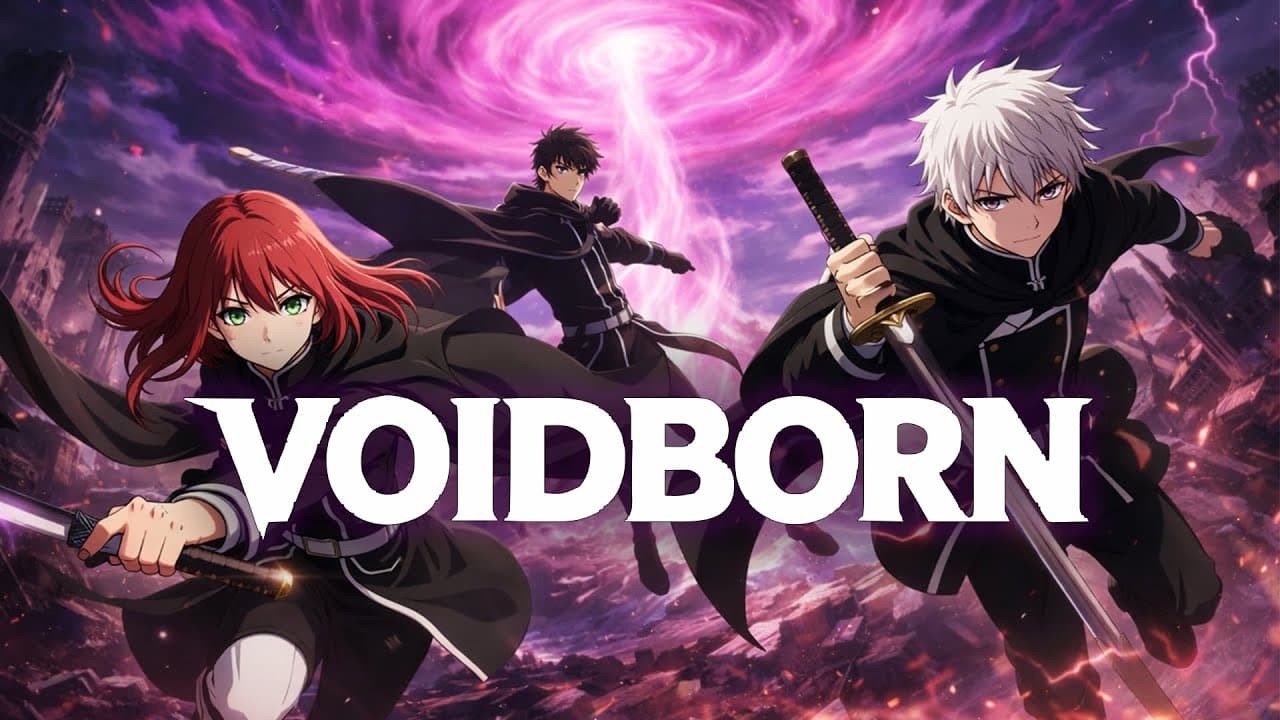
A swordsman and a blindfolded seer meet a line of white automatons, in Voidborn, episode 0, an anime by the ScreenWeaver team made with Seedance. Machines that were built to serve step forward and speak: a fair cousin of Humans and Their Tools. Read the screenplay page, then follow each shot from storyboard frame to final image.

Logline. Every seven years, the Rift opens and swallows the world’s dreams. A swordsman sworn to a blind seer escorts her through its levels, toward a promise they made to a girl left behind.

Screenplay · episode 0 · English subtitles

EXT. RUINS OF THE FIRST LEVEL - NIGHT

Broken towers under a violet sky. SIM, a swordsman in a black cloak, walks beside LADY MARIA, blindfolded, all in white.

SIM

Tell me, Maria... do you think Leia believes we are still alive?

MARIA

We made a promise... the two of us.

A line of white automatons rises from the ruins.

AUTOMATON

The Rift will wait for no one.

SIM

What are machines doing at this level?

One automaton steps forward. Its face is blank.

AUTOMATON

We must return to the surface.

Its eyes ignite red.

SIM

I am Sim, guardian of Lady Maria... and I will proceed with your execution.

Steel meets steel. Lightning runs down the blade.

CUT TO:

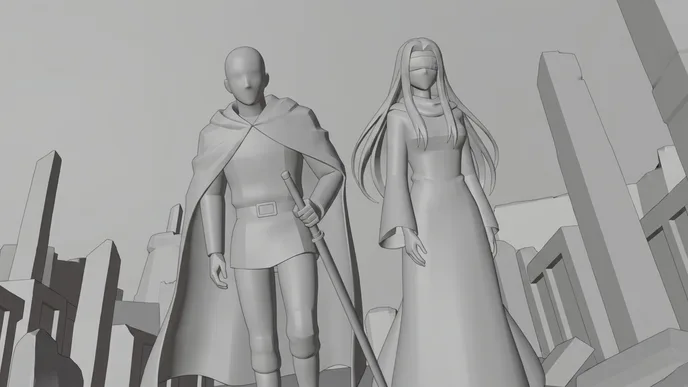
  1. A swordsman in a black cloak and a blindfolded woman in white walk through ruins at night
    Storyboard frame of the wide shot, in grey
    01

    Wide · the pair

    Wide shot, a bald swordsman in a black cloak and a blindfolded red-haired woman in white walk through night ruins

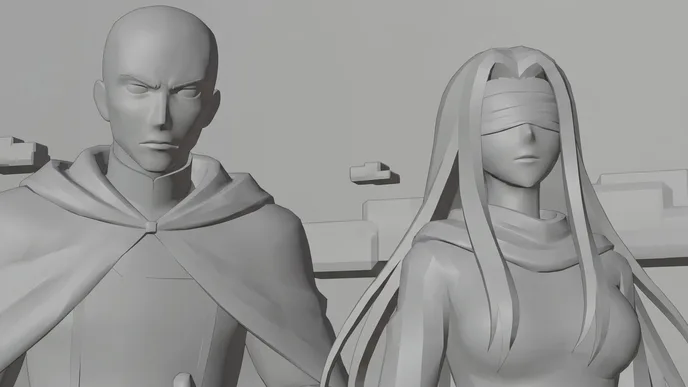
  2. Medium two-shot of a bald swordsman and a blindfolded red-haired woman
    Storyboard frame of the two-shot, in grey
    02

    Two-shot · the promise

    Medium two-shot, the swordsman and the blindfolded seer side by side, violet night sky, broken towers

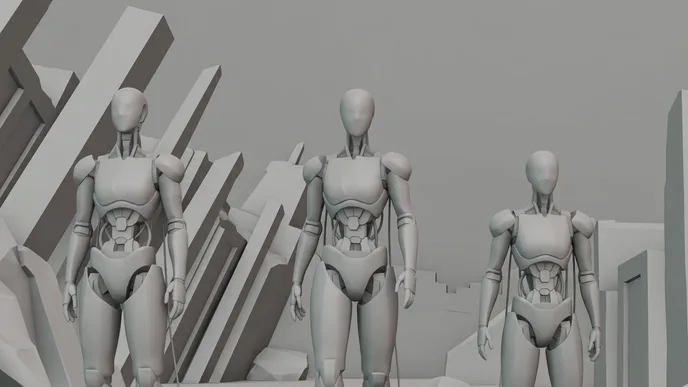
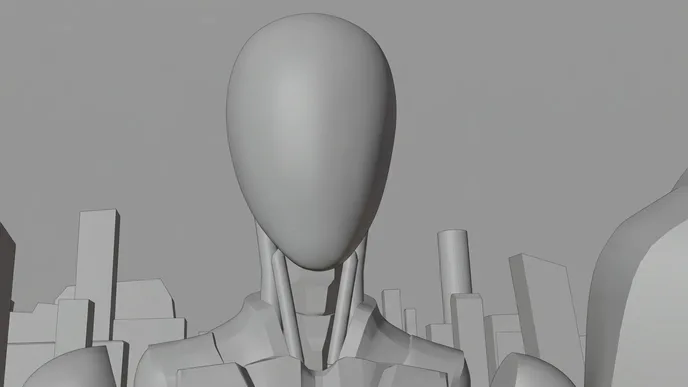
  3. Three white humanoid automatons stand in night ruins
    Storyboard frame of the automatons shot, in grey
    03

    Wide · the machines

    Wide low angle, three white humanoid automatons standing in the ruins, cold blue moonlight

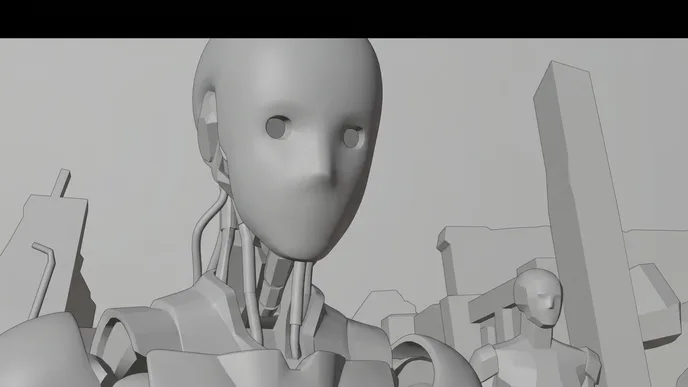
  4. Close-up of a white automaton with a smooth blank face
    Storyboard frame of the blank face close-up, in grey
    04

    Close-up · the blank face

    Close-up on an automaton's smooth faceless head, black eye slots, cables at the neck, ruins behind

  5. A white automaton's eyes glow red
    Storyboard frame of the red eyes close-up, in grey
    05

    Close-up · the red eyes

    Same framing, the automaton's eyes ignite red, the swordsman's shoulder out of focus in the foreground

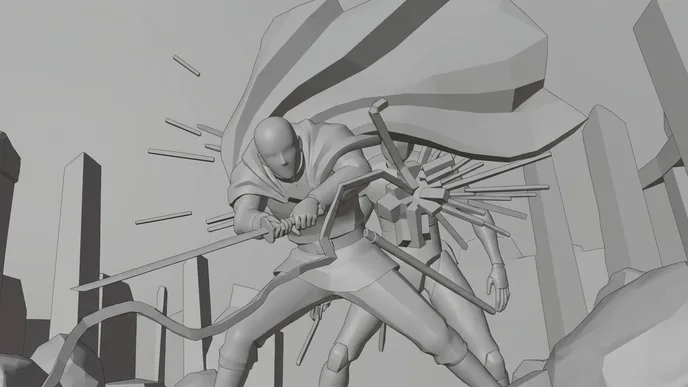
  6. A swordsman strikes with a katana wreathed in lightning and sparks
    Storyboard frame of the clash shot, in grey
    06

    Action · the clash

    Dynamic low angle, the swordsman strikes with his katana, lightning running along the blade, sparks, cape flying

Voidborn, episode 0 runs 13 minutes, inside the 3 to 15 minute Long Film range. This scene alone could be cut under three minutes for the Short Film award. The anime won 1st Place Silver and 2nd Place Dreamina at the Mondial Chroma Awards and an award at the Seoul International AI Film Festival. Playback starts among the ruins, about 7 minutes in.

The script

A 2 minute 40 film in four movements.

Aim for 2:40 so the edit has room under the three minute line. That is about 3 pages and 35 to 55 shots. A short film has no time to explain, so write the ending first.
  1. 0:00 to 0:15

    The tool

    A close shot of a tool in a human hand. The theme is stated in one image.

  2. 0:15 to 0:55

    The routine

    Who the person is and what the tool does for them. Keep to one place and one person.

  3. 0:55 to 2:10

    The reversal

    The tool does something the person did not ask for, or the person does something the tool could not. This is the idea of the film.

  4. 2:10 to 2:40

    The choice

    The human decides. End on the hand again, changed by what happened.

In 15 days there is no time for a second pass on every shot. Storyboard first, generate each scene once with care, and keep your prompts and chosen takes: the form will ask for them.

Day by day

Fifteen days, one short film.

From 1 October to 16 October. Submit a day early. The close is at 11:59 PM Australian Eastern time, and a late upload is a lost entry.
  1. 01

    1 to 2 October

    Check you are eligible, then pick the idea

    You must be based in Australia and at least 16, and the film must not have been screened or distributed before the festival’s dates. Then write five loglines around a person and a tool.

  2. 02

    3 to 4 October

    Three pages

    Three pages. The free Screenwriter plan formats them for you. A film under three minutes needs few lines of dialogue.

  3. 03

    5 to 6 October

    References and storyboard

    One reference per character and place, then the storyboard from the screenplay. Approve it before you generate: you have no time to regenerate.

  4. 04

    7 to 12 October

    Generate the footage

    Scene by scene. ScreenWeaver’s video generation is rolling out with the Filmmaker plan: if it is not on your account yet, use your storyboard as the plan and generate with a tool whose terms allow it.

  5. 05

    13 to 14 October

    Edit, sound, process statement

    Cut, mix, and clear the music. Prepare the process statement, a horizontal and a vertical poster, and five stills.

  6. 06

    15 to 16 October

    Submit

    Upload and send, following the channel named in the terms. Keep the confirmation email.

What loses the entry

Seven ways out.

Most come from the terms and conditions. Read them in full: they are clearer than the home page.
  • Not living in Australia

    Entrants must be Australian residents aged 16 or over, and the film must be Australian-made. Under 18, you also need a parent’s or guardian’s consent.

  • A film shown too early

    It must not have been screened or distributed before the cut-off the festival sets. The site and the terms give two different dates, so keep the film offline until 18 November.

  • The wrong length

    Short and Student films run under 3 minutes. A Long film runs 3 to 15. One entry per category, and the same entrant cannot enter twice in a category.

  • A work in progress

    Only final cuts are accepted, and the film must have been completed in the past 12 months.

  • Real faces, brands and music

    No unauthorised images of real people, no third-party brand that suggests endorsement, and no music you do not own or license. A generated track is fine if the rights are secured.

  • A thin AI statement

    Tools used, a few example prompts and your role as the human in the loop are all required. A one line answer gives the judges nothing to weigh on the creativity criterion.

  • No student proof

    The Student award needs proof of current enrolment, and the entrant must be attending a school or university when entering.

Why ScreenWeaver

Judges want the human in the loop. Keep your decisions visible.

DISRUPT wants proof that a person led the tools. ScreenWeaver keeps your screenplay, your storyboard and your footage in one connected project, each step yours.
  • Your decisions, in order

    The screenplay, the shot breakdown and the storyboard record what you decided before any footage exists. That is the material behind the human in the loop statement the form asks for.

  • Control of each shot

    In the storyboard you set framing, angle, movement and duration shot by shot. A visible directing choice is the clearest proof that a person led the tool.

  • Footage on Seedance

    The footage pipelines run on Seedance 2.0 and 2.5 and stay connected to your script and storyboard. They are rolling out with the Filmmaker plan, so keep a fallback for the 16 October deadline.

  • Free to begin

    The Screenwriter plan is $0 with no expiry, and DISRUPT entry is free too. Storyboard Beta is $9.99 a month.

Real productions

International festival-recognized films have been written and produced with ScreenWeaver.

ScreenWeaver is already being used as a creative workspace for real AI film productions, from cinematic shorts to animated series pilots selected, nominated, and awarded by international festivals.

  • Video thumbnail for VOIDBORN

    VOIDBORN

    AI animated / cinematic short

    Festival recognition

    • 1st Place Silver

      Mondial Chroma Awards

    • 2nd Place Dreamina

      Mondial Chroma Awards

    • Award Winner

      Seoul International AI Film Festival

  • Video thumbnail for Les Fils du Vinnana

    Les Fils du Vinnana

    AI short film

    Festival recognition

    • Honorable Mention

      Top Quark Film Festival

    • People's Choice Nominee

      Illuminate Oneness of Humanity

    • Nominee

      ALTFF Supershort

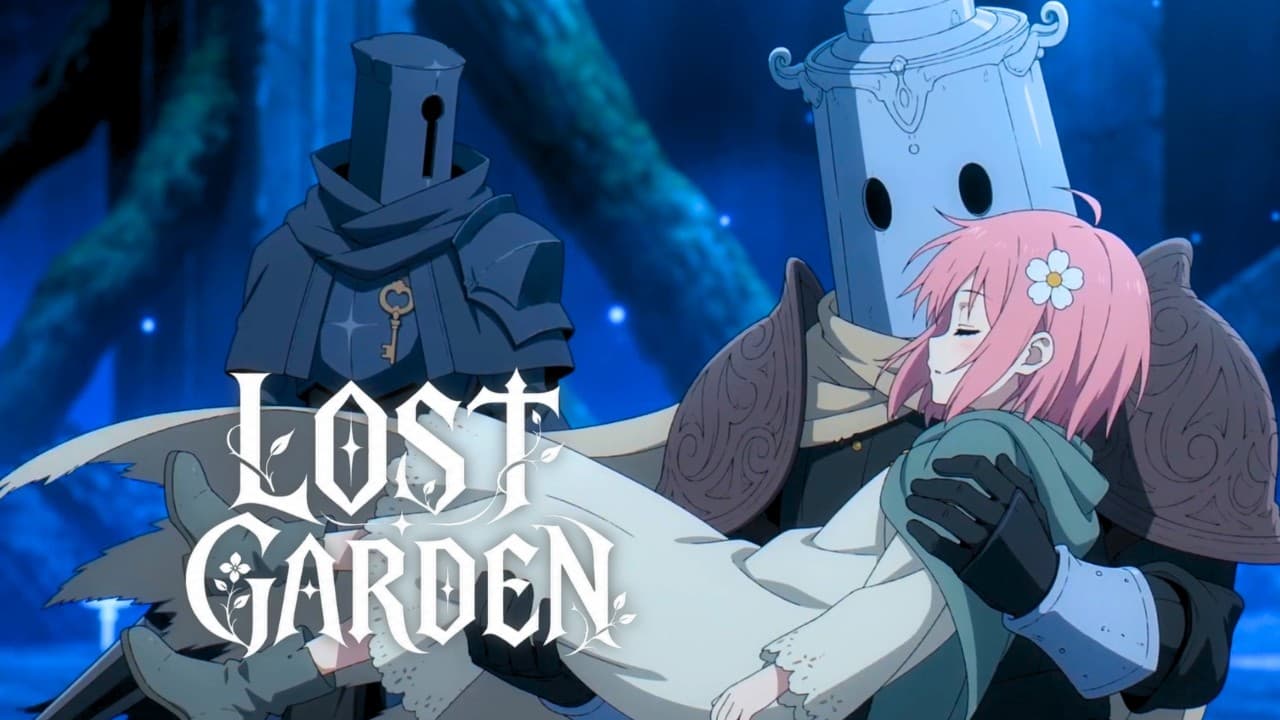
  • Video thumbnail for Lost Garden

    Lost Garden

    AI animated series pilot

    Festival recognition

    • Finalist

      AI London Festival

The pipeline

Write. Board. Produce.

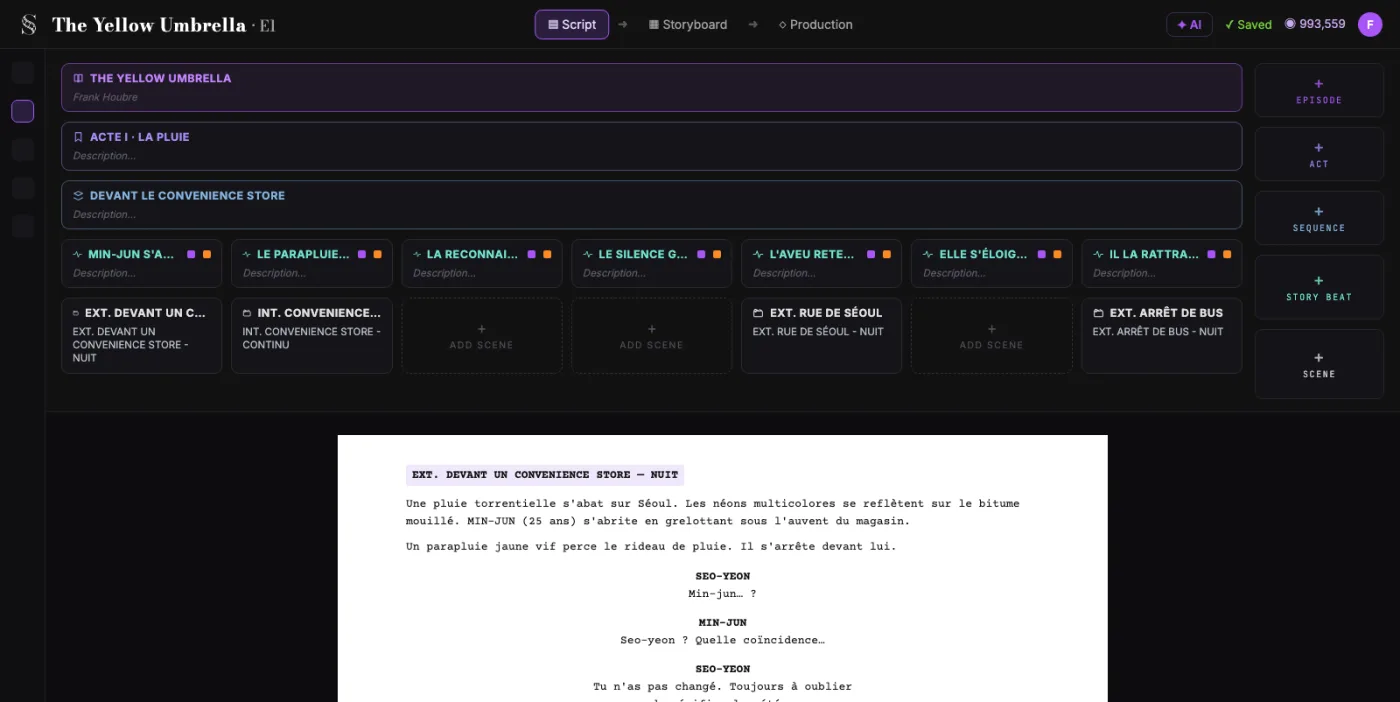
  1. ScreenWeaver screenplay editor: acts, sequences and beats above the formatted script of The Yellow Umbrella

    01The screenplay, enriched

    An industry-standard screenplay editor, and more: a visual outline and beat editor, your writing inspirations (notes, photos, audio) kept next to the page, and an AI researcher to support your writing, not replace it.

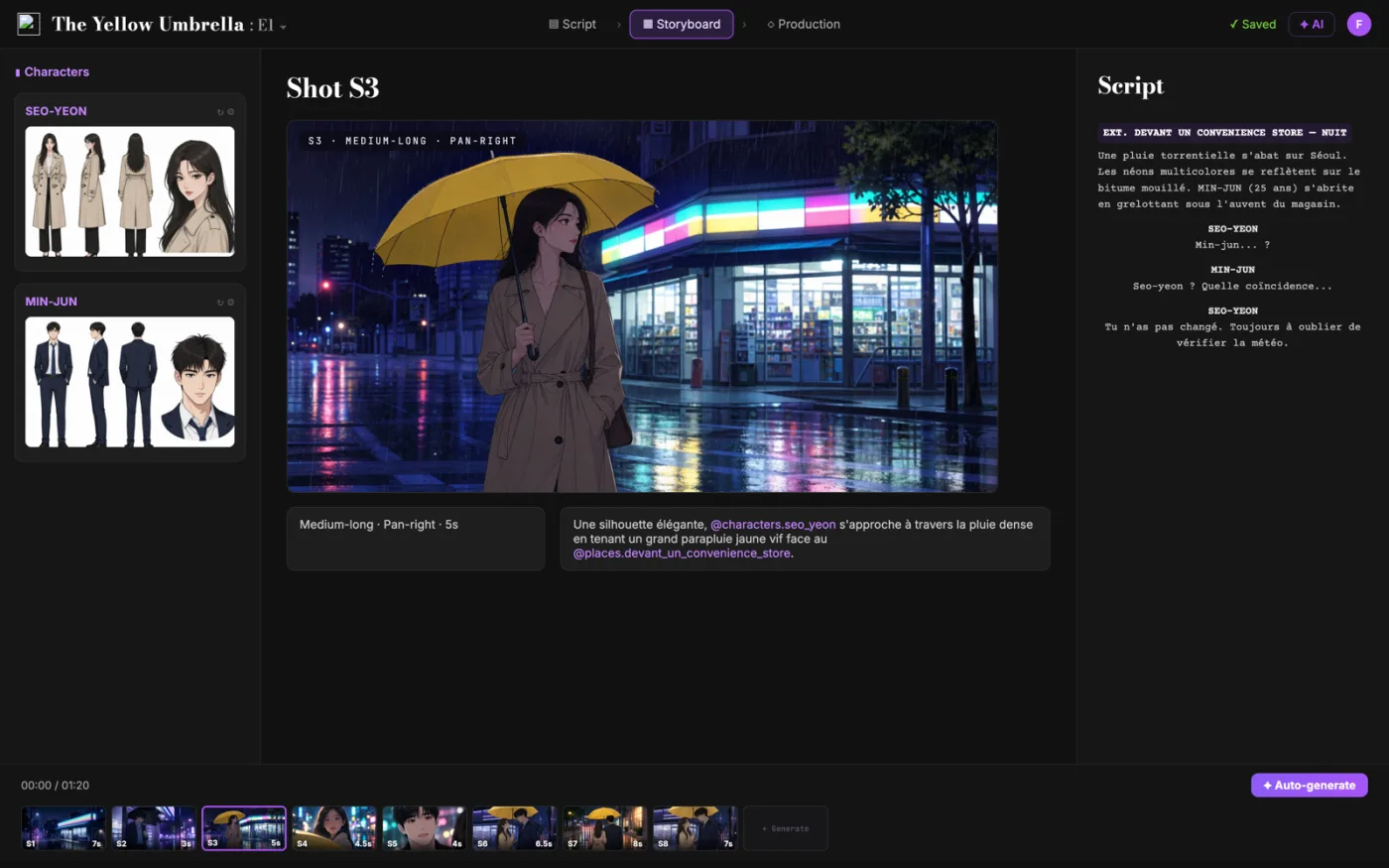
  2. ScreenWeaver storyboard: shot S3 of The Yellow Umbrella with characters, shot settings and the script beside it

    02The storyboard, made easy

    Shot breakdown generated from your screenplay, manual control over every shot (frame, angle, movement, duration), and generative AI previsualization in one click.

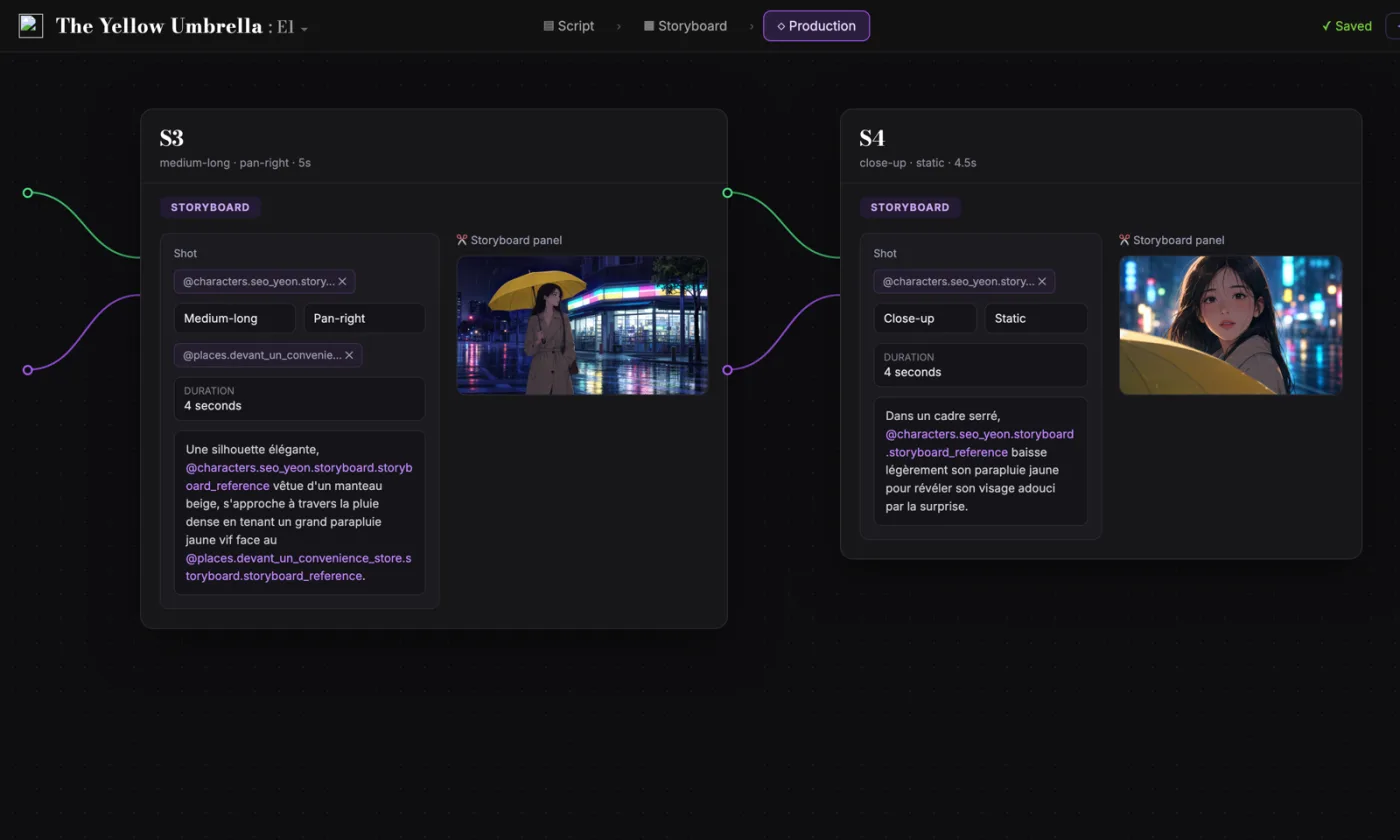
  3. ScreenWeaver production canvas: shots S3 and S4 as connected nodes carrying their storyboard panels and prompts

    03AI production, with finesse

    Footage generation pipelines connected to your screenplay and storyboard. Optimized out of the box, fully editable workflow.

FAQ

DISRUPT AI Film Festival, your questions

How do you win the DISRUPT AI Film Festival?
Four awards of AU$2,500 are given: Best Short Film, Best Long Film, Best Student Film and the Grand Prix. Entries are judged on originality, creativity, technical execution and alignment with the theme Humans and Their Tools. The judges favour a human story over a showcase of the tool.
Can I enter DISRUPT if I do not live in Australia?
No. The terms open the competition to Australian residents over 16, and the film must be Australian-made. If you live elsewhere, look at the other festival guides on ScreenWeaver instead.
What is the deadline, and is entry free?
The competition ends at 11:59 PM AEST on 16 October 2026. There are no entry fees. You may submit one entry per category.
How long can the film be?
Short and Student films run under 3 minutes. Long films run from 3 to 15 minutes. Entries must be final cuts completed in the past 12 months.
Which AI tools can I use?
Any. The terms say there is no preferred AI tool, and the FAQ lists text to video, voice, image generation, effects, music and prompt engineering. You must say what you used.
Who is on the jury?
The festival does not name its judges. The terms speak of a panel of qualified judges, and the final decision is made in Melbourne after submissions close.
Is ScreenWeaver allowed at DISRUPT?
The terms say there is no preferred AI tool, so yes. Use it for the screenplay and storyboard today, and for footage built on Seedance 2.0 and 2.5 as the Filmmaker plan rolls out. List every tool in your entry.
Who owns the film, and what does the festival get?
You keep full intellectual property rights. The promoter receives a non-exclusive, perpetual licence to show the film for festival and promotional purposes. Winners also agree to be named and shown in promotion of the competition.

Fifteen days. A person and a tool.

A person, a tool and 2 minutes 40 seconds. Write the first page free today.