Hot Docs 2027 · AI documentaries guide

Can you submit an AI documentary to Hot Docs?No rule stops you. Honesty is the test.

Hot Docs publishes no rule on AI. The documentary world has a standard all the same, and it is disclosure. Here are the 2027 dates and fees, what the rules do cover, and a plan, starting with the screenplay in ScreenWeaver.
  • No AI rule published
  • Early deadline 29 October 2026
  • Festival 23 April to 2 May 2027
Lost Garden · Episode 1

Independent guide. ScreenWeaver does not organise Hot Docs and is not affiliated with Hot Docs. Rules read on 1 October 2026. Official submission page

Available today in ScreenWeaver: free screenwriting, and a storyboard generated from your screenplay with Storyboard Beta, $9.99 a month.

Rolling out: video generation of each shot, powered by Seedance, with the Filmmaker plan.

The 2027 call in brief

What Hot Docs asks of a film.

Hot Docs is the Toronto documentary festival, and its call for 2027 is open. It takes documentaries of all lengths and subjects. It has no clause on AI, nor on archive or reenactment, so everything below applies to your film as to any other.
Festival
23 April to 2 May 2027, Toronto
Deadlines
Early 29 October 2026, regular 10 December, late 4 January 2027
Fees in CAD
Short $35, $50 or $70. Over 40 minutes $70, $120 or $165, plus 13% HST in Canada
Eligible films
Completed after 1 January 2026
Premiere
Shorts: Toronto. Mid-length, feature, series: Ontario and not online there
AI rule
None published
Lengths
Short up to 40 minutes, mid-length 41 to 65, feature 66 or more
Results
By mid-March 2027 on one page, end of March on another

Source: the Submit to Hot Docs Festival page and the Festival Submissions FAQ on hotdocs.ca, read on 1 October 2026. The submission page says deadlines and fees may change from previous years.

AI and the rulebook

Silence on AI, and five things that still apply.

Neither the submission page nor the FAQ mentions artificial intelligence, archive or reenactment. No rule is not the same as no consequences: here is what applies, and what the profession expects.
  • What the rules say

    Nothing about AI. Read in full on 1 October 2026, the submission page and the FAQ contain no clause on generative media, synthetic images, archival footage or reenactments. Hot Docs may add one: read the page again the week you apply.

  • The clause that reaches generated footage

    The applicant is solely responsible for clearing copyright on everything in the film, and Hot Docs may disqualify a film with unauthorised copyrighted material. A generated image that copies a protected work, a real person's likeness or a recognisable archive is a clearance problem before it is an ethics one.

  • A curated, documentary-only call

    Hot Docs takes Canadian and international documentaries, and every submission is considered by its programming team. Programming and slotting are decided by that team, and the decision is final. Nothing says a hybrid is out. Nothing says it is in.

  • The professional yardstick

    The best-known standard is not a festival rule. The Archival Producers Alliance published best practices for generative AI in documentaries in September 2024. Hot Docs is not stated to adopt them, but they are endorsed by organisations including the IDA and POV, and they frame the debate.

  • Disclose before they ask

    The form has a space to describe the film and its cut. Use it to say what is generated and what is real. A label you wrote beats a doubt the programmer formed alone.

Key dates

Three deadlines, one decision.

The 2027 call is open. The three deadlines differ only by fee, and a film completed after 1 January 2026 qualifies for all of them. <b>Choose the one your cut can meet.</b>
  1. 29 Oct 2026

    Early deadline

    Short $35, mid-length, feature or series $70, in Canadian dollars. Fees are not refunded.

  2. 10 Dec 2026

    Regular deadline

    Short $50, longer $120. All links must reach Hot Docs by the deadline you apply to.

  3. 4 Jan 2027

    Late deadline

    Short $70, longer $165. The most time for the cut and the most money.

  4. Mid to end Mar 2027

    Decisions by email

    The submission page says mid-March and the FAQ says end of March. Only the primary contact on your form is told.

  5. 23 Apr to 2 May 2027

    The festival in Toronto

    Ten days of screenings. Selected films must provide a DCP, and English-language films of 41 minutes or more need a closed caption track.

Who decides

The programmers choose, juries follow.

Hot Docs names no jury on the submission pages. It does say how a film is chosen, and who sees it before anyone awards a prize.
  • The programming team

    All screening programmes are curated and all submissions are considered by the programming team. Nothing is automatic: every film has to be picked, so the first minutes of your screener carry weight.

  • Competitions are chosen, not entered

    Canadian Spectrum and International Spectrum films are chosen by the programming department, then eligible for jury prizes. International Spectrum asks at least an International Premiere, with priority to World Premieres.

  • Decisions without comments

    Hot Docs is under no obligation to comment on a film and says the volume of submissions rules out notes. A refusal says nothing about your use of AI.

Where a film goes

Four ways to be filed.

Hot Docs takes documentaries of all subject matter. What it sorts by is length and origin. Under each, the angle we would take for a film that uses generated material.
  • 01

    Short documentary

    Up to 40 minutes, rounded up to the minute. Shorts must be at least a Toronto premiere, and a film already online counts as one.

    The easiest door for a first documentary with a labelled generated element. A short can put the disclosure on screen in the first seconds.

  • 02

    Feature and mid-length

    Features run 66 minutes or more and mid-lengths 41 to 65. Both must be at least Ontario premieres, and not available online in Ontario.

    Do not put a feature online in Ontario while you wait for a decision. The premiere clause is stricter than any AI question.

  • 03

    Episodic series

    Long-form narratives that cannot be told in a feature. No set runtime, and all episodes must sit on one screener link.

    A limited series with reconstructed scenes needs one visual convention for every episode. Label once, label the same way.

  • 04

    Canadian or international

    The director's residency or citizenship, and where the film was produced, decide the submission category. Hot Docs rules on which one applies.

    Co-productions can land in either. State the financing and the crew location on the form. Do not leave the programmers to guess.

The ethics yardstick

What documentary makers expect of generated images.

The strongest reference is a professional standard. In September 2024 the Archival Producers Alliance, a group of archival producers and researchers, published best practices on generative AI in documentaries. Its founders summarised four areas in a PBS Editorial Standards article.

  1. 01

    Primary sources come first. The authors accept good reasons to use generated media, such as showing people or places missing from the record, but they treat real material as the base.

  2. 02

    Be transparent inside the team. The guidelines suggest a temporary watermark on generated material during the edit, and a cue sheet for every generated element with prompt, software version, date, description and timecodes.

  3. 03

    Be transparent with the audience. They strongly advise making the use clear, through a lower third, a watermark, narration or a line at the top of the show, depending on context.

  4. 04

    Treat it like a reconstruction. The authors ask for the same care for accuracy and sensitivity as a traditional re-creation, and warn about algorithmic bias, since models draw on an incomplete historical record.

A traceable method

Lost Garden: every shot has a paper trail.

ScreenWeaver is a fiction and animation tool, and Hot Docs takes documentaries only. This scene from Lost Garden, episode 1 is an invented world, with no real person and no real event. It is here to show the method: the screenplay line, the storyboard frame and the final image for each shot, which is what a cue sheet asks for.

Logline. A small knight wakes up in a dead world and learns he is the last guardian of a seed that could bring the garden back.

Screenplay · episode 1 · the Source Tree

INT. HEART OF THE ROOTS - NIGHT

Living roots coil around LANTERN and pin him down. A voice stops them.

THE SOURCE TREE

Stop. He is my guest.

A giant woman of roots and white lilies opens her arms over the cavern.

Her eyes open. Blue, and vast.

THE SOURCE TREE

Welcome to you, Lantern Knight.

She lifts him in her palm, like a lamp.

THE SOURCE TREE

Do not be afraid. I will not harm you.

In the dark, a seed of light opens. Inside the flower, a sleeping child.

THE SOURCE TREE

You must find yours. Protect her.

CUT TO:

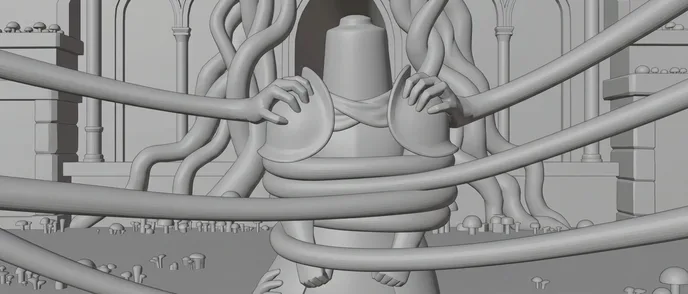
  1. A small lantern-helmed knight bound by thick roots in a ruined hall
    Storyboard frame of the trap shot, in grey
    01

    Medium · the trap

    Medium shot, Lantern bound by thick living roots in a ruined hall, glowing blue mushrooms on the floor, cold light

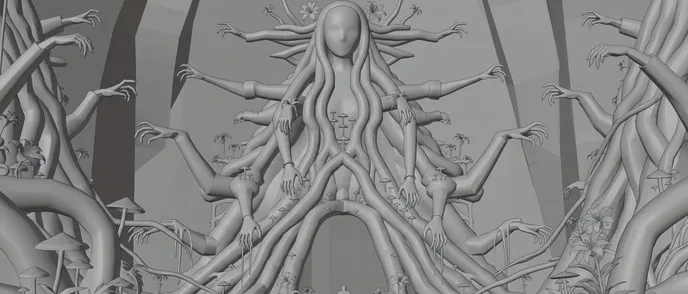
  2. A giant woman made of roots and white lilies spreads her many arms in a dark cavern
    Storyboard frame of the wide shot, in grey
    02

    Wide · the Source Tree

    Symmetrical wide shot, a giant woman made of roots, arms spread with many hands, white lilies, blue glyphs

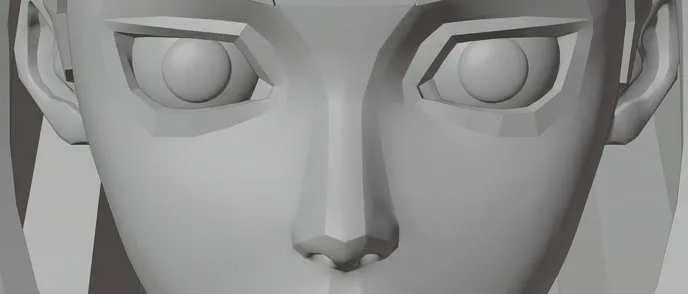
  3. Extreme close-up of a giant pale face with piercing blue eyes
    Storyboard frame of the eyes close-up, in grey
    03

    Extreme close-up · the eyes

    Extreme close-up on the giant's face, piercing blue eyes opening, pale skin, soft light from below

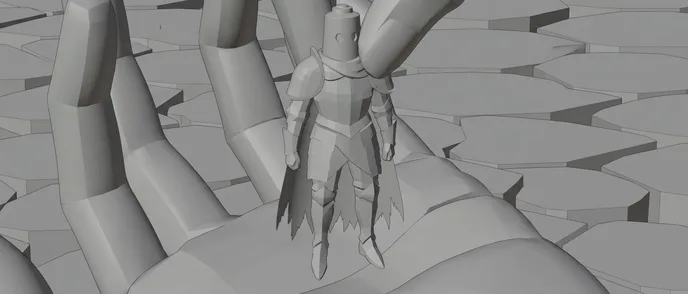
  4. A tiny armored knight stands in the middle of a giant open hand
    Storyboard frame of the palm shot, in grey
    04

    High angle · the palm

    High angle, the tiny knight standing in the center of a giant open palm, stone floor far below

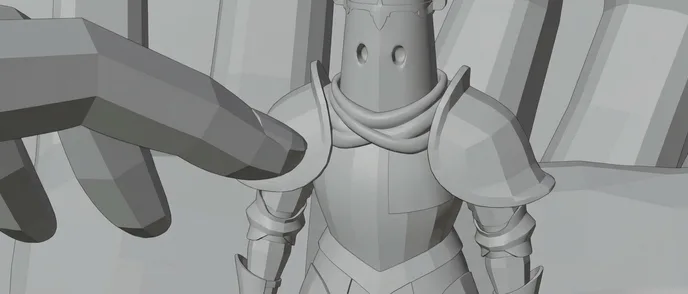
  5. A giant fingertip gently touches the chest of a small armored knight
    Storyboard frame of the touch close-up, in grey
    05

    Close-up · the touch

    Close-up, a giant fingertip gently touches the knight's armored chest, faceless helm, emotion through posture

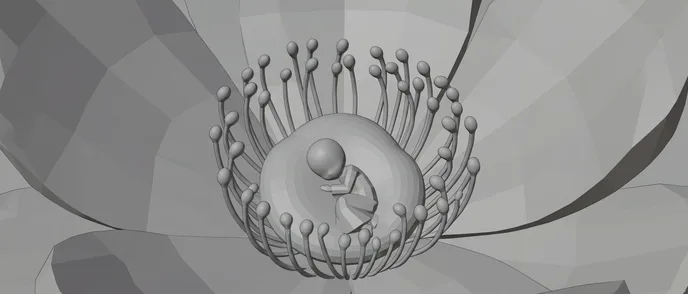
  6. A sleeping pink-haired child curled inside a glowing blue flower
    Storyboard frame of the seed insert, in grey
    06

    Insert · the seed

    Top-down insert, a glowing pale blue flower opening, a sleeping child with pink hair curled inside

Lost Garden, episode 1, 17 minutes, would sit under Hot Docs' 40 minute short line by length, but it is fiction and would not be an entry. It was a finalist at the AI London Festival, and it is an animated series by the ScreenWeaver team made with Seedance. We show it for the traceability of its shots. The player opens on the Source Tree scene.

The script

A 12 minute short documentary in four movements.

A short can run up to 40 minutes. At 12 minutes you hold about 12 pages of narration and scenes, and you can afford to explain a labelled reconstruction without losing the thread.
  1. 0:00 to 1:00

    The question

    A real person, a real place, an honest question. Say in the first minute what kind of film this is.

  2. 1:00 to 4:00

    The evidence

    Interviews, documents, places. Real material goes first, so the audience knows what the baseline is.

  3. 4:00 to 10:00

    The gap

    Where no image exists, one clearly labelled reconstruction can stand in. Tell the audience before it starts, not after.

  4. 10:00 to 12:00

    What we know and what we do not

    End with the limit of the record. A documentary that says what it could not show earns more trust than one that hides it.

Put the label in the picture, not only in the credits: a lower third or a visual convention that never changes, as the best practices suggest.

Step by step

From the question to the submit button.

The regular deadline is 10 December and the late one 4 January. A documentary is rarely finished in weeks, so plan for the late deadline or the next call. Real material comes first in every step.
  1. 01

    October 2026

    Decide what AI is for

    Write down every use you plan: narration, a labelled reconstruction, translation, a title sequence. Cut anything that stands in for something real that exists.

  2. 02

    November 2026

    Treatment and AI log

    Write the treatment free in ScreenWeaver, and start an AI log from day one: tool, version, prompt, date, what it shows, how it will be labelled.

  3. 03

    November to mid-December

    Gather the real material

    Interviews, places, documents, rights. Secure clearances and consent now: the clearance clause is the one Hot Docs does state.

  4. 04

    December 2026

    Labelled reconstructions

    Storyboard each one, with its caption written first. Generate them last, with Seedance in ScreenWeaver as video generation reaches your plan, and keep prompts in the log.

  5. 05

    Late December

    Cut, mix, caption

    Lock one cut. Hot Docs watches one version, so send the strongest. Add the on-screen labels and English subtitles if the film is not in English.

  6. 06

    By 4 January 2027

    Submit with a working link

    A streaming link with a password that does not change, live until April 2027. Describe generated material in the form, in plain words.

Mistakes to avoid

Eight ways to lose a documentary slot.

The AI question has no rule, so the rejections come from elsewhere. Most of them are on the submission page, and a few are about trust.
  • A person who never said it

    A synthetic voice or face of a real person, saying what they did not say, is the line the profession draws most clearly. It is also a likeness and clearance problem.

  • Generated archive that passes as real

    A generated photograph in the style of a period, shown without a label, can be quoted by others as a real document. Label it where it appears.

  • A premiere already used

    Features, mid-lengths and series must not have screened in Ontario, nor be online there, including at online festivals. Shorts need a Toronto premiere, and online release is fine.

  • Sending it twice

    Re-submissions are not accepted, and the festival considers one cut only. A new version is not guaranteed to be seen if the first was already reviewed.

  • Counting the wrong length

    Round up to the nearest minute, then check the fee: 40 minutes or under is a short, and 41 or more costs roughly double or more.

  • Not in English

    Films must be in English, subtitled or English-versioned. A non-English film can enter with an English transcript, then must be subtitled or dubbed at your expense if selected.

  • A screener that fails

    The link must stream until April 2027 and download-only links are refused. The password must not change, and a link sent by email does not count.

  • A film finished before the cutoff

    Everything must have been completed after 1 January 2026. A film finished before that date is out, whatever its subject.

Why ScreenWeaver

Documentary needs proof. A connected project keeps it.

ScreenWeaver is an AI production pipeline for films and series, with screenplay, storyboard and footage tied together. For a documentary, its use is narrow and honest: structure, narration, and labelled illustration.
  • A log that writes itself

    Every shot is tied to its scene, its storyboard frame and its prompt. That is most of an AI cue sheet, made while you work and not afterwards.

  • A treatment and narration, free

    Write the structure, the narration and the interview plan in industry format, at no cost. The pages stay yours, and private to you.

  • Invent, do not impersonate

    Use generated footage for invented scenes, or for a reconstruction you label. Keep real people off the generated screen. That is our advice, and Hot Docs does not require it.

  • Start for free today

    The Screenwriter plan is free, $0 with no end date. Storyboard Beta costs $9.99 a month. Video generation is part of the Filmmaker plan, now rolling out.

Real productions

International festival-recognized films have been written and produced with ScreenWeaver.

ScreenWeaver is already being used as a creative workspace for real AI film productions, from cinematic shorts to animated series pilots selected, nominated, and awarded by international festivals.

  • Video thumbnail for VOIDBORN

    VOIDBORN

    AI animated / cinematic short

    Festival recognition

    • 1st Place Silver

      Mondial Chroma Awards

    • 2nd Place Dreamina

      Mondial Chroma Awards

    • Award Winner

      Seoul International AI Film Festival

  • Video thumbnail for Les Fils du Vinnana

    Les Fils du Vinnana

    AI short film

    Festival recognition

    • Honorable Mention

      Top Quark Film Festival

    • People's Choice Nominee

      Illuminate Oneness of Humanity

    • Nominee

      ALTFF Supershort

  • Video thumbnail for Lost Garden

    Lost Garden

    AI animated series pilot

    Festival recognition

    • Finalist

      AI London Festival

The pipeline

Write. Board. Produce.

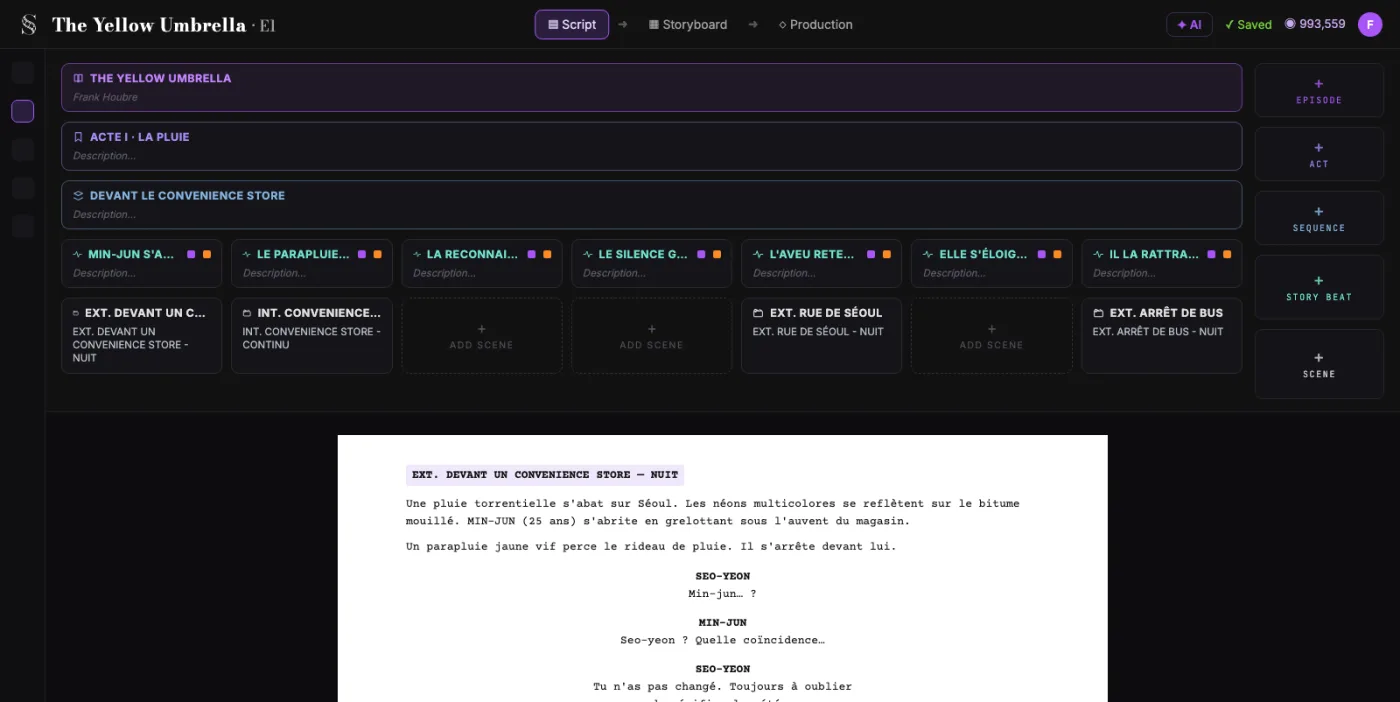
  1. ScreenWeaver screenplay editor: acts, sequences and beats above the formatted script of The Yellow Umbrella

    01The screenplay, enriched

    An industry-standard screenplay editor, and more: a visual outline and beat editor, your writing inspirations (notes, photos, audio) kept next to the page, and an AI researcher to support your writing, not replace it.

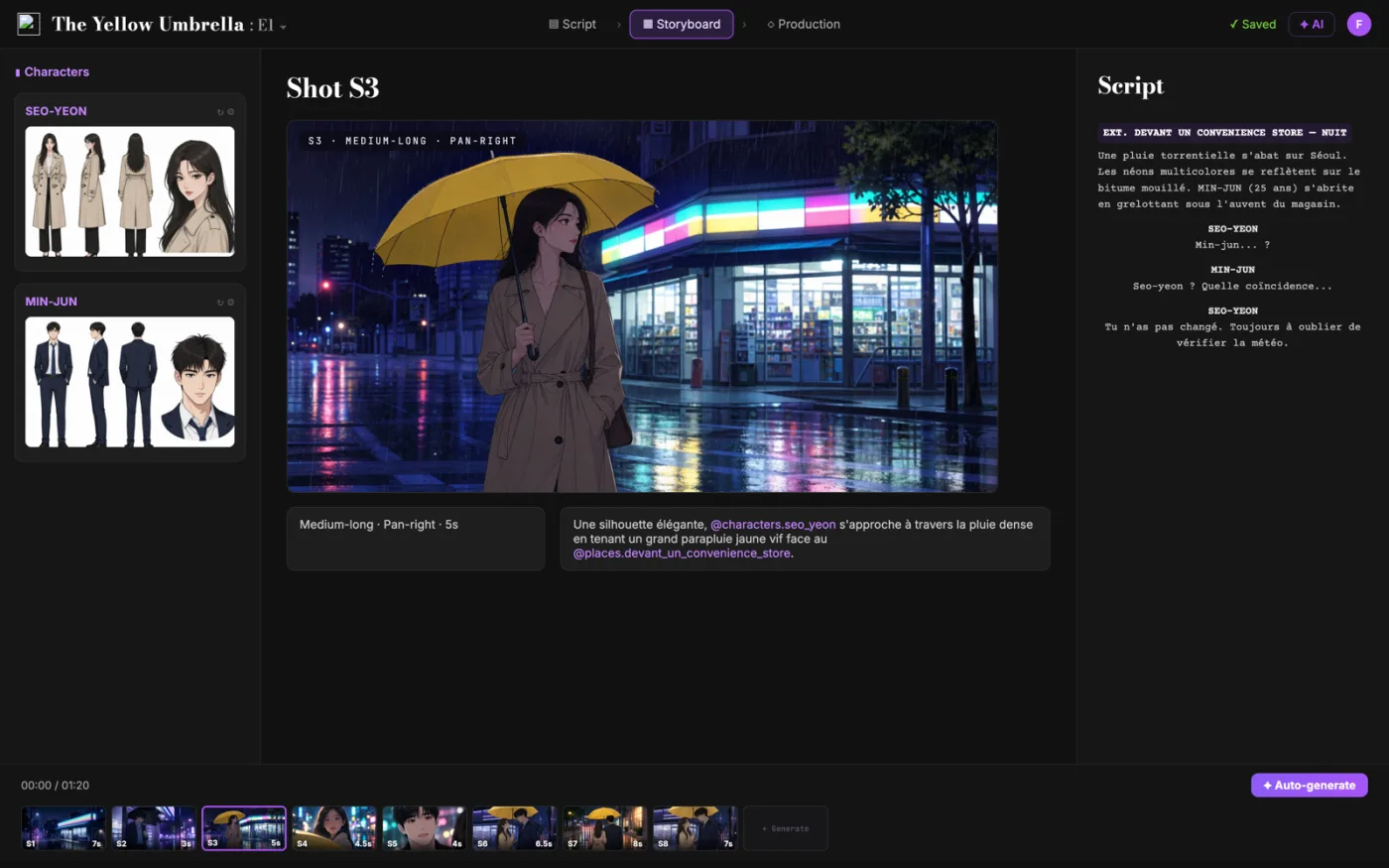
  2. ScreenWeaver storyboard: shot S3 of The Yellow Umbrella with characters, shot settings and the script beside it

    02The storyboard, made easy

    Shot breakdown generated from your screenplay, manual control over every shot (frame, angle, movement, duration), and generative AI previsualization in one click.

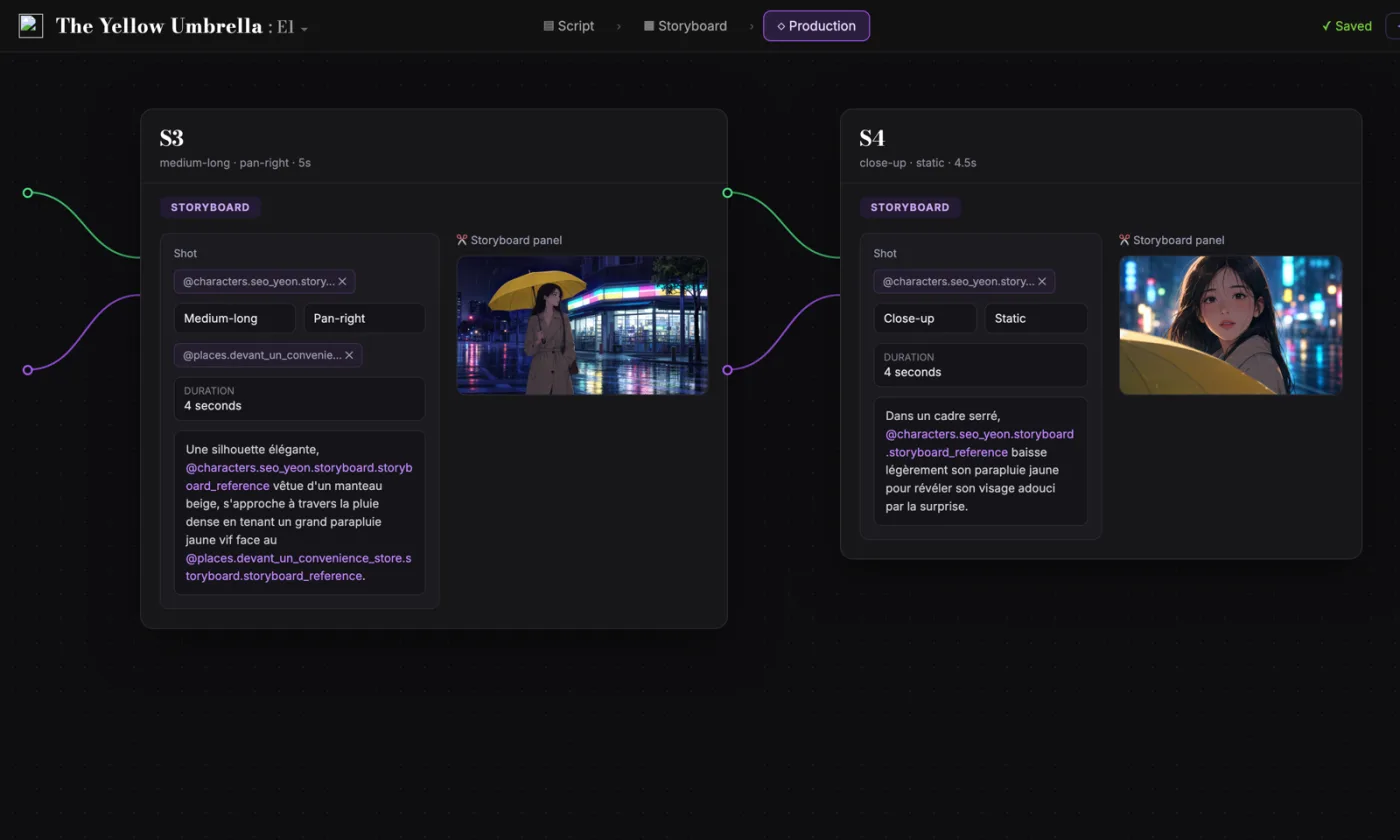
  3. ScreenWeaver production canvas: shots S3 and S4 as connected nodes carrying their storyboard panels and prompts

    03AI production, with finesse

    Footage generation pipelines connected to your screenplay and storyboard. Optimized out of the box, fully editable workflow.

FAQ

Hot Docs and AI, your questions

Can you submit an AI documentary to Hot Docs?
Nothing in the 2027 submission page or FAQ forbids it, and nothing mentions AI at all. No rule is not a licence to mislead: copyright clearance applies, programmers decide, and the profession expects generated images to be labelled.
What is the next Hot Docs deadline?
Early deadline 29 October 2026, regular 10 December 2026 and late 4 January 2027. The festival runs 23 April to 2 May 2027 in Toronto.
How much does it cost?
In Canadian dollars, a short of 1 to 40 minutes costs $35, $50 or $70 by deadline. A mid-length, feature or series costs $70, $120 or $165. 13% HST is added on transactions within Canada, and fees are not refunded.
Do I have to tell Hot Docs I used AI?
The pages we read do not ask. We still advise you to say so in the form, in plain words. A disclosure you chose reads better than a doubt a programmer formed alone.
Can I use AI for a reenactment?
Hot Docs has no rule on reenactments either. The Archival Producers Alliance advises the same care as a traditional re-creation, plus a clear label for the audience. Never put a real person's voice or face to words they did not say.
Must the film be a premiere?
Shorts need at least a Toronto premiere, and online availability counts as one. Features, mid-lengths and series need at least an Ontario premiere and must not be online in Ontario. The programming team also weighs premiere status in its final decision.
When will I know if my film is selected?
By mid-March 2027 according to the submission page, and by the end of March according to the FAQ. Only the primary contact on your entry form is told, and Hot Docs gives no comments.
Is a series accepted?
Yes, in the episodic category, for long-form narratives that do not fit in a feature. Put all the episodes on one screener link.

Real material first. Then the page.

Write your treatment free today and start the log with the first idea.