Sheffield DocFest 2027 · AI films guide

Can you submit an AI film to Sheffield DocFest?Only a documentary, and no rule says more.

The 2027 Film Entry Guidelines contain no AI clause. They welcome completed documentaries only, with an early deadline on 20 November 2026. Here is what that means for a film made with generative tools, and how to prepare its written and storyboarded parts in ScreenWeaver.
  • Early deadline 20 November 2026
  • No AI clause in the guidelines
  • Festival 9 to 14 June 2027
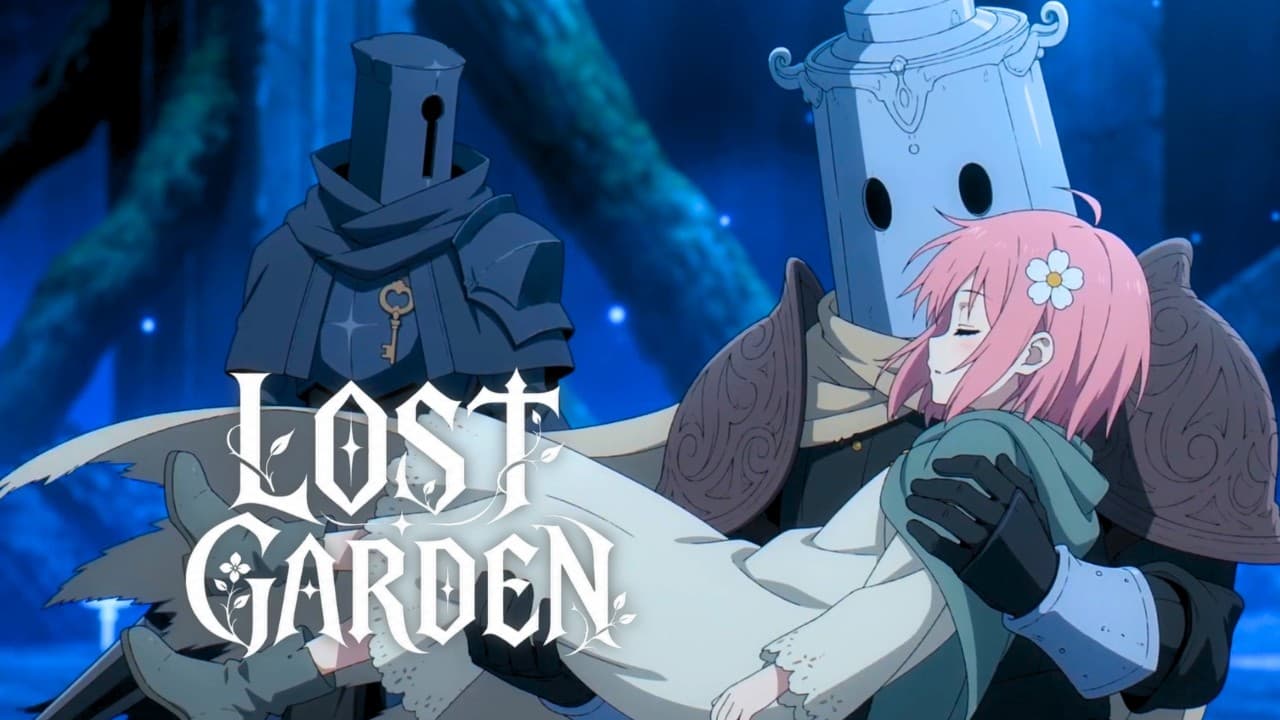
Lost Garden · Episode 2

Independent guide. ScreenWeaver does not organise Sheffield DocFest and is not affiliated with Sheffield DocFest or its organisers. Rules read on 1 October 2026. Film programme entries

Available today in ScreenWeaver: free screenwriting, and a storyboard generated from your screenplay with Storyboard Beta, $9.99 a month.

Rolling out: video generation of each shot, powered by Seedance, with the Filmmaker plan.

The rules on one card

What Sheffield DocFest asks of a film.

Sheffield DocFest calls itself the UK’s leading documentary festival. It screens 100+ films and expects more than 2,900 entries. Its entry guidelines run to eight sections and say nothing about AI.
Festival
9 to 14 June 2027, Sheffield
Early deadline
20 November 2026, 12:00 GMT
Later deadlines
29 January and 19 February 2027
Fees, plus VAT
£30 to £48 for shorts, £40 to £58 above 40 min
AI rule
None in the entry guidelines
Eligibility
Completed documentaries, UK premiere minimum
Language
English dialogue or English subtitles
The answer
April 2027, no individual feedback

Source: the Film Programme Entries page and the 2027 Film Entry Guidelines on sheffdocfest.com, read on 1 October 2026. The PDF was downloaded and read as text. A short is a film up to 40 minutes, credits included. The organisers can change the terms at any time.

What the rules say about AI

No clause to cite, five points to weigh.

Sheffield has no AI clause, so there is no sentence to cite. What you can read is what the guidelines require of every film, how the festival treats AI in its programme, and the documentary standard a film will be held to.
  • What the guidelines say

    We read all eight sections of the 2027 Film Entry Guidelines on 1 October 2026 and searched the text for AI, artificial intelligence and generative. There was no hit. The guidelines ask for no disclosure and set no limit.

  • Copyright is the clause that bites

    The applicant alone must secure clearance from the holders of any copyrighted material in the film, and DocFest may disqualify a film that includes unauthorised material. The guidelines do not carve out generated material, so check what each tool’s terms allow before you rely on its output.

  • The festival names AI as a theme

    Its 2026 public programme announcement lists AI among the unifying themes of selections, talks and industry sessions, next to Archival Work and Historical Memory. AI is a subject at Sheffield. The guidelines do not turn it into a rule.

  • A documentary promises reality

    The Archival Producers Alliance guidelines of September 2024 hold that documentary carries an obligation to reality. They ask makers to treat generated images with the care of a traditional re-creation, to keep a cue sheet for each generated element and to tell the audience what is synthetic. Sheffield has not adopted them, and they remain the yardstick to meet.

  • Rough cuts and series

    A rough cut is accepted if the film will not change in essence, and the final cut must be available in mid May 2027. Series count only as world premieres, with up to 120 minutes in one link. If part of the film is still being generated, promise only what you can deliver.

Key dates

Three windows, one cheap one.

The early deadline is the cheapest, and that is all it buys. <b>Each film is viewed once the form is complete and the fee paid</b>, whichever window it entered.
  1. 20 Nov 2026

    Early deadline

    £30 for a short and £40 for a longer film, plus VAT, until 12:00 noon GMT.

  2. 29 Jan 2027

    Standard deadline

    £38 and £48 plus VAT, until 12:00 noon GMT.

  3. 19 Feb 2027

    Late deadline

    £48 and £58 plus VAT. The last day to enter. Entry fees are non-refundable.

  4. April 2027

    The answer

    The primary contact on your entry form is told by then. Films that are not programmed receive no individual feedback.

  5. 9 to 14 Jun 2027

    The festival

    Selected films are delivered through a digital platform in early May, and the exact date comes with the selection. Sheffield screens only DCP, 35mm and 16mm.

Who decides

Programmers first, juries after.

Sheffield publishes no jury and no criteria at the entry stage. It does say who views the films.
  • The programming team

    All projects are viewed and selected by DocFest’s team of programmers and advisors. Some of them live or work abroad, so a screener may not show as watched in the UK. Do not read a verdict into your view count.

  • No feedback, at this scale

    With more than 2,900 entries expected, the festival cannot give comments to films it does not programme. A rejection tells you nothing about your film or its use of AI.

  • Juries come after selection

    The Youth Jury Award is chosen by young documentary lovers and the Audience Award by cinema audiences. International competition films must be world, international or European premieres.

Awards

Four awards, one standard of proof.

Sheffield honours films in several awards once they are selected. Four matter to a maker who uses generated material. Each card closes with our reading.
  • 01

    International Competition

    Strong artistic vision and courageous storytelling, Academy Award accredited.

    The most visible slot. A generated sequence that is an artistic decision argued inside the film answers the brief. A trick does not.

  • 02

    International Short Film Competition

    The best creative approach to documentary under 40 minutes, accredited by the Academy Awards, BAFTA and BIFA.

    A short is the right size for a film with one authored synthetic sequence. The form of the film is its pitch.

  • 03

    International First Feature Competition

    The future of non-fiction film and promising talent.

    For emerging directors. Generated material is no handicap if the film shows that the director can document, not only generate.

  • 04

    Tim Hetherington Award

    A film and filmmaker that best reflect the legacy of the photojournalist and filmmaker Tim Hetherington.

    Rooted in witnessing. A synthetic image has little place here unless it is labelled as a reconstruction of something nobody recorded.

The odds

What the numbers say.

The guidelines give 2026 figures: 49,873 in-person admissions and 2,478 industry delegates from 74 countries. For 2027 they expect more than 2,900 entries for a programme of 100+ films.

  1. 01

    Roughly one entry in thirty can be programmed. The film that wins a place is the one with a clear claim and a clear form, not the one with the best render.

  2. 02

    The festival is international. The 2026 programme included works from 66 countries and 45 languages, so a subtitled film is normal and a generated voice is not a reason to stand out.

  3. 03

    A rough cut can be enough. It must not change in essence, and the final cut is due in mid May 2027. A sequence still to be generated belongs in the final cut, not in a promise.

  4. 04

    A sensitive film has a private route. Write to films@sheffdocfest.com with SENSITIVE PROJECT in the subject to ask for an NDA or an encrypted entry. Use it for legal sensitivity, not to hide how a film was made.

A synthetic scene, made visible

Lost Garden: a recreation nobody could mistake.

Sheffield shows completed documentaries, and this is not one. It is the opening of Lost Garden, episode 2, an animated fantasy by the ScreenWeaver team, shown for how a synthetic sequence is built: the screenplay page, each shot as a storyboard frame, then the final image. A documentary maker would write and board a recreation the same way, in a style that cannot pass for footage.

Logline. A newborn knight whose inner light is leaking away crosses a world that has stopped hoping, to find the one blacksmith who can seal his armor.

Screenplay · episode 2 · page 1

INT. UNDERGROUND CAVERN - LOWER PATH - CONTINUOUS

Blue mushrooms the size of houses. LANTERN, a small knight with a lantern for a helm, walks alone.

He presses a hand to his chest. Sparks of light slip between his fingers.

SERRURE

Hold on. You're losing something.

Serrure lifts the edge of the cloak. A gash in the armor. Blue light leaks out like smoke.

SERRURE

That's your energy. What keeps you standing.

He grips Lantern's shoulder. Two knights alone among the crystals.

SERRURE

A suit that leaks goes out. Eventually.

Under the giant mushrooms, the road climbs into the dark.

SERRURE

So. We follow the road.

Serrure points the way. Lantern follows.

CUT TO:

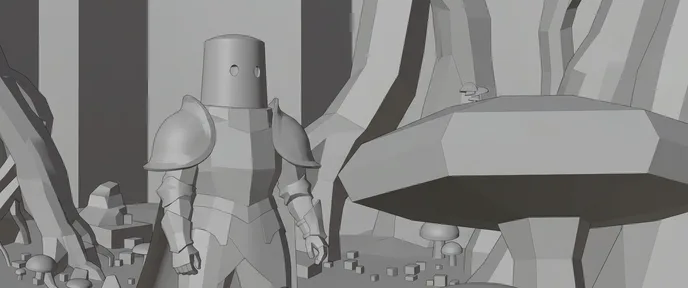
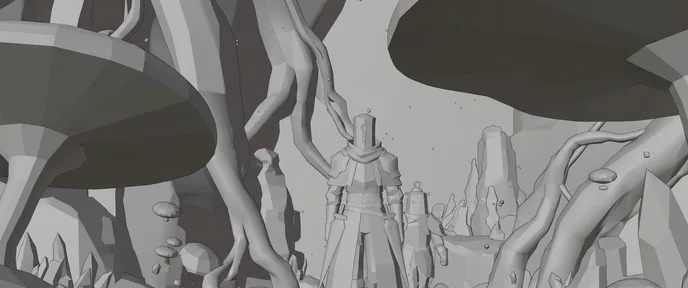
  1. A small knight with a lantern helm stands by a giant glowing blue mushroom in a crystal cavern
    Storyboard frame of the same wide shot, in grey
    01

    Wide · the world

    Wide shot, Lantern alone by a giant glowing blue mushroom, crystal cavern, roots, drifting spores, cold blue light

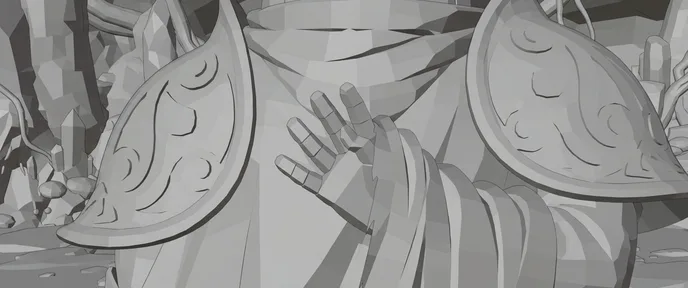
  2. Close-up of an armored chest under a cream cloak, a gloved hand, a spark of light
    Storyboard frame of the chest close-up, in grey
    02

    Close-up · the chest

    Close-up on Lantern's chest, his gloved hand pressed to the cloak, a spark of light escaping between the fingers

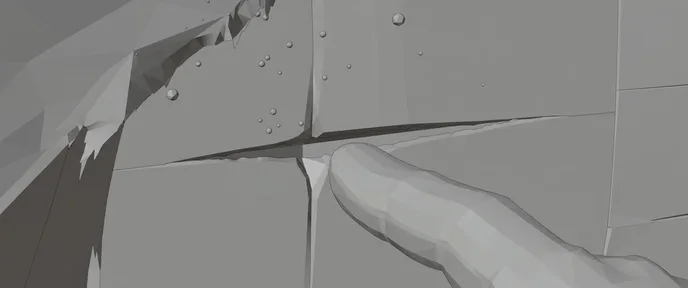
  3. A torn gash in an armor plate leaking bright blue light, a finger pointing at it
    Storyboard frame of the wound insert, in grey
    03

    Insert · the wound

    Extreme close-up, Serrure's finger near a torn gash in the back plate, blue light leaking out like luminous smoke

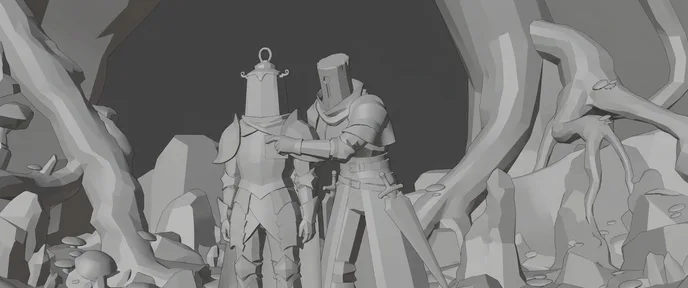
  4. Two armored knights side by side, one with a hand on the other's shoulder, in a crystal cavern
    Storyboard frame of the two-shot, in grey
    04

    Two-shot · the bond

    Medium two-shot among crystals and roots, Serrure's hand on Lantern's shoulder, faceless armors, emotion through posture only

  5. Two small knights walk beneath two giant glowing blue mushrooms
    Storyboard frame of the wide shot, in grey
    05

    Wide · the scale

    Wide low angle, the two knights tiny beneath two giant glowing mushrooms, blue crystals in the foreground, mist

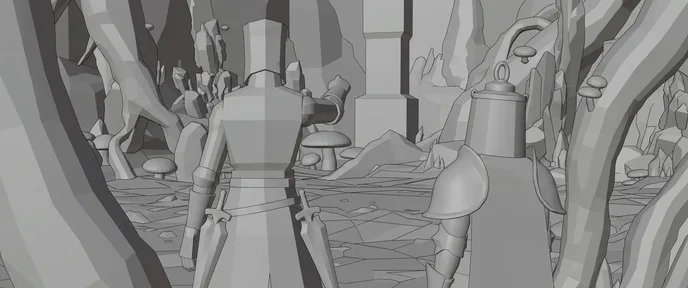
  6. Seen from behind, a tall dark knight points ahead while the small lantern knight looks on
    Storyboard frame of the over-the-shoulder shot, in grey
    06

    Over the shoulder · the road

    Over-the-shoulder from behind, Serrure points ahead into the cavern, Lantern beside him, roots framing the path

Lost Garden, episode 2, 21 minutes, made with Seedance by the ScreenWeaver team. The AI London Festival named episode 1 a finalist. Sheffield counts anything up to 40 minutes as a short, so a film of this length would pay the short-film fee. Playback begins on the opening cave scene.

The script

A 30 minute documentary in five movements.

Up to 40 minutes, credits included, is a short at Sheffield and costs less. A 30 minute film with one authored synthetic sequence is a shape the programmers can place. Think treatment and narration, not shot list.
  1. 0:00 to 3:00

    The claim

    A real place, voice or document, and the question the film will test.

  2. 3:00 to 9:00

    The people

    Contributors and locations, filmed. The audience must believe you before anything synthetic appears.

  3. 9:00 to 21:00

    The missing footage

    The authored sequence stands in for what nobody recorded. Frame it so it cannot be taken for archive.

  4. 21:00 to 28:00

    The challenge

    Return to real testimony and confront the reconstruction with it.

  5. 28:00 to 30:00

    The ground

    Close on something verifiable. Leave the effect to the middle of the film.

Keep the label constant. A frame, a colour or a change of ratio that marks synthetic material must appear every time. A viewer who learns the code once should never have to learn it again.

Step by step

From the claim to the early entry.

Seven weeks to 20 November, with a second chance at 29 January. The early window rewards a finished cut, not a rushed one.
  1. 01

    By 8 October

    Test the claim

    Say in two sentences what real thing the film documents. If you cannot, it is fiction, and an AI festival is the better door.

  2. 02

    By 15 October

    Inventory what is synthetic

    A table of every generated image, voice or music cue: tool, version, date, prompt and the source of any reference. Add the timecode where each appears.

  3. 03

    By 29 October

    Write and board the recreations

    The treatment and the storyboard of the sequences you author, in ScreenWeaver. Decide the visual code that sets them apart from footage.

  4. 04

    By 12 November

    Cut a screener

    An online screener on Vimeo or YouTube, H264 or MP4, with English subtitles where needed. A rough cut is acceptable if the film will not change in essence.

  5. 05

    20 November, before noon GMT

    Enter at the early rate

    The form, the fee and a direct link with the right password. Your film is viewed only once the form is complete and the fee paid.

  6. 06

    December to January

    Use the standard window if you are not ready

    £38 or £48 plus VAT. A better cut entered on 29 January beats an unfinished one entered in November.

  7. 07

    April to May 2027

    Prepare for a yes

    A DCP, accessibility assets such as descriptive subtitles or audio description, and the final cut available by mid May.

Why films get rejected

Eight ways to be out before you are watched.

These come from the entry guidelines. None is about AI, and each can cost you a fee or a place.
  • A film already online

    The film must not be available on any platform accessible to UK audiences, and must be at least a UK premiere. If it has been shown, its world premiere must fall after 1 April 2026.

  • Entering a fiction film

    The festival welcomes completed documentary films. A story invented from scratch makes no claim on reality, and has no place in this call.

  • No English

    Entered films need English dialogue or English subtitles. A transcript or a partial translation is not accepted.

  • Unlicensed material

    DocFest may disqualify a film that includes unauthorised copyrighted material. Keep licences for music, archive and any generated output that reproduces something protected.

  • Entering an old film again

    A film previously submitted to DocFest is eligible again only if it has changed significantly in narrative or art form.

  • An incomplete entry

    A film is viewed only when the form is complete and the fee paid, by card online. The fee is non-refundable, with no combined discounts.

  • A screener that does not play

    Give a direct link and the right password. If either changes, write to films@sheffdocfest.com with the new one.

  • The wrong screening format

    Sheffield screens only DCP, 35mm and 16mm. Without a DCP, the festival can point you to a mastering service.

Why ScreenWeaver

A documentary festival asks for proof. ScreenWeaver keeps the record.

ScreenWeaver builds authored film: screenplay, storyboard and footage in one connected project. It does not shoot or edit a documentary. It handles the parts you write, and keeps a record of them.
  • Treatment and structure, free

    Write the treatment and the narration on the Screenwriter plan, with outline and beats, and export to PDF or Final Draft. Structure is where a documentary is won in the edit, and it starts here.

  • A record of every generated shot

    Every generated shot stays linked to its scene, its storyboard frame and its prompt, because the pipelines are connected to the script. That record answers a programmer’s question about method.

  • Recreations that look like recreations

    Boarding a sequence lets you choose its look, ratio and movement before it exists. You can make it unmistakably different from your footage.

  • Start for free today

    The Screenwriter plan is free for good, $0 and no expiry, and covers the treatment and the narration. The storyboard beta runs $9.99 a month, and Seedance video generation comes with the Filmmaker plan.

Real productions

International festival-recognized films have been written and produced with ScreenWeaver.

ScreenWeaver is already being used as a creative workspace for real AI film productions, from cinematic shorts to animated series pilots selected, nominated, and awarded by international festivals.

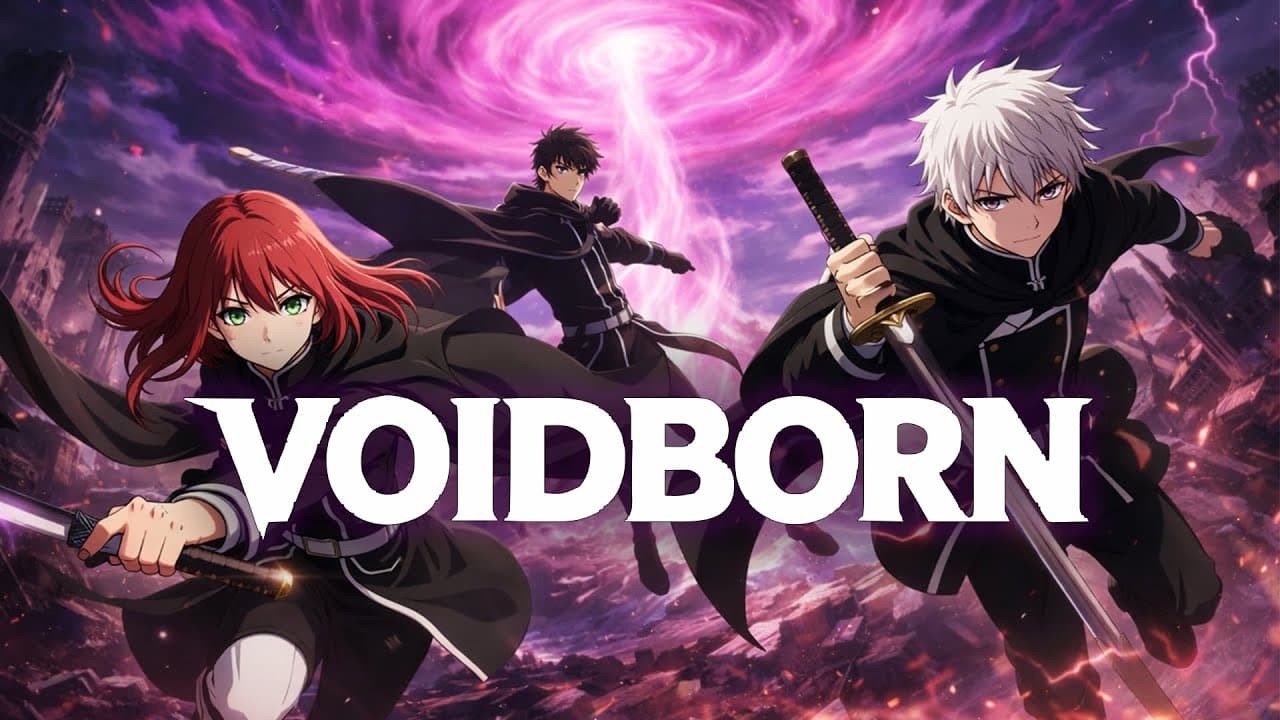
  • Video thumbnail for VOIDBORN

    VOIDBORN

    AI animated / cinematic short

    Festival recognition

    • 1st Place Silver

      Mondial Chroma Awards

    • 2nd Place Dreamina

      Mondial Chroma Awards

    • Award Winner

      Seoul International AI Film Festival

  • Video thumbnail for Les Fils du Vinnana

    Les Fils du Vinnana

    AI short film

    Festival recognition

    • Honorable Mention

      Top Quark Film Festival

    • People's Choice Nominee

      Illuminate Oneness of Humanity

    • Nominee

      ALTFF Supershort

  • Video thumbnail for Lost Garden

    Lost Garden

    AI animated series pilot

    Festival recognition

    • Finalist

      AI London Festival

The pipeline

Write. Board. Produce.

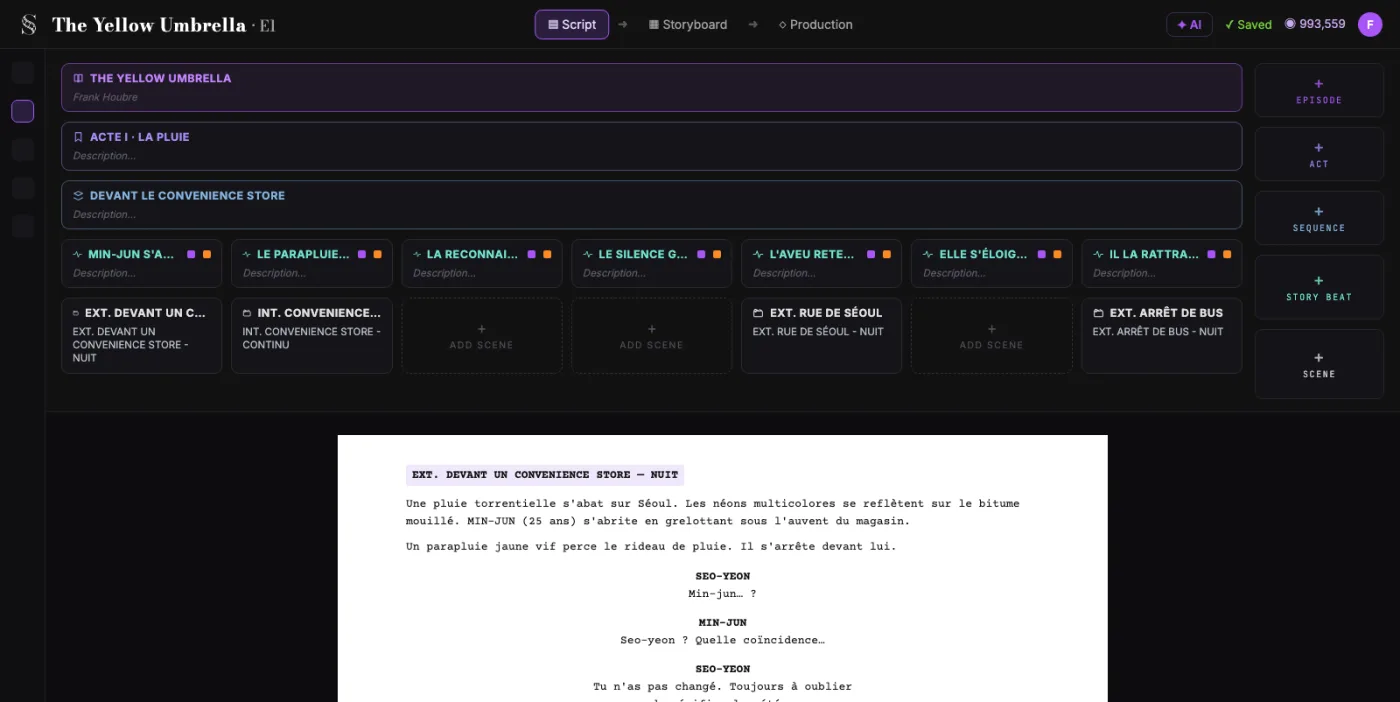
  1. ScreenWeaver screenplay editor: acts, sequences and beats above the formatted script of The Yellow Umbrella

    01The screenplay, enriched

    An industry-standard screenplay editor, and more: a visual outline and beat editor, your writing inspirations (notes, photos, audio) kept next to the page, and an AI researcher to support your writing, not replace it.

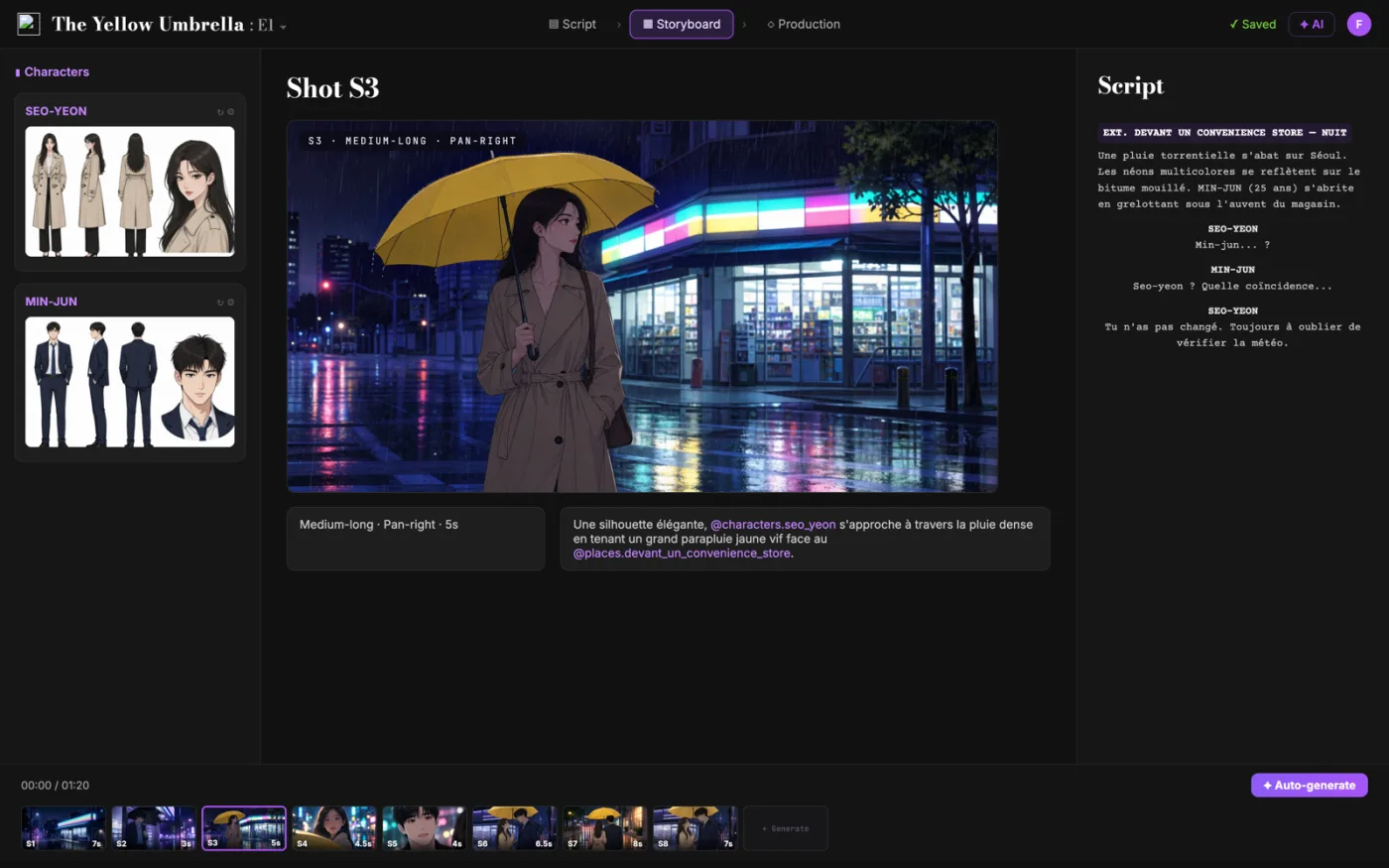
  2. ScreenWeaver storyboard: shot S3 of The Yellow Umbrella with characters, shot settings and the script beside it

    02The storyboard, made easy

    Shot breakdown generated from your screenplay, manual control over every shot (frame, angle, movement, duration), and generative AI previsualization in one click.

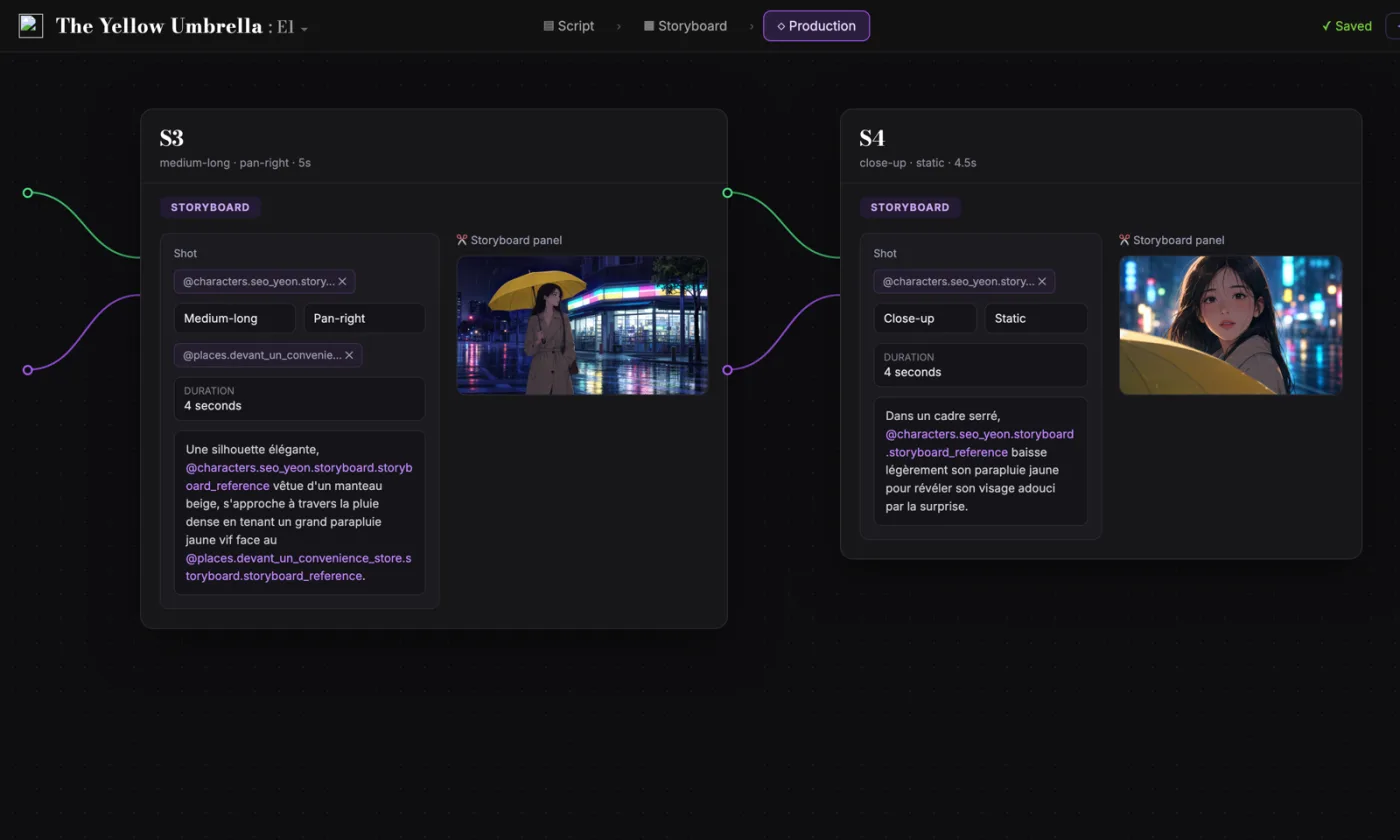
  3. ScreenWeaver production canvas: shots S3 and S4 as connected nodes carrying their storyboard panels and prompts

    03AI production, with finesse

    Footage generation pipelines connected to your screenplay and storyboard. Optimized out of the box, fully editable workflow.

FAQ

Sheffield DocFest and AI films, your questions

Can you submit an AI film to Sheffield DocFest?
The 2027 Film Entry Guidelines contain no AI clause, so nothing forbids it and nothing requires a disclosure. They are written for completed documentary films, so a fiction film made with AI is not the right fit. The early deadline is 20 November 2026.
What are the Sheffield DocFest 2027 deadlines?
Early on 20 November 2026, standard on 29 January 2027 and late on 19 February 2027, each at 12:00 noon GMT. The festival runs from 9 to 14 June 2027, and you are told by April.
What are the Sheffield entry fees?
For shorts up to 40 minutes, £30, £38 or £48 plus VAT by window. For films over 40 minutes, £40, £48 or £58. Fees are paid by card and are non-refundable.
Do I have to tell Sheffield DocFest my film uses AI?
The guidelines do not ask. For a documentary, telling is wise: the Archival Producers Alliance guidelines call for transparency to the audience. Say it in your synopsis and in the credits.
Which premiere status does Sheffield require?
At least a UK premiere at Sheffield, and not available online to UK audiences. If it has been shown, the world premiere must be after 1 April 2026. Some awards need an international or world premiere.
Is a rough cut accepted?
Yes, if the film will not change in essence and the final cut is available in mid May 2027. Send the most recent cut before the deadline.
Does Sheffield take series?
Series and episodic work are considered only as world premieres. The festival advises a maximum of 120 minutes of material in a single preview link, such as two 60 minute episodes.
Is there a discount?
Yes. Graduate films from film schools and universities get 25 percent off, with proof of status. Filmmakers in DAC-listed countries get 25 or 50 percent off, and the least developed countries are waived. Discounts do not combine.

The early window closes on 20 November. Start with the claim.

Open the treatment page for free today. Board the sequences you author, and keep a record of every generated element.