César 2027 · AI films guide

Can an AI film enter the César?No AI rule exists. The filters are French, and strict.

The Académie des Arts et Techniques du Cinéma’s regulation does not mention AI at all. It does set a short film route and an animation route, tied to French production, a CNC visa and a vote by film professionals. Here is how they work, and how to prepare a film for the next window.
  • No AI rule in the regulation
  • Shorts under 1 hour, animation under 25% live action
  • Ceremony 25 February 2027
Lost Garden · Episode 2

Independent guide. ScreenWeaver does not organise the César and is not affiliated with the Académie des Arts et Techniques du Cinéma. Rules read on 1 October 2026. Official regulation

Available today in ScreenWeaver: free screenwriting, and a storyboard generated from your screenplay with Storyboard Beta, $9.99 a month.

Rolling out: video generation of each shot, powered by Seedance, with the Filmmaker plan.

The rules on one card

What the Académie asks of a film.

The César are not a festival with a call for entries. They are the prizes of a professional academy, voted by its members. The regulation is written for French cinema, and it is silent on AI.
Next ceremony
25 February 2027, Olympia, Paris
Who decides
Academy members, secret two-round online vote
AI rule
None in the 2025-2026 regulation
Short film
Under 1 hour, at least 30% French production
Registration for shorts
Form open 15 January to 15 July of the year before
Visa
CNC exploitation visa, 1 July to 30 June
Animated short
Under 25% live action, up to 12 films selected
Feature
French-initiative, CNC approval, 7 days in Paris

Source: the Règlement de l’Académie des Arts et Techniques du Cinéma, 2025-2026 version (PDF), and the full regulation page on academie-cinema.org, both read on 1 October 2026. Article 7 says the regulation is updated every year. The ceremony date comes from press reports of the Canal+ announcement. No entry fee appears in the regulation.

What the rules say about AI

Silence on AI, six rules that decide anyway.

We searched the whole regulation on 1 October 2026 for “intelligence artificielle”, “IA” and “génératif”. No match. That makes the other rules, the ones about who may enter and who votes, the real policy.
  • What the regulation says about AI

    Nothing. No ban, no disclosure duty, no AI category and no mention of generated images, voices or screenplays. It is the 2025-2026 text: Article 7 provides for an annual update, so read the new version when it is published.

  • Who votes

    The Académie is made of adult professionals of French cinema, and aims to keep at least 80% of its members among those who directly make films. They vote in secret, in two rounds, online. An AI film must convince film professionals, not a panel of technologists.

  • The short film route

    Shorts compete only if the Short Film Committee selects them. They must have a running time strictly under one hour, a French production share of at least 30%, and an exploitation visa from the CNC obtained between 1 July and 30 June. A film can enter only one short category: fiction, animation or documentary.

  • The animation route

    For the animated short, live-action footage must be under 25% of the running time, and the lead production company declares the film as animation at registration. Up to twelve films are selected for the first round, then three are nominated.

  • The feature route

    Best Film needs a feature of French initiative with CNC production approval and an exploitation visa, released in a commercial cinema of the Paris region for at least seven consecutive days. Best Animated Feature draws from those features, plus some minority co-productions. That is a theatrical release, not an upload.

  • Qualifying prizes

    Selection for shorts starts from a list of qualifying prizes, then a committee completes it. That list is approved each year by the Bureau and filed with the secretariat: the regulation does not publish it. Ask the Académie which festivals count.

Key dates

The 2027 window has closed. Learn its clock.

Registration for the February 2027 ceremony ended on 15 July 2026. The next window follows the same rule if the 2026-2027 text keeps it, which is not guaranteed.
  1. 1 Jul 2025 to 30 Jun 2026

    Visa window, 2027 ceremony

    A short had to hold its CNC exploitation visa, other than a temporary or exceptional one, within these twelve months.

  2. 15 Jan to 15 Jul 2026

    Registration, 2027 ceremony

    The dedicated form was open for six months. Closed for this ceremony.

  3. 25 Feb 2027

    The 52nd ceremony

    Announced at the Olympia in Paris, broadcast on Canal+. The regulation puts the ceremony at the end of February or the start of March.

  4. From 15 Jan 2027

    Registration, 2028 ceremony

    If the rule is unchanged, shorts holding a visa from 1 July 2026 to 30 June 2027 can register until 15 July 2027.

Who decides

Committees first, then the whole Académie.

No jury is named in the regulation. It does describe three successive filters, and members of the committees are bound by confidentiality.
  • The short film committees

    Fiction shorts pass an expert committee, which pre-selects by postal vote, then an artistic committee of directors, writers, composers, actors and technicians who have been nominated or have won a César. Animation and documentary have one dedicated committee each.

  • The selection quotas

    At most 24 fiction shorts and 12 animated shorts go to the first round. Few films pass this filter, and the committee does not explain its choices.

  • The first round

    All members vote in every category. Five films are nominated per category, except three for the animated short and the documentary short, and four for the fiction short.

  • The second round

    The nominated films are voted again, still by every member, and the ceremony reveals the winner. A member sees the nominees on a viewing platform, so a clear film in the first minutes helps.

Categories

Three prizes an AI film could aim for.

The César have no theme. They have categories, and your film does not choose among them alone: the producer declares its type at registration. Three are realistic, and under each is the angle we would take.
  • 01

    Best Fiction Short Film

    Shorts under one hour, declared as fiction, with up to 24 films selected for the first round.

    The most competitive door. A generated look has to be justified by the story: make the film something only this method could do, not a cheaper version of a live-action short.

  • 02

    Best Animated Short Film

    Shorts under one hour with under 25% live action, up to 12 selected and three nominated.

    The natural home of an AI-generated animated film, and the smallest field. Expect it to be compared with animated shorts that already won festival prizes, since qualifying prizes feed the selection.

  • 03

    Best Animated Feature

    Features with under 25% live action: French-initiative films that can compete for Best Film, and some French minority co-productions, released in cinemas.

    A long-term goal for a series built to become a film. It needs a distributor and a theatrical release, which no tool provides.

Reading the fine print

What the regulation teaches an AI filmmaker.

Nearly every sentence is about who made the film and how it reached the screen: producers, visas, releases, committees. None is about the tools. That is the lesson: the César judge a film as a French cinema object.

  1. 01

    The film travels through qualifying prizes. A short with no festival record is unlikely to reach a committee. Build a path through festivals the Académie recognises.

  2. 02

    One film, one category. A film can compete in only one short category, so choose fiction, animation or documentary with the producer before registering.

  3. 03

    The producer declares, the committee verifies. The film’s type is stated by the lead production company with the director’s agreement. A film cannot call itself animation if more than a quarter of it is live action.

Page to screen

Lost Garden: six shots from episode 2.

The César have a prize for animated shorts, and the length ceiling is one hour. This is the opening of Lost Garden, episode 2, an animated series made by the ScreenWeaver team: the screenplay page, then each shot as a storyboard frame and as the final image.

Logline. A newborn knight whose inner light is leaking away crosses a world that has stopped hoping, to find the one blacksmith who can seal his armor.

Screenplay · episode 2 · page 1

INT. UNDERGROUND CAVERN - LOWER PATH - CONTINUOUS

Blue mushrooms the size of houses. LANTERN, a small knight with a lantern for a helm, walks alone.

He presses a hand to his chest. Sparks of light slip between his fingers.

SERRURE

Hold on. You're losing something.

Serrure lifts the edge of the cloak. A gash in the armor. Blue light leaks out like smoke.

SERRURE

That's your energy. What keeps you standing.

He grips Lantern's shoulder. Two knights alone among the crystals.

SERRURE

A suit that leaks goes out. Eventually.

Under the giant mushrooms, the road climbs into the dark.

SERRURE

So. We follow the road.

Serrure points the way. Lantern follows.

CUT TO:

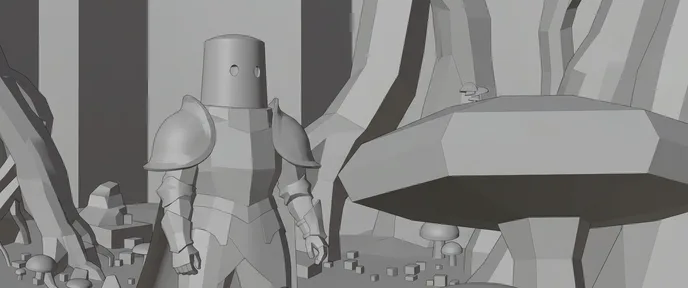
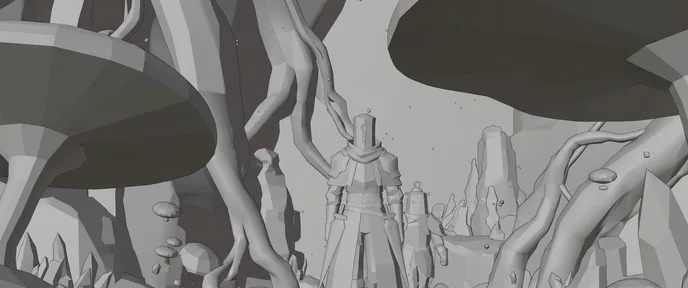
  1. A small knight with a lantern helm stands by a giant glowing blue mushroom in a crystal cavern
    Storyboard frame of the same wide shot, in grey
    01

    Wide · the world

    Wide shot, Lantern alone by a giant glowing blue mushroom, crystal cavern, roots, drifting spores, cold blue light

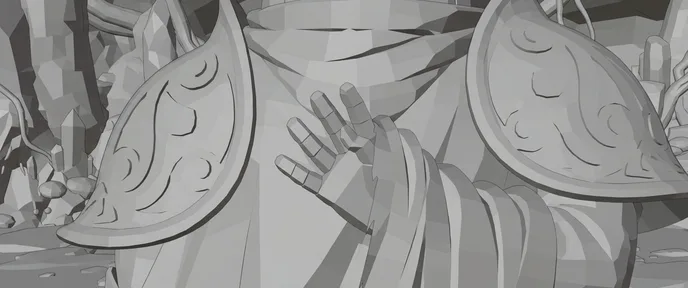
  2. Close-up of an armored chest under a cream cloak, a gloved hand, a spark of light
    Storyboard frame of the chest close-up, in grey
    02

    Close-up · the chest

    Close-up on Lantern's chest, his gloved hand pressed to the cloak, a spark of light escaping between the fingers

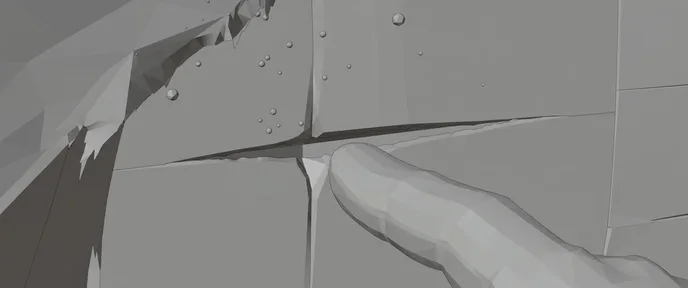
  3. A torn gash in an armor plate leaking bright blue light, a finger pointing at it
    Storyboard frame of the wound insert, in grey
    03

    Insert · the wound

    Extreme close-up, Serrure's finger near a torn gash in the back plate, blue light leaking out like luminous smoke

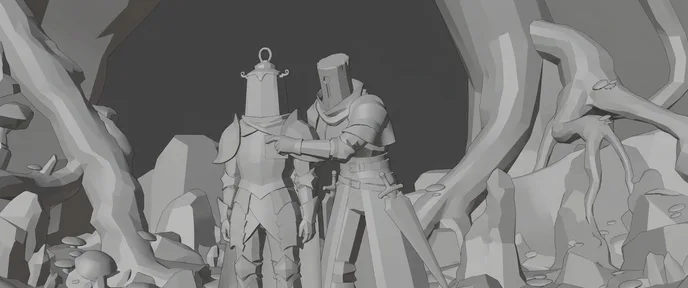
  4. Two armored knights side by side, one with a hand on the other's shoulder, in a crystal cavern
    Storyboard frame of the two-shot, in grey
    04

    Two-shot · the bond

    Medium two-shot among crystals and roots, Serrure's hand on Lantern's shoulder, faceless armors, emotion through posture only

  5. Two small knights walk beneath two giant glowing blue mushrooms
    Storyboard frame of the wide shot, in grey
    05

    Wide · the scale

    Wide low angle, the two knights tiny beneath two giant glowing mushrooms, blue crystals in the foreground, mist

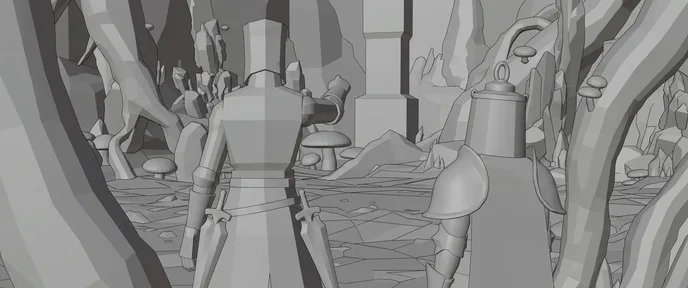
  6. Seen from behind, a tall dark knight points ahead while the small lantern knight looks on
    Storyboard frame of the over-the-shoulder shot, in grey
    06

    Over the shoulder · the road

    Over-the-shoulder from behind, Serrure points ahead into the cavern, Lantern beside him, roots framing the path

Lost Garden, episode 2 runs 21 minutes, well under the one-hour ceiling for a short, and is animated throughout. An animated series by the ScreenWeaver team, made with Seedance; episode 1 was a finalist at the AI London Festival. The player opens on the cave scene shown above.

The script

Fifteen minutes, four movements.

A short can run up to 59 minutes, but a film that arrives in front of a committee should be concise. Aim for 15 minutes: about 15 screenplay pages and 100 to 140 shots of 5 to 8 seconds.
  1. 0:00 to 1:15

    The first image

    A committee watches many films. Open on a clear place and a clear problem.

  2. 1:15 to 5:15

    The character and the wish

    Who we follow, what they hope for, and the look of the world, held steady.

  3. 5:15 to 12:00

    The complication

    A single escalating situation. One scene told through image and sound alone.

  4. 12:00 to 15:00

    The consequence

    The change the film promised, shown without explanation. Then the credits.

Let the story, not the tool, be the subject. A member voting in the second round remembers a character and a feeling. Say how the film was made in the production notes, and keep the explanation out of the film.

Month by month

From now to the next registration.

The 2027 window is closed. This plan targets registration in January to July 2027, for the February or March 2028 ceremony, if the rule is unchanged. Most of it is production-company work, and it comes before any shot.
  1. 01

    October 2026

    Find the French producer

    The regulation asks for a French production share of at least 30% and a company holding the author’s rights. Without such a company, the film cannot register. This step comes before the screenplay.

  2. 02

    November to December 2026

    The screenplay and the choice of category

    Write it free in ScreenWeaver, for fiction or for animation. Decide with the producer which category to declare: a film can enter only one.

  3. 03

    January to March 2027

    Shot list and look

    Generate the shot breakdown from the screenplay, then lock the look: palette, characters, locations. A consistent animated film reads as authored.

  4. 04

    April to May 2027

    Footage, edit and sound

    Generate scene by scene as video generation reaches your plan. Keep prompts and versions: your production notes come from them.

  5. 05

    June 2027

    The CNC visa

    Your producer applies for the exploitation visa. It must be granted by 30 June to count for this window, and a temporary or exceptional visa does not count.

  6. 06

    Until 15 July 2027

    Register with the Académie

    The producer files the dedicated form with the film’s type declared. Ask the Académie which festivals are qualifying prizes before you spend on entries.

Ways to lose the entry

Eight reasons the Académie will not look.

None of them concerns AI. All of them are in the regulation, and most are about the production company.
  • No French production company

    A short needs at least 30% French production and a company holding the author’s rights. A film with no French production company behind it cannot register.

  • A running time of one hour

    A short must be strictly under an hour. A film that reaches 60 minutes is not a short.

  • A temporary or exceptional visa

    Only a standard CNC exploitation visa counts, granted within the visa window. Check the dates with your producer before you finish the film.

  • Missing the registration window

    The form is open from 15 January to 15 July of the year before the ceremony. A film whose visa came between 1 January and 30 June may ask to compete a year later, by a letter signed by the director and the producer.

  • One film, two categories

    A film is eligible for one short category only. Declaring it as fiction and animation is not an option.

  • Too much live action in an animated film

    For an animation prize, live-action footage must stay under 25% of the film. Mixing a generated animation with filmed sequences must be counted.

  • Expecting a technology prize

    The César have no AI category and no prize for the method. A film wins as a film, voted by human professionals.

  • A feature with no theatrical release

    Best Film needs a run of at least seven consecutive days in a Paris-region commercial cinema. An online premiere does not count.

Why ScreenWeaver

The César judge the film. ScreenWeaver helps you make one.

The Académie asks for no tool and takes no position on AI. What decides is the film itself, and a film comes from a script: screenplay, storyboard and footage in one connected project.
  • A screenplay a committee can read

    A tight screenplay in industry format, with a clear change at the end, gives a producer something to defend and a committee something to remember.

  • An animated look that holds

    References for characters and sets carry from shot to shot, so the film reads as one hand’s work. That is what separates a short from a sequence of clips.

  • Notes for a producer

    A producer who signs for the film wants to know how it was made. Each shot is traceable to its scene, its frame and its prompt, so the production notes write themselves.

  • Start for free today

    Your producer will want a script first, and the Screenwriter plan provides one at $0, with no expiry. A storyboard comes with Storyboard Beta at $9.99 per month. Footage generation will come with the Filmmaker plan, currently rolling out.

Real productions

International festival-recognized films have been written and produced with ScreenWeaver.

ScreenWeaver is already being used as a creative workspace for real AI film productions, from cinematic shorts to animated series pilots selected, nominated, and awarded by international festivals.

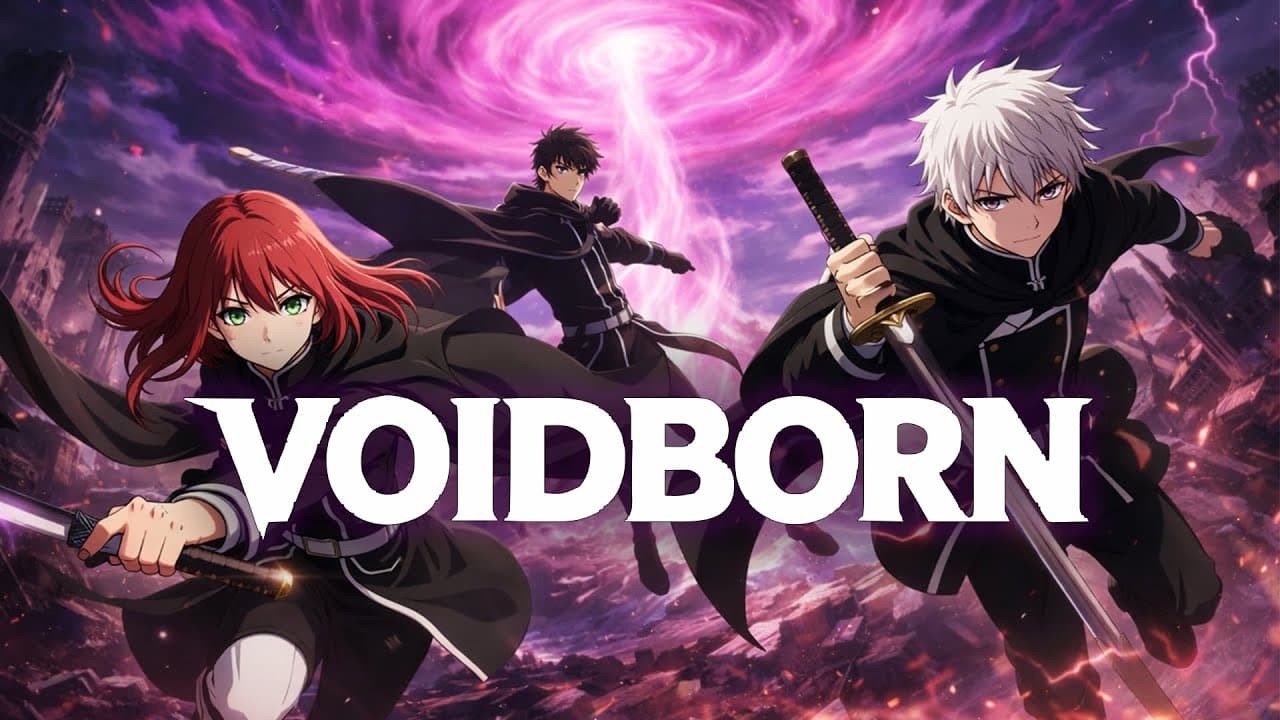
  • Video thumbnail for VOIDBORN

    VOIDBORN

    AI animated / cinematic short

    Festival recognition

    • 1st Place Silver

      Mondial Chroma Awards

    • 2nd Place Dreamina

      Mondial Chroma Awards

    • Award Winner

      Seoul International AI Film Festival

  • Video thumbnail for Les Fils du Vinnana

    Les Fils du Vinnana

    AI short film

    Festival recognition

    • Honorable Mention

      Top Quark Film Festival

    • People's Choice Nominee

      Illuminate Oneness of Humanity

    • Nominee

      ALTFF Supershort

  • Video thumbnail for Lost Garden

    Lost Garden

    AI animated series pilot

    Festival recognition

    • Finalist

      AI London Festival

The pipeline

Write. Board. Produce.

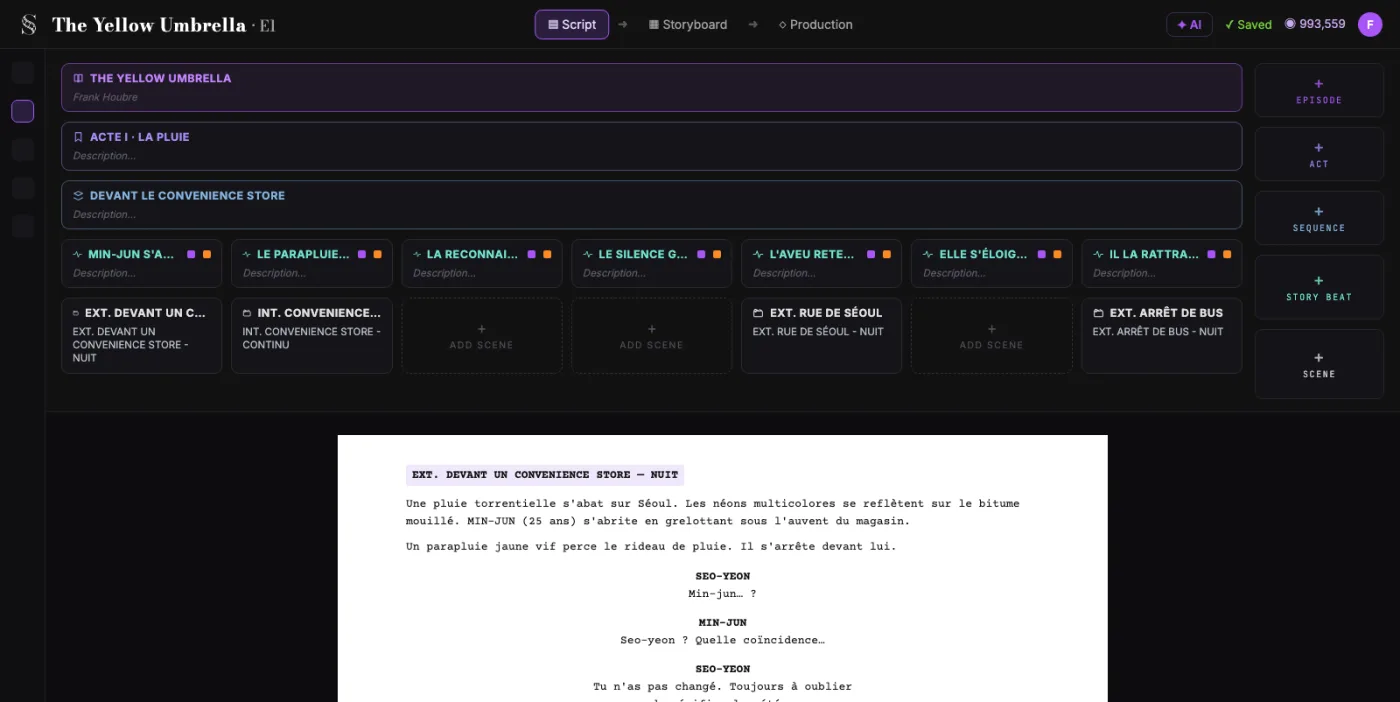
  1. ScreenWeaver screenplay editor: acts, sequences and beats above the formatted script of The Yellow Umbrella

    01The screenplay, enriched

    An industry-standard screenplay editor, and more: a visual outline and beat editor, your writing inspirations (notes, photos, audio) kept next to the page, and an AI researcher to support your writing, not replace it.

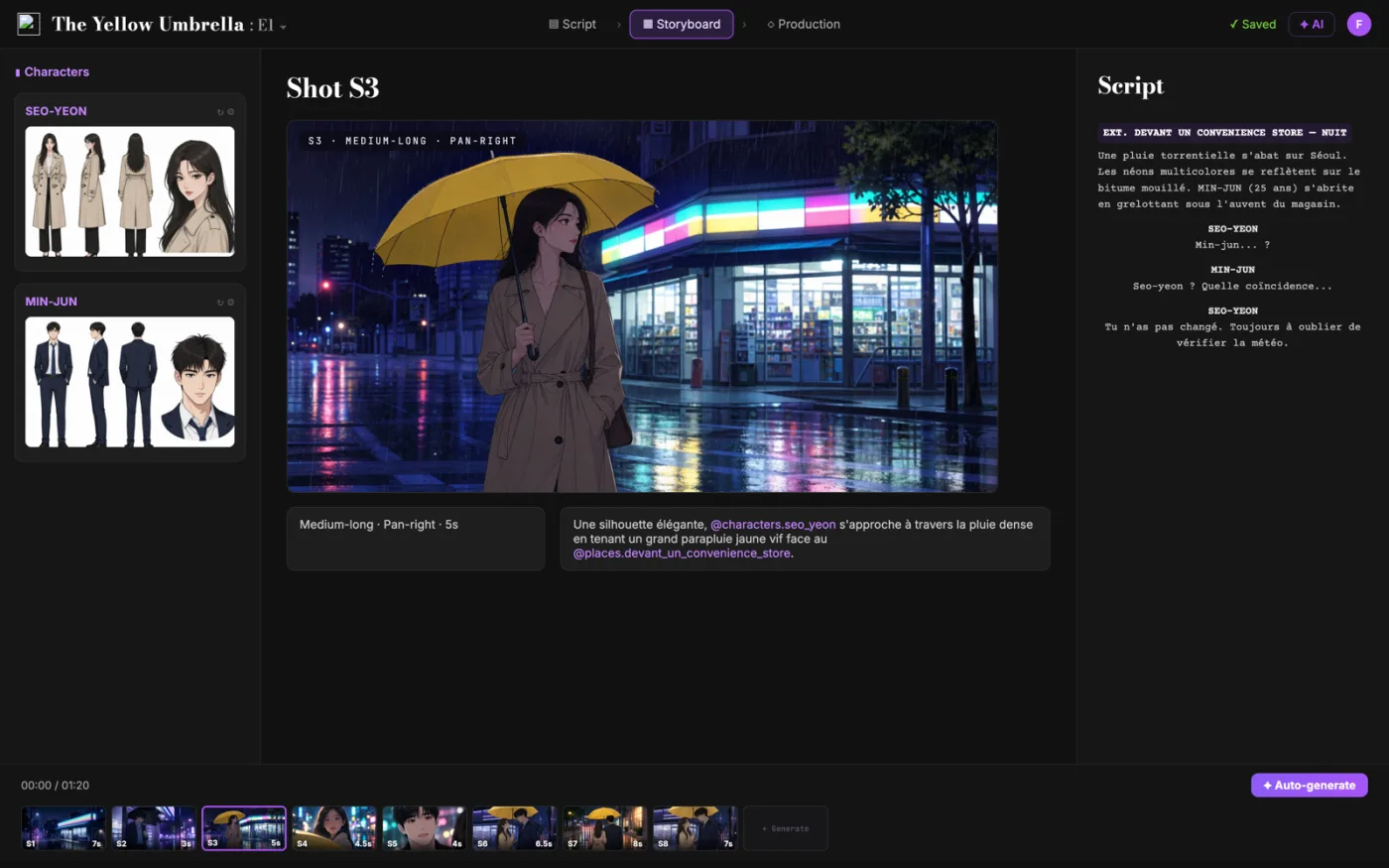
  2. ScreenWeaver storyboard: shot S3 of The Yellow Umbrella with characters, shot settings and the script beside it

    02The storyboard, made easy

    Shot breakdown generated from your screenplay, manual control over every shot (frame, angle, movement, duration), and generative AI previsualization in one click.

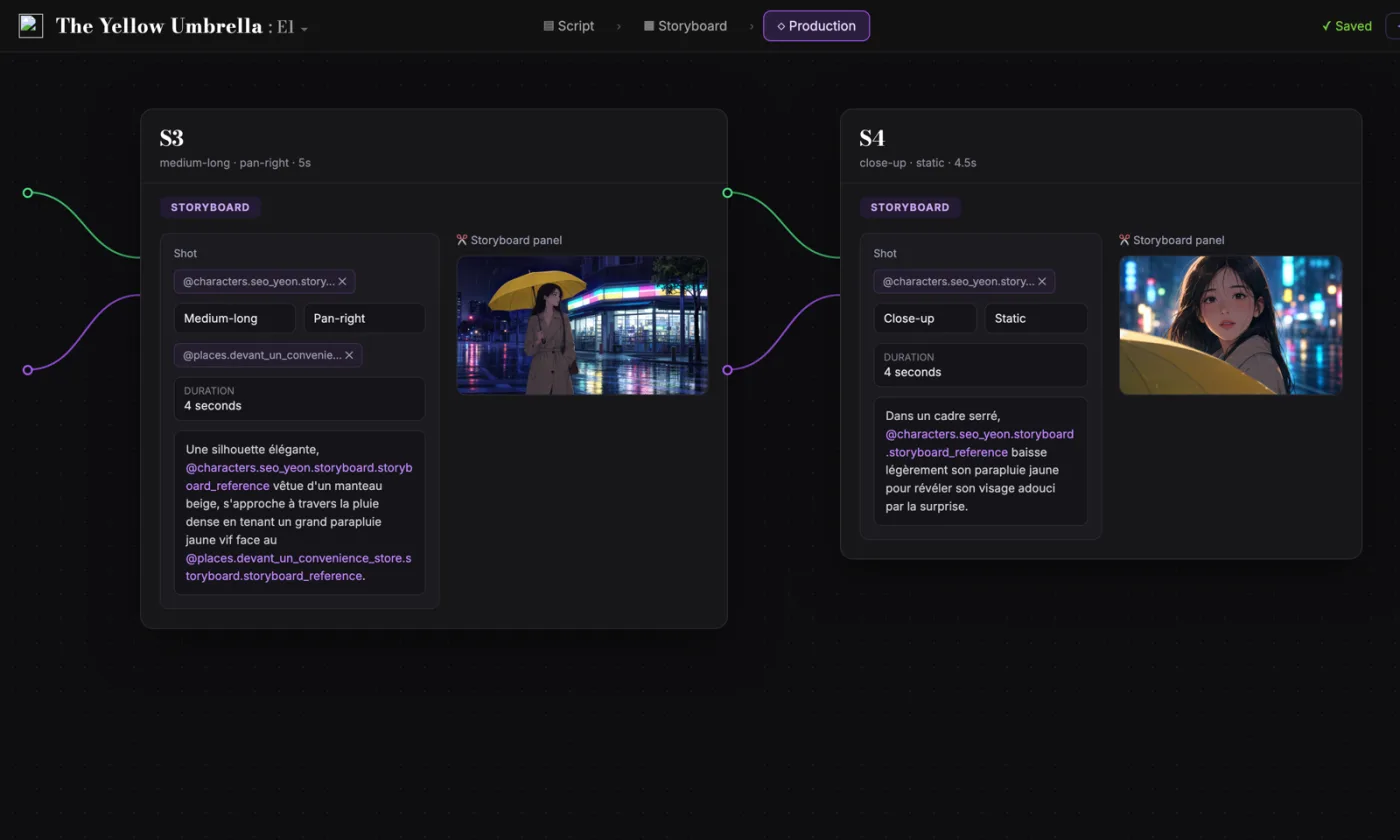
  3. ScreenWeaver production canvas: shots S3 and S4 as connected nodes carrying their storyboard panels and prompts

    03AI production, with finesse

    Footage generation pipelines connected to your screenplay and storyboard. Optimized out of the box, fully editable workflow.

FAQ

The César and AI films, your questions

Can an AI film enter the César?
The regulation of the Académie des Arts et Techniques du Cinéma does not mention AI, so it neither forbids nor welcomes it. Eligibility rests on French production, a CNC visa and a selection for shorts. The 2027 registration closed on 15 July 2026.
Is there a rule on AI in the César?
Not in the 2025-2026 regulation, which we read on 1 October 2026. Article 7 says it is updated every year, so check the next version when it appears.
How does a short film enter?
The production company registers it with the Académie’s dedicated form between 15 January and 15 July of the year before the ceremony. A committee then selects it. The film must run under an hour and hold a CNC visa.
Does an AI-generated animated film count as animation?
The regulation’s test is that live-action footage is under 25% of the running time and that the production company declares the film as animation. It does not say how the images are made.
Can I enter without a producer?
The registration is made by the production company, so you need one: your own, if it is French and holds the author’s rights, or a French partner’s. The film must reach at least 30% French production for a short.
When is the next ceremony?
The 52nd ceremony is announced for 25 February 2027 at the Olympia in Paris, broadcast on Canal+, according to press reports. Registration for it has closed.
What does it cost to register?
No fee appears in the regulation we read. Ask the Académie before you plan a budget.
Who votes for the winner?
The members of the Académie, in a secret online vote over two rounds. The Académie aims to keep at least 80% of its members among professionals who take direct part in making films.

A César film starts with a page.

Write the screenplay free today, then storyboard it and keep the notes your producer will ask for.