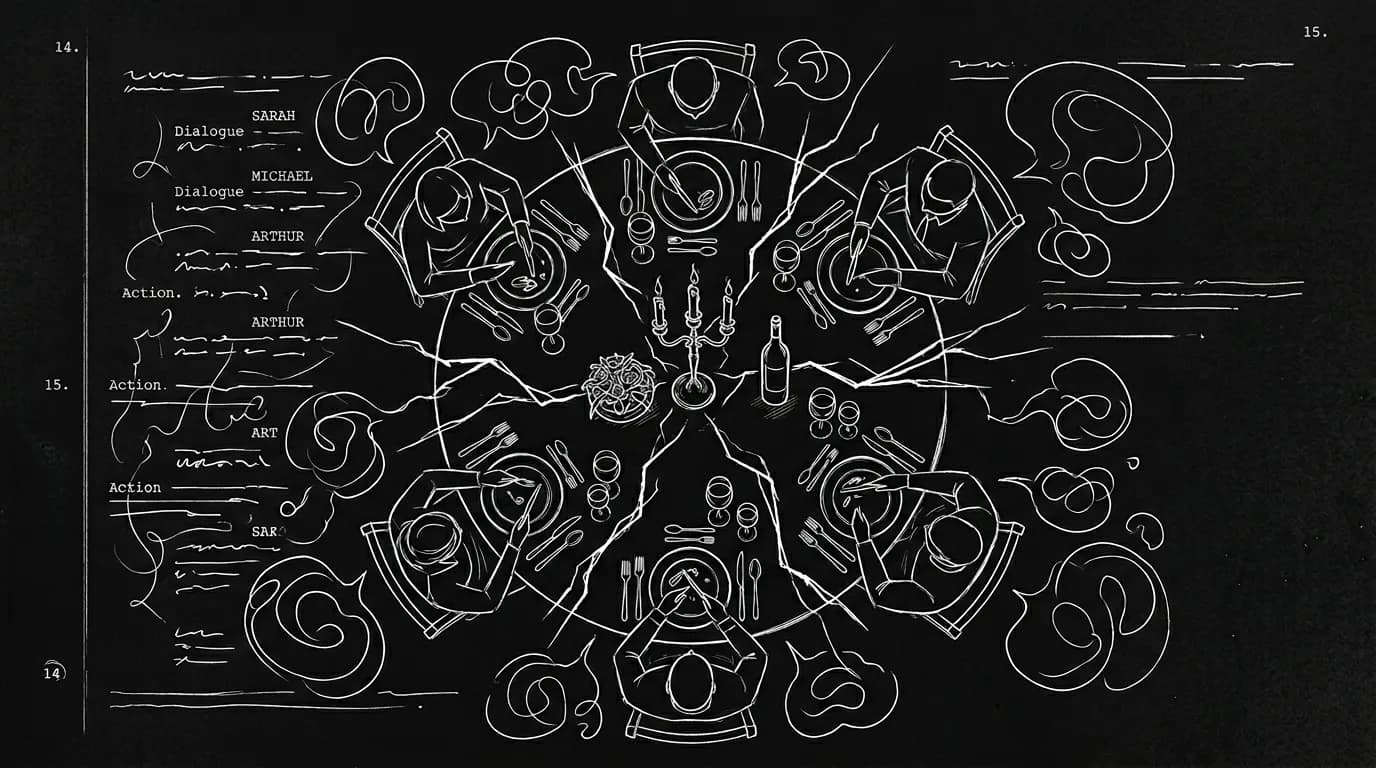

Six people sit around a table. They eat. They talk. The scene is eight pages long.
In the wrong hands, this is death. Static. Talking heads. A playwright's scene dropped into a screenplay where it doesn't belong.
In the right hands, this is Knives Out. The Godfather. August: Osage County. Parasite. Some of the most memorable scenes in cinema happen around a table, because the dinner scene is a pressure cooker. People are trapped in proximity. Exits are socially forbidden. Politeness is a mask, and everything beneath it is trying to erupt.
The dinner scene tests your craft. Can you make people sitting and eating feel dangerous, compelling, alive? Can you create visual movement without physical action? Can you sustain tension through subtext alone?
Here's how.
Free tool: use the Scene Extractor to pull and organize every scene from your script.
Cinematic workflow frames

These two visuals work as a pair: the first shows Cinematic workflow still, first angle, 35mm film grain, and the second shifts to Cinematic workflow still, second angle, 35mm film grain - compare them briefly, then move on.

Why Dinner Scenes Are Hard
The dinner scene fights against cinematic instincts:
Static staging. Characters are seated. Limited physical action. The camera has nowhere to go that's inherently interesting.
Dialogue-heavy. By nature, people at dinner talk. Without careful craft, the scene becomes a stage play transplanted to film.
Long form. Dinner takes time. If you're writing a dinner scene, you're probably writing multiple pages, maybe ten or more. That's a lot of runway to keep readers engaged.
Exposition risk. Dinner is often where writers dump backstory: "Remember when Dad left?" "Whatever happened to Uncle Frank?" The meal becomes a vehicle for information, and the scene dies.
The dinner scene is hard because it removes your easy tools: movement, location changes, action. What's left? Character. Subtext. Tension.
A great dinner scene is proof that you can write.
Principle #1: Something Must Be At Stake
The most common dinner scene failure is low stakes. People eat, chat pleasantly, and nothing happens. Why are we watching?
Every dinner scene needs a question the audience wants answered:
- Will she confront him about the affair?
- Will the secret be revealed?
- Will this family survive the meal without violence?
- Will the outsider be accepted or rejected?
The dinner is an arena. The food is incidental; the real meal is the conflict.
Example (stakes): A son brings his fiancée to meet his wealthy parents for the first time. The stakes: Will the parents accept her? The dinner is a trial, and every remark is a test.
Principle #2: Subtext Over Text
At dinner, people rarely say what they mean. They're polite. They're performing. The truth is beneath the surface.
Great dinner scenes are studies in subtext:
What they say: "This chicken is dry."
What they mean: "You're a failure. You've always been a failure."
What they say: "How's work going, sweetheart?"
What they mean: "I'm testing whether you'll lie to me."
If your dinner dialogue is on-the-nose, characters saying exactly what they feel, the scene will feel flat. Make them hide. Make them hint. Make the audience work.
A Table: Surface vs. Subtext Examples
| Surface Dialogue | Subtext |
|---|---|
| "Pass the salt." | Breaking eye contact. Refusing engagement. |
| "Your mother called." | "She thinks you're failing, and I agree." |
| "This is delicious." | A plea for approval. |
| "I remember when you used to cook." | "You've changed. We've changed." |
| "How long are you staying?" | "Please leave." |
| Silence. | The loudest statement of all. |
Principle #3: Use the Table As Choreography
Film is visual. Even in a static scene, you need visual storytelling. The general-purpose version of this diagnosis, for any scene that dies on the page, is in how to make a scene more visually interesting.
The table is your stage. Use it:
Who sits where? Seating reveals hierarchy and alliance. The patriarch at the head. The outsider at the corner. The estranged sibling across from their enemy.
What are they doing? Pouring wine. Cutting meat. Reaching for bread. Physical actions punctuate dialogue and reveal character. The nervous eater. The one who doesn't touch their food.
What's on the table? The meal is production design. A lavish feast says money. A sparse meal says poverty or asceticism. Empty bottles say drinking. Uneaten plates say tension.
Who moves first? In a long dinner scene, someone eventually leaves the table, to get something from the kitchen, to answer a phone, to storm out. These micro-movements are relief valves and escalation opportunities.

Principle #4: Build Through Beats
A long dinner scene isn't one beat, it's many. Structure it like a miniature narrative:
Beat 1: The Arrival. Characters assemble. Pleasantries. The surface is calm.
Beat 2: First Crack. Something slightly off. A comment that lands wrong. A look held too long.
Beat 3: Escalation. More cracks. The facade starts to slip. Cross-talk. Allies form and break.
Beat 4: Crisis. The breaking point. A confrontation. An accusation. A truth spoken aloud.
Beat 5: Aftermath. The silence after the explosion. Or: everyone pretending it didn't happen. Or: someone leaves.
Each beat is a mini-scene. Treat them as separate challenges.
Principle #5: Vary the Temperature
A ten-page dinner scene at constant intensity is exhausting. Vary the temperature:
Hot moments: Confrontation, revelation, raised voices.
Cold moments: Silence. Politeness returning. Someone changing the subject.
Medium moments: Backstory delivered casually. Small talk with underlying tension.
The variation keeps readers alert. They sense when the temperature is rising; they dread what's coming.
Try it free
Try Screenweaver for free on your script
It is free. Import your existing project, get a clearer view of your outline, and regain control of your story structure in minutes.
Start FreeScenario: A Dinner Scene Step by Step
Setup: Thanksgiving at a suburban home. Parents (RICHARD, CAROL), their adult children (SARAH, MICHAEL), Michael's new girlfriend (KIM), and the family dog begging under the table.
Stakes question: Will the family accept Kim, and will Michael finally stand up to his father?
Beat 1: Arrival (pages 1–2)
Pleasant chaos. Carol fusses over seating. Richard carves the turkey. Small talk about traffic, the house, Kim's job. Surface calm.
Beat 2: First Crack (page 3)
Richard asks Kim about her "plans." It sounds innocent, but his tone condescends. Sarah notices. Michael laughs it off, but his laugh is tight.
Beat 3: Escalation (pages 4–6)
Carol tries to steer toward safe topics. Richard keeps finding ways to diminish Kim, her education, her career, her "interesting" background. Sarah defends her, which surprises Kim. Michael is silent, eating faster.
Beat 4: Crisis (pages 6–7)
Richard makes one comment too many. Kim responds calmly but cuts him with surgical precision, she knows his business is failing; she Googled him. Richard explodes. Michael finally speaks: "Enough." He takes Kim's hand. They stand.
Beat 5: Aftermath (page 8)
Michael and Kim leave. Carol cries. Richard sits alone at the head of the table, turkey going cold. The dog whines.
Eight pages. Clear structure. Rising tension. Visual details. Stakes and payoff.
The "Trench Warfare" Section: What Goes Wrong
Failure Mode #1: Everyone Agrees
The characters have a pleasant conversation. No tension. No conflict. The scene is a documentary on polite eating.
How to Fix It: Introduce a source of friction. A secret someone's keeping. A historical wound. An outsider who doesn't fit. Dinner without conflict is boring.
Failure Mode #2: Too Many Characters
Eight people at the table, and you try to give everyone a scene. The reader loses track. No one has focus.
How to Fix It: Establish a primary conflict (two or three characters) and let others be chorus. Not everyone needs to speak.
Failure Mode #3: Static Action Description
"They eat." "They drink." "They listen." The page is visually dead.
How to Fix It: Specific actions. "Richard saws at his turkey, knife scraping plate, Carol winces." Use the props. Fork drops. Glass spills. The casserole goes untouched.
Failure Mode #4: Exposition Dump
"So Sarah, how's your job at the law firm where you've worked for five years since graduating from Yale?" The characters deliver biography.
How to Fix It: Exposition through conflict. We learn Sarah's a lawyer when Richard snaps, "Don't prosecute me, counselor, I'm your father." Information arrives sideways.
Failure Mode #5: Endless Scene
The dinner runs twelve pages. Nothing justifies the length. Readers skim.
How to Fix It: Cut ruthlessly. Does every page advance conflict? Does every exchange matter? If you can lose a beat, lose it.
Famous Dinner Scenes and What They Do
The Godfather – The Restaurant Hit:
It's a dinner meeting that's really an assassination. Stakes couldn't be higher. The tension comes from delay, Michael excuses himself, retrieves a gun, and must summon courage. The food is incidental; the violence is inevitable.
Knives Out – Family Dinner:
Multiple factions at one table, each lying about something. The scene is interrogation disguised as gathering. Every character has motive. The audience studies each face for guilt.
Parasite – Two Dinners:
The wealthy family's effortless dinner contrasts with the poor family hiding beneath the table. Same space, two realities. Class tension made visceral through staging.
August: Osage County – Funeral Dinner:
A powder keg. Truths that shouldn't be spoken are spoken. The table contains decades of resentment, and the scene lets it explode. Pure theatrical energy, but adapted with cinematic precision.

The Perspective: Stillness as Intensity
The dinner scene teaches something essential: stillness can be more intense than motion.
When characters are physically constrained, trapped by etiquette, by location, by social obligation, every small gesture gains weight. A raised eyebrow becomes a declaration of war. A fork set down becomes surrender.
This is the craft of writing beyond spectacle. You cannot rely on a car chase or a fistfight. You must rely on character, on dialogue, on the tension between what's said and what's meant.
If you can write a dinner scene that crackles, you can write anything. The skills transfer: subtext, visual detail, beat structure, stakes. These are universal.
So take the challenge. Six people. One table. Eight pages.
Make us unable to look away.
[YOUTUBE VIDEO: A scene breakdown of a famous dinner sequence, analyzing how the director and writer created tension through staging, dialogue, and editing within a single-room setting.]
Further reading:
- For scenes with hidden listeners, see writing the eavesdropping scene.
- If you're balancing multiple characters, see how to use AI to harmonize dialogue across multiple writers.
- The Academy's YouTube channel features interviews with writers about chamber-piece writing at youtube.com/@Oscars{:rel="nofollow"}.
Final Step
Build your next script with Screenweaver
Move from ideas to production-ready pages faster with timeline-native writing and AI-assisted story flow.
Try Screenweaver