Tribeca Festival 2027 · AI films guide

Can you submit an AI film to Tribeca?Yes. The rules say nothing about AI.

Tribeca's 2027 entry rules contain no clause on AI, and the festival has screened AI work since 2024. One program, Love & Laughs, bans generative AI. The fees, the sections and a plan for the first deadlines. Then build your film in ScreenWeaver, page by page and shot by shot.
  • Submissions open since 30 September
  • No AI clause in the main rules
  • Festival 3 to 12 June 2027
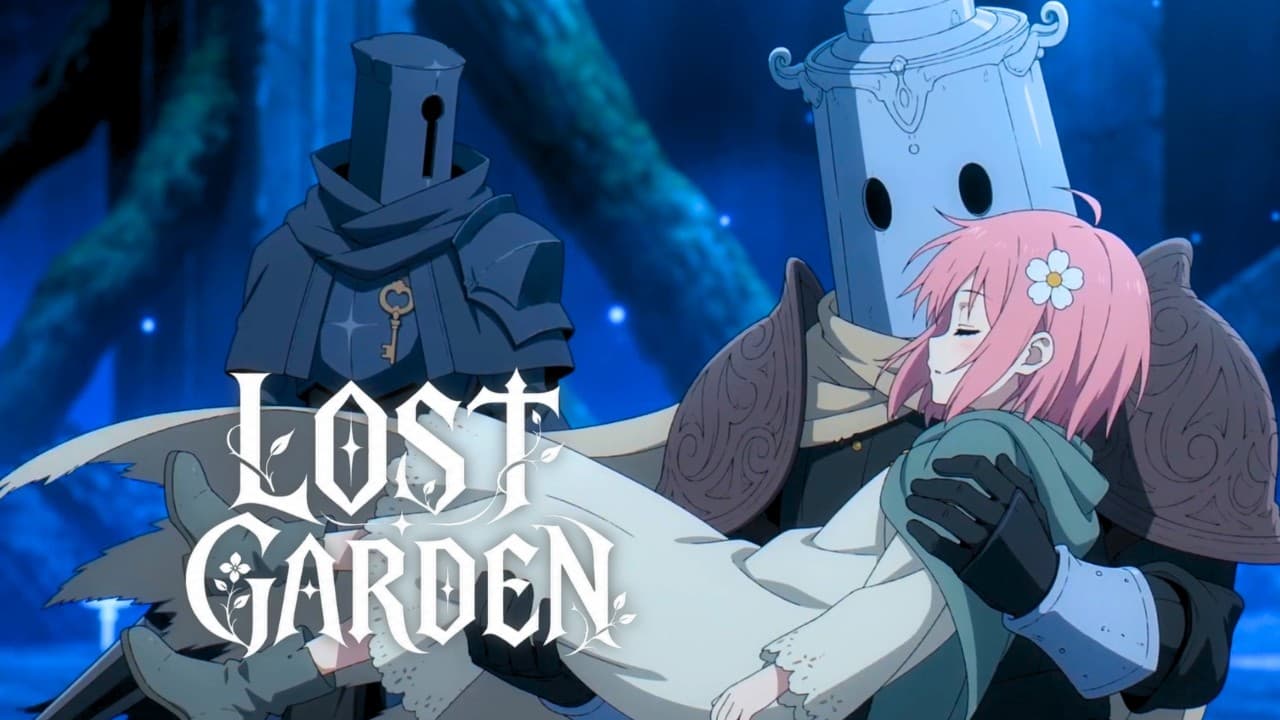
Lost Garden · Episode 2

Independent guide. ScreenWeaver does not organise the Tribeca Festival and is not affiliated with Tribeca Enterprises. Rules read on 1 October 2026. Official submissions page

Available today in ScreenWeaver: free screenwriting, and a storyboard generated from your screenplay with Storyboard Beta, $9.99 a month.

Rolling out: video generation of each shot, powered by Seedance, with the Filmmaker plan.

The rules on one card

What Tribeca asks of a short.

Tribeca is a general festival, not an AI festival. It asks nothing about AI, so the ordinary rules decide whether your film gets in: premiere status, runtime, subtitles and a working link.
Festival
3 to 12 June 2027, New York
The call
Open since 30 September 2026, 10 am ET
Shorts deadlines
28 October, 2 December 2026, 3 February 2027
Shorts fees
$50 early, $70 official, $80 extended
Short runtime
Under 40 minutes
Premiere, shorts
At least New York Regional to compete
AI rule
None in the 2027 entry rules
Language
English subtitles required, no dialogue lists

Source: the 2027 Tribeca Festival Entry Rules and Regulations (v2) and tribecafilm.com/festival/submissions, read on 1 October 2026. Fees are non-refundable, payable by credit card, and students can ask for a discount code. The rules can change, so check the page before you pay.

What the rules say about AI

No rule, one ban, and a history.

I read the full 2027 entry rules for the words AI and generative AI and found neither. What exists around that silence is a program with its own ban, and three times Tribeca showed AI work.
  • The main rules: silence

    The 2027 Entry Rules and Regulations (v2) and the submissions page contain no clause on AI or generative AI. No declaration form, no quota, no list of tools. Read on 1 October 2026. Silence means the usual rules apply, not that nothing is asked.

  • One program says no

    Love & Laughs, a 2027 initiative run by Tribeca Studios with Blackmaled Productions and Universal, states: “No materials in the submission packet may be created by or based upon any output or material generated, processed, or produced in whole or in part with the use of Generative AI.” Its call closed on 27 May 2026, and the clause is not in the festival's entry rules.

  • Sora Shorts, 2024

    In a press release of 31 May 2024, Tribeca and OpenAI announced five short films made with the text-to-video model Sora, screened on 15 June 2024. The filmmakers were Tribeca alumni given early access. It was a program, not an open call.

  • Tribeca Studios and OpenAI, 2026

    Announced on 18 June 2025, a year-long collaboration backed two independent filmmakers making live-action AI-integrated shorts. They premiered in 2026 as the program “Fueled by the Future”: SMOKED by Alice Gu and Mauvais Soleil by Youssef Michraf.

  • A feature made with AI, 2026

    Dreams of Violets, a 75 minute docudrama directed by Ash Koosha, was on the 2026 program. Trade press reported it as fully AI-generated, and reactions ran from curiosity to criticism. Tribeca's own page describes the film but does not say how it was made.

  • What it means for you

    If your film is selected you sign a release agreement and warrant that you hold the rights Tribeca needs to exhibit and promote it, and you answer for clearances. So say plainly how the film was made, and check the terms of every tool, voice and music track.

Key dates

Three windows for a short.

The 2027 call opened on 30 September 2026. A short can go in at <b>three prices</b>, and features and series close a week earlier than shorts.
  1. 30 Sep 2026

    Submissions open

    At 10 am ET, for features, shorts, Tribeca TV, Digital Creators, games, podcasts and Tribeca X. Works in Progress opens on 5 January 2027.

  2. 28 Oct 2026

    Shorts early deadline

    $50. Features and Tribeca TV close their early window on 21 October, at $70 and $50.

  3. 2 Dec 2026

    Shorts official deadline

    $70. Features and Tribeca TV close on 18 November.

  4. 3 Feb 2027

    Shorts extended deadline

    $80, and the last chance for a short. Features close their extended window on 16 December. Every date ends at 11:59 pm ET.

  5. 3 to 12 Jun 2027

    The festival

    The 26th Tribeca Festival, in New York. Invited filmmakers deliver an exhibition copy and sign the release.

Who decides

Programmers, with a few juries on top.

Tribeca names no jury for the submissions stage. Its rules say who picks and who can change the pick.
  • Programmers, at their sole discretion

    Films invited to the festival are shown in the section programmers judge most appropriate, in their sole discretion. You may apply as a short, but they decide where it plays.

  • Independent juries for some awards

    The Tribeca X Awards, for brand-supported storytelling, are chosen by an independent jury of industry leaders. Digital Creators has its own award for the most innovative and engaging online storytelling.

  • Tribeca Studios, by invitation

    Tribeca Studios runs invited programs such as Love & Laughs and the OpenAI collaboration. They are not routes you can enter through the festival form, but they show where AI work has come from.

  • Premiere status, locked on invitation

    Once invited, your premiere status is confirmed and locked. If you accept another festival's invitation that breaches it, Tribeca can rescind its own. Tell the festival about every other offer.

Where a film can go

Five sections an AI film could enter.

Tribeca has no AI section. Your project joins a section by its format, and programmers can move it. Under each, the angle we would take.
  • 01

    Shorts and music videos

    Narrative, documentary, animation, experimental films and music videos under 40 minutes. A short can stay online and remain eligible.

    The most direct route. Keep a New York Regional premiere to compete, and do not exhaust your premiere with a premature release.

  • 02

    Digital Creators

    Creators who publish on TikTok, Instagram, YouTube and other platforms, with a distinct voice and a direct link to fans.

    A fit for a recurring AI character or short drama with an audience already. Show the audience, not only the film. Selected creators enter the Tribeca Market.

  • 03

    Tribeca TV

    Episodic work, studio or independent. An independent pilot must show potential for serial growth, and standalone short films are not considered.

    Where an AI series belongs. Send a pilot with a clear second episode in mind. Consistent faces across episodes are what sell it.

  • 04

    Tribeca X

    Brand-supported storytelling, including commercials of 30 or 60 seconds and creator collaborations that premiered after 1 January 2026.

    The route for an AI ad made with a brand. Entry fees run from $425 to $575, so enter only with a real brand partner.

  • 05

    Features

    Narrative or documentary films of 40 minutes and over, with at least a New York Regional premiere. Works in progress are accepted if clearly marked.

    A long AI film is possible, as Dreams of Violets showed. It carries the highest fees and the strictest premiere rules, so start with a short.

Tribeca and AI so far

What three programs teach.

Tribeca has put AI work in front of its audience in 2024 and again in 2026. Each time the route was different: an invited program, a partnership, and a feature that went through selection.

  1. 01

    The first AI films came by invitation. Sora Shorts gave five alumni, among them Nikyatu Jusu and Michaela Ternasky-Holland, early access to Sora. Tribeca framed it as storytelling in a new form.

  2. 02

    Personal stories came first. SMOKED draws on its director's experience of the Palisades fires, and Mauvais Soleil asks AI to change a filmmaker's face in Casablanca. The subject was human before it was technical.

  3. 03

    A fully AI feature was accepted. Dreams of Violets, anchored in a real event, reached the 2026 program. It also drew harsh reviews. Acceptance is not praise.

  4. 04

    None of this is a rulebook. These are programs and selections, not promises to open-call entries. Treat them as proof of interest and send the best film you can make.

From page to screen

Lost Garden: an episode that could be a pilot.

Tribeca TV looks for pilots that show potential for serial growth. Here is the opening of Lost Garden, episode 2, an animated series by the ScreenWeaver team, made with Seedance: the screenplay page, then each shot as a storyboard frame and as the final image. Two characters, one road, and an obvious next scene.

Logline. A newborn knight whose inner light is leaking away crosses a world that has stopped hoping, to find the one blacksmith who can seal his armor.

Screenplay · episode 2 · page 1

INT. UNDERGROUND CAVERN - LOWER PATH - CONTINUOUS

Blue mushrooms the size of houses. LANTERN, a small knight with a lantern for a helm, walks alone.

He presses a hand to his chest. Sparks of light slip between his fingers.

SERRURE

Hold on. You're losing something.

Serrure lifts the edge of the cloak. A gash in the armor. Blue light leaks out like smoke.

SERRURE

That's your energy. What keeps you standing.

He grips Lantern's shoulder. Two knights alone among the crystals.

SERRURE

A suit that leaks goes out. Eventually.

Under the giant mushrooms, the road climbs into the dark.

SERRURE

So. We follow the road.

Serrure points the way. Lantern follows.

CUT TO:

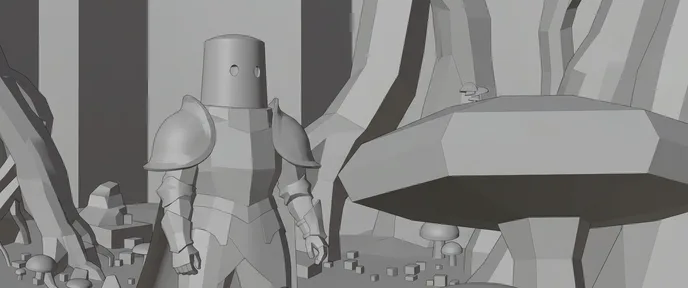
  1. A small knight with a lantern helm stands by a giant glowing blue mushroom in a crystal cavern
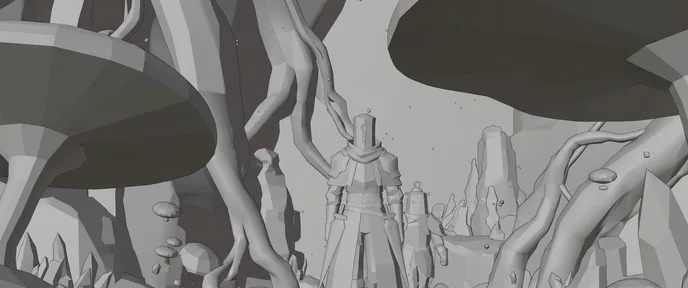
    Storyboard frame of the same wide shot, in grey
    01

    Wide · the world

    Wide shot, Lantern alone by a giant glowing blue mushroom, crystal cavern, roots, drifting spores, cold blue light

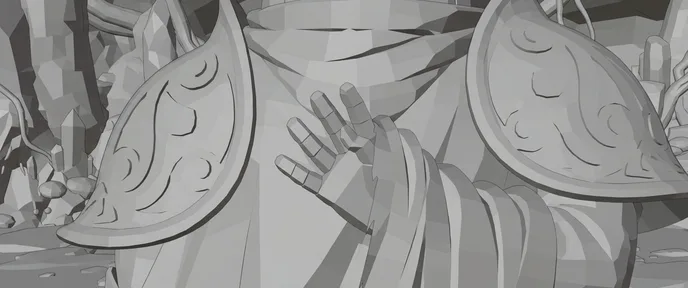
  2. Close-up of an armored chest under a cream cloak, a gloved hand, a spark of light
    Storyboard frame of the chest close-up, in grey
    02

    Close-up · the chest

    Close-up on Lantern's chest, his gloved hand pressed to the cloak, a spark of light escaping between the fingers

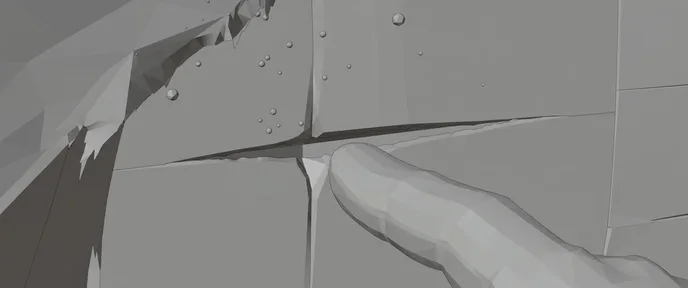
  3. A torn gash in an armor plate leaking bright blue light, a finger pointing at it
    Storyboard frame of the wound insert, in grey
    03

    Insert · the wound

    Extreme close-up, Serrure's finger near a torn gash in the back plate, blue light leaking out like luminous smoke

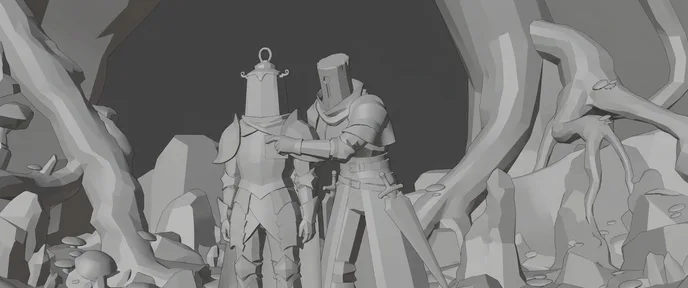
  4. Two armored knights side by side, one with a hand on the other's shoulder, in a crystal cavern
    Storyboard frame of the two-shot, in grey
    04

    Two-shot · the bond

    Medium two-shot among crystals and roots, Serrure's hand on Lantern's shoulder, faceless armors, emotion through posture only

  5. Two small knights walk beneath two giant glowing blue mushrooms
    Storyboard frame of the wide shot, in grey
    05

    Wide · the scale

    Wide low angle, the two knights tiny beneath two giant glowing mushrooms, blue crystals in the foreground, mist

  6. Seen from behind, a tall dark knight points ahead while the small lantern knight looks on
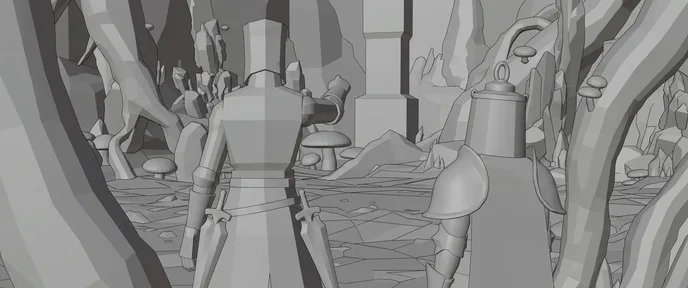
    Storyboard frame of the over-the-shoulder shot, in grey
    06

    Over the shoulder · the road

    Over-the-shoulder from behind, Serrure points ahead into the cavern, Lantern beside him, roots framing the path

Lost Garden, episode 2, 21 minutes, under the 40 minute line that separates shorts from features at Tribeca. As an episode it would suit Tribeca TV, not a standalone short. The player opens on this scene.

The script

A 15 minute short in five movements.

Tribeca shorts can run to 39 minutes, but a first selection rewards control. Aim for 15 minutes: about 15 screenplay pages and 150 to 200 shots of 4 to 6 seconds.
  1. 0:00 to 0:55

    The hook

    One image that sets the tone, and a question the film will answer.

  2. 0:55 to 3:40

    The world and its rule

    Who we follow, what they want, and the rule of the place. Show one rule, then keep it.

  3. 3:40 to 9:20

    The escalation

    The cost rises scene by scene. Cut shots that repeat an effect.

  4. 9:20 to 12:40

    The turn

    The scene people will describe afterwards. Let silence do some of the work.

  5. 12:40 to 15:00

    The echo

    An image that answers the first one. End when the question is answered.

A non-English film needs English subtitles when you submit, and dialogue lists are refused. Burn the subtitles into the screener and keep a clean master.

Week by week

From now to the official deadline.

The early deadline for shorts is 28 October, which would save you $20. Sixty-two days to the official deadline on 2 December make a better film than 27 days to the early one.
  1. 01

    1 to 14 October

    Choose the section and write

    Short, pilot or Digital Creators? Then write the screenplay free in ScreenWeaver, in industry format. Fifteen pages for a 15 minute short.

  2. 02

    15 to 28 October

    Characters, locations, storyboard

    Approve one reference per character and set, generate the shot breakdown, then adjust framing and duration shot by shot. Let the early deadline pass.

  3. 03

    29 October to 18 November

    Generate the footage

    Generate one scene at a time, following the storyboard. Log the tool, the version and its role for each scene. If a question about AI ever comes, the answer will be ready.

  4. 04

    19 to 29 November

    Edit, sound, subtitles

    Cut to under 40 minutes, mix, burn in English subtitles if needed. Mark any unfinished element clearly: Tribeca accepts work in progress only if it is labelled.

  5. 05

    30 November and 1 December

    Prepare the link

    Upload to a password-protected streaming link. It must stay active until early June 2027, and a changed password must be reported at once.

  6. 06

    2 December

    Submit at the official deadline

    $70 for a short, 11:59 pm ET. The extended deadline on 3 February 2027 costs $80 and remains a safety net. Do not pay twice for the same film.

Ways to lose a spot

Eight rules to read before you pay.

All of them come from the 2027 Entry Rules and Regulations. Fees are non-refundable, and an eligibility change after submission can disqualify a film.
  • Reading silence as permission

    No AI clause does not clear your rights. If selected, you warrant that you own what Tribeca needs and you indemnify the festival. Clear every voice, track and tool.

  • Mixing up a program and the festival

    Love & Laughs bans generative AI in its packet, which is a rule for that program only. Another program or partner call may have its own terms: read each one.

  • A link that breaks

    The screening link must stay active and its password must not change. If it fails and you do not answer within 48 hours, the submission may be ineligible.

  • No English subtitles

    A project in another language must carry English subtitles at submission. A dialogue list is not accepted.

  • Anything public before 2026

    A film with any public screening, broadcast, distribution or exhibition before 1 January 2026 is not eligible. A short may stay online later and remain eligible, but needs a New York Regional premiere to compete.

  • A work in progress, unmarked

    Unfinished projects must be clearly marked Work in Progress or Rough Cut, with a note on what will change. Unmarked, a rough shot looks like an error.

  • A standalone short in Tribeca TV

    An independent pilot must show potential for serial growth. A standalone short film will not be considered there.

  • Using a discount you are not owed

    The music video code and the student discount are only for those categories. A non-music video using the music video code is taken out of consideration.

Why ScreenWeaver

Tribeca asks nothing about AI. ScreenWeaver keeps your answer ready.

ScreenWeaver keeps screenplay, storyboard and footage in a single project, so a short and a pilot can grow from the same material. Tribeca imposes no tool, so the film is judged as a film.
  • From a short to a pilot

    The same project can be a 15 minute short for the shorts section or a first episode for Tribeca TV. The app also handles series and short dramas.

  • Rights you can account for

    A selected film means a release agreement with a rights warranty. In ScreenWeaver your projects are private and you own your work, and each shot traces to its prompt. You still check each tool's terms.

  • The same faces from episode to episode

    Characters, locations and references carry from shot to shot and episode to episode. That is what makes a pilot look like the start of a series.

  • Start for free today

    Your screenplay costs nothing on the Screenwriter plan, with no expiry. Storyboard Beta is $9.99 a month. Filmmaker, the plan for video generation, is rolling out.

Real productions

International festival-recognized films have been written and produced with ScreenWeaver.

ScreenWeaver is already being used as a creative workspace for real AI film productions, from cinematic shorts to animated series pilots selected, nominated, and awarded by international festivals.

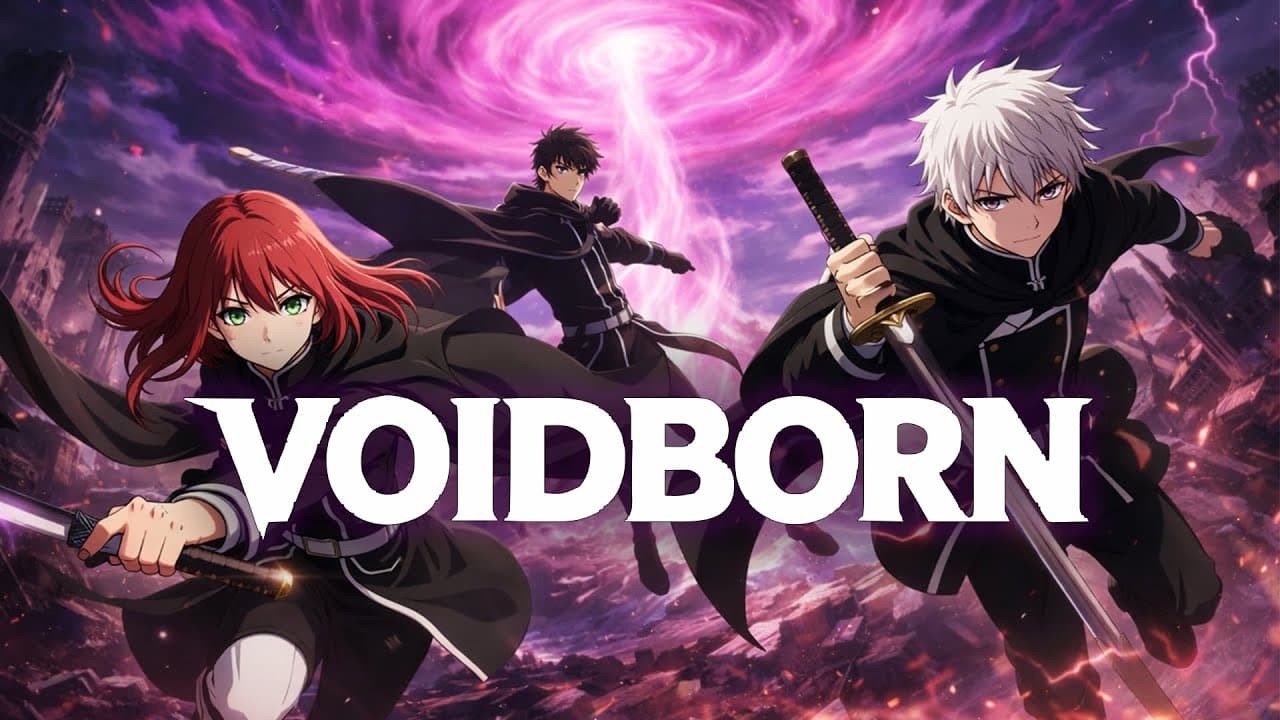
  • Video thumbnail for VOIDBORN

    VOIDBORN

    AI animated / cinematic short

    Festival recognition

    • 1st Place Silver

      Mondial Chroma Awards

    • 2nd Place Dreamina

      Mondial Chroma Awards

    • Award Winner

      Seoul International AI Film Festival

  • Video thumbnail for Les Fils du Vinnana

    Les Fils du Vinnana

    AI short film

    Festival recognition

    • Honorable Mention

      Top Quark Film Festival

    • People's Choice Nominee

      Illuminate Oneness of Humanity

    • Nominee

      ALTFF Supershort

  • Video thumbnail for Lost Garden

    Lost Garden

    AI animated series pilot

    Festival recognition

    • Finalist

      AI London Festival

The pipeline

Write. Board. Produce.

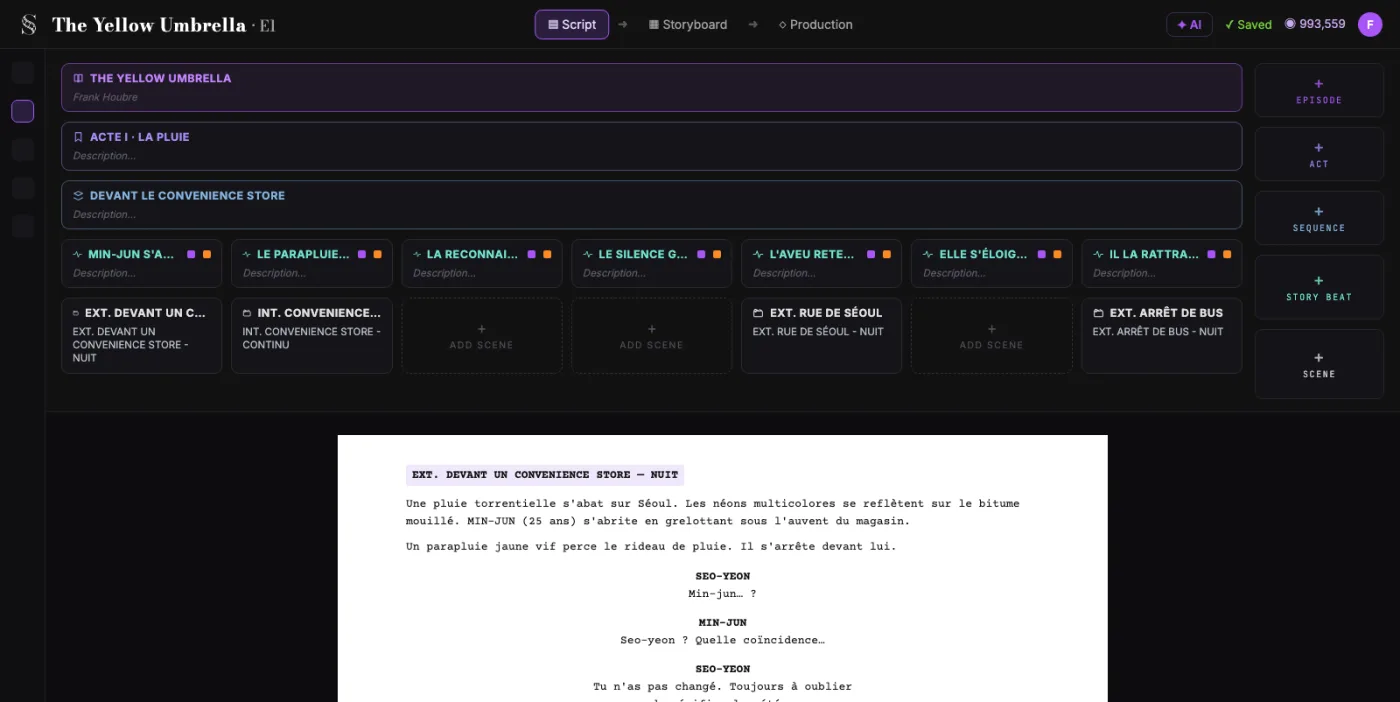
  1. ScreenWeaver screenplay editor: acts, sequences and beats above the formatted script of The Yellow Umbrella

    01The screenplay, enriched

    An industry-standard screenplay editor, and more: a visual outline and beat editor, your writing inspirations (notes, photos, audio) kept next to the page, and an AI researcher to support your writing, not replace it.

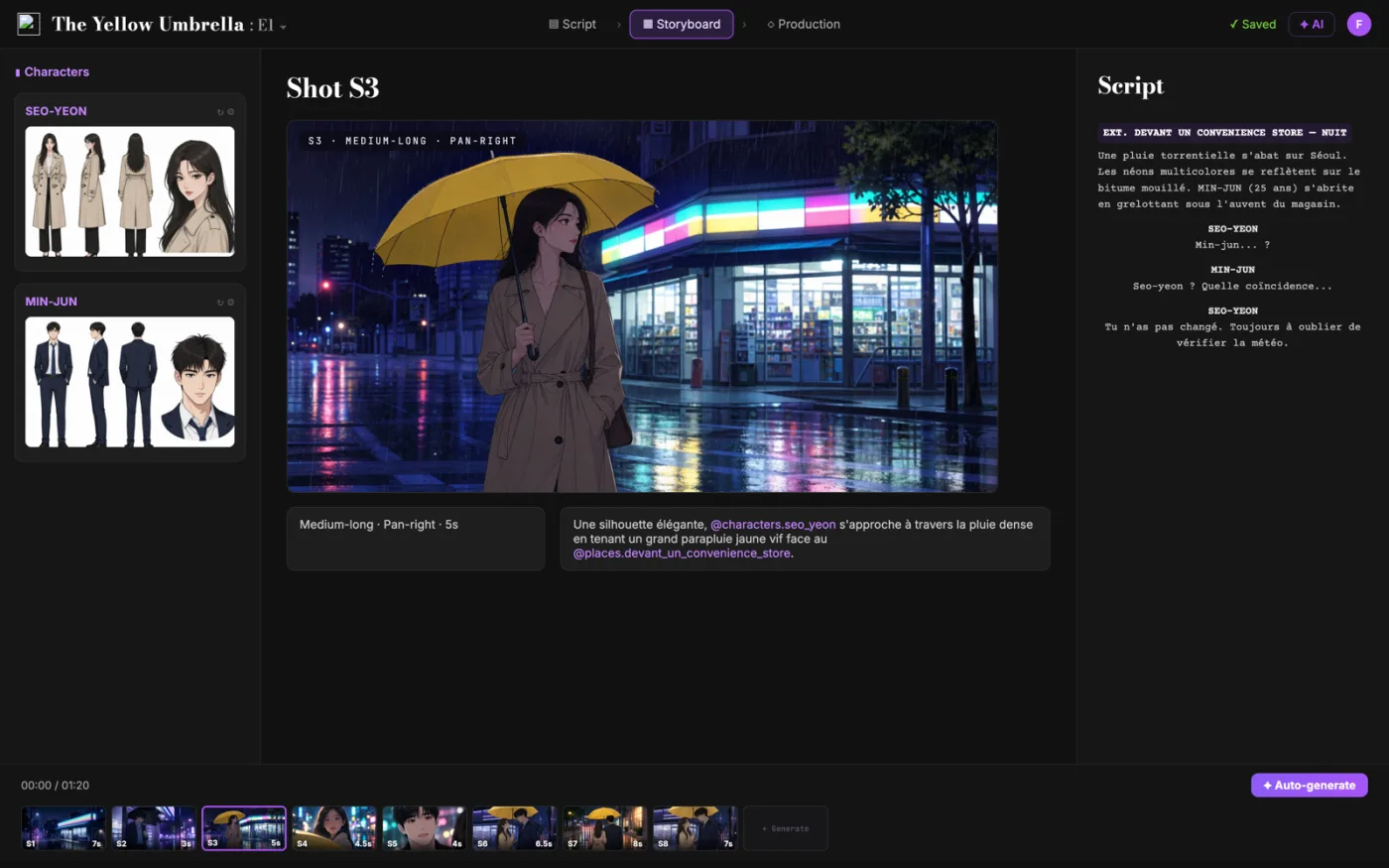
  2. ScreenWeaver storyboard: shot S3 of The Yellow Umbrella with characters, shot settings and the script beside it

    02The storyboard, made easy

    Shot breakdown generated from your screenplay, manual control over every shot (frame, angle, movement, duration), and generative AI previsualization in one click.

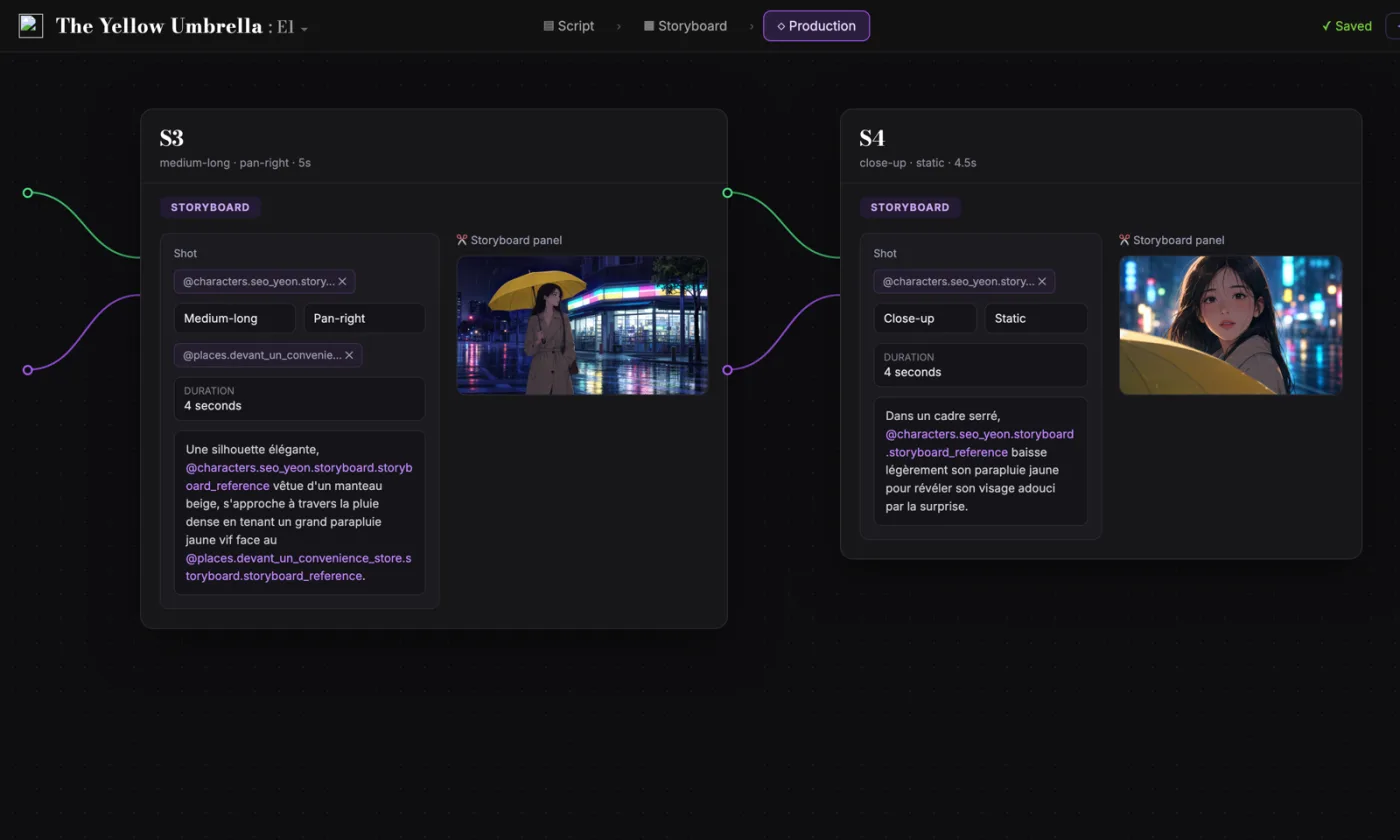
  3. ScreenWeaver production canvas: shots S3 and S4 as connected nodes carrying their storyboard panels and prompts

    03AI production, with finesse

    Footage generation pipelines connected to your screenplay and storyboard. Optimized out of the box, fully editable workflow.

FAQ

Tribeca and AI films, your questions

Can you submit an AI film to Tribeca?
Yes. The 2027 Entry Rules and Regulations contain no clause on AI or generative AI, and Tribeca has screened AI work since 2024. One program, Love & Laughs, forbids generative AI in its submission packet, and that rule does not apply to the festival's general call.
Does Tribeca require AI disclosure?
Not in the rules I read: there is no declaration form. If your film is selected you sign a release that warrants you hold the rights needed. Say how the film was made anyway, and honestly.
Has Tribeca screened AI films?
Yes. Sora Shorts showed five films made with OpenAI's Sora in 2024. The 2026 program “Fueled by the Future” premiered two AI-integrated shorts made with Tribeca Studios and OpenAI, and the 75 minute Dreams of Violets, reported as fully AI-generated, was on the 2026 program.
What are the deadlines and fees for shorts?
28 October 2026 at $50, 2 December 2026 at $70, and 3 February 2027 at $80, each at 11:59 pm ET. Students can ask for a discount code, and fees are non-refundable.
Which section does an AI short go in?
Shorts and Music Videos, for a film under 40 minutes. A pilot goes to Tribeca TV, a creator series to Digital Creators and a brand-made ad to Tribeca X. Programmers can place a film in another section.
Does my short need a premiere?
To be in competition it must at least be a New York Regional premiere. A short may stay online and remain eligible, but it must not have had any public screening, broadcast or distribution before 1 January 2026.
How long can a short be?
Under 40 minutes. A film of 40 minutes or more is a feature, with its own fees and deadlines. There is no shorter limit stated.
Is there a prize for AI films?
None is listed in the rules. The Tribeca X Awards, picked by an independent jury, honour brand-supported storytelling, and Digital Creators has an award for online storytelling. Neither is an AI prize.

Sixty-two days to the official deadline.

Write the screenplay for free today. Storyboard it, then generate it.