Kling AI NextGen · Guide

How to win the Kling AI NextGen Creative Contest.Up to $1M in funding. One tool imposed: Kling.

The 2025 contest is over and no new one is announced. The standing NEXTGEN Initiative has no deadline and funds up to $1,000,000 per project. Here is what it asks, what the contest rewarded, and where ScreenWeaver fits when Kling is the imposed tool.
  • No deadline: rolling
  • Up to $1,000,000 in funding
  • Kling required
Lost Garden · Episode 2

Independent guide. ScreenWeaver does not organise the Kling AI NextGen contest and is not affiliated with Kling AI or Kuaishou. Rules read on 1 October 2026. Official page

Available today in ScreenWeaver: free screenwriting, and a storyboard generated from your screenplay with Storyboard Beta, $9.99 a month.

Rolling out: video generation of each shot, powered by Seedance, with the Filmmaker plan. Seedance footage does not count as Kling footage: for this programme, the shots are generated in Kling.

The rules on one card

What the NEXTGEN Initiative asks for.

Kling AI, from Kuaishou, ran the NextGen Creative Contest in 2025 and, in 2026, a Global 4K Short Film contest and university challenges. On 1 October 2026 its official NextGen page presents the NEXTGEN Initiative, a standing funding programme with no deadline. That is the live opportunity, so this card describes it.
Status
No open contest found, the Initiative takes projects
Full funding
Up to $1,000,000 for one project
Partial funding
Up to $300,000, up to 50% of a project
Technology partner
Up to 1 million Kling AI credits
AI and tool rule
At least 50% AI-generated, a significant part with Kling
Project stage
Pre-production or production, never distributed
Language
Submission in English, English-dubbed version required
Timing
Answer within 20 business days, finish within 6 months

Source: kling.ai/nextgen for the Initiative, read on 1 October 2026, and The Korea Times and Kling AI's own announcements for the contests. No submission deadline appears on the page, and the page can change without notice.

Key dates

Last year's rhythm, and no date yet.

Kling opened its 2025 contest in mid-September. Nothing similar is announced on the official page on 1 October 2026, so watch Kling's channels through October.
  1. 12 Sep to 6 Oct 2025

    The 2025 contest submissions

    Entries were open to 6 October, Beijing time, for a prize pool of $42,000 in cash and 1.25 million Kling AI credits.

  2. 18 Oct 2025

    Winners announced

    From more than 4,600 submissions from 122 countries, 10 finalists were chosen, then the winners.

  3. 29 Oct 2025

    Ceremony in Tokyo

    The awards ceremony and a screening of the winning shorts.

  4. 7 Jul 2026

    The 2026 ceremony in Seoul

    Awards for the Global 4K Short Film Creative Contest and the university challenges, held by Kling AI with MBC C&I and the Korean Society for Media Policy Studies.

  5. Any day

    The Initiative, no deadline

    Submit when the project is ready. You are told within 20 business days, and each project can be submitted once.

What Kling looks for

Three qualities, no weights.

The Initiative names three things it looks for and gives no weights. For the 2025 contest, Kling said its finalists were chosen on narrative, execution, creativity and significance.
  • Creative Vision

    Cinematic storytelling and strong audio-visual expression, in Kling's words. A pitch that starts from a character and a feeling beats one that starts from a feature list.

  • Technical Innovation

    Pioneering use of AI in the production. Show something you did with Kling that a default prompt would not do: a method for consistency, camera, sound, written down as a method.

  • Gold Standard

    Excellence that sets a new benchmark for AI filmmaking. The benchmark moves with each model release, so compare your proof of concept with the latest Kling output, not with last year's.

Funding is a business decision as much as a creative one: the Initiative promises promotion and business development and, for partial funding, royalties or other profit sharing to be determined.

Who decides

A committee, and last year's panel.

Kling does not name the people behind the Initiative. What it does say is how your project is handled, and who judged the last contest.
  • The initiative committee

    Projects go to Kling's NEXTGEN Initiative committee, which answers within 20 business days. A declined project can be resubmitted only with the committee's approval.

  • The 2025 contest panel

    Kling published an official judging panel of creative figures for the 2025 contest, and Tim Yip was among them. No panel is announced for a new call.

The formats

Four kinds of project it names.

The Initiative sets no genre. It names short dramas, mini-series, animations and experimental works, and its page shows a fully funded example, an AI-generated anthology series.
  • 01

    Short drama

    Serialised stories in short episodes, the first format Kling lists.

    A hook in every episode and a bible that keeps faces and sets stable over dozens of episodes. Plan the season, not just the pilot.

  • 02

    Mini-series

    A closed run of episodes with a beginning, a middle and an end.

    Pitch a pilot and the shape of the season. Funders read a series by its engine: what does each episode repeat, and what changes?

  • 03

    Animation

    Animated worlds and characters, from stylised shorts to series.

    A single style you can reproduce on demand is worth more than a dazzling one. Show the same character in three situations in Kling.

  • 04

    Experimental

    Works that treat the medium itself as the subject.

    This is where the Technical Innovation criterion lives. Explain the method, not only the result.

The contests so far

What the contests show.

Kling has run several contests, each built around its own models. The 2025 NextGen contest drew more than 4,600 submissions from 122 countries. The 2026 Global 4K Short Film contest drew about 9,000 creators, with one Gold and three Silver awards.

  1. 01

    The odds are long. In 2025, 10 finalists came from over 4,600 submissions, about one in 460.

  2. 02

    Kling shows what it wants. The 2026 contest was built around native 4K output. Each contest showcases a new capability, so read Kling's release notes before the next call.

  3. 03

    It is global. The 2026 Global 4K Gold Award went to a creator from Malaysia, and the same year Kling also ran university challenges in Korea and China.

  4. 04

    Contests change names, the Initiative stays. 2025 NextGen, 2026 Global 4K, 2026 university challenges: each had a date. The standing Initiative is the one page with no end date.

From script to screen

Lost Garden: the preparation, six shots.

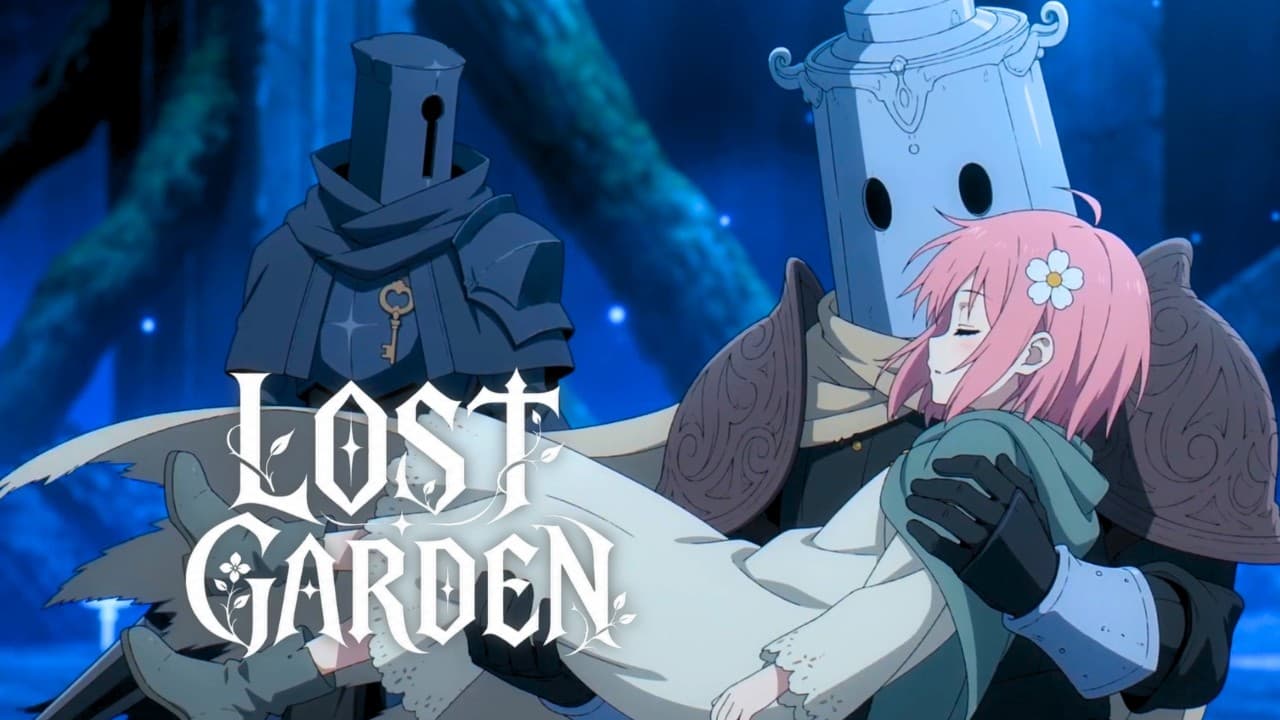
The scene opens Lost Garden, episode 2, the animated series the ScreenWeaver team makes with Seedance. It is shown as a model of the preparation behind a pitch, not as Kling footage: the screenplay, the storyboard frame and the final image for each of six shots. For a funded series, the footage would be generated in Kling.

Logline. A newborn knight whose inner light is leaking away crosses a world that has stopped hoping, to find the one blacksmith who can seal his armor.

Screenplay · episode 2 · page 1

INT. UNDERGROUND CAVERN - LOWER PATH - CONTINUOUS

Blue mushrooms the size of houses. LANTERN, a small knight with a lantern for a helm, walks alone.

He presses a hand to his chest. Sparks of light slip between his fingers.

SERRURE

Hold on. You're losing something.

Serrure lifts the edge of the cloak. A gash in the armor. Blue light leaks out like smoke.

SERRURE

That's your energy. What keeps you standing.

He grips Lantern's shoulder. Two knights alone among the crystals.

SERRURE

A suit that leaks goes out. Eventually.

Under the giant mushrooms, the road climbs into the dark.

SERRURE

So. We follow the road.

Serrure points the way. Lantern follows.

CUT TO:

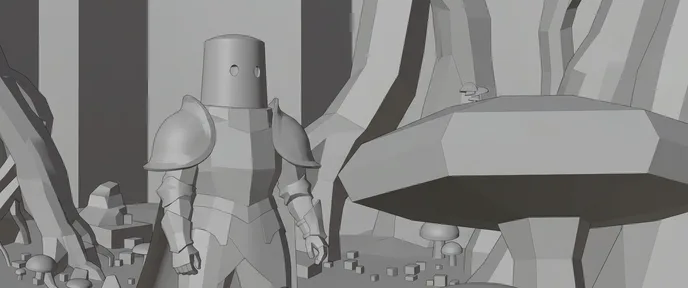
  1. A small knight with a lantern helm stands by a giant glowing blue mushroom in a crystal cavern
    Storyboard frame of the same wide shot, in grey
    01

    Wide · the world

    Wide shot, Lantern alone by a giant glowing blue mushroom, crystal cavern, roots, drifting spores, cold blue light

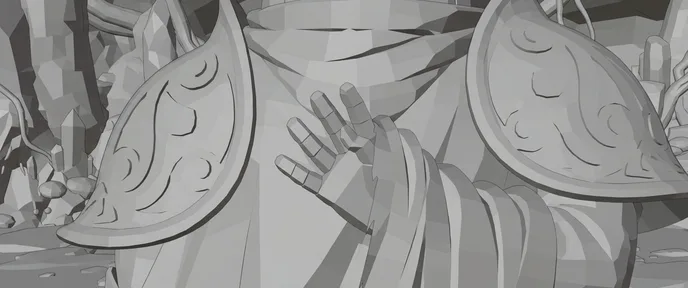
  2. Close-up of an armored chest under a cream cloak, a gloved hand, a spark of light
    Storyboard frame of the chest close-up, in grey
    02

    Close-up · the chest

    Close-up on Lantern's chest, his gloved hand pressed to the cloak, a spark of light escaping between the fingers

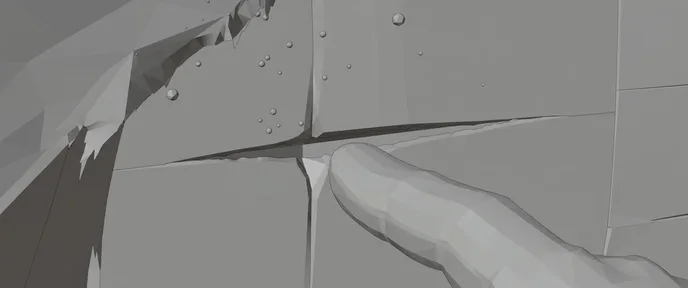
  3. A torn gash in an armor plate leaking bright blue light, a finger pointing at it
    Storyboard frame of the wound insert, in grey
    03

    Insert · the wound

    Extreme close-up, Serrure's finger near a torn gash in the back plate, blue light leaking out like luminous smoke

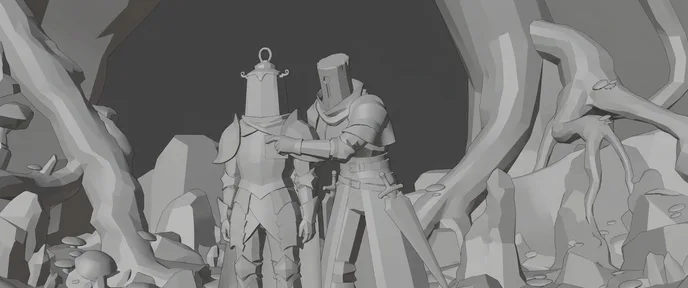
  4. Two armored knights side by side, one with a hand on the other's shoulder, in a crystal cavern
    Storyboard frame of the two-shot, in grey
    04

    Two-shot · the bond

    Medium two-shot among crystals and roots, Serrure's hand on Lantern's shoulder, faceless armors, emotion through posture only

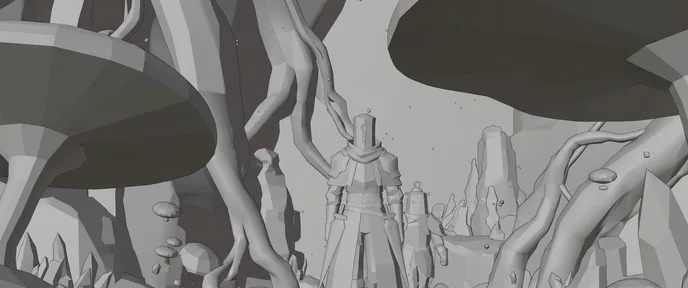
  5. Two small knights walk beneath two giant glowing blue mushrooms
    Storyboard frame of the wide shot, in grey
    05

    Wide · the scale

    Wide low angle, the two knights tiny beneath two giant glowing mushrooms, blue crystals in the foreground, mist

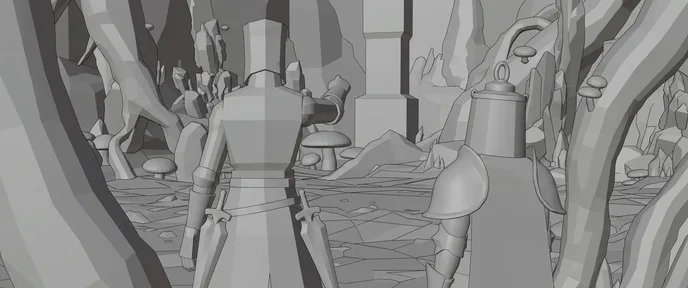
  6. Seen from behind, a tall dark knight points ahead while the small lantern knight looks on
    Storyboard frame of the over-the-shoulder shot, in grey
    06

    Over the shoulder · the road

    Over-the-shoulder from behind, Serrure points ahead into the cavern, Lantern beside him, roots framing the path

Lost Garden, episode 2, 21 minutes, made with Seedance. Episode 1 of the series reached the finals at the AI London Festival. The Initiative needs a significant part made with Kling, so this footage would not count. The screenplay, the storyboard and the series bible would.

The script

A 4 minute proof of concept in five movements.

Kling sets no running time. About four minutes is enough to show a series' tone, its lead and its world, in about 50 shots of 4 to 5 seconds.
  1. 0:00 to 0:15

    The hook

    A single image that says what kind of series this is.

  2. 0:15 to 1:00

    The lead

    Who we will follow for twenty episodes, and what they cannot have.

  3. 1:00 to 2:30

    The world in action

    The rules of the place, shown through a scene rather than explained.

  4. 2:30 to 3:30

    The first twist

    Something that makes the premise bigger.

  5. 3:30 to 4:00

    The promise

    A last image that tells the committee what happens next.

The Initiative funds projects in pre-production or production, so you are selling a series, not a finished short. End on a question the series will answer.

Week by week

From the idea to the single submission.

There is no deadline, and you can submit a project only once. Submit when it is ready, not when it is early.
  1. 01

    Week 1

    Choose the format

    Short drama, mini-series, animation or experimental. Write the logline and the promise of the series in two sentences, and test them on someone who does not know the project.

  2. 02

    Weeks 2 and 3

    The pilot and the bible

    Write the pilot for free in ScreenWeaver, in industry format. Add a one page bible with the characters, the rules of the world, the tone and the shape of season one.

  3. 03

    Week 4

    Storyboard the key scenes

    Generate the storyboard from the screenplay and pick the scenes you will make in Kling. These frames become the visual spine of your pitch.

  4. 04

    Weeks 5 and 6

    A proof of concept in Kling

    Generate a few minutes in Kling. At least half of the final work must be AI-generated, with a significant part made with Kling, so work in it from now on. Keep every prompt.

  5. 05

    Week 7

    English version and rights

    The submission is in English. For a project in another language, make an English-dubbed version. Check that you own the story and everything in it, or hold the rights.

  6. 06

    Week 8

    Submit once

    Send the project with the materials the page asks for, then wait up to 20 business days. A declined project can be resubmitted only with the committee's approval.

Rejection traps

Seven ways to waste your one shot.

The guidelines are short, and each project is submitted only once. Check every line before you press send.
  • Waiting for a contest that is not open

    We found no open contest on 1 October 2026. Do not hold a finished project for a date that may not come. The Initiative takes submissions without a deadline.

  • A project already distributed

    Projects in pre-production or production are welcome. Those that have already been distributed will not be considered, so a film that is online is out.

  • Footage made elsewhere

    At least 50% of the final work must be AI-generated, with a significant portion made with Kling. Footage from other tools, including Seedance footage made in ScreenWeaver, does not stand in for that Kling part.

  • No English version

    The submission itself must be in English. A project in another language needs an English-dubbed version.

  • Rights you do not hold

    The project must be original, to secure full ownership, or you must hold every necessary right. Music, characters and adapted stories are where this usually fails.

  • Submitting too early

    Each project can be submitted once. If it is declined, resubmitting requires the committee's approval. A weak first pitch costs you the project.

  • Expecting a cheque

    Partial funding is up to 50% of a project, with royalties or other profit sharing to be determined. Funded projects must be finished within 6 months of acceptance.

Why ScreenWeaver

Kling makes the footage. ScreenWeaver prepares the series.

ScreenWeaver puts the screenplay, the storyboard and the footage in one connected project. For this programme, the footage part belongs to Kling.
  • An honest division of labour

    The Initiative requires Kling for a significant part of the work, so ScreenWeaver's Seedance footage cannot be that part. ScreenWeaver covers everything before it: screenplay, series bible, storyboard and planning.

  • A pitch package, not a folder

    The pilot, the bible and the storyboard live in one project and stay linked. That is what a committee reads to judge Creative Vision before it watches any footage.

  • One look, decided once

    Approve the characters, locations and frames in the storyboard, then generate each shot in Kling from the same frames. Fewer prompts, fewer surprises, a series that looks like one series.

  • Free to start

    Writing in the Screenwriter plan is free, with no expiry. The storyboard step, Storyboard Beta, costs $9.99 per month. Kling's own plan is a separate cost, so budget for it.

Real productions

International festival-recognized films have been written and produced with ScreenWeaver.

ScreenWeaver is already being used as a creative workspace for real AI film productions, from cinematic shorts to animated series pilots selected, nominated, and awarded by international festivals.

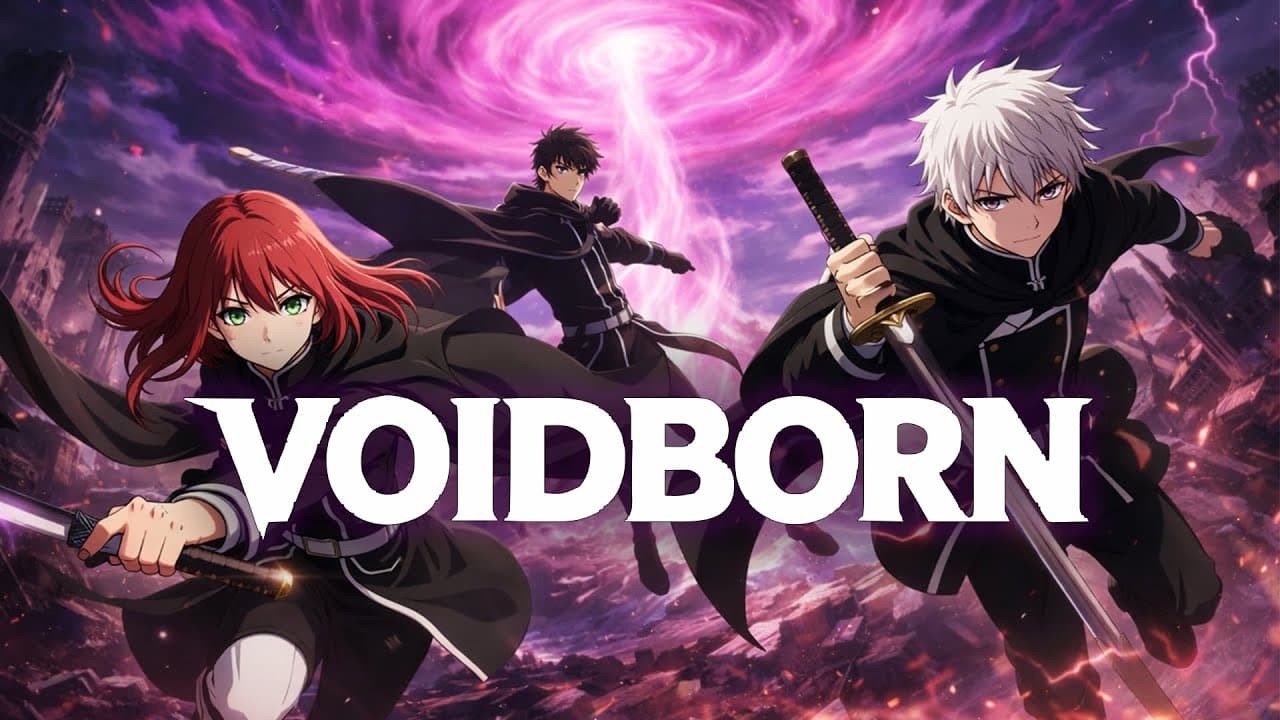
  • Video thumbnail for VOIDBORN

    VOIDBORN

    AI animated / cinematic short

    Festival recognition

    • 1st Place Silver

      Mondial Chroma Awards

    • 2nd Place Dreamina

      Mondial Chroma Awards

    • Award Winner

      Seoul International AI Film Festival

  • Video thumbnail for Les Fils du Vinnana

    Les Fils du Vinnana

    AI short film

    Festival recognition

    • Honorable Mention

      Top Quark Film Festival

    • People's Choice Nominee

      Illuminate Oneness of Humanity

    • Nominee

      ALTFF Supershort

  • Video thumbnail for Lost Garden

    Lost Garden

    AI animated series pilot

    Festival recognition

    • Finalist

      AI London Festival

The pipeline

Write. Board. Produce.

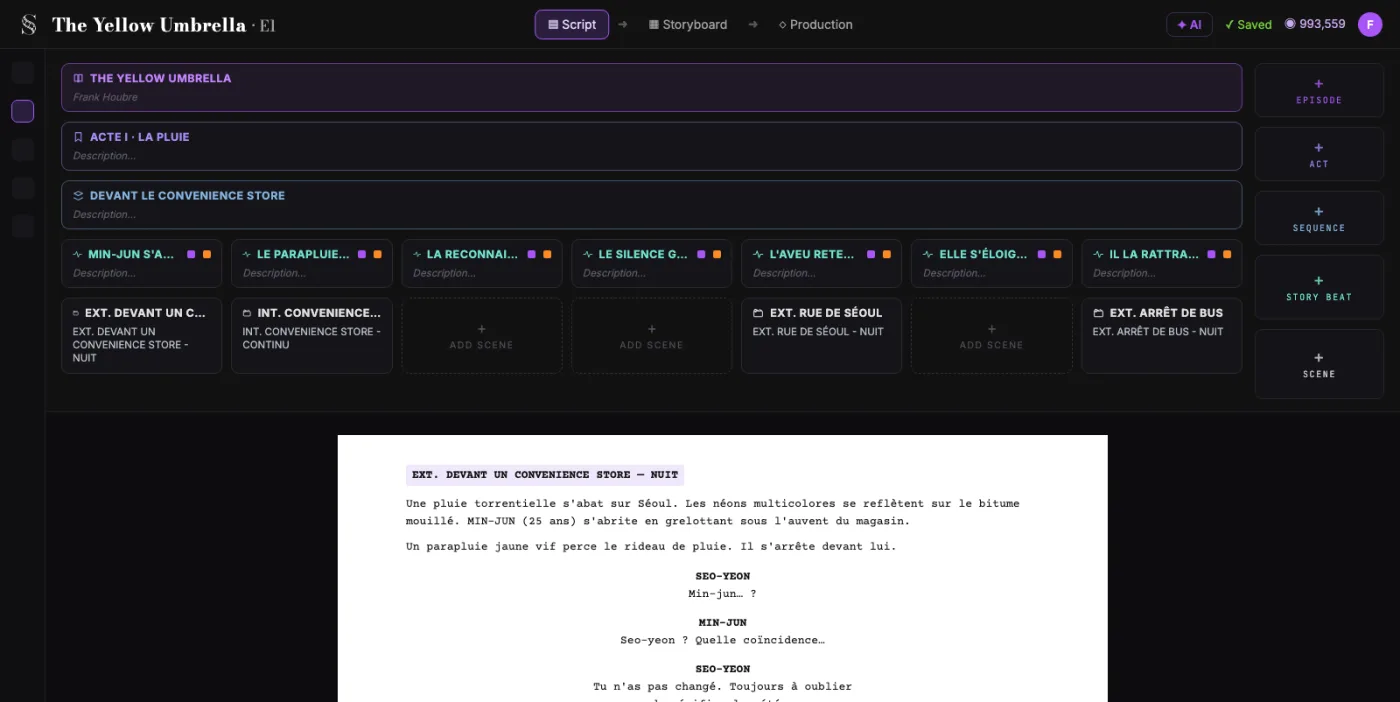
  1. ScreenWeaver screenplay editor: acts, sequences and beats above the formatted script of The Yellow Umbrella

    01The screenplay, enriched

    An industry-standard screenplay editor, and more: a visual outline and beat editor, your writing inspirations (notes, photos, audio) kept next to the page, and an AI researcher to support your writing, not replace it.

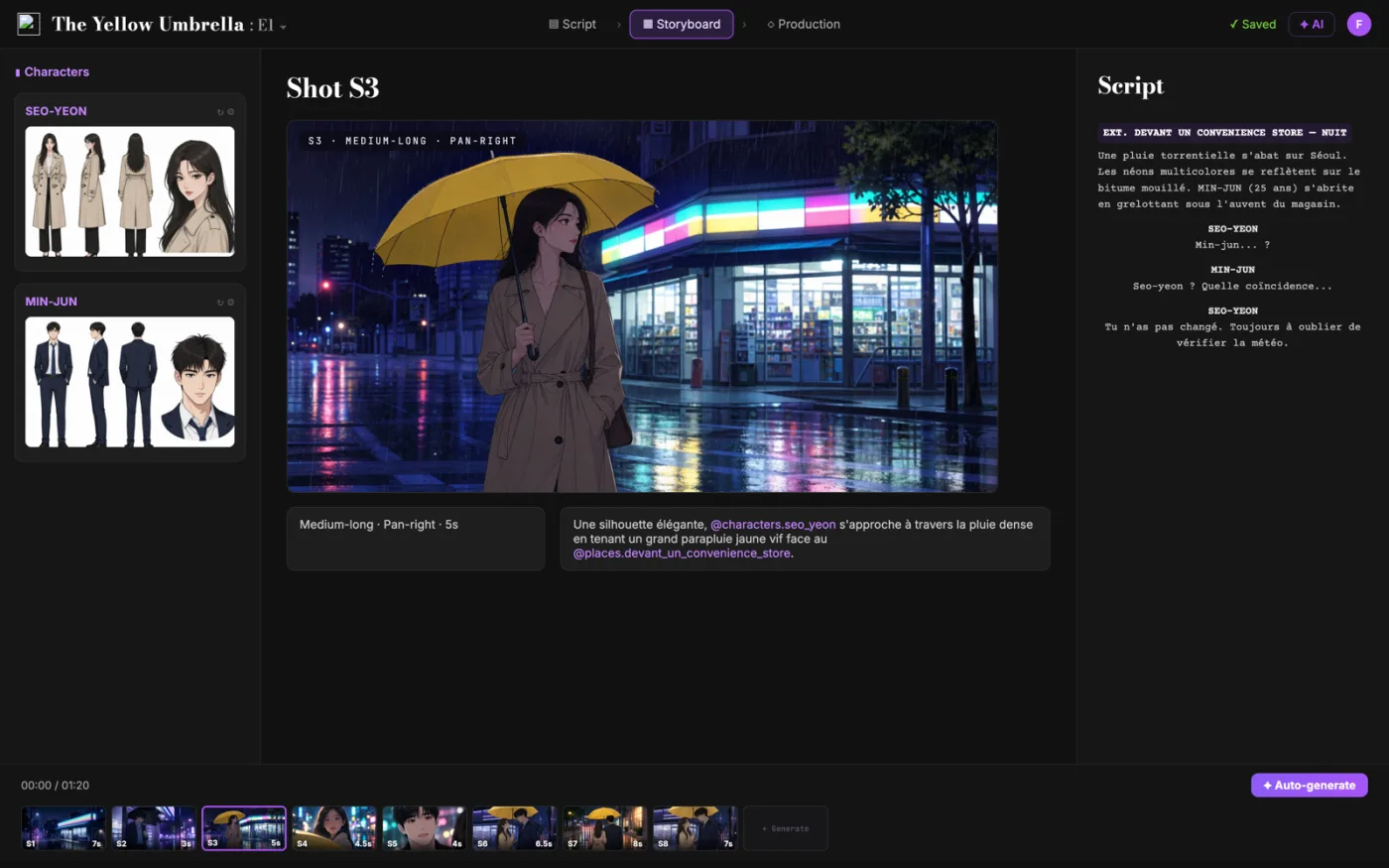
  2. ScreenWeaver storyboard: shot S3 of The Yellow Umbrella with characters, shot settings and the script beside it

    02The storyboard, made easy

    Shot breakdown generated from your screenplay, manual control over every shot (frame, angle, movement, duration), and generative AI previsualization in one click.

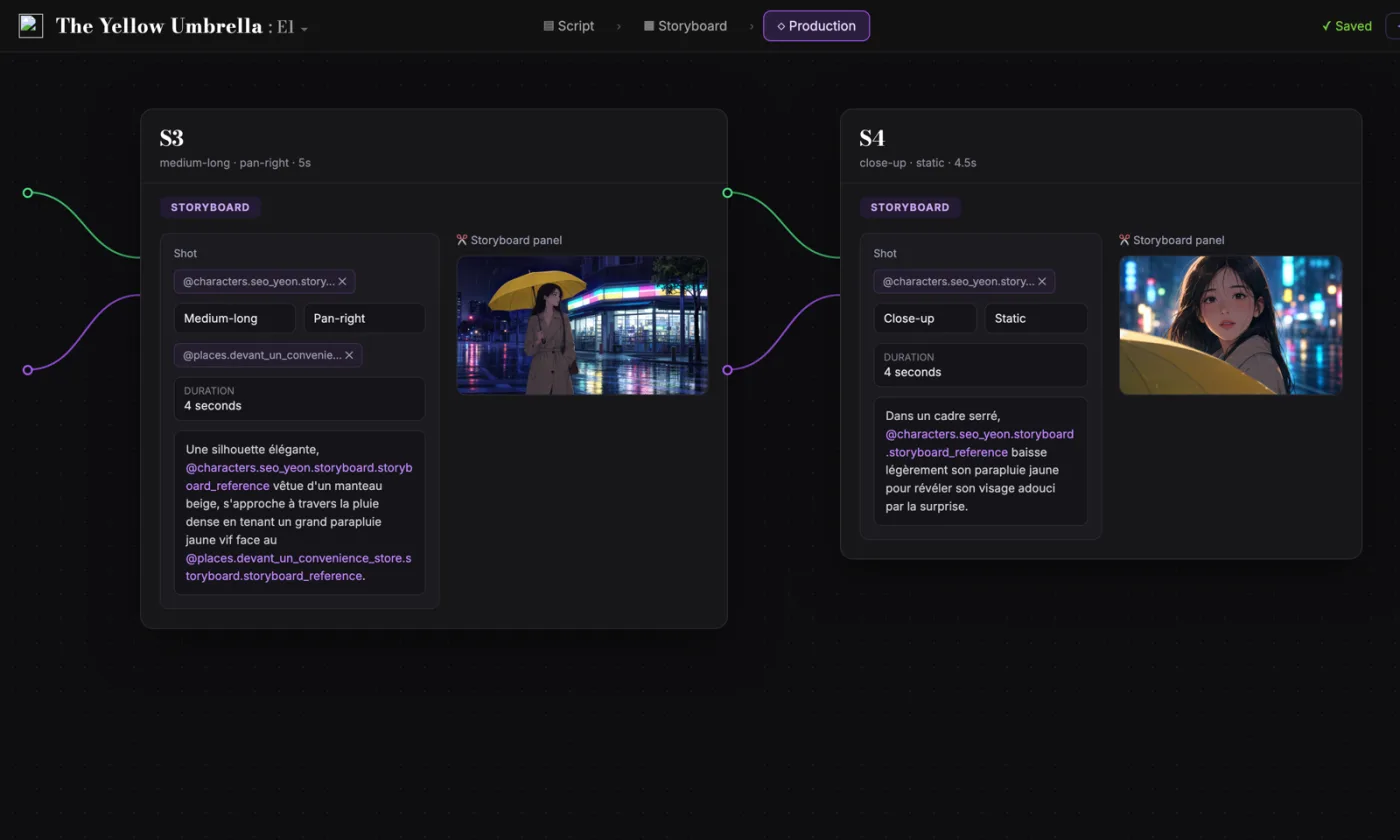
  3. ScreenWeaver production canvas: shots S3 and S4 as connected nodes carrying their storyboard panels and prompts

    03AI production, with finesse

    Footage generation pipelines connected to your screenplay and storyboard. Optimized out of the box, fully editable workflow.

FAQ

Kling AI NextGen, your questions

How do you win the Kling AI NextGen Creative Contest?
No contest is open today. For the 2025 one, finalists were chosen on narrative, execution, creativity and significance. The route that is open is the NEXTGEN Initiative, judged on Creative Vision, Technical Innovation and Gold Standard. Prepare a strong pilot, a bible and a proof of concept made in Kling.
Is a new Kling contest open?
We found none on 1 October 2026. The 2025 contest opened in mid-September, so a new call is possible. Check kling.ai and Kling AI's channels in October. The Initiative has no deadline either way.
Can I use ScreenWeaver for a Kling contest or for the Initiative?
For the writing, the series bible, the storyboard and the planning, yes. The footage must be made in Kling: ScreenWeaver's Seedance footage does not count as the Kling part. Seedance generation is also still rolling out with the Filmmaker plan.
How much funding is there?
Full funding goes up to $1,000,000 for one project. Partial funding goes up to $300,000, up to 50% of the project. The technology partner route gives up to 1 million Kling AI credits, based on duration. The 2025 contest paid $42,000 and 1.25 million credits in total.
Does the whole project have to be made in Kling?
At least 50% of the final work must be AI-generated, with a significant portion made with Kling. The Initiative does not give a percentage for Kling itself.
What if my film is already finished?
The Initiative is for projects in pre-production or production. Projects already distributed will not be considered. A finished film is better sent to a festival, such as those on our list.
Which language must I use?
The submission is in English. Projects in other languages are welcome, with an English-dubbed version.
Can I send the same project twice?
Each project may be submitted only once. If it is declined, resubmission requires the approval of the initiative committee.

One submission. Start with the page.

Start the pilot today, at no cost. Storyboard it, then generate the proof of concept in Kling.