NEXTALE Award · Guide

How to win the NEXTALE Award.20 episodes. Any AI tool. 14 December.

The NEXTALE Award is a free contest for a complete AI short drama of 20 episodes or more, in any language. Upload every episode to NEXTALE Studio by 14 December 2026 to compete for the $2,000 grand prize. The first 10 complete series get $100 each. Here are the rules, the traps and a five week plan.
  • Deadline 14 December 2026
  • $3,000 prize fund, free entry
  • Any AI tool, Seedance included
Lost Garden · Episode 2

Independent guide by the ScreenWeaver team. ScreenWeaver does not organise the NEXTALE Award and is not affiliated with NEXTALE. Rules read on 6 November 2026. Official award page

Available today in ScreenWeaver: free screenwriting, and a storyboard generated from your screenplay with the Auteur plan, $39.99 a month.

Also available now: video generation of each shot, powered by Seedance, on the same Auteur plan. NEXTALE names Seedance among the tools it accepts.

The rules on one card

What the NEXTALE Award asks for.

NEXTALE is a new platform for short series, launching in December. The award is how it fills its catalogue: every complete series goes live, and the team picks one winner. The Terms of Service name Nextale FZE, registered in Sharjah, as the company behind it.
Deadline
14 December 2026, all episodes uploaded
Prize fund
$3,000: $2,000 grand prize, $100 × 10
Format
One complete AI short drama, 20 episodes minimum
AI rule
Made with AI, any tool: Higgsfield, Kling, Seedance…
Entry fee
Free, with a free NEXTALE Studio account
Who can enter
Anyone, any country, any language
Genre
Any genre, none gets priority
Revenue
100% of paid views for six months after launch

Sources: the award page and the Terms of Service of nextale.com, read on 6 November 2026. They give no opening date, no time zone for the deadline, no episode length, no aspect ratio and no judging criteria. The Terms require account holders to be at least 18.

Key dates

Five weeks, then a launch.

The entry form is a Studio account, open today. No time zone is given for the deadline, so treat 13 December as your real last day.
  1. Open now

    Create your Studio account

    Free. The page says to click Apply and create the account: there is no separate form.

  2. 14 Dec 2026

    Deadline

    All episodes of the series must be uploaded to Studio. A quick check only verifies that every episode is there.

  3. December 2026

    NEXTALE launches

    Every complete series goes live on the platform. There is no selection, prize or not.

  4. 20 Dec 2026

    Winners announced

    The NEXTALE team names the series that takes the $2,000 grand prize.

Three ways to earn

One prize, ten bonuses, six months of views.

Most contests pay the winner and nobody else. NEXTALE pays three ways, and two of them do not depend on winning.
  • 01

    The $2,000 grand prize

    One winning series, picked by the NEXTALE team among all complete series submitted by 14 December.

    No criteria are published, only one line in the FAQ: “We care about the story.” Write a series people want to finish, not a showreel.

  • 02

    $100 for the first 10 complete series

    The first 10 series that reach 20 episodes and pass the check get $100 each. The page calls it guaranteed.

    Speed pays here, but only if the series is complete. Twenty finished episodes early beat thirty half-made ones.

  • 03

    Six months of paid views

    Every series keeps all the revenue from its paid views for the first six months after launch, prize or not.

    This is where a series with real hooks can earn more than the prize. Each episode must make the viewer pay for the next one.

From script to screen

Lost Garden: a series that holds its world.

Lost Garden is an animated series by the ScreenWeaver team, made with Seedance. Twenty episodes is a lot of faces, places and props to keep stable. This scene from episode 2 shows how: the screenplay page, then each shot as a storyboard frame and as the final image, all from one project.

Logline. A newborn knight whose inner light is leaking away crosses a world that has stopped hoping, to find the one blacksmith who can seal his armor.

Screenplay · episode 2 · page 1

INT. UNDERGROUND CAVERN - LOWER PATH - CONTINUOUS

Blue mushrooms the size of houses. LANTERN, a small knight with a lantern for a helm, walks alone.

He presses a hand to his chest. Sparks of light slip between his fingers.

SERRURE

Hold on. You're losing something.

Serrure lifts the edge of the cloak. A gash in the armor. Blue light leaks out like smoke.

SERRURE

That's your energy. What keeps you standing.

He grips Lantern's shoulder. Two knights alone among the crystals.

SERRURE

A suit that leaks goes out. Eventually.

Under the giant mushrooms, the road climbs into the dark.

SERRURE

So. We follow the road.

Serrure points the way. Lantern follows.

CUT TO:

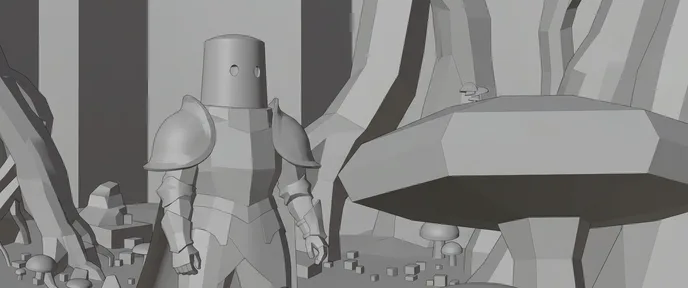
  1. A small knight with a lantern helm stands by a giant glowing blue mushroom in a crystal cavern
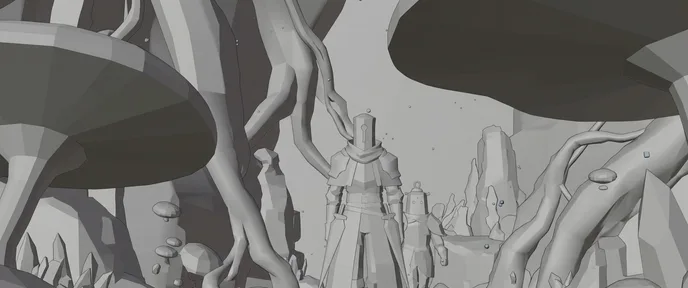
    Storyboard frame of the same wide shot, in grey
    01

    Wide · the world

    Wide shot, Lantern alone by a giant glowing blue mushroom, crystal cavern, roots, drifting spores, cold blue light

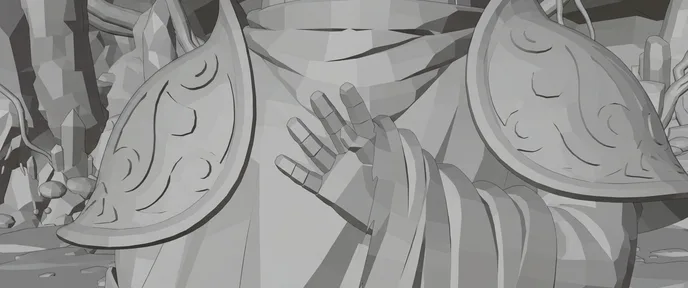
  2. Close-up of an armored chest under a cream cloak, a gloved hand, a spark of light
    Storyboard frame of the chest close-up, in grey
    02

    Close-up · the chest

    Close-up on Lantern's chest, his gloved hand pressed to the cloak, a spark of light escaping between the fingers

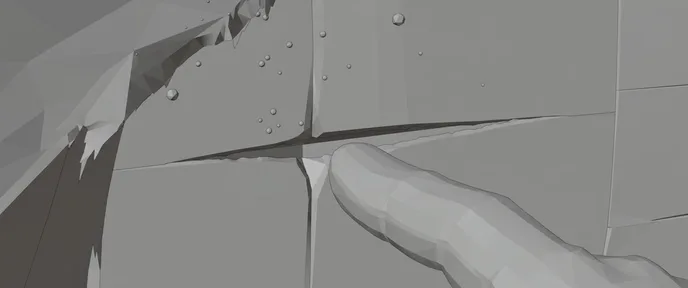
  3. A torn gash in an armor plate leaking bright blue light, a finger pointing at it
    Storyboard frame of the wound insert, in grey
    03

    Insert · the wound

    Extreme close-up, Serrure's finger near a torn gash in the back plate, blue light leaking out like luminous smoke

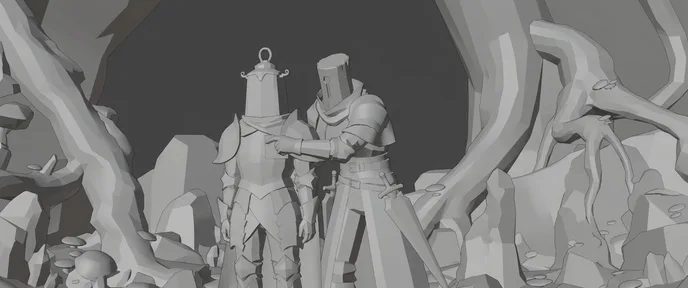
  4. Two armored knights side by side, one with a hand on the other's shoulder, in a crystal cavern
    Storyboard frame of the two-shot, in grey
    04

    Two-shot · the bond

    Medium two-shot among crystals and roots, Serrure's hand on Lantern's shoulder, faceless armors, emotion through posture only

  5. Two small knights walk beneath two giant glowing blue mushrooms
    Storyboard frame of the wide shot, in grey
    05

    Wide · the scale

    Wide low angle, the two knights tiny beneath two giant glowing mushrooms, blue crystals in the foreground, mist

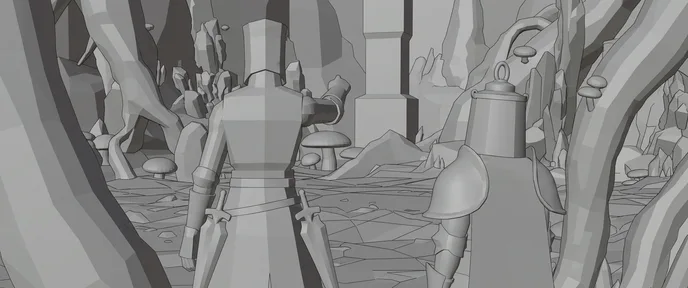
  6. Seen from behind, a tall dark knight points ahead while the small lantern knight looks on
    Storyboard frame of the over-the-shoulder shot, in grey
    06

    Over the shoulder · the road

    Over-the-shoulder from behind, Serrure points ahead into the cavern, Lantern beside him, roots framing the path

Lost Garden, episode 2 runs 21 minutes, far longer than a short drama episode. Cut into one or two minute pieces, each ending on a turn, the cave sequence alone would give several NEXTALE episodes. The video starts at the opening, in the cave.

The series

Twenty episodes in five movements.

The rules set no episode length. Short drama episodes usually run one to two minutes, so plan about 30 minutes of series, and end every episode on a question.
  1. Episodes 1 to 2

    The hook

    Who we follow and what they want, in the first seconds. Episode 1 ends on a betrayal, a secret or a choice.

  2. Episodes 3 to 7

    The trap closes

    The main conflict is set. Each episode adds one obstacle and one reveal.

  3. Episodes 8 to 13

    Escalation

    The stakes rise. Around episode 10, a twist turns what the viewer believed upside down.

  4. Episodes 14 to 18

    The fall

    The hero loses what they held. The antagonist seems to win.

  5. Episodes 19 to 20

    The payoff

    The reversal and a real ending. The grand prize goes to the best complete series.

Write the last line of every episode first. Twenty cliffhangers are the spine of the series.

Week by week

From the logline to the 20th upload.

About five weeks to 14 December 2026. That is four episodes a week, so the writing must be done in the first two weeks.
  1. 01

    6 to 12 November

    Concept and series bible

    One logline, three main characters, one place. Create your free Studio account so nothing waits at the end.

  2. 02

    13 to 19 November

    Write all 20 episodes

    Write the full series in ScreenWeaver, for free, with the cliffhanger of each episode decided first.

  3. 03

    20 to 26 November

    Storyboard and character references

    Generate the storyboard from the screenplay. Approve one reference per character so the faces hold for 20 episodes.

  4. 04

    27 November to 9 December

    Generate and edit

    Two or three episodes a day. Generate the shots, cut each episode, upload it to Studio as soon as it is done.

  5. 05

    By 11 December

    Finish and check

    Count the episodes in Studio: 20 or more, all uploaded. Keep a margin before the 14th, since no time zone is given.

Traps

Six ways to miss the prize.

The check is light, but a series that is not complete is not in the contest.
  • Nineteen episodes

    Twenty is the minimum. The check only verifies that every episode is there, and a missing one is enough to lose the grand prize and the $100 bonus.

  • The last evening

    The page gives 14 December with no hour and no time zone. Uploading 20 episodes on the last night is a bet you do not need.

  • Faces that drift

    Across 20 episodes, a heroine who changes face loses the viewer. Lock the references before you generate a single episode.

  • A pilot, not a series

    The grand prize is for the best complete series. Twenty episodes with no ending is a long trailer.

  • Characters that are not yours

    The page says you keep the IP of your characters and story. That only works if they are your own, not borrowed from a film or a real person.

  • Skipping the Creator Agreement

    The Terms say the Creator Agreement and Content Policy, accepted in Studio, govern licensing and payouts. Read them before you upload.

Why ScreenWeaver

Twenty episodes need one project.

A short drama series is a writing job first, then a consistency job. ScreenWeaver puts the screenplay, the storyboard and the footage in one connected project.
  • The whole series in one place

    Twenty episodes, one screenplay, one set of characters. Each scene is tied to its storyboard frames.

  • Characters that carry

    Characters, locations and references carry from shot to shot and from episode to episode.

  • Built for short drama

    Vertical 9:16 short dramas are one of the formats ScreenWeaver is built for, along with films and series.

  • Footage powered by Seedance

    NEXTALE accepts Seedance. Generate the shots with Seedance 2.0 and 2.5 on the Auteur plan, $39.99 a month. Writing is free, today.

Real productions

International festival-recognized films have been written and produced with ScreenWeaver.

ScreenWeaver is already being used as a creative workspace for real AI film productions, from animated shorts to short films nominated and awarded by international festivals.

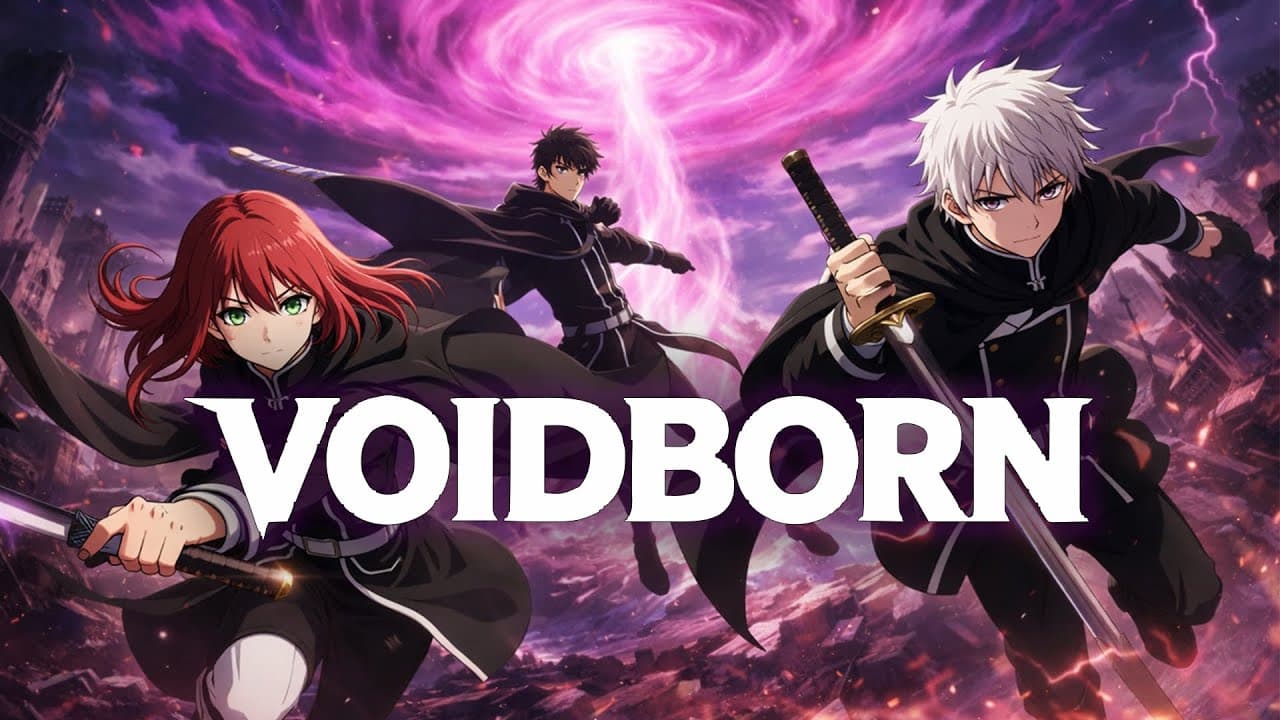
  • Video thumbnail for VOIDBORN

    VOIDBORN

    AI animated / cinematic short

    Festival recognition

    • 1st Place Silver

      Mondial Chroma Awards

    • 2nd Place Dreamina

      Mondial Chroma Awards

    • Award Winner

      Seoul International AI Film Festival

  • Video thumbnail for Les Fils du Vinnana

    Les Fils du Vinnana

    AI short film

    Festival recognition

    • Honorable Mention

      Top Quark Film Festival

    • People's Choice Nominee

      Illuminate Oneness of Humanity

    • Nominee

      ALTFF Supershort

The pipeline

Write. Board. Produce.

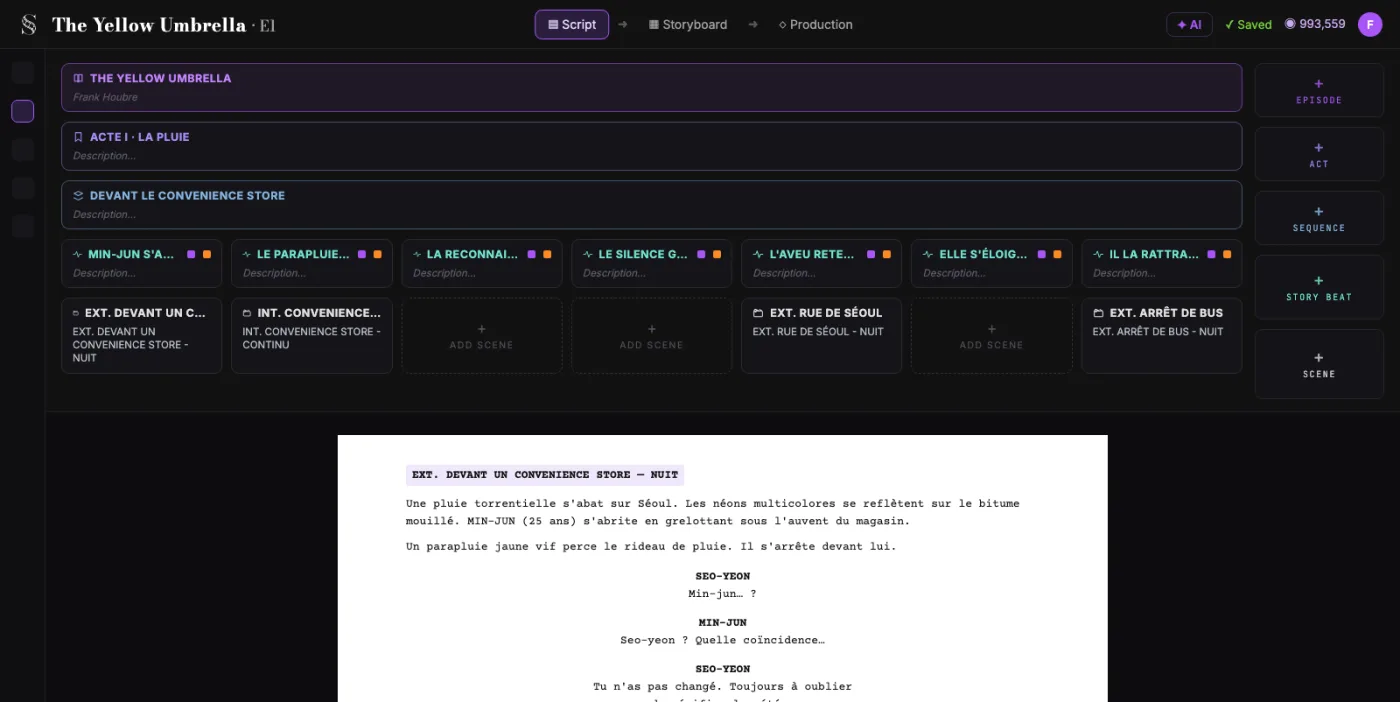
  1. ScreenWeaver screenplay editor: acts, sequences and beats above the formatted script of The Yellow Umbrella

    01The screenplay, enriched

    An industry-standard screenplay editor, and more: a visual outline and beat editor, your writing inspirations (notes, photos, audio) kept next to the page, and an AI researcher to support your writing, not replace it.

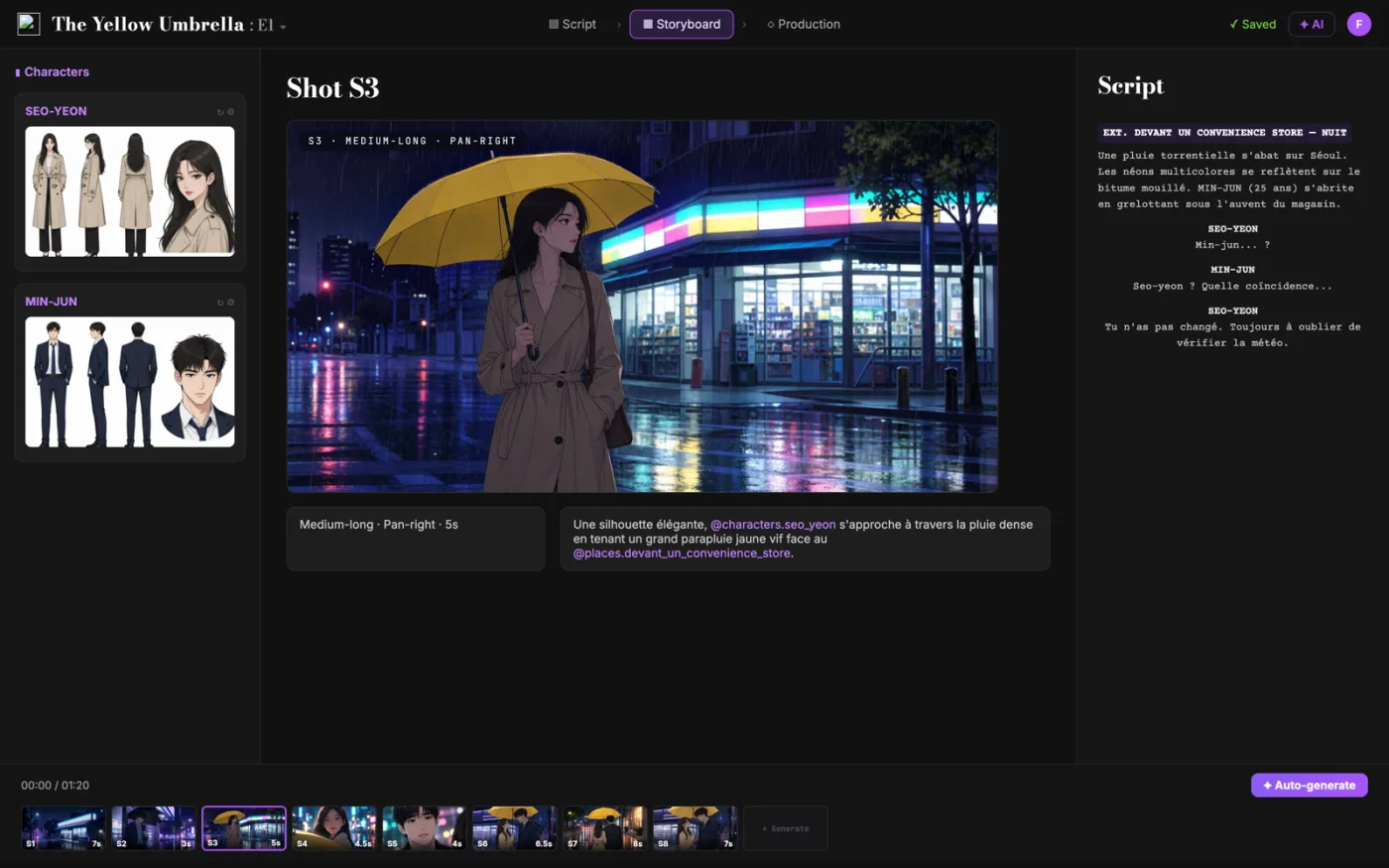
  2. ScreenWeaver storyboard: shot S3 of The Yellow Umbrella with characters, shot settings and the script beside it

    02The storyboard, made easy

    Shot breakdown generated from your screenplay, manual control over every shot (frame, angle, movement, duration), and generative AI previsualization in one click.

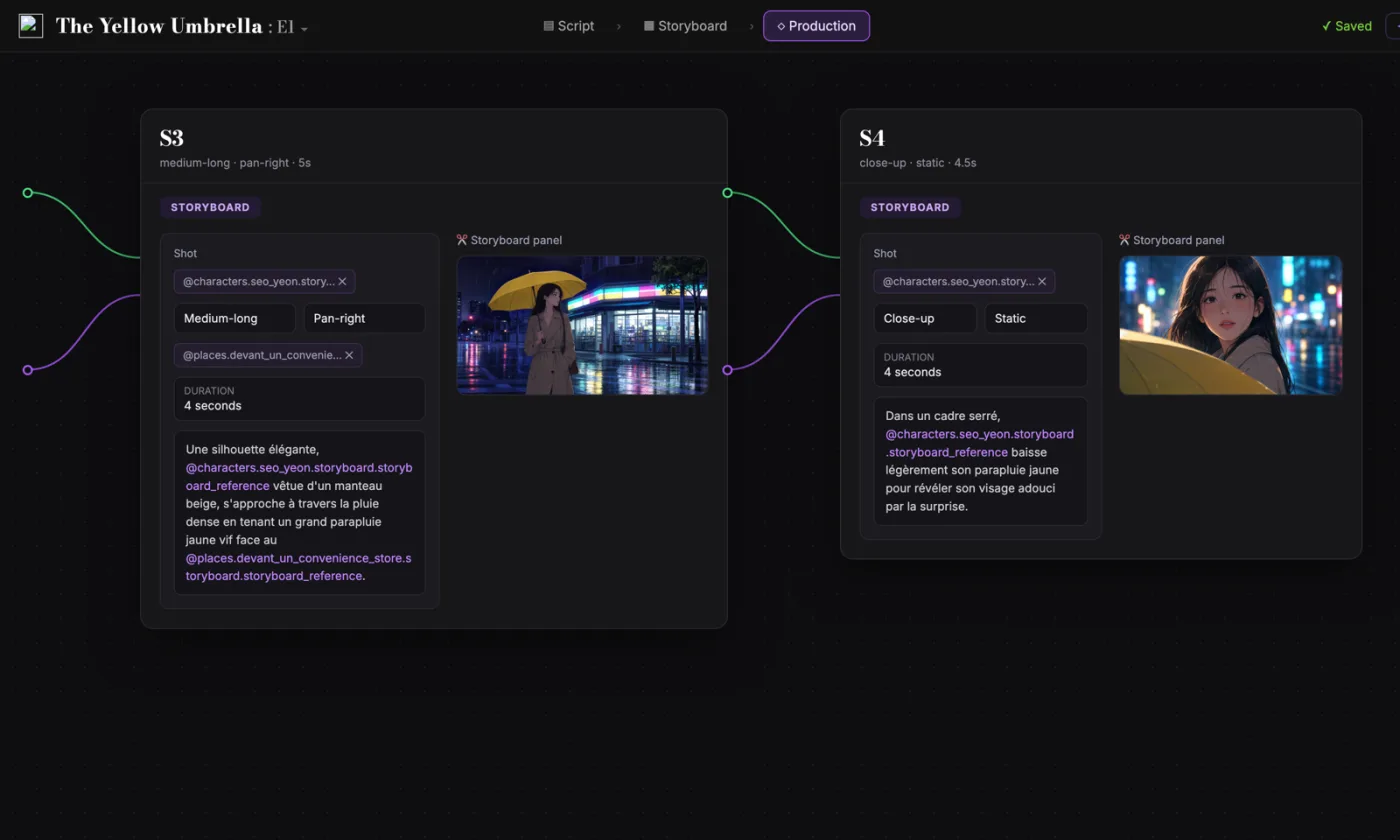
  3. ScreenWeaver production canvas: shots S3 and S4 as connected nodes carrying their storyboard panels and prompts

    03AI production, with finesse

    Footage generation pipelines connected to your screenplay and storyboard. Optimized out of the box, fully editable workflow.

FAQ

The NEXTALE Award, your questions

How do you win the NEXTALE Award?
Upload a complete AI short drama of at least 20 episodes to NEXTALE Studio by 14 December 2026. Entry is free and any AI tool is allowed. The NEXTALE team picks one series for the $2,000 grand prize, and the first 10 complete series get $100 each.
Can I make my series with ScreenWeaver?
Yes. NEXTALE accepts any AI tool and names Seedance. Write and storyboard the 20 episodes in ScreenWeaver, generate the shots with Seedance on the Auteur plan, then upload the episodes to NEXTALE Studio.
Is it free to enter?
Yes. The award page says entering and creating a Studio account are free.
How long must each episode be?
The official pages we read on 6 November 2026 set no episode length and no aspect ratio. Only the count is fixed: 20 episodes or more.
Who picks the winner?
The NEXTALE team, with no jury and no published criteria. The FAQ says: “We care about the story.”
Who owns my series?
You keep the IP of your characters and story. NEXTALE distributes and monetises the series, under a licence set by the Terms and the Creator Agreement in Studio.
How does the revenue work?
Every series keeps all the revenue from its paid views for the first six months after launch, prize or not. The pages we read do not say what happens after six months.
When are the winners announced?
On 20 December 2026, after the platform launch in December.

Twenty episodes. Start with the first line.

Write the series today, at no cost. Storyboard every episode, then generate the shots.