Jaipur IFF 2027 · World AI Cinema Competition guide

How to win the Jaipur World AI Cinema Competition.Late deadline 15 October, final 5 December.

The first World AI Cinema Competition runs inside the 19th Jaipur International Film Festival, 8 to 12 January 2027, with fifteen AI awards from a micro film under five minutes to a feature. The official pages disagree on some dates and fees, so this guide shows each version.
  • Late deadline 15 October 2026
  • Final deadline 5 December 2026
  • Festival 8 to 12 January 2027
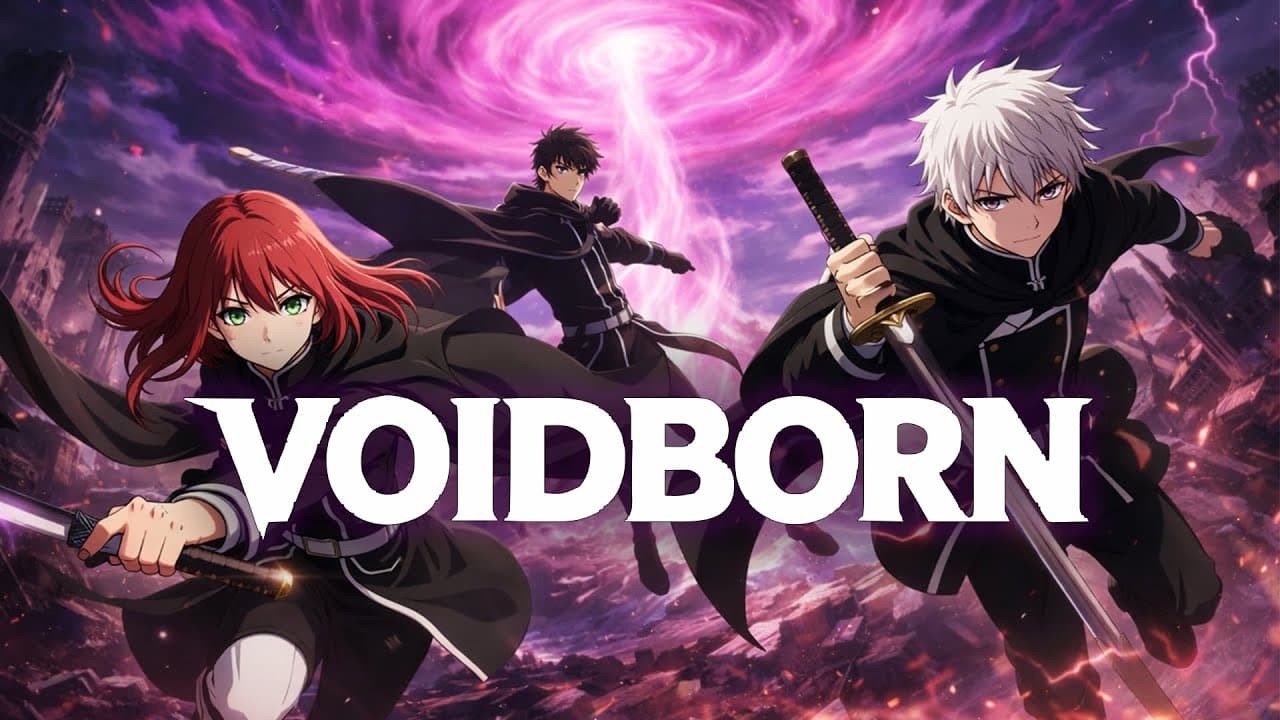
Voidborn · Episode 0

Independent guide. ScreenWeaver does not organise the Jaipur International Film Festival and is not affiliated with the Jaipur International Film Festival Trust. Rules read on 1 October 2026. JIFF 2027 entry form

Available today in ScreenWeaver: free screenwriting, and a storyboard generated from your screenplay with Storyboard Beta, $9.99 a month.

Rolling out: video generation of each shot, powered by Seedance, with the Filmmaker plan.

The rules on one card

What the Jaipur AI competition asks.

The competition is new, and its pages are not yet in step with each other. This card gives the AI page’s numbers first and flags every place where another official page says something else.
Festival
19th JIFF, 8 to 12 January 2027, Jaipur, India
The AI strand
1st World AI Cinema Competition, also named WAICF India
Deadlines
Late 15 Oct, final 5 Dec 2026, extended 15 Nov on jiffindia.org only
AI short fee
₹2,500 or $45 late, ₹3,000 or $55 extended; $50 and $60 on the JIFF fee page
Lengths
Micro under 5 min, short up to 45 min, feature 46 to 180 min
Eligibility
Shorts made January 2024 to December 2026, post-production accepted
AI rule
No AI share or disclosure rule published
Prize money
Up to ₹25 lakh on the AI page, depending on sponsorship

Source: jiffindia.org (home page, JIFF 2027 programme, entry form and festival deadlines pages) and the WAICF page on filmdais.com, read on 1 October 2026. The AI page lists three deadlines and the JIFF deadlines page five. The Festhome listing was not readable, and some third-party listings give other dates.

Key dates

Two weeks to the late bracket, nine to the last.

Dates differ between the festival’s own pages. We keep <b>the ones that two pages agree on</b> and mark the rest. Neither page gives an hour or a time zone for a deadline.
  1. 15 Oct 2026

    Late deadline

    Common to the official pages. A short up to 45 minutes costs ₹2,500 or $45 on the AI page and $50 on the JIFF fee page.

  2. 5 Nov 2026

    First nomination list

    For entries received up to 15 October.

  3. 15 Nov 2026

    Extended deadline

    Listed on jiffindia.org but not on the AI page, which goes from 15 October to 5 December. Treat it as unconfirmed.

  4. 5 Dec 2026

    Final deadline

    The last day on jiffindia.org and on the AI page. A second nomination list also appears on 5 December, for entries to 15 November.

  5. 21 Dec 2026

    Final list and programme

    The final nomination list and the programme go live. The festival runs from 8 January 2027.

Categories

Fifteen awards. Six that suit a writer-director.

The festival’s AI page lists eight film categories and seven creative innovation awards, while jiffindia.org lists ten. Here are the six that fit a screenplay-led filmmaker, and the angle we would take.
  • 01

    Best AI Micro Film

    Ultra-short creative films, under 5 minutes.

    The fastest way in: one idea, one place, about 40 shots, finished before the late deadline.

  • 02

    Best AI Short Film

    Short films created with AI tools, from 1 to 45 minutes.

    The core category. Aim near 10 minutes, where a story has room without the cost of a long film.

  • 03

    Best AI Animation Film

    AI-generated animation, 2D and 3D animation, virtual characters and worlds.

    The place for an anime or an animated fable. Hold the character design across every shot.

  • 04

    AI-Assisted Film (Human + AI)

    A category on jiffindia.org for films that combine human work and AI.

    The honest door if part of your film is shot or drawn by hand. Pick the category that matches your pipeline, since no AI share is published.

  • 05

    Best AI Screenplay / Story Concept

    A creative innovation award for the writing itself.

    The one category that needs no footage. Check whether it expects AI-assisted writing, since its name says so.

  • 06

    Best AI Character Creation

    A second creative innovation award, for characters.

    A character sheet and a few consistent shots can make the entry. Show the same face in three lights.

Page to screen

Voidborn: an anime scene in six shots.

The competition has a Best AI Animation Film award and a micro film category under five minutes. This is a scene from Voidborn, episode 0, an anime made by the ScreenWeaver team: the screenplay page, then each shot as a storyboard frame and as the final image.

Logline. Every seven years, the Rift opens and swallows the world’s dreams. A swordsman sworn to a blind seer escorts her through its levels, toward a promise they made to a girl left behind.

Screenplay · episode 0 · English subtitles

EXT. RUINS OF THE FIRST LEVEL - NIGHT

Broken towers under a violet sky. SIM, a swordsman in a black cloak, walks beside LADY MARIA, blindfolded, all in white.

SIM

Tell me, Maria... do you think Leia believes we are still alive?

MARIA

We made a promise... the two of us.

A line of white automatons rises from the ruins.

AUTOMATON

The Rift will wait for no one.

SIM

What are machines doing at this level?

One automaton steps forward. Its face is blank.

AUTOMATON

We must return to the surface.

Its eyes ignite red.

SIM

I am Sim, guardian of Lady Maria... and I will proceed with your execution.

Steel meets steel. Lightning runs down the blade.

CUT TO:

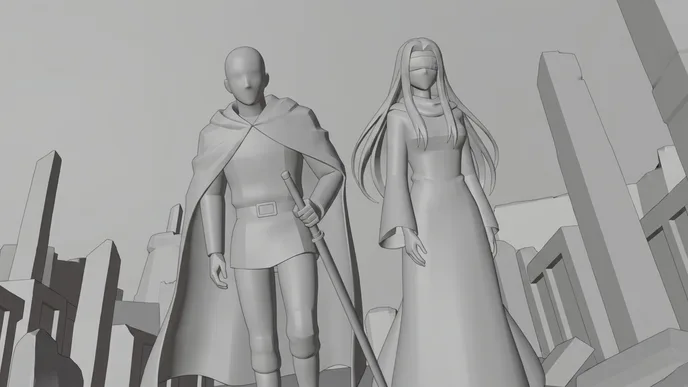
  1. A swordsman in a black cloak and a blindfolded woman in white walk through ruins at night
    Storyboard frame of the wide shot, in grey
    01

    Wide · the pair

    Wide shot, a bald swordsman in a black cloak and a blindfolded red-haired woman in white walk through night ruins

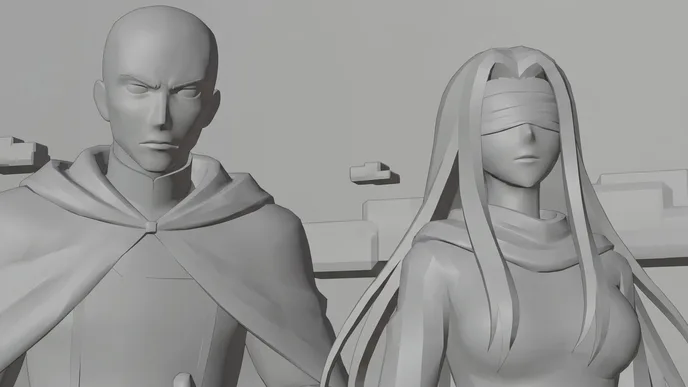
  2. Medium two-shot of a bald swordsman and a blindfolded red-haired woman
    Storyboard frame of the two-shot, in grey
    02

    Two-shot · the promise

    Medium two-shot, the swordsman and the blindfolded seer side by side, violet night sky, broken towers

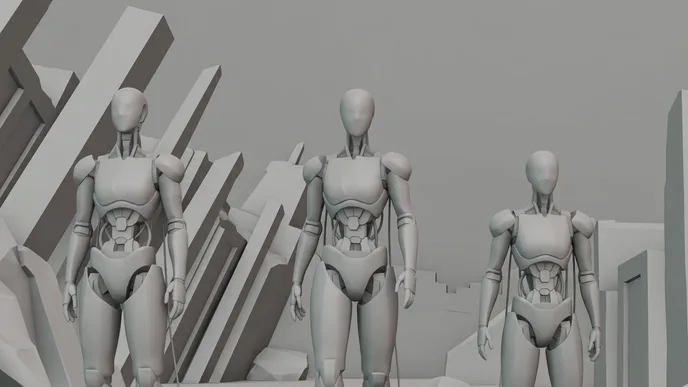
  3. Three white humanoid automatons stand in night ruins
    Storyboard frame of the automatons shot, in grey
    03

    Wide · the machines

    Wide low angle, three white humanoid automatons standing in the ruins, cold blue moonlight

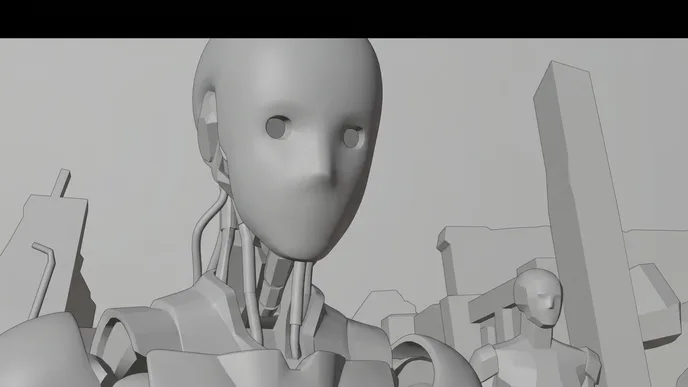
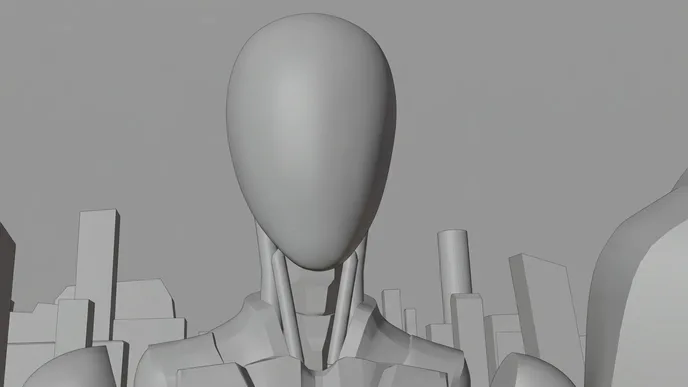
  4. Close-up of a white automaton with a smooth blank face
    Storyboard frame of the blank face close-up, in grey
    04

    Close-up · the blank face

    Close-up on an automaton's smooth faceless head, black eye slots, cables at the neck, ruins behind

  5. A white automaton's eyes glow red
    Storyboard frame of the red eyes close-up, in grey
    05

    Close-up · the red eyes

    Same framing, the automaton's eyes ignite red, the swordsman's shoulder out of focus in the foreground

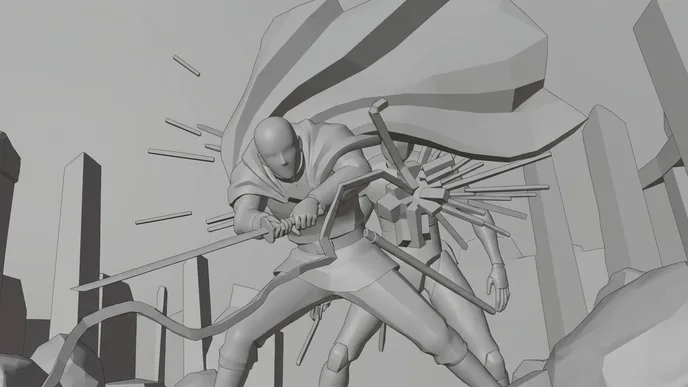
  6. A swordsman strikes with a katana wreathed in lightning and sparks
    Storyboard frame of the clash shot, in grey
    06

    Action · the clash

    Dynamic low angle, the swordsman strikes with his katana, lightning running along the blade, sparks, cape flying

Voidborn, episode 0 runs 13 minutes, so a micro film would be one sequence cut to under five minutes. The Seoul International AI Film Festival gave it an award, and the Mondial Chroma Awards two prizes. Press play and the player opens on the scene the shots come from.

The script

A 4 minute micro film in four movements.

The micro category stops under five minutes. Aim for 4 minutes: 4 screenplay pages and 35 to 45 shots of 5 to 7 seconds.
  1. 0:00 to 0:10

    The image

    A jury watching dozens of films decides fast. Open on one striking image.

  2. 0:10 to 0:50

    The idea

    State the premise in pictures, not in a voice-over.

  3. 0:50 to 3:30

    The development

    Change the situation twice. Nothing more fits in four minutes.

  4. 3:30 to 4:00

    The reversal

    Finish on a turn that recasts the first image.

The festival accepts all languages. English subtitles are our advice for the jury, not a stated rule.

Week by week

From now to 5 December.

The late deadline is two weeks away and the final one nine weeks away. This plan aims at 5 December and says how to catch 15 October with a micro film if you want the earlier list.
  1. 01

    1 to 7 October

    Pick the category

    Choose between micro film, short, animation and AI-assisted film, and read the entry form. The fee list differs between the AI page and the JIFF page.

  2. 02

    8 to 15 October

    Catch the late bracket, or skip it

    A 4 minute micro film can be written and storyboarded in a week in ScreenWeaver. If footage is not ready, skip the late bracket and aim for the final one.

  3. 03

    16 October to 5 November

    Screenplay and storyboard

    Write the short free, storyboard each shot and fix characters and locations. Entries sent by 15 October appear in the first list on 5 November.

  4. 04

    6 to 22 November

    Footage

    Generate shot by shot with Seedance in ScreenWeaver as video generation comes to your plan. Keep every prompt, since you may be asked about AI use.

  5. 05

    23 November to 1 December

    Edit, sound, subtitles

    Edit, mix and subtitle in English, then export a file. Make a screener link that opens without an account.

  6. 06

    2 to 5 December

    Submit

    Submit through a platform with a checkout. Do not wait for the last evening: the pages give no hour or time zone for the deadline.

Ways to lose money or a slot

Seven checks before any payment.

A new competition on a large festival site means loose ends. Confirm each point on the platform where you pay, not on a summary page.
  • Trusting one deadline

    jiffindia.org lists five deadlines, the AI page three, and third-party listings differ again. Check the date on your submission platform.

  • Two fee grids

    The AI page prices a short at ₹2,500 or $45 late, the JIFF fee page at $50. Confirm the amount at checkout before you pay.

  • Paying by bank transfer

    The entry form lists PayPal, UPI and a bank deposit, with proof sent by email. Prefer a submission platform, which keeps a record of your payment.

  • Withdrawing after the nominations

    After the final nominations, a withdrawal can cost 20 times the submission fee. Do not submit a film you might pull.

  • Banking on the prize money

    The AI page promises up to ₹25 lakh, depending on sponsorship and funding, and jiffindia.org up to ₹50 lakh for the whole festival, depending on government support. JIFF says it pays no screening fees.

  • The wrong category

    No AI share is published, and the festival offers both AI categories and an AI-assisted one. Pick the one that matches how you worked, and describe the pipeline.

  • A film outside the dates

    Shorts must be produced between January 2024 and December 2026. Films in post-production are accepted, so a work-in-progress can enter.

Why ScreenWeaver

Two awards need no footage. Start with the page.

A festival with fifteen AI awards rewards writing and characters as well as footage. ScreenWeaver lets you start with the page and add images when they are ready, in one connected project.
  • A screenplay category

    The screenplay and story concept award can be entered without a frame, and the editor is free, with PDF and Final Draft export.

  • Characters that hold

    References for each character carry from shot to shot, which serves the character creation award and every shot of an animation.

  • A micro film in a week

    The storyboard sets each shot’s duration, so you can fit four minutes before you generate anything.

  • Free to start

    Screenwriting costs nothing on the Screenwriter plan and never expires. Storyboard Beta is $9.99 a month, and the Filmmaker plan carries Seedance video generation.

Real productions

International festival-recognized films have been written and produced with ScreenWeaver.

ScreenWeaver is already being used as a creative workspace for real AI film productions, from cinematic shorts to animated series pilots selected, nominated, and awarded by international festivals.

  • Video thumbnail for VOIDBORN

    VOIDBORN

    AI animated / cinematic short

    Festival recognition

    • 1st Place Silver

      Mondial Chroma Awards

    • 2nd Place Dreamina

      Mondial Chroma Awards

    • Award Winner

      Seoul International AI Film Festival

  • Video thumbnail for Les Fils du Vinnana

    Les Fils du Vinnana

    AI short film

    Festival recognition

    • Honorable Mention

      Top Quark Film Festival

    • People's Choice Nominee

      Illuminate Oneness of Humanity

    • Nominee

      ALTFF Supershort

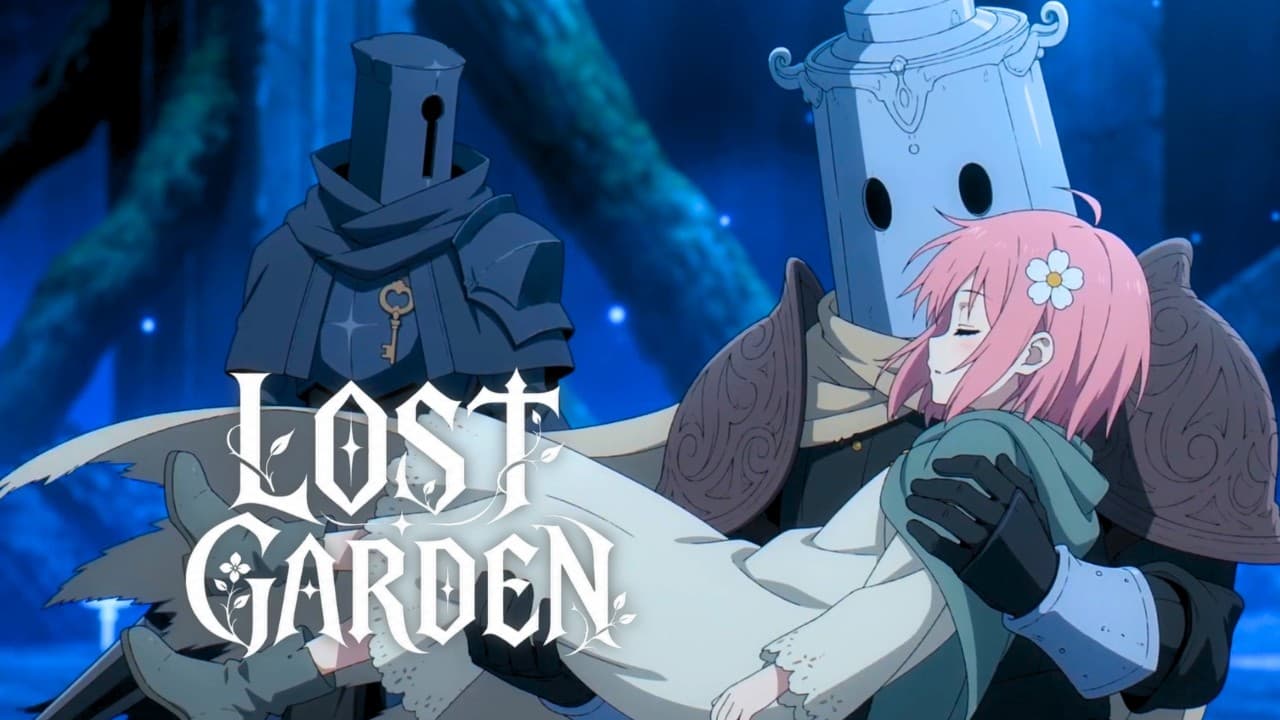
  • Video thumbnail for Lost Garden

    Lost Garden

    AI animated series pilot

    Festival recognition

    • Finalist

      AI London Festival

The pipeline

Write. Board. Produce.

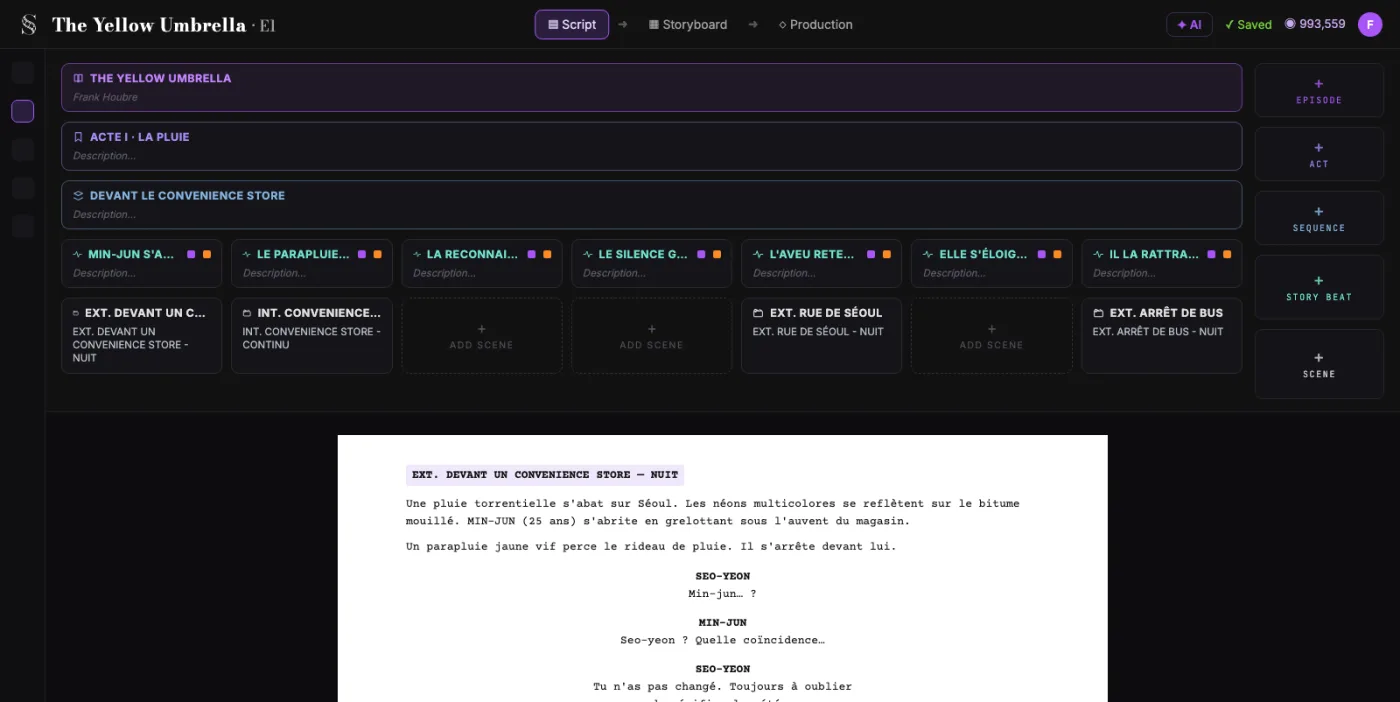
  1. ScreenWeaver screenplay editor: acts, sequences and beats above the formatted script of The Yellow Umbrella

    01The screenplay, enriched

    An industry-standard screenplay editor, and more: a visual outline and beat editor, your writing inspirations (notes, photos, audio) kept next to the page, and an AI researcher to support your writing, not replace it.

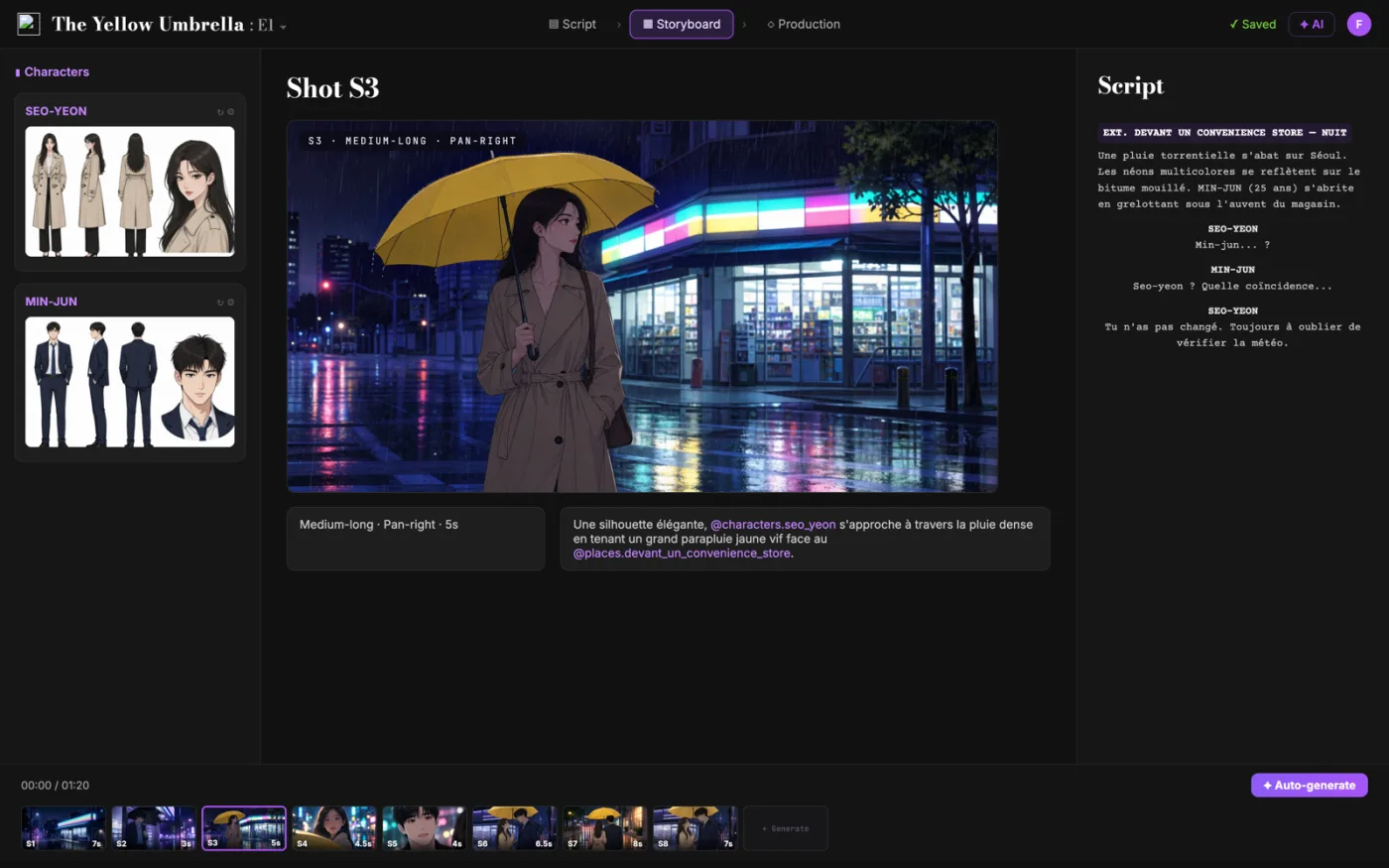
  2. ScreenWeaver storyboard: shot S3 of The Yellow Umbrella with characters, shot settings and the script beside it

    02The storyboard, made easy

    Shot breakdown generated from your screenplay, manual control over every shot (frame, angle, movement, duration), and generative AI previsualization in one click.

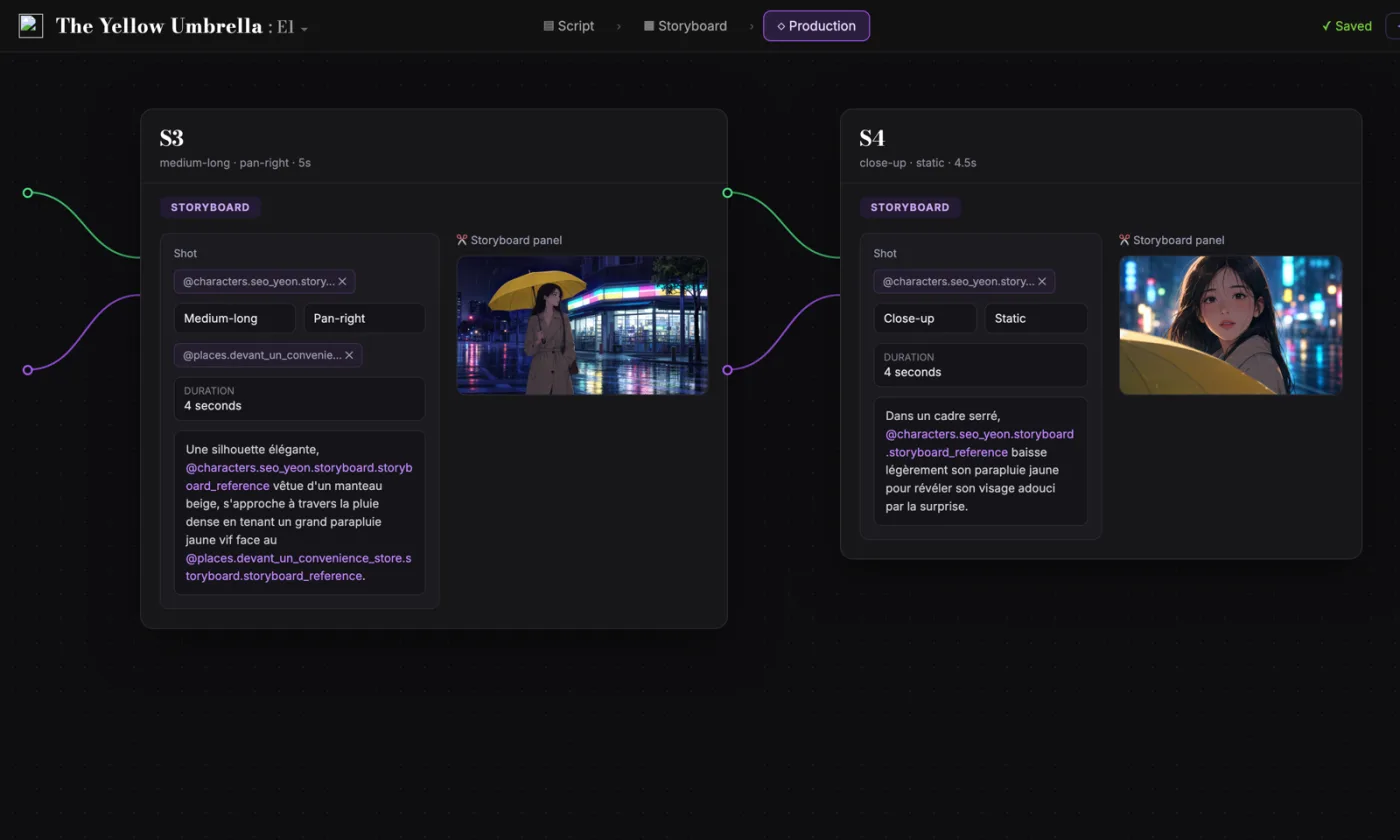
  3. ScreenWeaver production canvas: shots S3 and S4 as connected nodes carrying their storyboard panels and prompts

    03AI production, with finesse

    Footage generation pipelines connected to your screenplay and storyboard. Optimized out of the box, fully editable workflow.

FAQ

Jaipur World AI Cinema Competition, your questions

How do you win the Jaipur World AI Cinema Competition?
Enter the right category before 5 December 2026 with a finished AI micro film, short or animation. The festival publishes no judging criteria and no jury for the AI strand, so a clear idea and a clean finish are your tools.
Which deadlines apply?
Late 15 October 2026, extended 15 November (listed on jiffindia.org only) and final 5 December. Nomination lists come on 5 November, 5 December and 21 December. Other listings differ, so check on your platform.
What are the fees?
On the AI page, a short up to 45 minutes is ₹2,500 or $45 late and ₹3,000 or $55 extended. A feature is ₹6,000 or $80 late and ₹8,000 or $100 extended. The JIFF fee page lists shorts at $50 and $60.
How long can my film be?
Micro films under 5 minutes, shorts up to 45 minutes, features from 46 to 180 minutes. The official page says all durations and all languages are accepted.
Are there rules on how much AI a film uses?
None is published for the AI strand. The categories separate AI films from AI-assisted films, human and AI together. Pick the one that matches your pipeline and describe it.
What can you win?
Up to ₹25 lakh on the AI page, depending on sponsorship and funding, with 3 to 5 winners per category and honours such as the AI Visionary Award. The whole of JIFF lists up to ₹50 lakh, depending on government support.
How do I submit?
Through FilmDais, FilmFreeway, WFCN, Festhome or Sfilmmaker, or by email or post. Screener links on YouTube, Vimeo, WeTransfer or Google Drive are accepted, and films already on YouTube are eligible.

Nine weeks to the final deadline. Start with the page.

Start the screenplay free today. Storyboard follows, and Seedance footage once it reaches your plan.