IFFR 2027 · AI films guide

Can you submit an AI film to IFFR?The rules are silent. The premiere rules are not.

The International Film Festival Rotterdam sets no rule on AI, neither a ban nor a disclosure clause. What it does enforce is strict: a world premiere for the Tiger Short, nothing screened in the Netherlands, nothing finished before 2026. The 2027 call closed on 15 September, so here is how to prepare for the next one, starting with the screenplay in ScreenWeaver.
  • No AI rule in the 2027 terms
  • 2027 call closed 15 Sep 2026
  • Festival 28 Jan to 7 Feb 2027
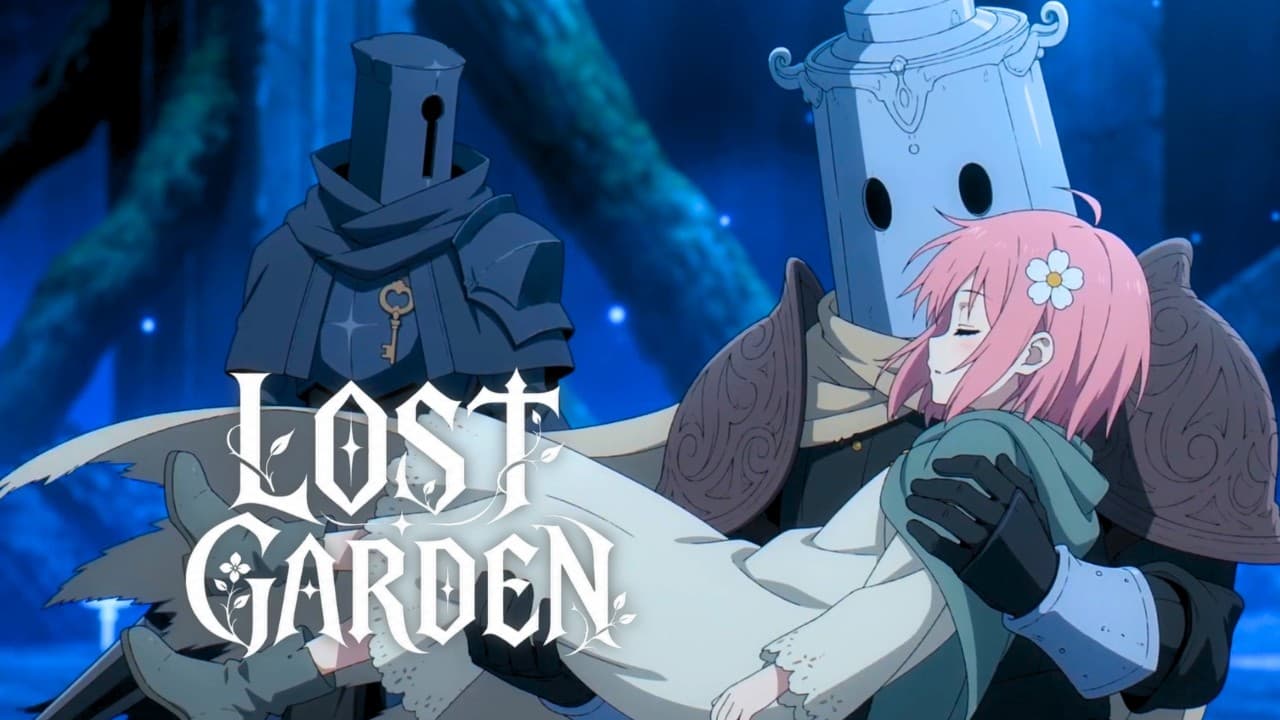
Lost Garden · Episode 2

Independent guide. ScreenWeaver does not organise IFFR and is not affiliated with the International Film Festival Rotterdam. Rules read on 1 October 2026. Official submissions page

Available today in ScreenWeaver: free screenwriting, and a storyboard generated from your screenplay with Storyboard Beta, $9.99 a month.

Rolling out: video generation of each shot, powered by Seedance, with the Filmmaker plan.

The rules on one card

What IFFR asks of a film.

IFFR is a curated festival with an adventurous streak. Its submission terms hold no clause on artificial intelligence, so an AI film is read like any other: by programmers, and under the practical rules below.
Festival
28 January to 7 February 2027, Rotterdam
2027 call
Closed on 15 September 2026, 17:00 CEST
Short or mid-length fee
€40, €55 or €70 by window, ex VAT
Feature fee
€65, €85 or €110 by window, ex VAT
What a short is
Under 64 minutes
Premiere for shorts
World, international or European; Tiger Short: world
AI rule
None in the terms or on the submissions page
Eligibility
Finished after 1 January 2026, never screened in the Netherlands

Source: IFFR 2027 Terms and Conditions for participation (last edit 1 May 2026), its film and media submissions page and its professionals FAQ, read on 1 October 2026. IFFR may change its terms at its own discretion. The 2028 call is not announced.

What the rules say about AI

No clause, and six things to know.

We read the full 2027 terms and the submissions page. The words “artificial intelligence”, “generative” and “AI” appear in neither. Silence is not a ban, and it is not a promise.
  • The Terms and Conditions

    Five parts, from general information to screening protocol, and not one line on AI. The document is marked “Last edit: 1 May 2026” and says IFFR can change it at its full discretion. We read the whole text on 1 October 2026.

  • The submissions page

    It welcomes “narrative films, (creative) documentaries, cross media projects, experimental works and animation”. It names no tool, no AI and no disclosure. The page was read on 1 October 2026.

  • Disclosure is your call

    Nothing asks you to declare AI, so the description you write for the programmers is where you choose. We advise one plain line: what was generated, what was not. Never hide it: an honest answer costs nothing, an evasive one can cost the film.

  • Which door suits an AI film

    Films under 64 minutes enter the Short & Mid-length programme or the Tiger Short Competition. Features go to the Tiger or Big Screen competitions. Immersive, interactive or live work uses Art Directions, which has its own form.

  • Credits are printed

    The terms list what IFFR publishes: director, screenplay, cinematography, editing, production design, sound, music, principal cast. For an AI film, decide who signs each role and what a generated shot stands in for before you submit.

  • What AI does not change

    The premiere rules, the completion date and the Dutch screening rule apply to every film. IFFR does not refund ineligible entries. These rules decide your entry long before AI does.

Key dates

Five dates from the 2027 call.

The 2027 call is closed. Its calendar is the best guide to the next one.
  1. 1 May 2026

    Call opens

    Submissions for IFFR 2027 opened with an early fee of €40 for a short and €65 for a feature.

  2. 15 Jun 2026

    Early fee ends

    The standard fee ran to 31 August: €55 for a short, €85 for a feature.

  3. 15 Sep 2026

    Final deadline

    17:00 CEST, with the late fee. Form and payment both had to be complete, and nothing was accepted after.

  4. 16 Dec 2026

    Screening copies due

    Selected films deliver their copy six weeks before the festival: a DCP for cinemas, a high-resolution file for online.

  5. 28 Jan to 7 Feb 2027

    The festival

    Up to five public screenings per selected film. IFFR pays no screening fees.

Who decides

Programmers first, a jury after.

IFFR names no jury at submission stage. It does say who reads your film and what you get back.
  • Two selection committees

    The FAQ says one committee selects feature films and another selects short and mid-length films, and that programmers view all submissions. Your short is read by short-film programmers, not by a general panel.

  • No feedback

    IFFR says it cannot give any, because of the number of titles it receives. A rejection tells you nothing about the film, and nothing about its AI.

  • The Tiger Short jury

    In 2026 it had three members: the artist Sammy Baloji, the photographer and filmmaker Anka Gujabidze, and Jukka-Pekka Laakso, director of the Tampere Film Festival since 2002. They give three equal awards. Expect artists and festival people, not a genre audience.

Programmes

Four doors for an AI film.

IFFR has programmes, not themes. The programmers place the film, but your form decides which door you knock on. Under each, how we would approach it.
  • 01

    Tiger Short Competition

    Films under 64 minutes, world premiere only, with three equal awards of €5,000 chosen by an international jury.

    The door with a prize. Aim a finished short at it, built on one formal idea, not a proof of concept.

  • 02

    Short & Mid-length

    A non-competitive programme for short and mid-length films with a world, international or European premiere.

    More room for a film that already played elsewhere in Europe. Say where it screened on the form.

  • 03

    Tiger Competition

    Feature-length films by first, second or third-time directors, shown as a world premiere, with a Tiger Award of €40,000.

    A long road for an AI feature. It suits a series that grows into a film, not a short made this winter.

  • 04

    Art Directions

    The strand for immersive media, XR, interactive installations and live audiovisual work, with a €40 form of its own.

    If your project is nearer to a world than to a film, this is the strand. The 2027 immersive form closed on 14 August 2026.

The winners

What the Tiger Short winners say.

The 2026 awards went to The Second Skin by Mariia Lapidus (USA, Mexico), The Apple Doesn’t Fall… by Dean Wei (China) and Ndjimu (Deep Cobalt) by Petna Ndaliko Katondolo (Democratic Republic of the Congo, USA). In 2025 they went to Merging Bodies, A Metamorphosis and Temo Re.

  1. 01

    No profile to copy. The 2026 winners come from three continents: North America, Asia and Africa. There is no house style to imitate.

  2. 02

    Everyone can win. IFFR says the Tiger Short is not only for young and upcoming talents. A first AI film competes with established artists.

  3. 03

    Stillness can win. Temo Re, the 2025 winner, is made entirely of black-and-white photographs, according to its director’s jury biography. A film built from generated stills is a fair formal choice if it has rhythm.

  4. 04

    Length is open. Shorts run from 1 to 63 minutes and 22 of them competed in 2026. Pick the length the idea needs.

A scene, shot by shot

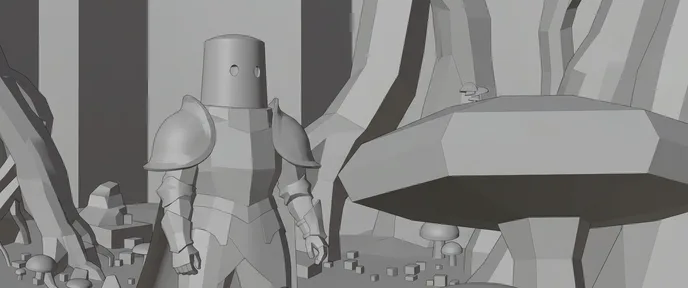
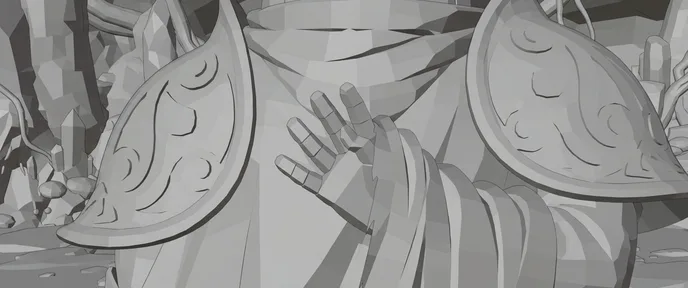
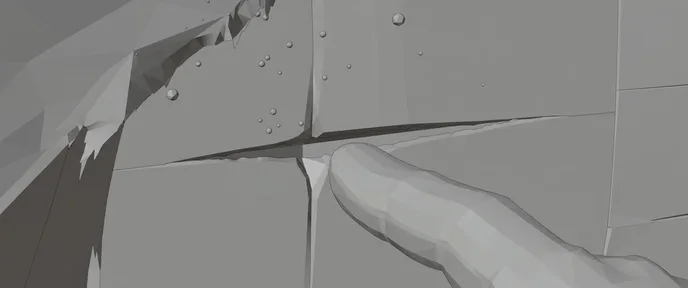
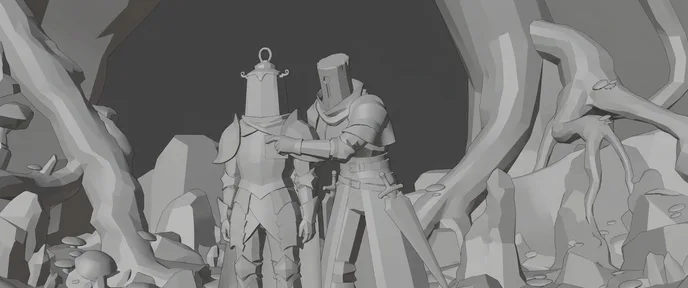
Lost Garden: six shots from the cave.

IFFR accepts frames from 1.33 to 2.39 on its screens, and this scene is cut for the widest. It is the opening of Lost Garden, episode 2, an animated series by the ScreenWeaver team made with Seedance: first the screenplay page, then every shot as a storyboard frame beside its final image.

Logline. A newborn knight whose inner light is leaking away crosses a world that has stopped hoping, to find the one blacksmith who can seal his armor.

Screenplay · episode 2 · page 1

INT. UNDERGROUND CAVERN - LOWER PATH - CONTINUOUS

Blue mushrooms the size of houses. LANTERN, a small knight with a lantern for a helm, walks alone.

He presses a hand to his chest. Sparks of light slip between his fingers.

SERRURE

Hold on. You're losing something.

Serrure lifts the edge of the cloak. A gash in the armor. Blue light leaks out like smoke.

SERRURE

That's your energy. What keeps you standing.

He grips Lantern's shoulder. Two knights alone among the crystals.

SERRURE

A suit that leaks goes out. Eventually.

Under the giant mushrooms, the road climbs into the dark.

SERRURE

So. We follow the road.

Serrure points the way. Lantern follows.

CUT TO:

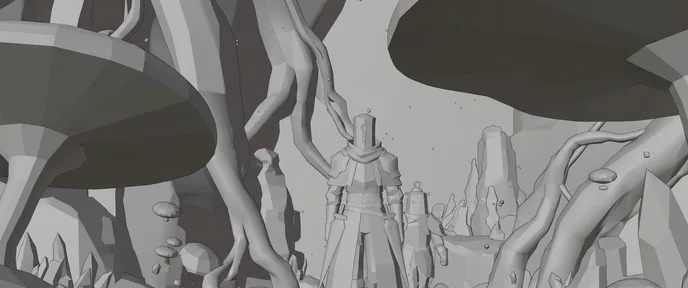
  1. A small knight with a lantern helm stands by a giant glowing blue mushroom in a crystal cavern
    Storyboard frame of the same wide shot, in grey
    01

    Wide · the world

    Wide shot, Lantern alone by a giant glowing blue mushroom, crystal cavern, roots, drifting spores, cold blue light

  2. Close-up of an armored chest under a cream cloak, a gloved hand, a spark of light
    Storyboard frame of the chest close-up, in grey
    02

    Close-up · the chest

    Close-up on Lantern's chest, his gloved hand pressed to the cloak, a spark of light escaping between the fingers

  3. A torn gash in an armor plate leaking bright blue light, a finger pointing at it
    Storyboard frame of the wound insert, in grey
    03

    Insert · the wound

    Extreme close-up, Serrure's finger near a torn gash in the back plate, blue light leaking out like luminous smoke

  4. Two armored knights side by side, one with a hand on the other's shoulder, in a crystal cavern
    Storyboard frame of the two-shot, in grey
    04

    Two-shot · the bond

    Medium two-shot among crystals and roots, Serrure's hand on Lantern's shoulder, faceless armors, emotion through posture only

  5. Two small knights walk beneath two giant glowing blue mushrooms
    Storyboard frame of the wide shot, in grey
    05

    Wide · the scale

    Wide low angle, the two knights tiny beneath two giant glowing mushrooms, blue crystals in the foreground, mist

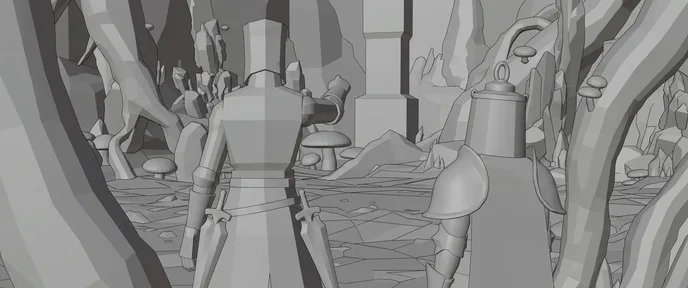
  6. Seen from behind, a tall dark knight points ahead while the small lantern knight looks on
    Storyboard frame of the over-the-shoulder shot, in grey
    06

    Over the shoulder · the road

    Over-the-shoulder from behind, Serrure points ahead into the cavern, Lantern beside him, roots framing the path

Lost Garden, episode 2 runs 21 minutes, well inside the 63 minutes IFFR allows a short. Its knights have faceless helms, so feeling travels through posture and light, a choice that suits a festival of image-led cinema. Its first episode was a finalist at the AI London Festival. Press play and the film opens on this scene.

The script

Fifteen minutes, five movements.

IFFR sets no length for a short except that it stays under 64 minutes. Fifteen minutes holds a formal idea without wearing it out: about 15 screenplay pages and 130 to 180 shots of 5 to 7 seconds.
  1. 0:00 to 1:30

    The rule of the film

    State the formal idea in the first minute: one place, one recurring image, one voice. The programmer learns it here and judges the rest by it.

  2. 1:30 to 4:30

    The world as it is

    Show life under that rule and let the audience settle. One shot may run long.

  3. 4:30 to 10:30

    The pressure

    Push the rule until something gives. This is where an AI film can show what a camera cannot, if the idea needs it.

  4. 10:30 to 13:30

    The break

    The rule breaks, or the character does. Let sound carry more than image.

  5. 13:30 to 15:00

    The afterimage

    End on one image the audience takes out of the room. Cut before the explanation.

The preview copy needs English subtitles even for films spoken in English or Dutch, unless the film has no dialogue. A silent or near-silent short saves a whole step.

Month by month

Between now and the 2028 call.

The 2028 call is not announced. If it follows the 2027 pattern, it opens around 1 May 2027 and closes in mid-September. One rule shapes the plan: a film must be finished after 1 January of the year before the festival, which would mean after 1 January 2027.
  1. 01

    October 2026

    Read the terms, start a log

    Read the full terms once, then the FAQ. Start a production log for the film: tool, version, task and date for every generated element.

  2. 02

    November 2026

    Find the rule of the film

    Write a logline, then one sentence that states the formal idea. Write the screenplay free in ScreenWeaver and read it aloud.

  3. 03

    December 2026

    Settled references, then a storyboard

    Settle one reference for each character and place. Generate the shot breakdown and storyboard from the screenplay, then set framing, angle, movement and duration by hand.

  4. 04

    January to March 2027

    Watch the festival, then generate

    Watch the Tiger Short titles during the festival. Then generate the footage scene by scene with Seedance in ScreenWeaver, as video generation reaches your plan. Do not finish before 1 January 2027.

  5. 05

    April to June 2027

    Cut, mix, English subtitles

    Assemble the cut, mix the sound and add subtitles. IFFR accepts a work in progress if the film can be finished in time, so a ready rough cut can go in at the early fee.

  6. 06

    July to September 2027

    Submit one complete cut

    Send one final version with a streamable, downloadable link. IFFR need not consider new versions of a submission, so do not plan to swap the cut later.

Ways to lose a slot

Eight rules that end an entry.

They sit in the terms in plain words. IFFR does not refund an ineligible entry.
  • A Dutch premiere

    A short with only Dutch premiere status is not considered and not refunded. Accepting an invitation from another Dutch festival that runs before IFFR makes the entry ineligible, so say so on the form.

  • A film already shown in the Netherlands

    Any public screening in the Netherlands counts. Private cast and crew screenings do not.

  • Finished too early

    A film completed before 1 January 2026 could not enter the 2027 edition. The cut-off moves up each year, so time the end of your edit.

  • A preview that cannot be downloaded

    The link must be both streamable and downloadable, and stay valid until 7 February 2027. A DCP cannot serve as a preview. A dead link makes the submission incomplete.

  • No English subtitles on the preview

    Every preview copy carries them, even for a film spoken in English or Dutch. Only a film without dialogue is exempt.

  • A form without payment

    Both must be complete before a deadline for its fee to apply, and nothing is taken after 15 September. Processing can take up to four weeks, so send it all before the last week.

  • A student film

    Student films are excluded, except work made in a post-graduate master’s year.

  • Burned-in subtitles on a selected film

    A selected non-English film delivers English subtitles as a separate file, not burned into the copy. English-language films are asked for subtitles or closed captions.

Why ScreenWeaver

IFFR wants a vision. A vision starts on paper.

IFFR imposes no tool and no AI quota. It reads for form and voice. ScreenWeaver keeps screenplay, storyboard and footage in one connected project, so the form is decided before the first render.
  • A form you can set shot by shot

    Programmers judge a short on its form. Storyboard Beta lets you set framing, angle, movement and duration for each shot, so the formal idea is on the page before any footage exists.

  • The same faces, the same rooms

    References for each character and place follow you from shot to shot. A fifteen minute film needs a look that holds, or the rule of the film breaks by accident.

  • An answer for the programmer

    Each generated shot leaves a trail back to the scene, the storyboard frame and the prompt that produced it. If someone asks how a sequence was made, the answer is already in the project.

  • Begin before the call opens

    The Screenwriter plan costs $0 and has no end date. A storyboard with Storyboard Beta is $9.99 a month. Seedance video generation comes later with the Filmmaker plan.

Real productions

International festival-recognized films have been written and produced with ScreenWeaver.

ScreenWeaver is already being used as a creative workspace for real AI film productions, from cinematic shorts to animated series pilots selected, nominated, and awarded by international festivals.

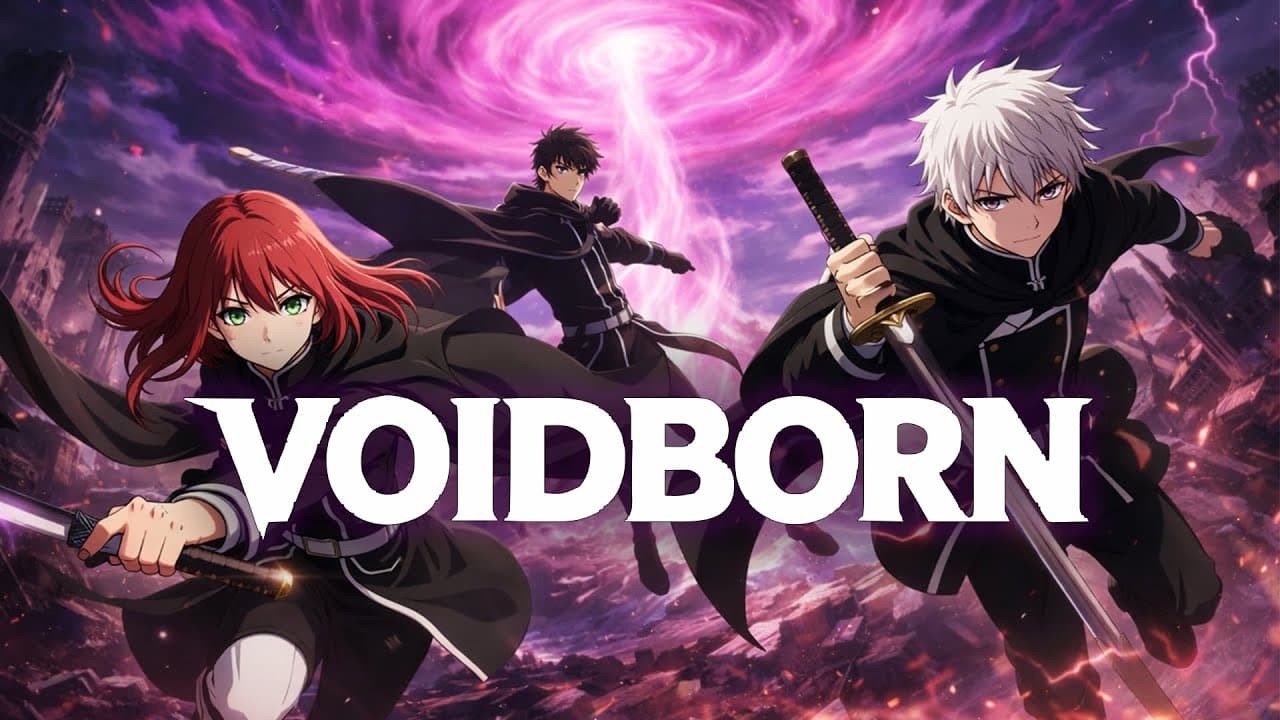
  • Video thumbnail for VOIDBORN

    VOIDBORN

    AI animated / cinematic short

    Festival recognition

    • 1st Place Silver

      Mondial Chroma Awards

    • 2nd Place Dreamina

      Mondial Chroma Awards

    • Award Winner

      Seoul International AI Film Festival

  • Video thumbnail for Les Fils du Vinnana

    Les Fils du Vinnana

    AI short film

    Festival recognition

    • Honorable Mention

      Top Quark Film Festival

    • People's Choice Nominee

      Illuminate Oneness of Humanity

    • Nominee

      ALTFF Supershort

  • Video thumbnail for Lost Garden

    Lost Garden

    AI animated series pilot

    Festival recognition

    • Finalist

      AI London Festival

The pipeline

Write. Board. Produce.

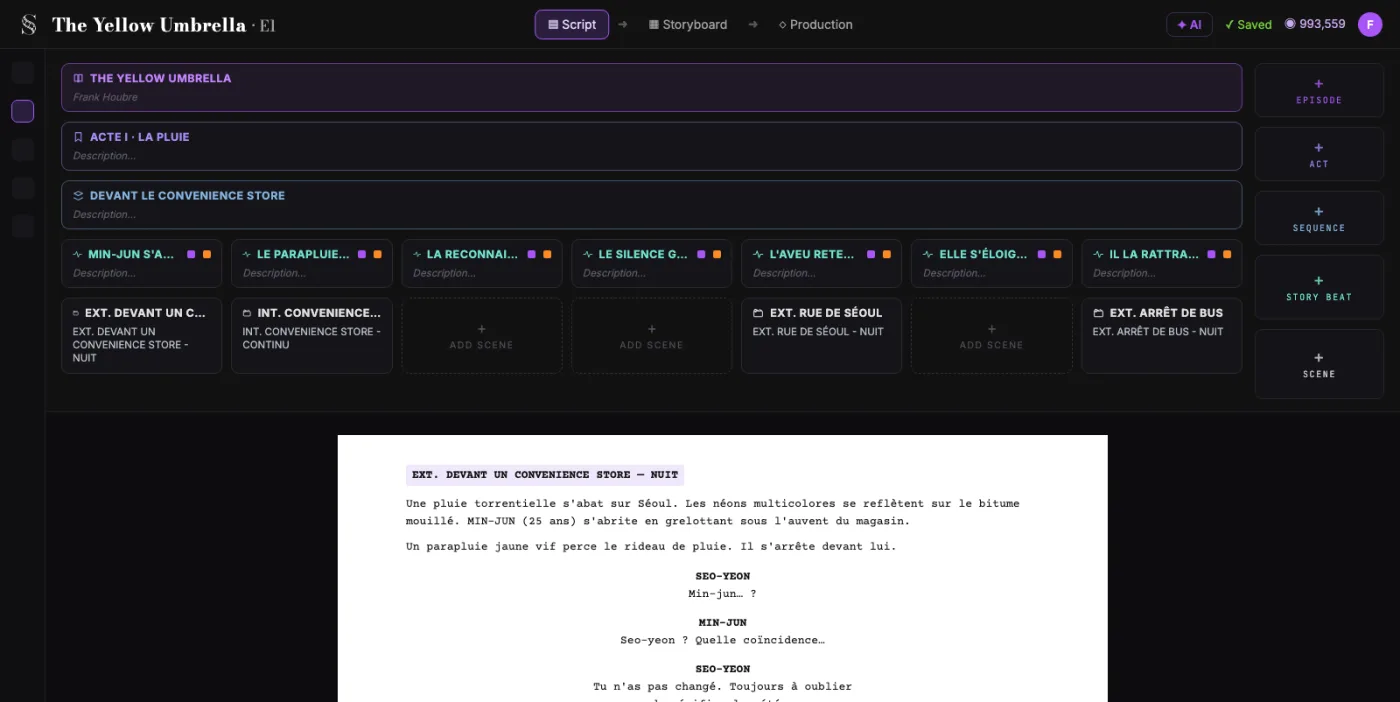
  1. ScreenWeaver screenplay editor: acts, sequences and beats above the formatted script of The Yellow Umbrella

    01The screenplay, enriched

    An industry-standard screenplay editor, and more: a visual outline and beat editor, your writing inspirations (notes, photos, audio) kept next to the page, and an AI researcher to support your writing, not replace it.

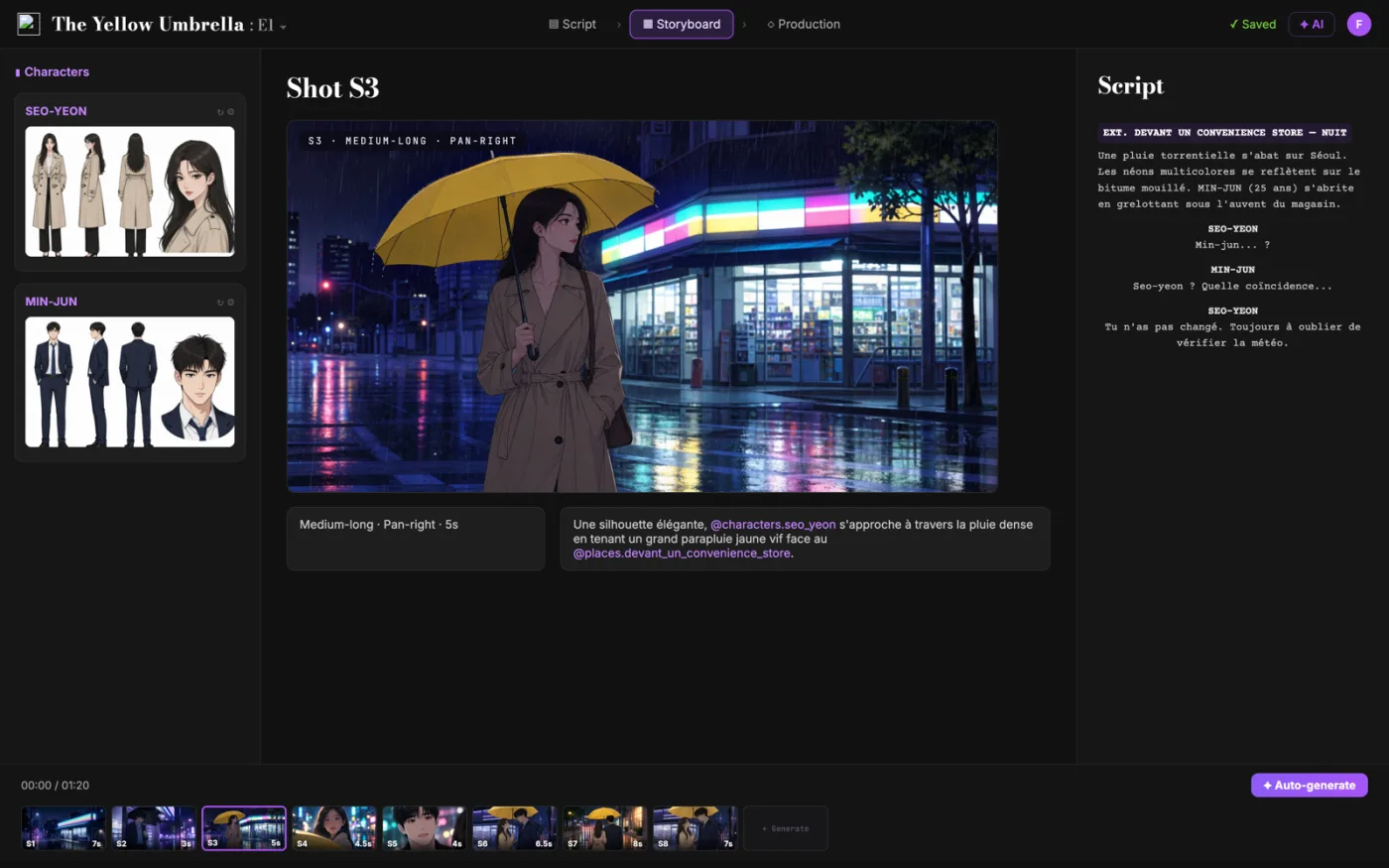
  2. ScreenWeaver storyboard: shot S3 of The Yellow Umbrella with characters, shot settings and the script beside it

    02The storyboard, made easy

    Shot breakdown generated from your screenplay, manual control over every shot (frame, angle, movement, duration), and generative AI previsualization in one click.

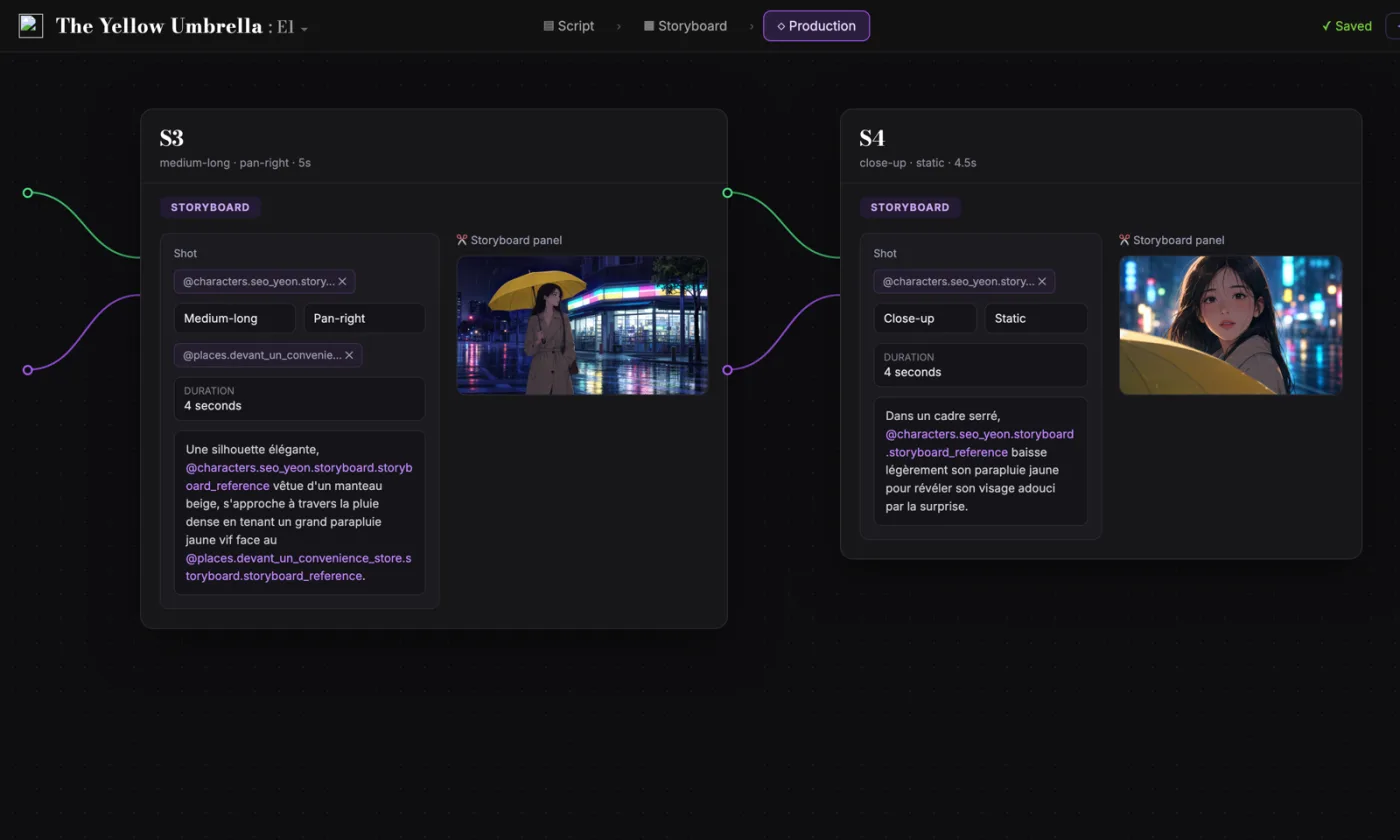
  3. ScreenWeaver production canvas: shots S3 and S4 as connected nodes carrying their storyboard panels and prompts

    03AI production, with finesse

    Footage generation pipelines connected to your screenplay and storyboard. Optimized out of the box, fully editable workflow.

FAQ

IFFR and AI films, your questions

Can you submit an AI film to IFFR?
Yes. The 2027 terms and the submissions page contain no rule on AI: no ban and no disclosure clause. The film is read by programmers like any other. The 2027 call closed on 15 September 2026.
Does IFFR ask you to disclose AI use?
Not in the terms or on the public pages we read. The entry form sits behind an account page we could not open. We advise a plain description of what was generated and what was not.
Has the 2028 call been announced?
The 2028 call is not announced. The 2027 call opened on 1 May 2026 and closed on 15 September 2026, with the early and standard fees ending on 15 June and 31 August.
What does it cost?
For 2027, €40, €55 or €70 for a short or mid-length film and €65, €85 or €110 for a feature, plus VAT, depending on the window. Art Directions forms cost €40. Fee waivers exist only for residents of countries with payment restrictions.
Does my film need to be a premiere?
Short and mid-length films need a world, international or European premiere, and a Dutch premiere is not enough. The Tiger Short asks for a world premiere. A film already screened in the Netherlands is not eligible.
What counts as a short at IFFR?
Under 64 minutes. From 64 minutes a film is a feature, with its own form and fee. The Tiger Short Competition covers films up to 63 minutes.
Can I submit a work in progress?
Yes, if the film can be finished in time for the festival. Mark the preview as a work in progress on the form. IFFR is not obliged to look at a new version, so send your best cut first.
Does IFFR pay screening fees?
No. A selected film gets up to five public screenings and no screening fee. The three Tiger Short winners each receive an award and €5,000.

Next call, one finished film.

Draft the screenplay free this week. Then storyboard it and generate it scene by scene with Seedance.