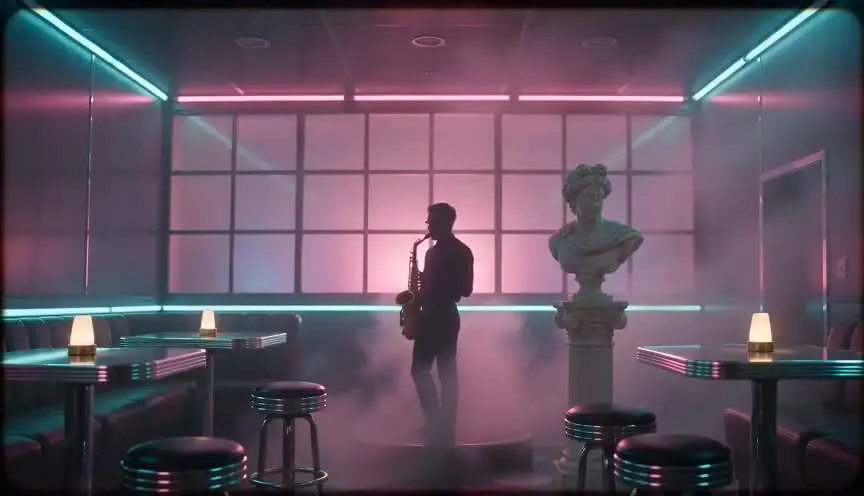
Neon lightingNight painted in saturated color
Neon lighting uses colored tubes, signs and LED strips as visible sources, washing faces and streets in saturated pinks, blues, greens and reds. The audience enters a nocturnal, urban world that feels electric, lonely or dreamlike.
Also calledNeon glowNeon washColored tube lighting
Lighting
Why it works on screen
Neon is the light of cities after dark: bars, motels, arcades, karaoke rooms, convenience stores, rain-soaked streets. It carries loneliness and excitement at once. Use it for crime, science fiction, romance at night, and stories about people outside the daytime rules. Color gives you a language: one character washed in red, another in blue, and a scene about the space between them. A scene earns neon when the city itself is a character, when the night changes who people are, or when the story wants the heightened feeling of a memory or a dream.
The shot list line
- Size
- Medium close-up
- Angle
- Eye level
- Movement
- Static or slow push in
- Lens
- 35mm to 50mm, wide aperture
- Duration
- 4 to 8 s
Use the neon practicals in frame, add hidden LED sources matching their hues from the same directions, and keep skin within gamut so saturated color does not clip.
Screenplay
On the page
Neon signs and tubes are part of the set, so a writer can name them: a flickering motel sign, a pink bar front, a green pharmacy cross. Choose one or two with meaning and describe them once. Do not describe the color on faces in every line. Which colors to use, how saturated, and what hidden sources support the signs are decisions for the cinematographer and the production designer, recorded in the shot list.
INT. KARAOKE ROOM - TAIPEI - 3 A.M.
A sealed box of a room. A pink neon heart on the wall, a blue screen scrolling lyrics nobody reads.
WEI-LING CHEN (30s) holds the microphone but does not sing. Her best friend HAO (30s) lies across the sofa, tie undone.
The heart buzzes and flickers.
WEI-LING
I'm taking the job in Berlin.
Hao sits up. The blue light catches half of his face, the pink the other.
Storyboard
In the storyboard
Draw the neon sign or tube in the frame and label its color. Use colored pencils or written labels on each face showing which color hits which side. Mark hidden LED sources with dotted lamp symbols and their hues. Keep the rest of the frame dark. Note "neon: pink key, blue edge" or the chosen palette. If the sign flickers or changes color, write the timing under the panel.
Pairs well with
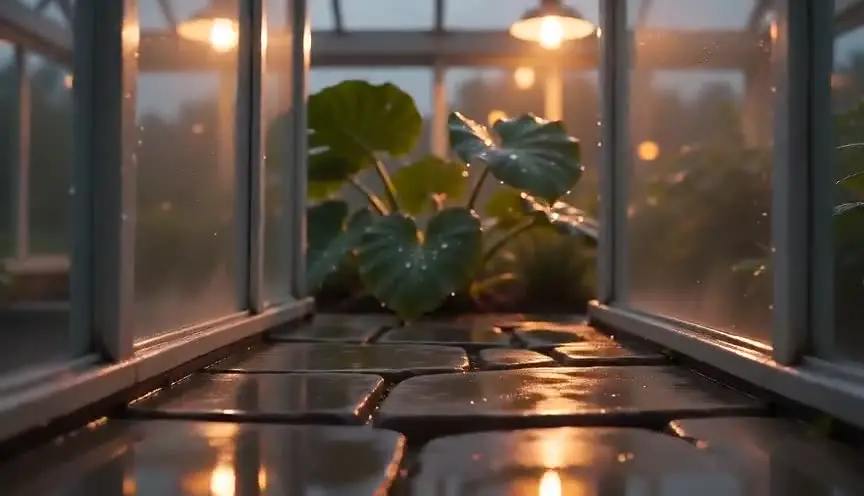
Wet streets and surfaces reflect neon twice over, doubling color and light across the frame. A wet-down turns a few signs into a whole glowing city at almost no cost.
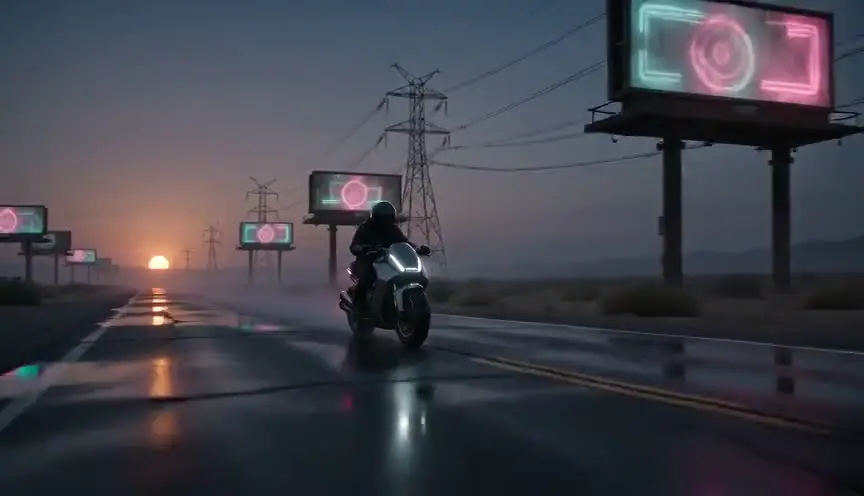
Neon is a key ingredient of the cyberpunk look. Pairing the lighting with that style's dense, high-tech city design builds a world where color signals both allure and decay.
Reference
Watch it in
Blade Runner (1982)
Jordan Cronenweth lets neon signs and wet streets be the main light of the city, a look that shaped a whole genre.
Drive (2011)
Newton Thomas Sigel bathes Los Angeles at night in pink and blue, giving a silent driver an inner, romantic glow.
Enter the Void (2009)
Benoît Debie pushes Tokyo's neon colors to a hallucinatory saturation that matches the film's drifting point of view.
ScreenWeaver
Set it up in ScreenWeaver
Name the neon signs and their colors in your action lines, and ScreenWeaver breaks the scene down into shots automatically. Open each shot, set framing, angle, movement and duration, and note the neon palette. The location and characters carry from shot to shot, so the pink stays pink and the blue stays blue across the coverage. The AI previsualization helps you balance the colors on the faces before you choose fixtures.
Start writing for freeThe prompt behind this clip
This is the exact prompt that rendered the clip at the top of the page. Keep the description of the camera and the light, change the subject and the place.
Neon lighting in a 1970s New York diner at night. A woman in her fifties sits alone at the counter, her face lit from the left in hot pink from a neon sign glowing through the window and from the right in cool cyan from a tube light above the pie case, the two colors meeting in a hard line down her cheek. Steam rises slowly from a coffee cup in front of her, catching both colors. The camera holds static and locked off, no movement, background out of focus with soft pink and cyan bokeh from other signs. No text.
Common mistakes
- 01
Clipped colors
Saturated neon clips easily, especially reds and blues, and skin turns flat plastic. Expose a little under and check each color channel on the monitor.
- 02
Rainbow soup
Too many colors at once make the image noisy and meaningless. Pick two main hues and give each a role in the scene.
- 03
No real sign in frame
Colored light without a visible sign looks like a music video filter. Show at least one practical so the color belongs to the world.