Clermont-Ferrand 49th edition · AI films guide

Can you submit an AI film to Clermont-Ferrand?Yes. Disclose it, and mind the one film cap.

The 2027 regulations add an AI clause: disclosure at submission, no bonus or penalty for AI itself, and one film per person when every image is generated. The International deadline closed on 24 September 2026. Here are the rules, the prizes and a plan for the next call.
  • Disclosure at submission
  • One fully generated film per person
  • Festival 29 January to 6 February 2027
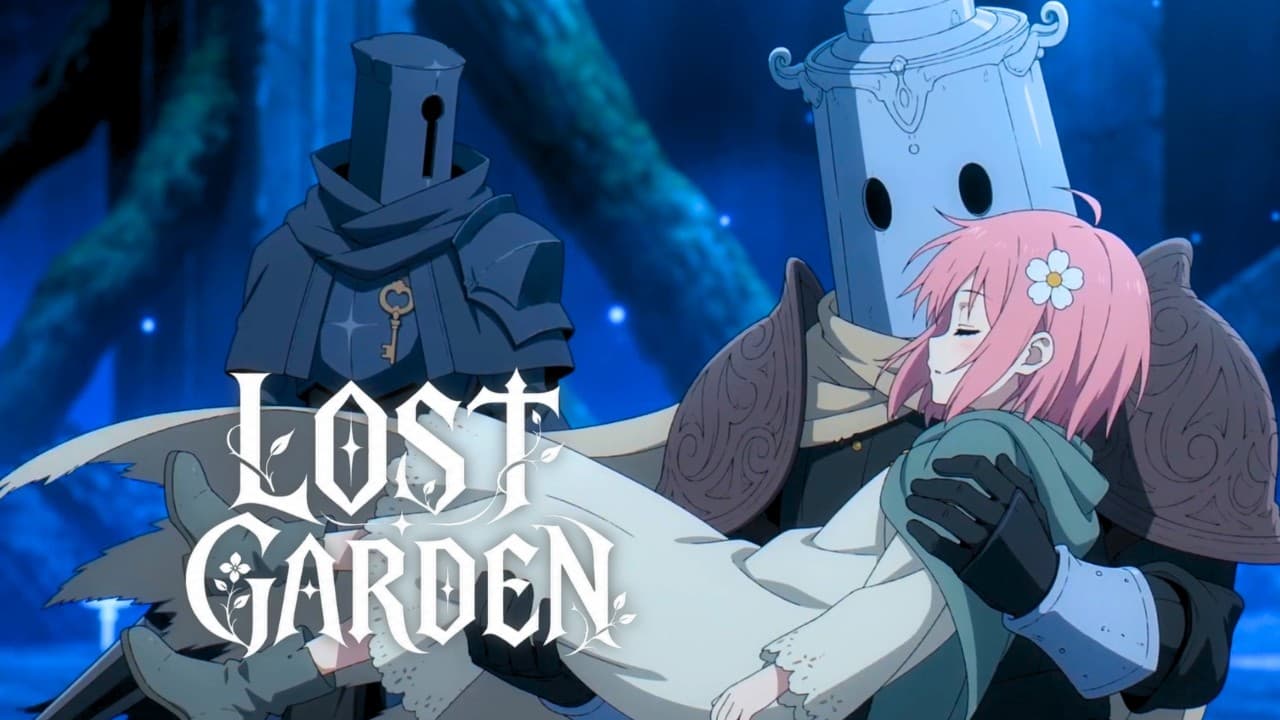
Lost Garden · Episode 2

Independent guide. ScreenWeaver does not organise Clermont-Ferrand International Short Film Festival and is not affiliated with Sauve qui peut le court métrage. Rules read on 1 October 2026. Official submission page

Available today in ScreenWeaver: free screenwriting, and a storyboard generated from your screenplay with Storyboard Beta, $9.99 a month.

Rolling out: video generation of each shot, powered by Seedance, with the Filmmaker plan.

The rules on one card

What Clermont-Ferrand asks of an AI short.

Clermont-Ferrand is a short film festival, and it is among the cheapest to enter. Its 2027 regulations hold a dedicated AI clause, article 1.2. Every other rule applies to your film as to any short.
Festival
29 January to 6 February 2027, 49th edition
International deadline
Closed on 24 September 2026
National deadline
1 October 2026, French productions only
Fee
€13 plus one Shortfilmdepot stamp, flat
Maximum length
40 minutes International, 59 National
AI rule
Disclosure required, one fully generated film per person
Eligibility
Completed after 1 October 2025, no premiere needed
Notification
End of November, list in early December

Source: the 2027 regulations of the International Competition (PDF, English) and of the National Competition (PDF, French), and the Submit a film page on lecourt-clermont.org, read on 1 October 2026. The 2026 regulations carried no AI clause. The call for the 50th edition is not announced.

What the rules say about AI

One clause, six points, and a limit to watch.

Article 1.2 of the 2027 regulations is called “provisions on the use of AI tools or models for content”. It is not a ban. It asks for disclosure, refuses two kinds of content and caps one kind of film. Here is each part.
  • Disclose at submission

    The use of generative AI in making a film, or of AI tools at any stage of production, must be clearly disclosed on Shortfilmdepot when you submit. The clause names generative AI for image or sound (characters, sets, animation, voices, music) and AI-assisted tools for writing, production or post-production. The list is not exhaustive, and the festival expects sincere, honest and complete declarations.

  • AI is not a selection criterion

    The festival’s artistic position is that AI is not, in itself, a selection criterion. Films are judged on originality, direction, storytelling, technical mastery and emotional impact. The tool earns you nothing and costs you nothing.

  • One fully generated film per person

    Submitting films whose images are entirely generated with generative AI models is limited to one film per natural person. If you break the rule, the festival may cancel the entries concerned, without refund.

  • Two kinds of content refused

    Submissions are not accepted if they reproduce or simulate a real person, living or dead, who can assert their rights, without that person’s or their representatives’ consent. They are also refused if they directly violate copyright, reproduction rights or data protection rules. The festival may ask for more details about AI use and cancel a non-compliant submission.

  • The clause can change

    An amendment clause lets the festival revise its AI policy at any time. The 2026 regulations had no AI clause at all, so the rule is new this year. Read the next regulations the day they are published.

  • Two limits that bite AI films

    Industrial or commercial films are not accepted, so an AI advertisement does not qualify. And a film submitted to a previous edition cannot enter again, even in a new version.

Key dates

The 2027 windows are shut. Learn the calendar.

Two windows exist for a film completed in 2026, one per competition, and both are over or ending today. <b>The festival has no early bird and takes no late entries</b>, so the pattern is the plan.
  1. 9 Jul 2026

    First window, closed

    For films completed between 1 October and 31 December 2025, in both competitions.

  2. 24 Sep 2026

    International deadline, closed

    The last day for films from outside France completed in 2026.

  3. 1 Oct 2026

    National deadline

    The last day for French productions, with France as main country of production.

  4. Late Nov 2026

    Selected directors contacted

    The festival writes to selected films at the end of November and publishes the list in early December.

  5. 17 Dec 2026

    DCP delivery

    Selected films must reach the festival by FTP by this date, under penalty of exclusion. The festival runs from 29 January 2027.

Who decides

Committees first, juries after.

Clermont-Ferrand names no jury at submission stage. It does say how films are watched and chosen, and the answers are practical.
  • Every film is watched

    The regulations say all submitted films are treated equitably and evaluated by the selection team. Decisions are taken collectively within the committee of each competition.

  • One preview file, one viewing

    Only an uploaded file on Shortfilmdepot counts. A work-in-progress is allowed, but the committee watches that version and will not see the film a second time. Your first upload is your cut.

  • The Lab committee

    The Lab Competition takes no application. Its committee picks from a pre-selection proposed by the International and National committees, and asks for offbeat, risky work.

  • Juries after selection

    Prizes go to selected films. A panel of judges awards the Grand Prix and the Special Jury Prize, and subscribed members of the audience award the Audience Prize. In 2026 other juries gave student, queer and broadcaster awards.

Competitions

Four sections, and one you cannot apply to.

Clermont-Ferrand sorts films by origin and by form, not by theme. Here is each competition, and the angle we would take with a generated short.
  • 01

    International Competition

    Shorts of up to 40 minutes from every country except France: fiction, documentary, experimental live action or animation.

    The natural home of a foreign AI short. Write the disclosure in the form, and prepare a dialogue list with a French or English translation.

  • 02

    National Competition

    French shorts of up to 59 minutes, with France as main country of production. Two French films are also selected for the International Competition.

    The one-film cap applies here too: the French regulations carry the same AI clause. Pick your best fully generated film.

  • 03

    Lab Competition

    A competition with no application of its own, fed by the pre-selections of the other two. It looks for explosive, offbeat and risky work.

    Where a formally daring generated short belongs. You cannot apply, so make the film strange enough to be proposed.

  • 04

    XR Competition

    Immersive work in VR, AR or MR, up to 60 minutes, produced in 2024 or 2025, with its own deadline of 24 September 2026.

    Not for a flat film. The page asks for live action or stop-motion, so a fully generated experience is a poor fit.

The 2026 winners

What the International Competition picked.

At the 48th edition the Grand Prix went to Cœur bleu by Samuel Suffren, a 15 minute fiction from Haiti and France. The 2026 and 2027 regulations give the same prize amounts: €5,000, €4,000 and €4,000, and the festival says they are not contractual.

  1. 01

    Fifteen minutes is the winning length. The Grand Prix and the Special Jury Prize (Buah by Jen Nee Lim, Singapore) were both 15 minute fictions, and the Audience Prize film ran 17 minutes.

  2. 02

    Animation has a prize of its own. Breaking Walls by Jan-Dirk Bouw, a 23 minute animated documentary from the Netherlands, Norway and Belgium, won Best Animation, worth €1,500 from Xilam.

  3. 03

    Every winner was finished in 2025. The competition wants recent films, and a short completed in the year of the call fits the window.

  4. 04

    Nothing in the lists says AI. No winner we read was flagged as generated, and the clause is new. The first AI short to place here will be remembered for its writing, not its tool.

From page to screen

Lost Garden: six shots, one self-standing short.

Clermont-Ferrand takes films of up to 40 minutes and refuses simulated real people. This scene comes from Lost Garden, episode 2, an animated fantasy by the ScreenWeaver team with invented characters: the screenplay page, then each shot as a storyboard frame and as the final image.

Logline. A newborn knight whose inner light is leaking away crosses a world that has stopped hoping, to find the one blacksmith who can seal his armor.

Screenplay · episode 2 · page 1

INT. UNDERGROUND CAVERN - LOWER PATH - CONTINUOUS

Blue mushrooms the size of houses. LANTERN, a small knight with a lantern for a helm, walks alone.

He presses a hand to his chest. Sparks of light slip between his fingers.

SERRURE

Hold on. You're losing something.

Serrure lifts the edge of the cloak. A gash in the armor. Blue light leaks out like smoke.

SERRURE

That's your energy. What keeps you standing.

He grips Lantern's shoulder. Two knights alone among the crystals.

SERRURE

A suit that leaks goes out. Eventually.

Under the giant mushrooms, the road climbs into the dark.

SERRURE

So. We follow the road.

Serrure points the way. Lantern follows.

CUT TO:

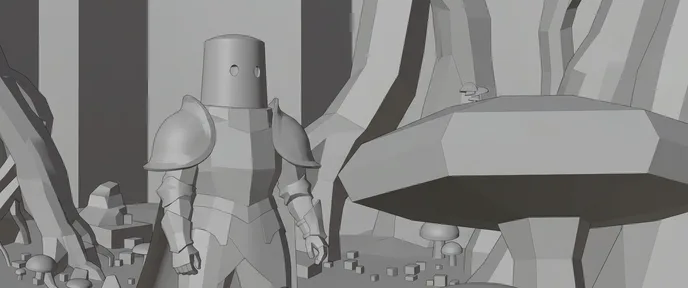
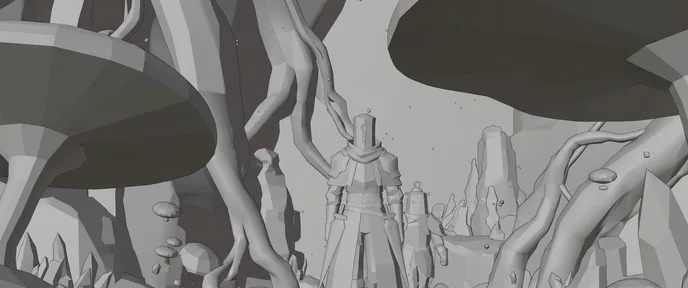
  1. A small knight with a lantern helm stands by a giant glowing blue mushroom in a crystal cavern
    Storyboard frame of the same wide shot, in grey
    01

    Wide · the world

    Wide shot, Lantern alone by a giant glowing blue mushroom, crystal cavern, roots, drifting spores, cold blue light

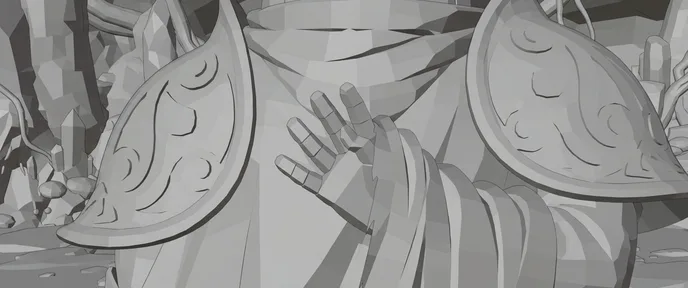
  2. Close-up of an armored chest under a cream cloak, a gloved hand, a spark of light
    Storyboard frame of the chest close-up, in grey
    02

    Close-up · the chest

    Close-up on Lantern's chest, his gloved hand pressed to the cloak, a spark of light escaping between the fingers

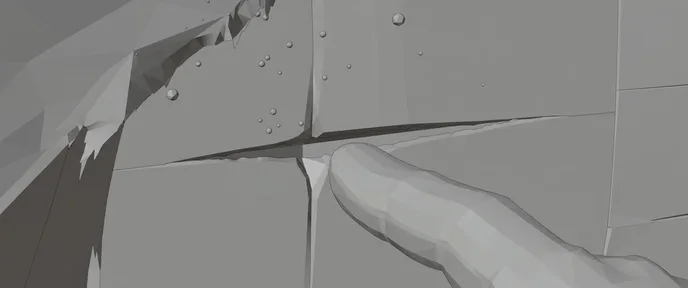
  3. A torn gash in an armor plate leaking bright blue light, a finger pointing at it
    Storyboard frame of the wound insert, in grey
    03

    Insert · the wound

    Extreme close-up, Serrure's finger near a torn gash in the back plate, blue light leaking out like luminous smoke

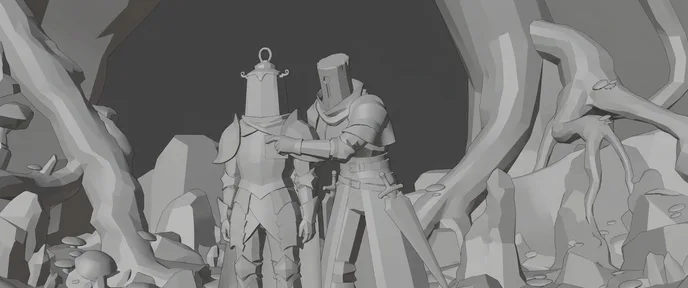
  4. Two armored knights side by side, one with a hand on the other's shoulder, in a crystal cavern
    Storyboard frame of the two-shot, in grey
    04

    Two-shot · the bond

    Medium two-shot among crystals and roots, Serrure's hand on Lantern's shoulder, faceless armors, emotion through posture only

  5. Two small knights walk beneath two giant glowing blue mushrooms
    Storyboard frame of the wide shot, in grey
    05

    Wide · the scale

    Wide low angle, the two knights tiny beneath two giant glowing mushrooms, blue crystals in the foreground, mist

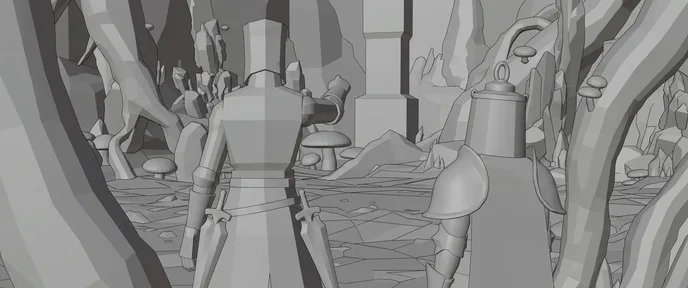
  6. Seen from behind, a tall dark knight points ahead while the small lantern knight looks on
    Storyboard frame of the over-the-shoulder shot, in grey
    06

    Over the shoulder · the road

    Over-the-shoulder from behind, Serrure points ahead into the cavern, Lantern beside him, roots framing the path

Lost Garden, episode 2 runs 21 minutes, about half the festival’s limit, and episode 1 was a finalist at the AI London Festival. Its two knights are invented, so the clause on real people never comes into play. To enter, you would cut a short that stands on its own. Press play and the player opens on this opening scene.

The script

A 15 minute short in four movements.

The 2026 prize winners in the International Competition ran 15 to 17 minutes. Aim for 15 minutes: about 15 screenplay pages and 110 to 140 shots of 6 to 8 seconds.
  1. 0:00 to 1:00

    The situation in one scene

    Selection teams see hundreds of shorts. Give them a person, a place and a problem inside the first minute.

  2. 1:00 to 4:30

    The first choice

    Let the character act and get it wrong, so the story is about a decision and not a tour.

  3. 4:30 to 11:30

    The pressure

    Keep the cost rising. An audience prize exists, so write scenes that work in a full room.

  4. 11:30 to 15:00

    The price of the choice

    End on a consequence, then cut. A short that stops early is easier to remember than one that explains.

A selected film must reach the festival as a DCP with non-embedded subtitles: English is required, French is desired for films not in French. Burnt-in subtitles and voice-over translation are refused.

Month by month

From now to the 50th edition.

The International deadline closed on 24 September 2026 and the National one closes today. This plan targets the 50th edition, whose windows should fall in July and late September 2027 if the pattern holds.
  1. 01

    October 2026

    Read the regulations

    Read the 2027 International regulations in full and mark article 1.2. Start a disclosure log for the project: tools, versions, tasks, dates.

  2. 02

    November 2026

    Write a short that stands alone

    Fifteen pages, written free in ScreenWeaver, with invented characters so the clause on real people never applies.

  3. 03

    December 2026

    Watch the selection

    The list comes out in early December. Watch what the International and Lab committees choose, and compare lengths and openings with your pages.

  4. 04

    January to March 2027

    Storyboard and generate

    Storyboard first, then footage scene by scene with Seedance in ScreenWeaver once video generation is on your plan. Keep every prompt: the form asks what AI did.

  5. 05

    April to June 2027

    Edit, sound, dialogue list

    Cut, mix, and write the dialogue list in the original language with a French or English translation. Export a clean .mp4 for the preview.

  6. 06

    July to September 2027

    Submit in the right window

    In the 2027 call, July was for films finished between October and December of the previous year, and late September for films finished in the year of the call. Upload only when the film is final.

Ways to be struck off

Eight ways a generated short can be struck off.

The festival is open about AI and strict about procedure. Check each point before you pay the €13: it is not refunded.
  • Not disclosing

    Article 1.2 requires disclosure on Shortfilmdepot at submission. The festival may ask for more details and cancel a submission that does not follow the principles. Declare every use, writing and post-production tools included.

  • A second fully generated film

    Only one film whose images are entirely generated is allowed per natural person. A second one may be cancelled without refund.

  • A face that belongs to someone

    Reproducing or simulating a real person who can assert their rights, without consent, makes the submission inadmissible. A celebrity look-alike or a late actor’s likeness is the risk. Invent your faces.

  • A commercial film

    Industrial or commercial films are not accepted. A product film or an advertisement made with AI does not belong in this competition.

  • Re-entering a changed cut

    A film submitted to a previous edition cannot be entered again, even in a new version, and works-in-progress count. The committee watches the first file only.

  • Missing a window

    Late entries are not accepted and nothing is refunded. A film finished after 24 September 2026 had to wait for the next edition.

  • A Vimeo link or a USB drive

    Preview links, DVDs, Blu-rays and USB drives are refused. Upload an .mp4 on Shortfilmdepot and select the video library option, which is required to compete.

  • Subtitles burnt into the image

    Selected films need subtitle files separate from the picture, in XML or MXF for the DCP. English is required, and French is desired for films not in French.

Why ScreenWeaver

Declare it, count it, invent the faces.

Clermont-Ferrand asks three things of an AI short: declare it, count it, and keep real people out. ScreenWeaver helps with each, in one connected project.
  • A declaration copied from the project

    The prompt behind every shot stays attached to it. When Shortfilmdepot asks what AI did, you read the answer off the project instead of rebuilding it.

  • An invented cast

    Characters and references are defined once and carried from shot to shot. An invented cast keeps you clear of the real person clause and keeps the look steady.

  • A short timed on paper

    Time the screenplay and the storyboard before generating. The 40 minute limit and the 15 minute sweet spot are checked where changing a scene costs nothing.

  • Free to start

    Writing is $0 on the Screenwriter plan, with no end date. Storyboard Beta is $9.99 a month, and Seedance video generation is the Filmmaker plan’s job.

Real productions

International festival-recognized films have been written and produced with ScreenWeaver.

ScreenWeaver is already being used as a creative workspace for real AI film productions, from cinematic shorts to animated series pilots selected, nominated, and awarded by international festivals.

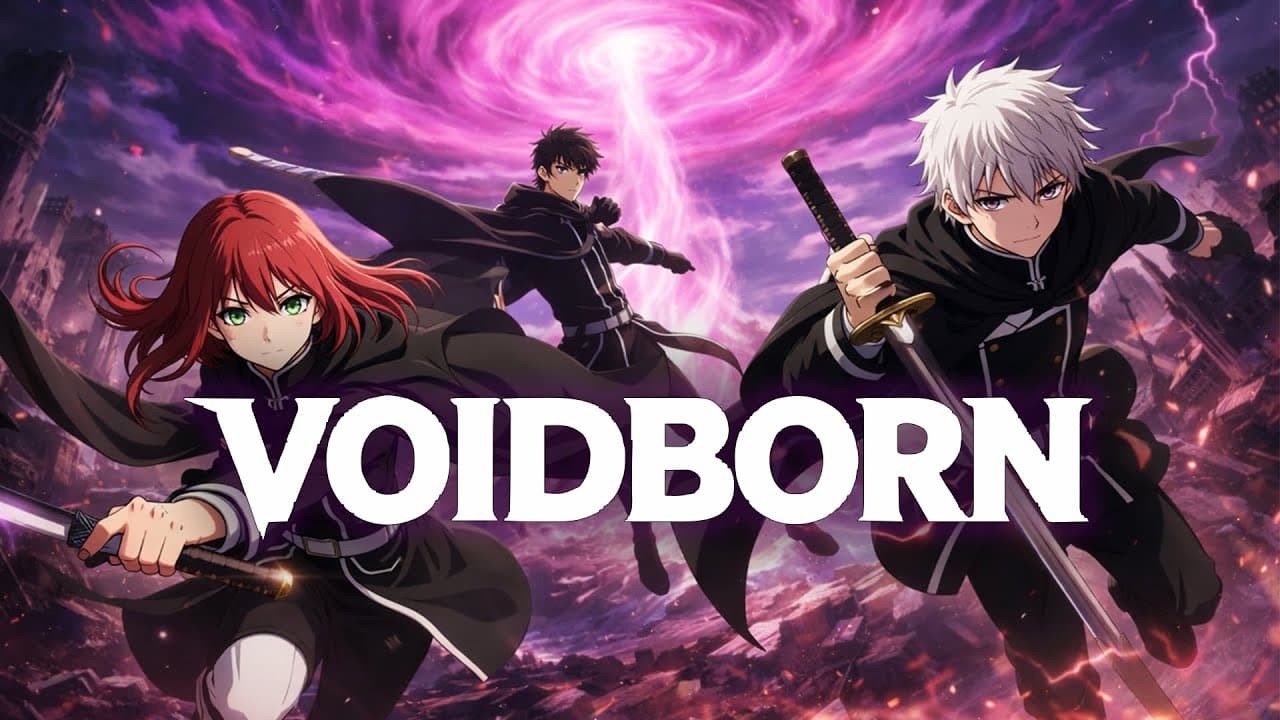
  • Video thumbnail for VOIDBORN

    VOIDBORN

    AI animated / cinematic short

    Festival recognition

    • 1st Place Silver

      Mondial Chroma Awards

    • 2nd Place Dreamina

      Mondial Chroma Awards

    • Award Winner

      Seoul International AI Film Festival

  • Video thumbnail for Les Fils du Vinnana

    Les Fils du Vinnana

    AI short film

    Festival recognition

    • Honorable Mention

      Top Quark Film Festival

    • People's Choice Nominee

      Illuminate Oneness of Humanity

    • Nominee

      ALTFF Supershort

  • Video thumbnail for Lost Garden

    Lost Garden

    AI animated series pilot

    Festival recognition

    • Finalist

      AI London Festival

The pipeline

Write. Board. Produce.

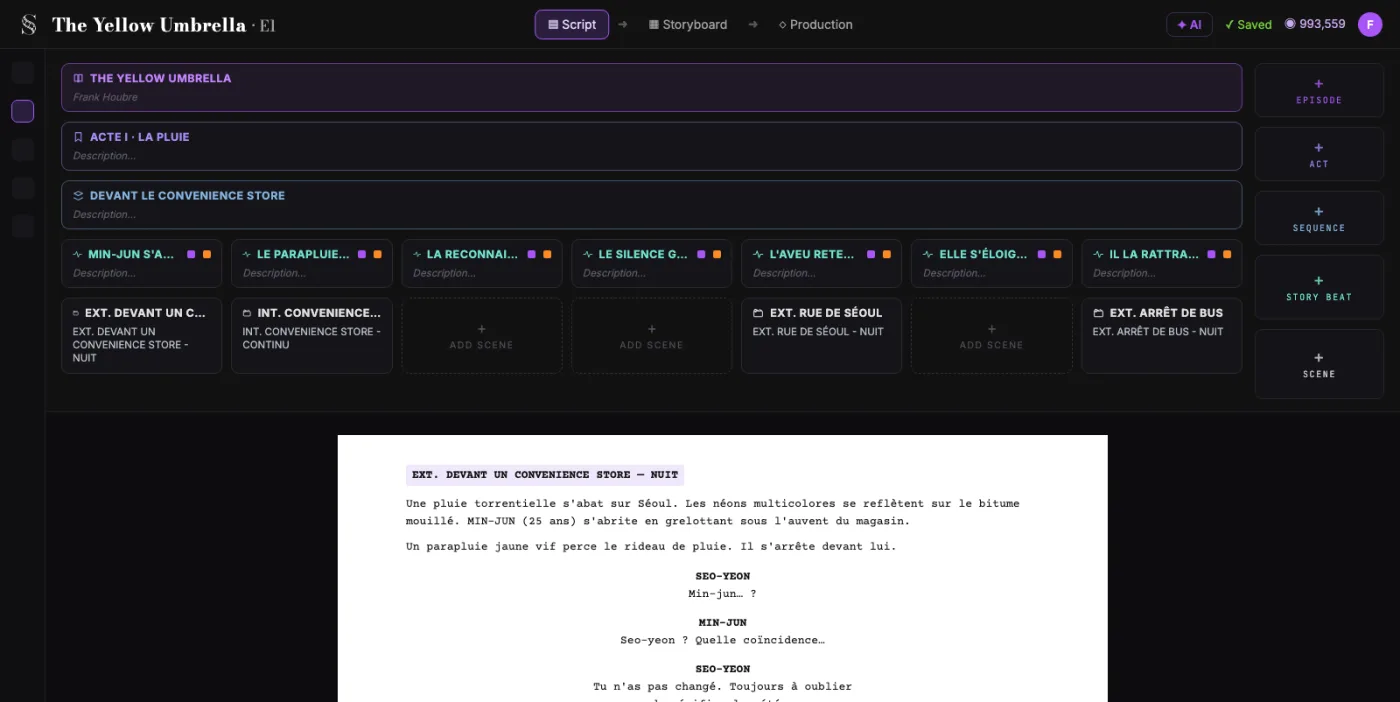
  1. ScreenWeaver screenplay editor: acts, sequences and beats above the formatted script of The Yellow Umbrella

    01The screenplay, enriched

    An industry-standard screenplay editor, and more: a visual outline and beat editor, your writing inspirations (notes, photos, audio) kept next to the page, and an AI researcher to support your writing, not replace it.

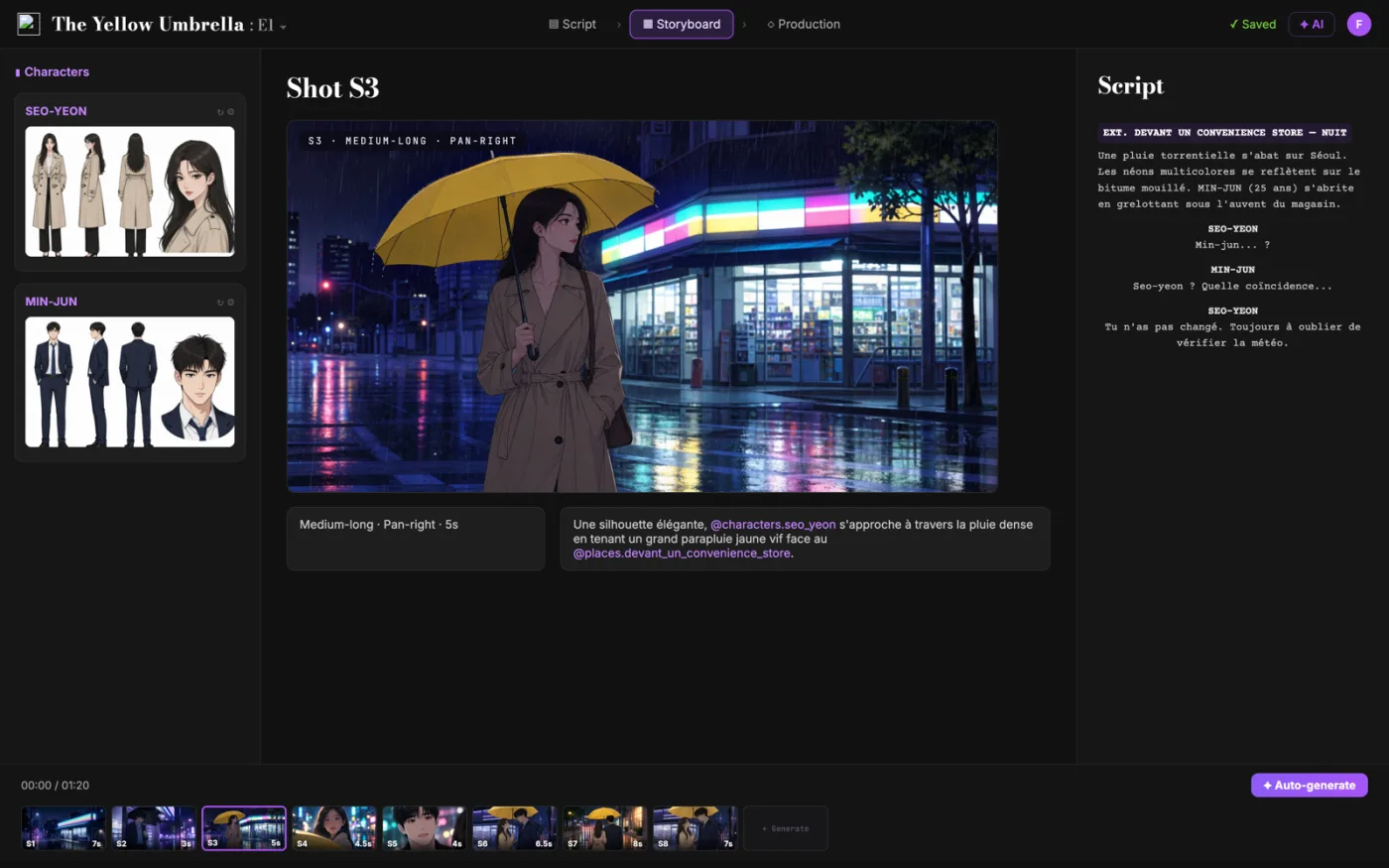
  2. ScreenWeaver storyboard: shot S3 of The Yellow Umbrella with characters, shot settings and the script beside it

    02The storyboard, made easy

    Shot breakdown generated from your screenplay, manual control over every shot (frame, angle, movement, duration), and generative AI previsualization in one click.

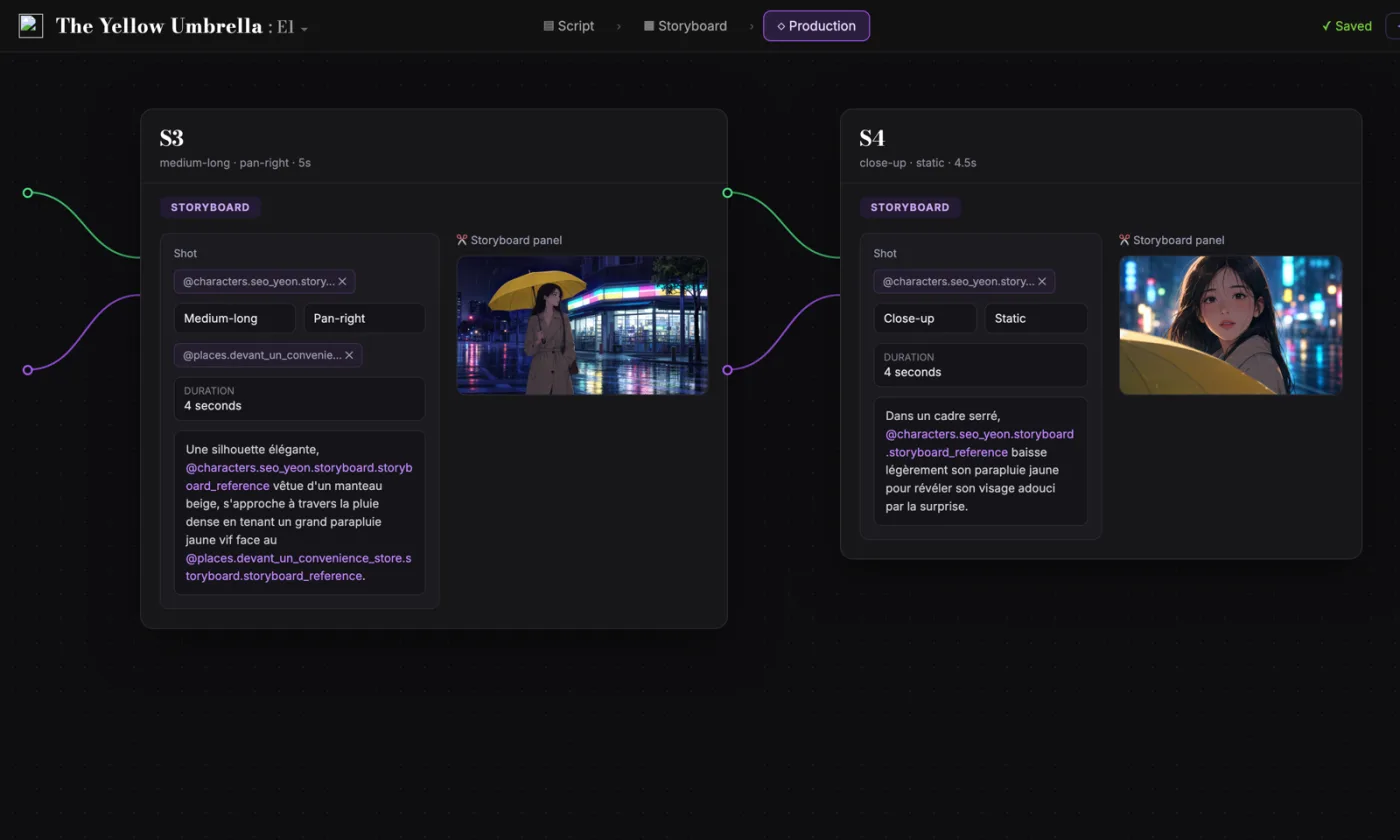
  3. ScreenWeaver production canvas: shots S3 and S4 as connected nodes carrying their storyboard panels and prompts

    03AI production, with finesse

    Footage generation pipelines connected to your screenplay and storyboard. Optimized out of the box, fully editable workflow.

FAQ

Clermont-Ferrand and AI films, your questions

Can you submit an AI film to Clermont-Ferrand?
Yes. The 2027 regulations accept AI-made films with mandatory disclosure at submission, and limit films whose images are entirely generated to one per person. The International deadline closed on 24 September 2026.
What does the Clermont-Ferrand AI clause say?
Article 1.2 asks you to disclose generative AI for image and sound and AI tools for writing, production or post-production. It refuses real person simulation and copyright breaches, says AI is not a selection criterion, caps fully generated films at one per person, and may change at any time.
Is AI banned at Clermont-Ferrand?
No. The festival says AI is not in itself a selection criterion and judges films on originality, direction, storytelling, technical mastery and emotional impact. Industrial or commercial films are refused, with or without AI.
What are the deadlines for 2027?
International Competition: 24 September 2026, closed, for films completed in 2026. National Competition, French productions only: 1 October 2026. The 50th edition call is not announced. The 2027 pattern was a July and a late September window.
What does an entry cost?
€13 plus one Shortfilmdepot stamp, a flat fee with no early bird. There are no waivers and no refunds. Film schools, distributors and promotion bodies get 50 percent off when they submit several films by different directors.
What is the maximum length?
40 minutes for the International Competition, 59 minutes for the National Competition and 60 minutes for XR. The film must be completed after 1 October 2025 for the 2027 edition.
Is a premiere required?
No. The festival requires no premiere and no exclusivity, and films shown at other festivals or online are accepted. The regulations add that films not yet shown get particular attention, and ask you to list your previous festivals and awards.
Which competition suits an AI short?
A film from outside France enters the International Competition, a French one the National Competition. The Lab Competition takes no application: its committee picks from the two other pre-selections. The XR section is for immersive work.

The 2027 call is shut. The next one starts with a page.

Write your short free today and keep a disclosure log from the first prompt. Storyboard comes next, then footage with Seedance when your plan gets it.