BFI London Film Festival 2026 · AI films guide

Can you submit an AI film to the BFI London Film Festival?No AI clause found. Transparency is the house line.

The festival's submissions page, now closed, carries no clause on AI. The BFI's own guidance for funded projects does not prohibit AI but asks for transparency, and the 70th edition screens an AI-guided installation. The 71st call is not announced: here is what we could verify, and a plan for it, starting with the screenplay in ScreenWeaver.
  • No AI clause on the festival page
  • 70th LFF 7 to 18 October 2026
  • 71st call not announced
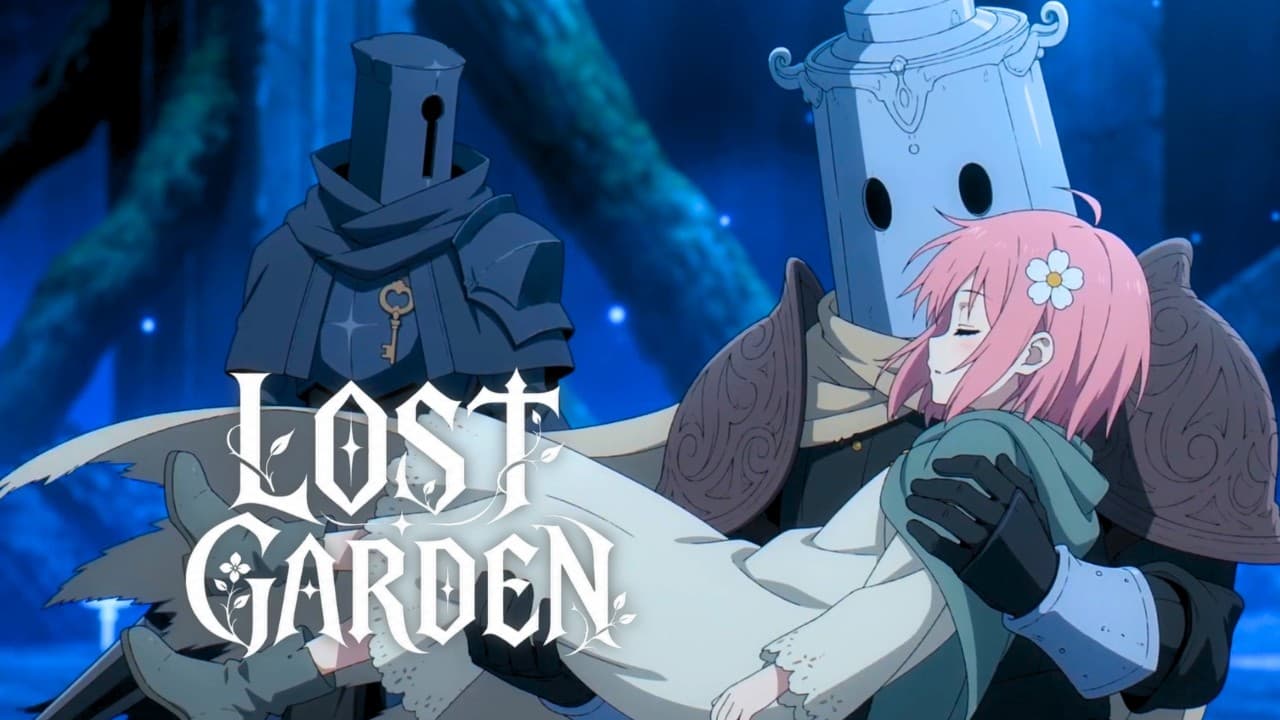
Lost Garden · Episode 1

Independent guide. ScreenWeaver does not organise the BFI London Film Festival and is not affiliated with the British Film Institute. Rules read on 1 October 2026. Official submissions page

Available today in ScreenWeaver: free screenwriting, and a storyboard generated from your screenplay with Storyboard Beta, $9.99 a month.

Rolling out: video generation of each shot, powered by Seedance, with the Filmmaker plan.

The facts on one card

What we could verify about the LFF.

The LFF is the UK's flagship festival, run by the British Film Institute. It publishes no AI rule on its submissions page. It does programme AI work, and the institution behind it has written a policy that shows how it thinks.
Festival
70th edition, 7 to 18 October 2026, London
Programme
251 features, shorts, series and immersive works, 88 countries
Premieres
33 world, 16 international, 20 European
2026 call
Closed, decisions around the end of August
AI rule at the festival
None found on the submissions page
BFI AI guidance
Not prohibited, transparency required (funding)
Awards
Best Film, Sutherland, Grierson, Short Film
Next call
71st edition: not announced

Source: the 70th BFI London Film Festival submissions page, the programme announcement of 2 September 2026, the Official Competition announcement of 17 August 2026 and the BFI guidance on AI in funding applications (updated 28 January 2026), read on 1 October 2026. The guidelines document with eligibility and fees is not on the pages we could read, so we quote no fee and no length limit.

What the rules say about AI

No festival rule, one clear institutional line.

Be exact about what exists. The festival page says nothing on AI. The BFI's guidance covers funding, not festival selection. Together they show a direction, not a rule you can cite.
  • The festival's submissions page

    The 70th page says submissions for October 2026 are closed and that filmmakers hear around the end of August. It carries no AI clause. Page opened on 1 October 2026.

  • The BFI's AI guidance

    Updated on 28 January 2026 and written for funding applications and funded projects, not for the festival. It says the BFI does not prohibit AI but requires applicants “to be transparent about the use of any AI, both assistive and generative”.

  • The questions the BFI asks

    Is your use of AI lawful? Do you know what the tool does with your inputs? Are you open with your team, your funders and your audience? Does AI support human creativity rather than replace it? Answer them for your film even if no form asks.

  • AI is already in the programme

    The 2026 LFF Expanded strand lists nine projects across immersive art, VR, AI and games. Red the Ocean Around U, by CROSSLUCID and Orion Facey, is an AI-guided digital environment in the BFI IMAX. It is an installation, not a competition film.

  • What we could not read

    The BFI publishes a submission guidelines document with each call. It is not on the pages we could open, so we quote no fee, no length limit and no premiere rule. Read it in full when the 71st call opens.

  • UK first screenings

    The 2026 announcement says every feature and series screens to UK audiences for the very first time. Plan on no earlier UK screening, online or in person, and ask the festival before you post.

Key dates

The calendar of the 70th edition.

The 70th LFF runs from 7 to 18 October 2026. Its calendar shows how the BFI works: answers in August, programme in September.
  1. 17 Aug 2026

    Official Competition named

    Ten films for the Best Film Award, from Hirokazu Koreeda to Carol Morley.

  2. End Aug 2026

    Decisions to submitters

    The submissions page says filmmakers who submitted hear around the end of August.

  3. 2 Sep 2026

    Full programme

    251 works announced, with the Short Film Competition and LFF Expanded line-ups.

  4. 7 to 18 Oct 2026

    The 70th festival

    The winners of the four competitions and the Audience Awards are announced on 18 October.

  5. Spring 2027, expected

    71st call

    Not announced. The 69th call, for 2025, closed on 23 May 2025, so a late May deadline is the recent pattern.

Who decides

Programmers first, then four juries.

Trade press reported the 2026 juries on 1 October. The titles they judge are chosen earlier, by the festival's own team.
  • The programmers

    Kristy Matheson is the festival's director. The pages we read do not describe how the programme is chosen, so treat selection as curatorial, not as a formula.

  • The Official Competition jury

    Led by the documentary filmmaker Sam Pollard, with Mariano Llinás and Julie La Bassiere. It chooses the Best Film Award from ten films, announced on 18 October.

  • The Short Film jury

    Led by the producer Helen Simmons, with the comedian and creator Leo Reich and the story consultant Jack Casey. Ten shorts compete for an award that recognises a distinctive cinematic voice.

  • The Audience Awards

    Three prizes chosen by festival audiences: Best Feature Film, Best Short and Best British Discovery.

Where AI can sit

Four doors, one already open.

The LFF groups its films in strands and its immersive work in LFF Expanded. We could verify four places where an AI project might land. Under each, our angle.
  • 01

    Short Film Competition

    Ten shorts in 2026 for the Short Film Award. Nineteen of the programme's 33 world premieres were shorts.

    The natural door for a first AI film. A voice is the ticket, not the tool.

  • 02

    Experimenta

    A strand for experimental work, named in the 2026 line-up beside Love, Debate, Laugh, Dare, Thrill, Cult, Journey, Create, Family and Shorts.

    The natural strand for formal play. An AI film that questions its own images belongs in that conversation.

  • 03

    LFF Expanded

    In its sixth year: immersive art, extended reality and video gaming, with nine projects in 2026, one of them AI-guided.

    Where AI is visible today. Think in installations and worlds, not only in films.

  • 04

    LFF Series

    Series and episodic work shown across the strands, with two world premiere series in 2026.

    A connected project suits episodes. Show the world and the shape of an episode in the same film.

The 2026 programme

What the 70th edition tells you.

The 70th edition lists 251 films, series and immersive works from 88 countries, with 33 world premieres, 19 of them shorts. The Short Film Competition shows ten films: Aman, Daughters of the Late Colonel, Fareye, How to Hide It, Into the Forest, A Kind of Purity, Landscapes of Shame, Mon Taxi, Treasure Island and White Musk.

  1. 01

    Shorts are first-class here. They take 19 of the 33 world premieres and have their own competition and Audience Award.

  2. 02

    AI shows up as an installation. In the announcement we read, the one work described as AI-guided is Red the Ocean Around U, an immersive environment, not a competition film.

  3. 03

    Voice comes before technique. The Short Film Award text speaks of a distinctive cinematic voice, and the BFI's own guidance warns that generative tools often give formulaic, generic output.

  4. 04

    Juries are creators. The Short Film jury pairs a producer, a comedian and a story consultant. Expect readers of story and tone more than readers of tools.

Script, board, final

Lost Garden: six shots from the Source Tree.

The BFI asks whether AI stays secondary to the story. This scene from Lost Garden, episode 1, an animated series by the ScreenWeaver team made with Seedance, is built that way: a giant, a small knight and a seed, with no technique on show. Below, the screenplay page, then every shot as a storyboard frame and a final image.

Logline. A small knight wakes up in a dead world and learns he is the last guardian of a seed that could bring the garden back.

Screenplay · episode 1 · the Source Tree

INT. HEART OF THE ROOTS - NIGHT

Living roots coil around LANTERN and pin him down. A voice stops them.

THE SOURCE TREE

Stop. He is my guest.

A giant woman of roots and white lilies opens her arms over the cavern.

Her eyes open. Blue, and vast.

THE SOURCE TREE

Welcome to you, Lantern Knight.

She lifts him in her palm, like a lamp.

THE SOURCE TREE

Do not be afraid. I will not harm you.

In the dark, a seed of light opens. Inside the flower, a sleeping child.

THE SOURCE TREE

You must find yours. Protect her.

CUT TO:

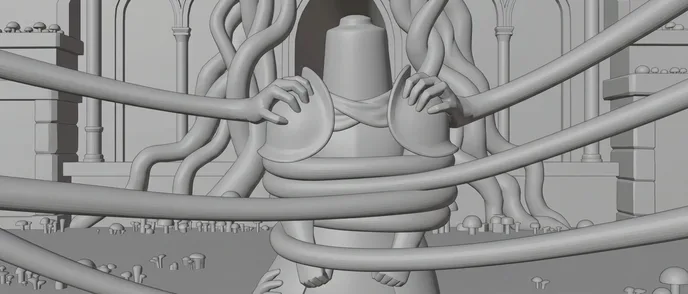
  1. A small lantern-helmed knight bound by thick roots in a ruined hall
    Storyboard frame of the trap shot, in grey
    01

    Medium · the trap

    Medium shot, Lantern bound by thick living roots in a ruined hall, glowing blue mushrooms on the floor, cold light

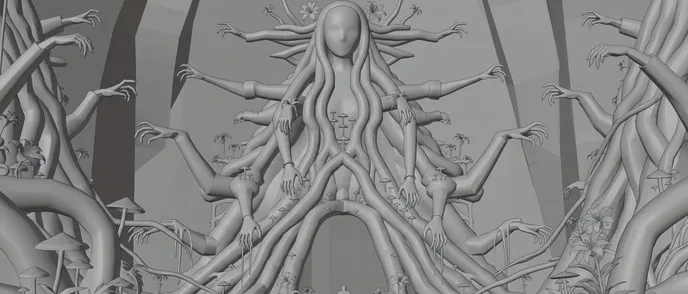
  2. A giant woman made of roots and white lilies spreads her many arms in a dark cavern
    Storyboard frame of the wide shot, in grey
    02

    Wide · the Source Tree

    Symmetrical wide shot, a giant woman made of roots, arms spread with many hands, white lilies, blue glyphs

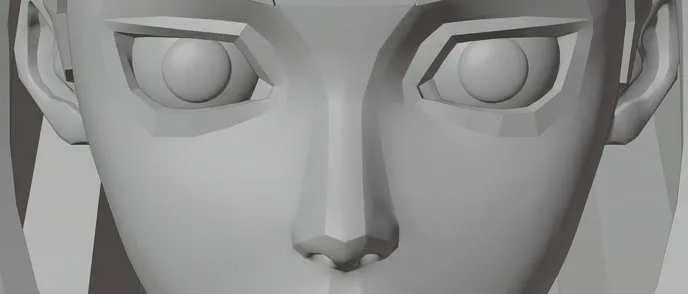
  3. Extreme close-up of a giant pale face with piercing blue eyes
    Storyboard frame of the eyes close-up, in grey
    03

    Extreme close-up · the eyes

    Extreme close-up on the giant's face, piercing blue eyes opening, pale skin, soft light from below

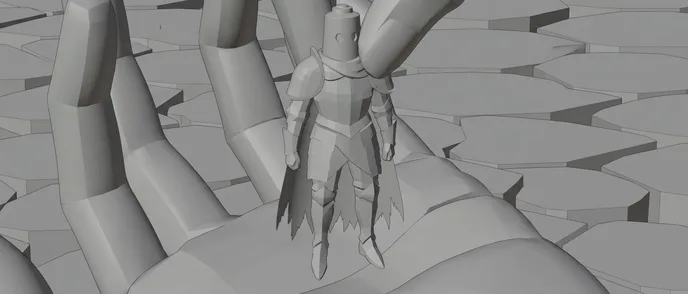
  4. A tiny armored knight stands in the middle of a giant open hand
    Storyboard frame of the palm shot, in grey
    04

    High angle · the palm

    High angle, the tiny knight standing in the center of a giant open palm, stone floor far below

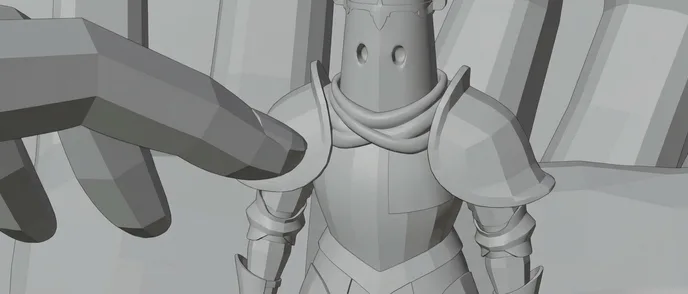
  5. A giant fingertip gently touches the chest of a small armored knight
    Storyboard frame of the touch close-up, in grey
    05

    Close-up · the touch

    Close-up, a giant fingertip gently touches the knight's armored chest, faceless helm, emotion through posture

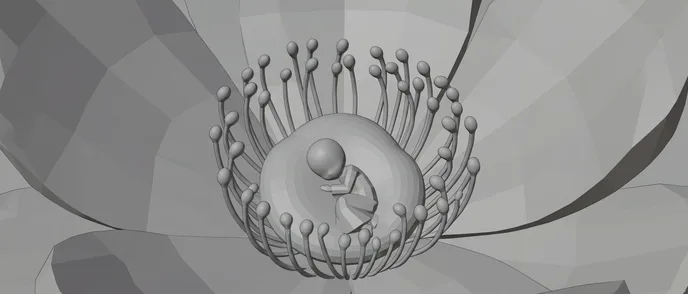
  6. A sleeping pink-haired child curled inside a glowing blue flower
    Storyboard frame of the seed insert, in grey
    06

    Insert · the seed

    Top-down insert, a glowing pale blue flower opening, a sleeping child with pink hair curled inside

Lost Garden, episode 1 runs 17 minutes, and at the AI London Festival it was a finalist. The Source Tree sequence would stand as the core of a 10 minute short for a shorts programme. The player cues up this scene.

The script

Twelve minutes, five movements.

Twelve minutes is a safe length for a shorts programme and long enough to hold a voice: about 12 screenplay pages and 100 to 140 shots of 5 to 7 seconds. The real limit is in the guidelines of the call, so confirm it there.
  1. 0:00 to 1:00

    The first image

    A programmer sees many shorts in a day. Open on a precise image and a feeling.

  2. 1:00 to 3:00

    The person

    One character, one want, one place. Keep the cast small so faces hold.

  3. 3:00 to 8:00

    The turn

    Something disturbs the person's world. Use sound as much as image.

  4. 8:00 to 10:30

    The cost

    Something is lost or chosen. Keep dialogue short and let performance carry it.

  5. 10:30 to 12:00

    The last image

    A closing image that reframes the first. Stop there.

A short needs a point of view the BFI would call a distinctive voice. Write it as one sentence before you write a page, then test every shot against it.

Month by month

From the 70th festival to the 71st call.

The 71st call is not announced. The last timing we could see had a late May deadline and decisions at the end of August, so a call in spring 2027 is the working assumption. Read its guidelines the day it opens.
  1. 01

    October 2026

    Watch the 70th LFF

    The festival runs from 7 to 18 October. Watch the Short Film Competition titles and one LFF Expanded work. Note length, opening and sound.

  2. 02

    November 2026

    A logline, then twelve pages

    Write twelve pages free in ScreenWeaver: one voice, one place, one change.

  3. 03

    December 2026

    The transparency file

    Start the record the BFI's questions call for: tools, versions, rights, consents and what AI replaced. Keep it from the first prompt.

  4. 04

    January to March 2027

    Board the film, then generate it

    References, storyboard, then footage scene by scene with Seedance in ScreenWeaver, as video generation reaches your plan.

  5. 05

    April 2027

    Edit, sound, credits

    Cut to your target length, clear every music source and remove any logo a generated shot added. Mix for a cinema.

  6. 06

    May 2027

    Read the guidelines, submit

    When the 71st call opens, read its guidelines in full before you pay. The premiere and length rules come from that document, not from this guide.

Ways to lose a slot

Six risks, from the BFI's own words.

Not all of these are festival rules. Some come from the BFI's AI guidance and some from the 2026 programme. None replaces the guidelines of the call.
  • Treating silence as permission

    The festival page has no AI clause and the BFI's wider position is transparency. A film that hides its AI use can be caught out later.

  • Generic output

    The BFI warns that generative tools often give formulaic, predictable results that resemble other people's work. In a competitive selection, sameness is the risk.

  • Rights nobody checked

    The BFI makes funded projects sign a warranty that no third-party rights are infringed, and AI use falls under it. Festival terms may differ, but a film with cloudy rights is a risk anywhere.

  • A film already shown in the UK

    The 2026 announcement says every feature and series screens in the UK for the first time. An earlier UK screening is likely to count against you. Ask before you post.

  • Cultural material used without consultation

    The BFI asks whether AI represents cultural perspectives and whether the knowledge holders were consulted. If your film draws on a culture that is not yours, consult first.

  • Missing the window

    In the recent pattern the deadline falls in late May, months before the festival. Count backwards from it, because a rough cut is no use without a complete submission.

Why ScreenWeaver

The BFI wants openness and a voice. Keep both.

The BFI's line is transparency and distinctive work. ScreenWeaver gives you a record and a way to keep a voice: screenplay, storyboard and footage in one connected project.
  • A transparency record from the start

    Each frame can be traced to its scene, its board and its prompt. The BFI asks if you are open with everyone on your project, and a project history makes that easy to answer.

  • A voice you steer shot by shot

    Storyboard Beta lets you set framing, angle, movement and duration by hand, so the film follows your direction and not the tool's average.

  • One film, one look

    References for characters and locations follow every shot. A short that looks like one film is a short with a voice.

  • Free to start, with time to spare

    Writing in ScreenWeaver costs nothing, with no time limit, on the Screenwriter plan. Storyboard Beta is $9.99 a month, with Seedance video generation to come on the Filmmaker plan.

Real productions

International festival-recognized films have been written and produced with ScreenWeaver.

ScreenWeaver is already being used as a creative workspace for real AI film productions, from cinematic shorts to animated series pilots selected, nominated, and awarded by international festivals.

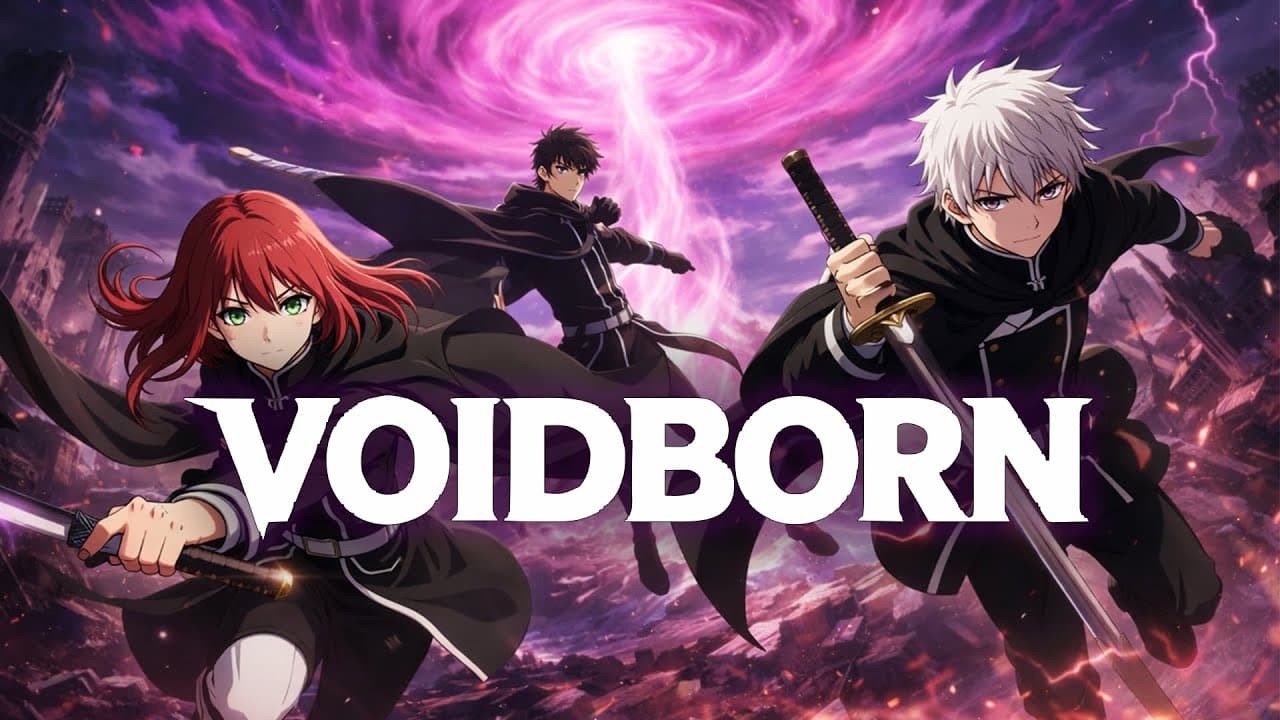
  • Video thumbnail for VOIDBORN

    VOIDBORN

    AI animated / cinematic short

    Festival recognition

    • 1st Place Silver

      Mondial Chroma Awards

    • 2nd Place Dreamina

      Mondial Chroma Awards

    • Award Winner

      Seoul International AI Film Festival

  • Video thumbnail for Les Fils du Vinnana

    Les Fils du Vinnana

    AI short film

    Festival recognition

    • Honorable Mention

      Top Quark Film Festival

    • People's Choice Nominee

      Illuminate Oneness of Humanity

    • Nominee

      ALTFF Supershort

  • Video thumbnail for Lost Garden

    Lost Garden

    AI animated series pilot

    Festival recognition

    • Finalist

      AI London Festival

The pipeline

Write. Board. Produce.

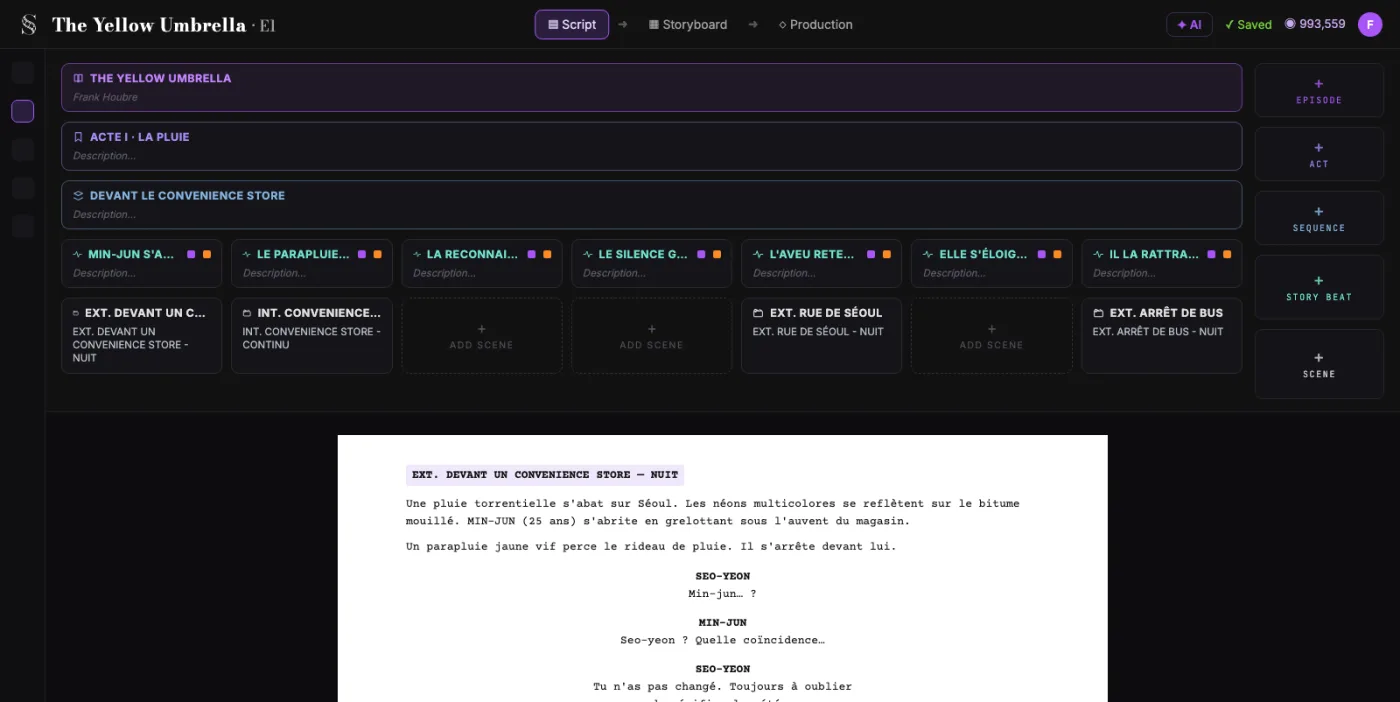
  1. ScreenWeaver screenplay editor: acts, sequences and beats above the formatted script of The Yellow Umbrella

    01The screenplay, enriched

    An industry-standard screenplay editor, and more: a visual outline and beat editor, your writing inspirations (notes, photos, audio) kept next to the page, and an AI researcher to support your writing, not replace it.

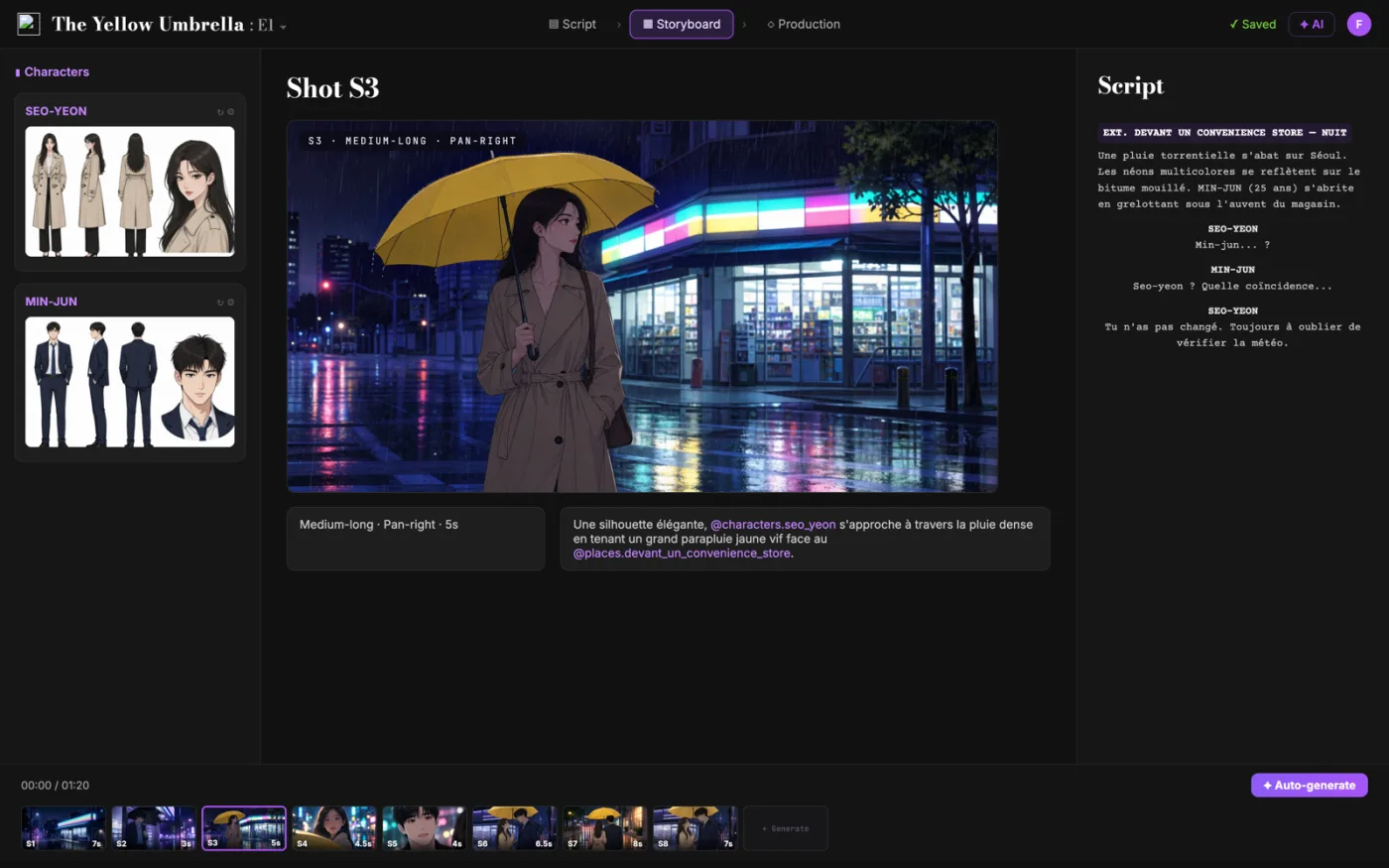
  2. ScreenWeaver storyboard: shot S3 of The Yellow Umbrella with characters, shot settings and the script beside it

    02The storyboard, made easy

    Shot breakdown generated from your screenplay, manual control over every shot (frame, angle, movement, duration), and generative AI previsualization in one click.

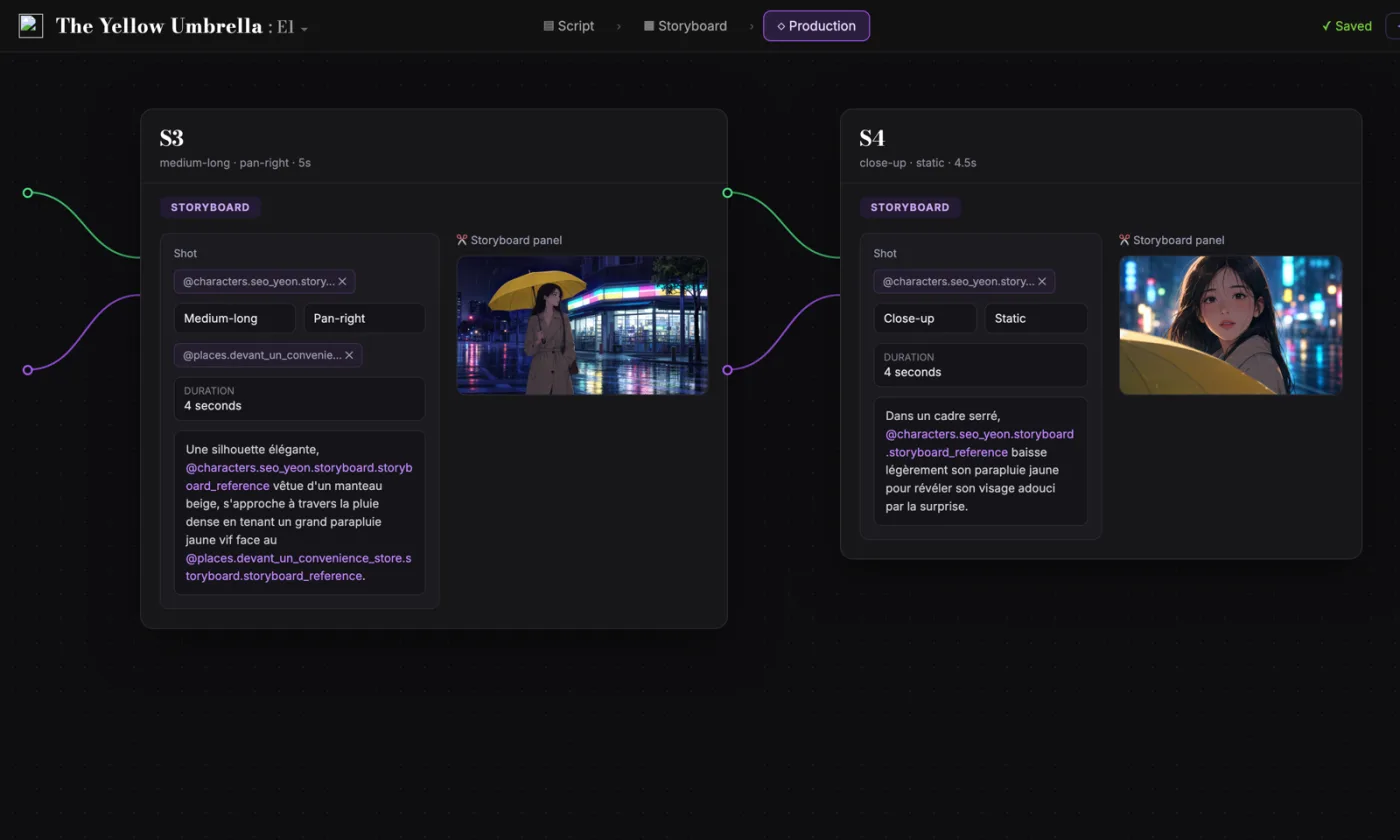
  3. ScreenWeaver production canvas: shots S3 and S4 as connected nodes carrying their storyboard panels and prompts

    03AI production, with finesse

    Footage generation pipelines connected to your screenplay and storyboard. Optimized out of the box, fully editable workflow.

FAQ

The BFI London Film Festival and AI films, your questions

Can you submit an AI film to the BFI London Film Festival?
We found no rule against it. The 70th submissions page, now closed, contains no AI clause, and the BFI's guidance for funded projects does not prohibit AI but requires transparency. The detailed guidelines were not readable, so read them when the 71st call opens.
Does the LFF screen films made with generative AI?
Nothing we read says no. The 2026 programme includes an AI-guided installation in LFF Expanded. No competition title is described as AI-made in the announcements we read.
What does the BFI say about AI?
In guidance updated on 28 January 2026 for funding applications, it says it does not prohibit AI in applications or in the projects it supports, but requires transparency about assistive and generative AI, and legal compliance. It does not use AI to assess applications.
Is the 71st call open?
The 71st call is not announced. The 70th festival runs from 7 to 18 October 2026, and submitters heard around the end of August. A call in spring 2027 is the working assumption.
What are the submission fees?
We could not read the current fee table, so we give no figure. The BFI's submission guidelines list fees by window. Read them when the call opens.
Is there a short film competition?
Yes. Ten films competed for the Short Film Award in 2026. It recognises short-form work with a distinctive cinematic voice, and a jury led by Helen Simmons decides.
Are there AI works at the festival?
Yes, in LFF Expanded: Red the Ocean Around U, by CROSSLUCID and Orion Facey, is an AI-guided digital environment shown in the BFI IMAX in 2026.
Does my film have to be a UK premiere?
In 2026 every feature and series screens to UK audiences for the first time, according to the programme announcement. The rules for shorts and the exact premiere definition sit in the guidelines, which we could not read.

A voice first. Then a project.

Begin the screenplay free, storyboard it, then generate the film with Seedance.