AI Filmfestival Biberach 2026 · Guide

How to win the AI Filmfestival Biberach.Six awards, €4,500, one small town.

The first German AI film festival runs 27 October to 1 November 2026 in Biberach an der Riss, with six awards worth €4,500 and a jury of four. The 2026 call is closed. Here is how it works, and a plan for the next one, starting with the screenplay in ScreenWeaver.
  • Festival 27 October to 1 November 2026
  • Six awards, €4,500
  • 2026 call closed
Lost Garden · Episode 2

Independent guide. ScreenWeaver does not organise the AI Filmfestival Biberach and is not affiliated with its organisers. Rules read on 1 October 2026. Official festival site

Available today in ScreenWeaver: free screenwriting, and a storyboard generated from your screenplay with Storyboard Beta, $9.99 a month.

Rolling out: video generation of each shot, powered by Seedance, with the Filmmaker plan.

The rules on one card

What the festival asks of a film.

The festival calls itself the first German AI film festival. Its own site lists the dates, the jury and the awards. The detailed rules sit on Festhome, so those lines say where they come from.
Edition
1st, 27 October to 1 November 2026, Biberach an der Riss
Selection
More than 80 films, from about 280 entries
2026 call
Closed: late deadline 31 August 2026
Awards
Six, worth €4,500 in total
AI requirement
AI a substantial part of production, per Festhome
Length
Up to 60 minutes, per Festhome
Entry fee
€19, €25 late, €5 for students, per Festhome
Next call
No call published yet

Sources: kifestival.ensemble-film.de (dates, awards, jury, selection and news posts, read on 1 October 2026) and the festival's Festhome listing (rules, length, fees). The listing still shows an older award list worth €2,000: the festival's own awards page prevails. No 2027 call is published.

Key dates

How the first call ran.

The 2026 calendar shows the rhythm of a first edition. Expect something similar for 2027. This is an inference, not an announcement.
  1. 6 Apr 2026

    The call opens

    The Festhome listing dates the opening of the call from this day.

  2. 30 Jun 2026

    Standard deadline

    The standard fee of €19 applied until this date, according to Festhome.

  3. 31 Aug 2026

    Late deadline

    The last day, at €25. On 1 September the festival announced that no more submissions were possible, after about 280 entries.

  4. 6 Oct 2026

    Programme guide

    The festival planned to publish its programme guide and open ticket sales on this date. Festhome lists 15 October as the notification date.

  5. 27 Oct to 1 Nov 2026

    The festival

    In Biberach an der Riss: an opening ceremony, film blocks, five public panels and an award ceremony, with screenings starting on 28 October.

Who decides

A curator and four jurors.

A curator chose the programme and four jurors are named. Neither the criteria nor the weights are published, so the people are the only grid there is.
  • A curator picks the programme

    Marcel Barsotti, filmmaker and curator, selected the more than 80 films shown. The festival published nine instalments of selections before the programme was final. Being picked is the first prize.

  • Two actors on the jury

    Barbara Dussler, born in Biberach, trained at the Otto Falckenberg School in Munich and joined the ensemble of the Hessian State Theatre in Wiesbaden. Christian Kahrmann started acting at 13, in the series Lindenstraße. Performance and faces will be read by people who know acting.

  • A voice for diversity

    Nico Komarowsky is a manager for diversity, culture and social sustainability at Boehringer Ingelheim, which sponsors the €1,000 diversity award. Barbara Dussler is named as the diversity jury member. Show who is seen and how, do not only say it.

  • A juror who talks about AI

    Antje Nikola Mönning gave the festival's social media team an interview on AI and its meaning for the film industry. The jury is open about the subject, so be open about your method.

The six awards

Pick the award your film serves.

The festival sets no theme. It sets six awards, most with a sponsor from the region, and your film aims at the one that fits. Our suggested angle closes each card.
  • 01

    Best AI Film

    Drama, comedy and arthouse. It shares €2,000 from Kreissparkasse Biberach with two other awards.

    The widest category, so the strongest story wins: one character, one change, one place.

  • 02

    Best AI Genre Film

    Sci-fi, fantasy and horror.

    AI is at home in impossible worlds. Commit to the genre's rules and keep faces stable through the effects.

  • 03

    Best AI Animation

    Animation, anime, stop motion and other techniques.

    One drawn look held for the whole film, and a technique named in the entry. Say what you imitated and what you invented.

  • 04

    Best AI Documentary

    A €1,000 award sponsored by bytekomplex AG.

    Use AI to rebuild what was never filmed and mark every generated image. A documentary that hides its method has no place here.

  • 05

    Best AI-Supported Diversity Film

    A €1,000 award sponsored by Boehringer Ingelheim, with no restriction on the proportion of AI.

    The one award where the AI share does not matter. The film does: who it shows, and how.

  • 06

    Best AI Rookie

    A €500 award sponsored by the Walter family.

    For a first film. Keep it small and finished: a complete five minute short beats an unfinished epic.

The first edition

What a first edition shows.

This is the first edition, so there are no past winners. What exists is the shape of the first call: about 280 entries, more than 80 films selected, and a programme with films from more than 30 countries.

  1. 01

    About three films in ten were selected. More than 80 of roughly 280 entries made the programme. That is generous for a festival, but it is the figure of one edition.

  2. 02

    The entries are international. Counting FilmFreeway entries only, the United States sent 39, China 33, South Korea 26, Germany 22 and Italy 16. A German film is one of 22 from its country.

  3. 03

    Filmmakers travel. Creators from China, South Korea, the United States and Turkey confirmed their attendance. Plan to be in Biberach: the festival is built around meeting.

  4. 04

    The town is the venue. Screenings and events are spread over the Vinotheum, the Stadtbuchhandlung bookshop, the former Landesbank building and the AIDEN Hotel. A film works with a room, not only on a screen.

  5. 05

    The award list moved. The Festhome listing shows four awards worth €2,000, the festival's awards page six awards worth €4,500. Read the live page, since the first edition was still taking shape.

Page to screen

Lost Garden: an animated scene in six shots.

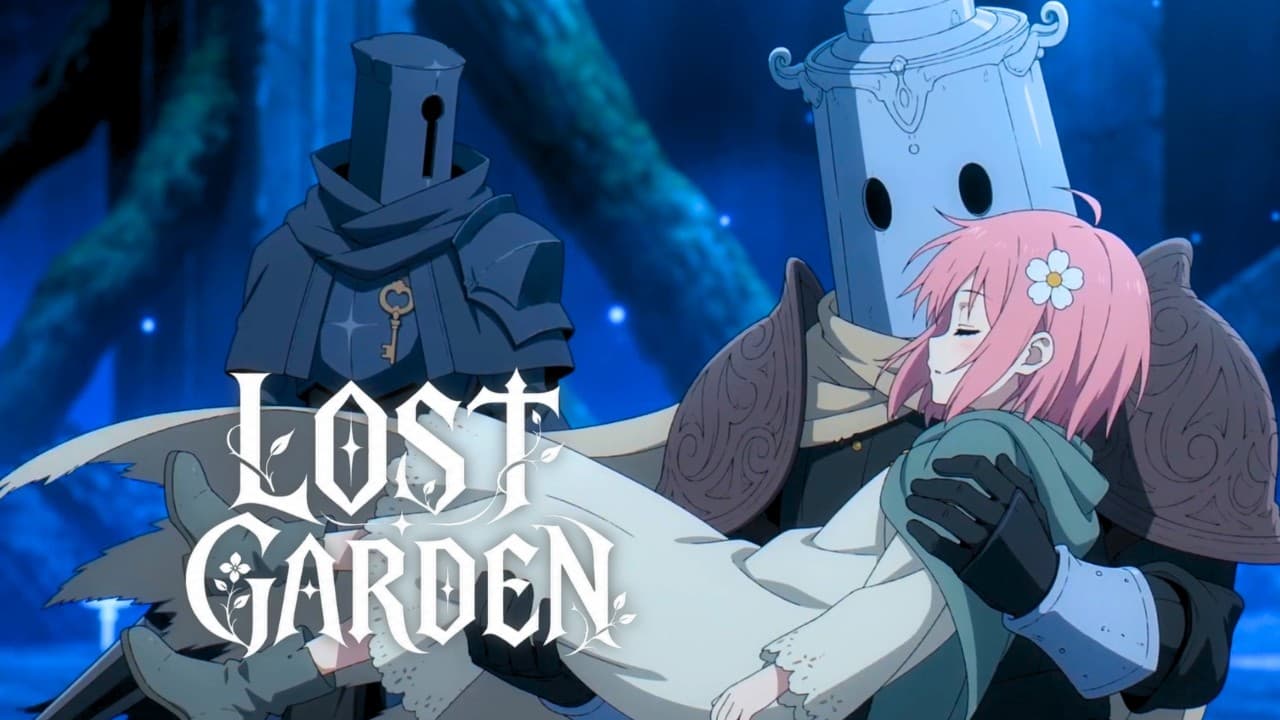
Best AI Animation is one of the six awards. The scene is the opening of Lost Garden, episode 2, an animated series made by the ScreenWeaver team. Then come six shots, each as a storyboard frame and as a final image.

Logline. A newborn knight whose inner light is leaking away crosses a world that has stopped hoping, to find the one blacksmith who can seal his armor.

Screenplay · episode 2 · page 1

INT. UNDERGROUND CAVERN - LOWER PATH - CONTINUOUS

Blue mushrooms the size of houses. LANTERN, a small knight with a lantern for a helm, walks alone.

He presses a hand to his chest. Sparks of light slip between his fingers.

SERRURE

Hold on. You're losing something.

Serrure lifts the edge of the cloak. A gash in the armor. Blue light leaks out like smoke.

SERRURE

That's your energy. What keeps you standing.

He grips Lantern's shoulder. Two knights alone among the crystals.

SERRURE

A suit that leaks goes out. Eventually.

Under the giant mushrooms, the road climbs into the dark.

SERRURE

So. We follow the road.

Serrure points the way. Lantern follows.

CUT TO:

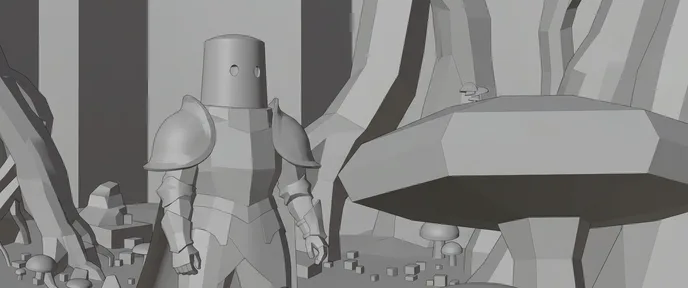
  1. A small knight with a lantern helm stands by a giant glowing blue mushroom in a crystal cavern
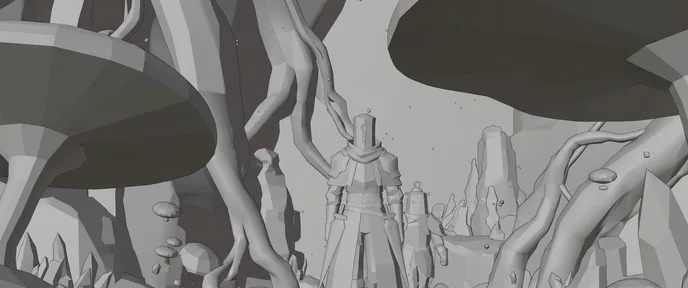
    Storyboard frame of the same wide shot, in grey
    01

    Wide · the world

    Wide shot, Lantern alone by a giant glowing blue mushroom, crystal cavern, roots, drifting spores, cold blue light

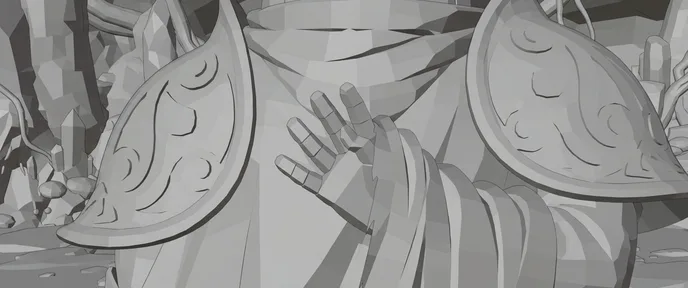
  2. Close-up of an armored chest under a cream cloak, a gloved hand, a spark of light
    Storyboard frame of the chest close-up, in grey
    02

    Close-up · the chest

    Close-up on Lantern's chest, his gloved hand pressed to the cloak, a spark of light escaping between the fingers

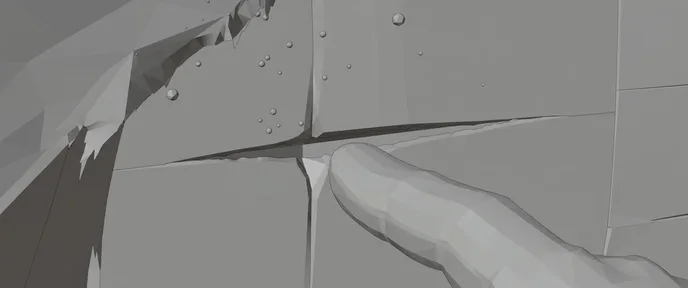
  3. A torn gash in an armor plate leaking bright blue light, a finger pointing at it
    Storyboard frame of the wound insert, in grey
    03

    Insert · the wound

    Extreme close-up, Serrure's finger near a torn gash in the back plate, blue light leaking out like luminous smoke

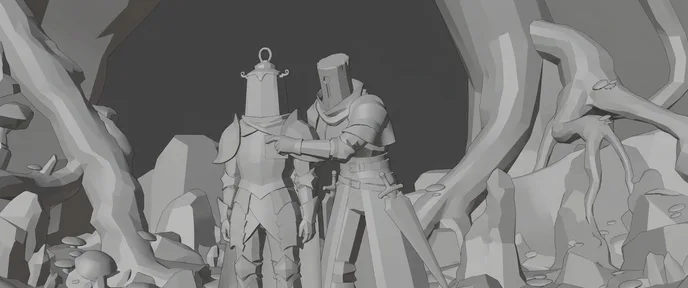
  4. Two armored knights side by side, one with a hand on the other's shoulder, in a crystal cavern
    Storyboard frame of the two-shot, in grey
    04

    Two-shot · the bond

    Medium two-shot among crystals and roots, Serrure's hand on Lantern's shoulder, faceless armors, emotion through posture only

  5. Two small knights walk beneath two giant glowing blue mushrooms
    Storyboard frame of the wide shot, in grey
    05

    Wide · the scale

    Wide low angle, the two knights tiny beneath two giant glowing mushrooms, blue crystals in the foreground, mist

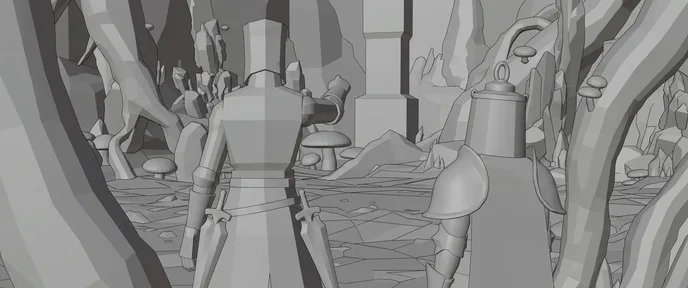
  6. Seen from behind, a tall dark knight points ahead while the small lantern knight looks on
    Storyboard frame of the over-the-shoulder shot, in grey
    06

    Over the shoulder · the road

    Over-the-shoulder from behind, Serrure points ahead into the cavern, Lantern beside him, roots framing the path

Lost Garden, episode 2 lasts 21 minutes, so in the Festhome listing it sits in the longer class, from 15 to 60 minutes. Its predecessor, episode 1, reached the finals at the AI London Festival. Press play to open the film at this sequence.

The script

Twelve minutes in five movements.

The Festhome listing stops at 60 minutes and splits films at 15. Aim for 12 minutes: about 12 screenplay pages and 110 to 150 shots of 4 to 6 seconds, which keeps you in the shorter class.
  1. 0:00 to 0:50

    The first image

    A place and a mood, in one shot. The curator has many films to place.

  2. 0:50 to 2:45

    The place and its people

    Who lives here, what they want, and what the world refuses them.

  3. 2:45 to 7:30

    The long middle

    Where AI films sag. Give every scene a new fact or a new cost, and cut the rest.

  4. 7:30 to 10:10

    The hinge

    The decision that changes the film. Give it the longest silence.

  5. 10:10 to 12:00

    The close

    A last image and a credit for every tool, since the festival asks about your workflow.

Festhome lists subtitles in English and German. Prepare English at least, and German if the film speaks another language.

Month by month

From the programme to the 2027 call.

The 2026 call is closed and the festival opens on 27 October. This plan uses the festival as research and has your film ready for an April 2027 call, if the first call's rhythm repeats.
  1. 01

    1 to 27 October 2026

    Read the programme

    The programme guide was due on 6 October. Pick the blocks closest to your idea and note the lengths. Tickets are sold through Reservix.

  2. 02

    27 October to 1 November

    Go, if you can

    Five public panels cover screenwriting, AI development, business and society, filmmaking techniques and security. Meet the curator and the jury if you attend.

  3. 03

    November 2026

    Choose the award and write

    Pick one of the six awards. Write the screenplay free in ScreenWeaver, for a film of about 12 minutes.

  4. 04

    December 2026 to February 2027

    Storyboard and generate

    References, storyboard, then footage with Seedance in ScreenWeaver as video generation reaches your plan. Document how AI was used: the Festhome listing asks for tools and workflow.

  5. 05

    March 2027

    Edit, sound, subtitles

    Cut to length, mix the sound and add English subtitles. The listing says a film must not be older than two years.

  6. 06

    April 2027

    Watch for the call

    The 2026 call opened on 6 April. Enter at the standard fee, not the late one, with a few lines on your AI workflow ready.

Ways to lose a spot

Seven traps in a festival with few published rules.

The festival's own site lists few rules. Most of these come from the Festhome listing and from how the first edition ran. Check them on the current call.
  • AI as an afterthought

    The listing says AI tools must be a substantial part of the production process. A film that is shot and only touched up is the wrong film here, except for the diversity award, where the AI share is free.

  • No account of the workflow

    The listing asks you to briefly document the creative use of AI, naming tools and workflow. A missing or vague note leaves a gap in the entry.

  • A film in the wrong length class

    The listing stops at 60 minutes and splits films at 15. A film of 16 minutes lands in the longer class. Cut to the class you want.

  • A film older than two years

    The listing says a film must not be more than two years old. A film finished in early 2025 may be out for a 2027 call.

  • Entering without choosing an award

    The six awards cover drama, genre, animation, documentary, diversity and first films. Choose the one your film serves best and say so in the entry.

  • Missing the late deadline

    The 2026 call had a standard deadline on 30 June and a late one on 31 August, then closed with a public notice. Do not count on an extension.

  • Reading an old listing

    The Festhome listing shows four awards worth €2,000, while the festival's site shows six worth €4,500. Always prefer the festival's own pages.

Why ScreenWeaver

A small festival, a clear brief. Build the film in one project.

The festival imposes no tool and asks you to document yours. ScreenWeaver keeps screenplay, storyboard and footage in one connected project, which documents the workflow as you go.
  • A workflow that documents itself

    Every shot is tied to its scene, its frame and its prompt, so the note on tools and workflow comes straight from the project.

  • Animation that holds one look

    References for characters, sets and light keep an animated film coherent over twelve minutes, which is the whole job in Best AI Animation.

  • From short to longer film

    One project can be cut as a 12 minute short or extended to a longer film, since the festival takes up to 60 minutes.

  • Start for free today

    Screenwriting on the Screenwriter plan is free and has no expiry. Storyboard Beta is $9.99 a month, and Seedance video generation will come with the Filmmaker plan.

Real productions

International festival-recognized films have been written and produced with ScreenWeaver.

ScreenWeaver is already being used as a creative workspace for real AI film productions, from cinematic shorts to animated series pilots selected, nominated, and awarded by international festivals.

  • Video thumbnail for VOIDBORN

    VOIDBORN

    AI animated / cinematic short

    Festival recognition

    • 1st Place Silver

      Mondial Chroma Awards

    • 2nd Place Dreamina

      Mondial Chroma Awards

    • Award Winner

      Seoul International AI Film Festival

  • Video thumbnail for Les Fils du Vinnana

    Les Fils du Vinnana

    AI short film

    Festival recognition

    • Honorable Mention

      Top Quark Film Festival

    • People's Choice Nominee

      Illuminate Oneness of Humanity

    • Nominee

      ALTFF Supershort

  • Video thumbnail for Lost Garden

    Lost Garden

    AI animated series pilot

    Festival recognition

    • Finalist

      AI London Festival

The pipeline

Write. Board. Produce.

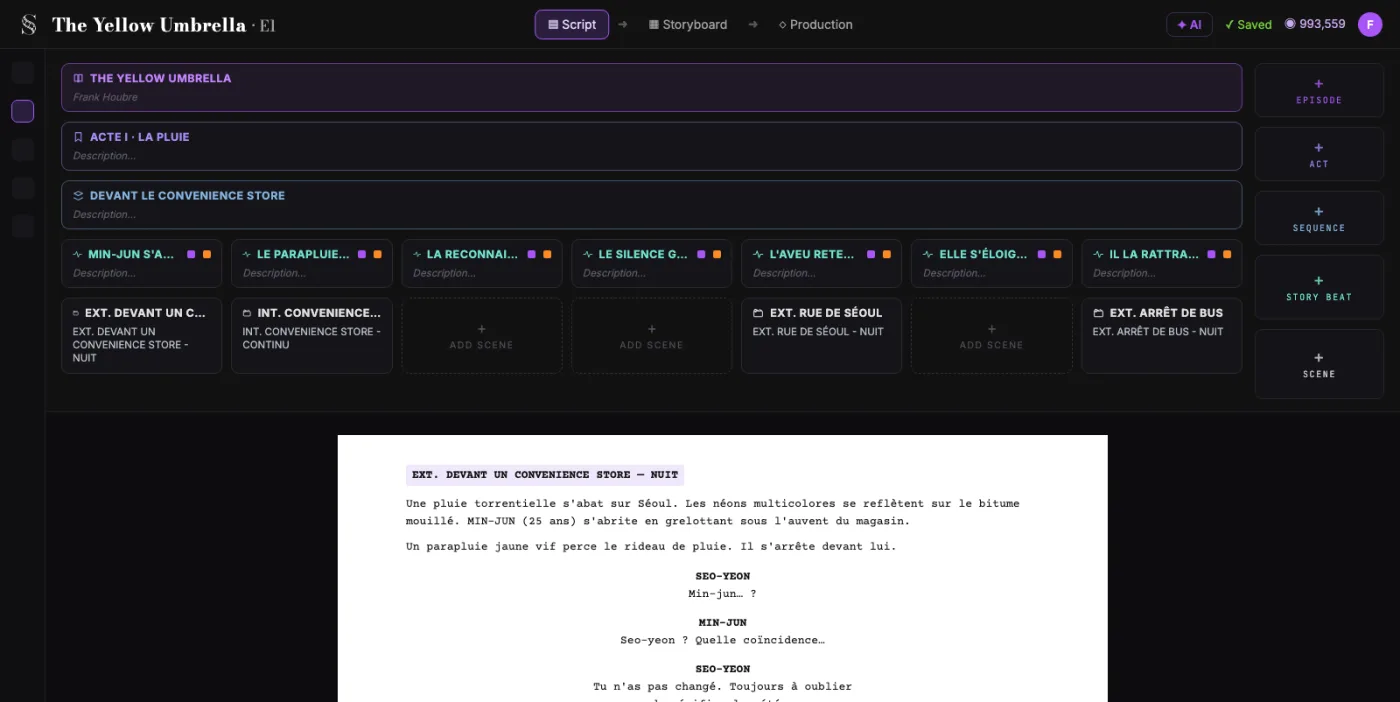
  1. ScreenWeaver screenplay editor: acts, sequences and beats above the formatted script of The Yellow Umbrella

    01The screenplay, enriched

    An industry-standard screenplay editor, and more: a visual outline and beat editor, your writing inspirations (notes, photos, audio) kept next to the page, and an AI researcher to support your writing, not replace it.

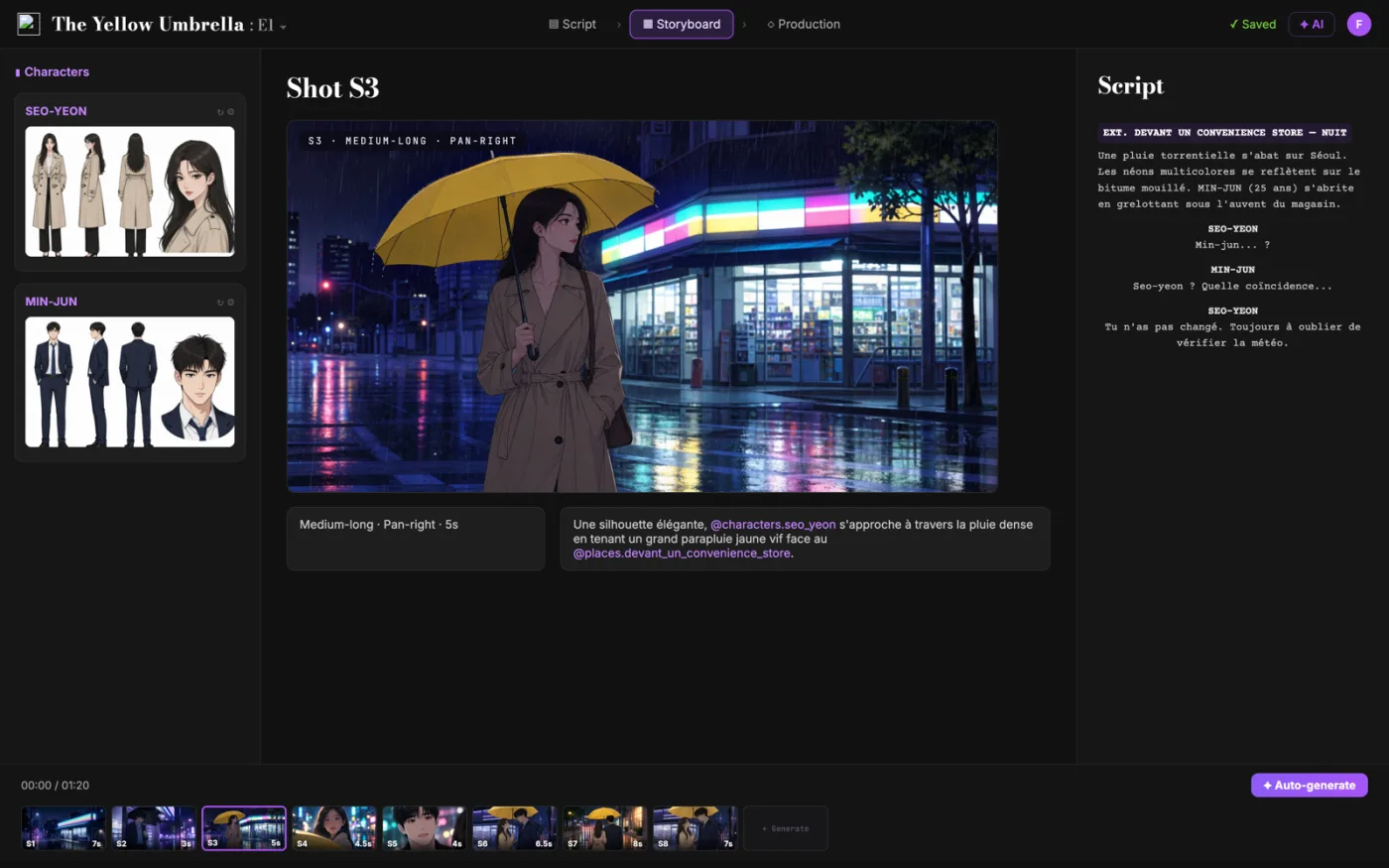
  2. ScreenWeaver storyboard: shot S3 of The Yellow Umbrella with characters, shot settings and the script beside it

    02The storyboard, made easy

    Shot breakdown generated from your screenplay, manual control over every shot (frame, angle, movement, duration), and generative AI previsualization in one click.

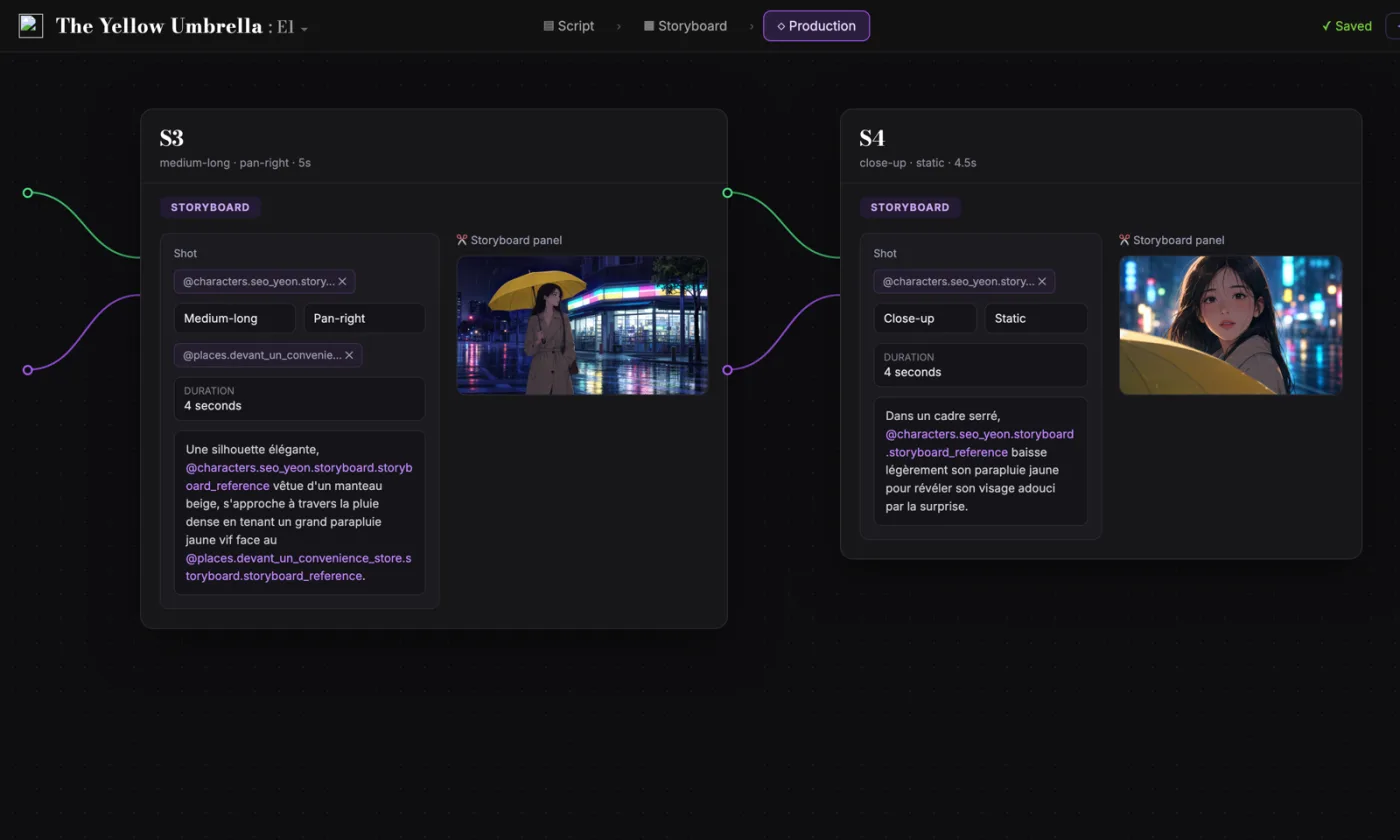
  3. ScreenWeaver production canvas: shots S3 and S4 as connected nodes carrying their storyboard panels and prompts

    03AI production, with finesse

    Footage generation pipelines connected to your screenplay and storyboard. Optimized out of the box, fully editable workflow.

FAQ

The AI Filmfestival Biberach, your questions

How do you win the AI Filmfestival Biberach?
The festival gives no scoring grid. A curator picks the programme, and a jury of four gives six awards worth €4,500 in total. Pick the award that fits the film, then make it finished, consistent and clear about its AI workflow.
When is the festival?
From 27 October to 1 November 2026 in Biberach an der Riss, Germany. Films are shown from 28 October. The programme guide and ticket sales were due on 6 October, and tickets are sold through Reservix.
What are the awards?
Best AI Film, Best AI Genre Film and Best AI Animation share €2,000 from Kreissparkasse Biberach. Best AI Documentary carries €1,000, Best AI-Supported Diversity Film €1,000 and Best AI Rookie €500, for €4,500 in total.
Is the 2026 call still open?
No. On 1 September 2026 the festival announced that no more submissions were possible, after about 280 entries. No 2027 call is published. The 2026 call opened on 6 April, which points to spring 2027.
How much AI must the film contain?
According to the Festhome listing, AI tools must be a substantial part of the production process, in image, video, audio or text. The diversity award has no restriction on the proportion of AI. The festival's own pages state no percentage.
Who is on the jury?
Antje Nikola Mönning, Christian Kahrmann, Nico Komarowsky and Barbara Dussler, who sits on the diversity jury. Marcel Barsotti is the curator who selected the programme.
How long can the film be?
Up to 60 minutes according to Festhome, which splits films into up to 15 minutes and 15 to 60 minutes. A separate class exists for students and pupils.
What is the entry fee?
On Festhome in 2026: €19 standard, €25 late and €5 for students and pupils. The festival's own pages do not list fees, so check the current call.

A first edition now. Your film for the second.

The screenplay is free today. Pick your award, then build the film one connected step at a time.