Karlovy Vary 2027 · AI films guide

Can you submit an AI film to Karlovy Vary?No AI rule. But no shorts either.

The rules of the 60th Karlovy Vary IFF hold no clause on AI. They do hold a hard line on length: films under 60 minutes are not accepted, and a world premiere is the price of entry. The 61st edition's rules are not out yet, so here is what the latest ones say, and how to prepare an AI feature for the next call, starting with the screenplay in ScreenWeaver.
  • No AI rule in the 60th rules
  • Features of 60 minutes or more only
  • Festival 2 to 10 July 2027
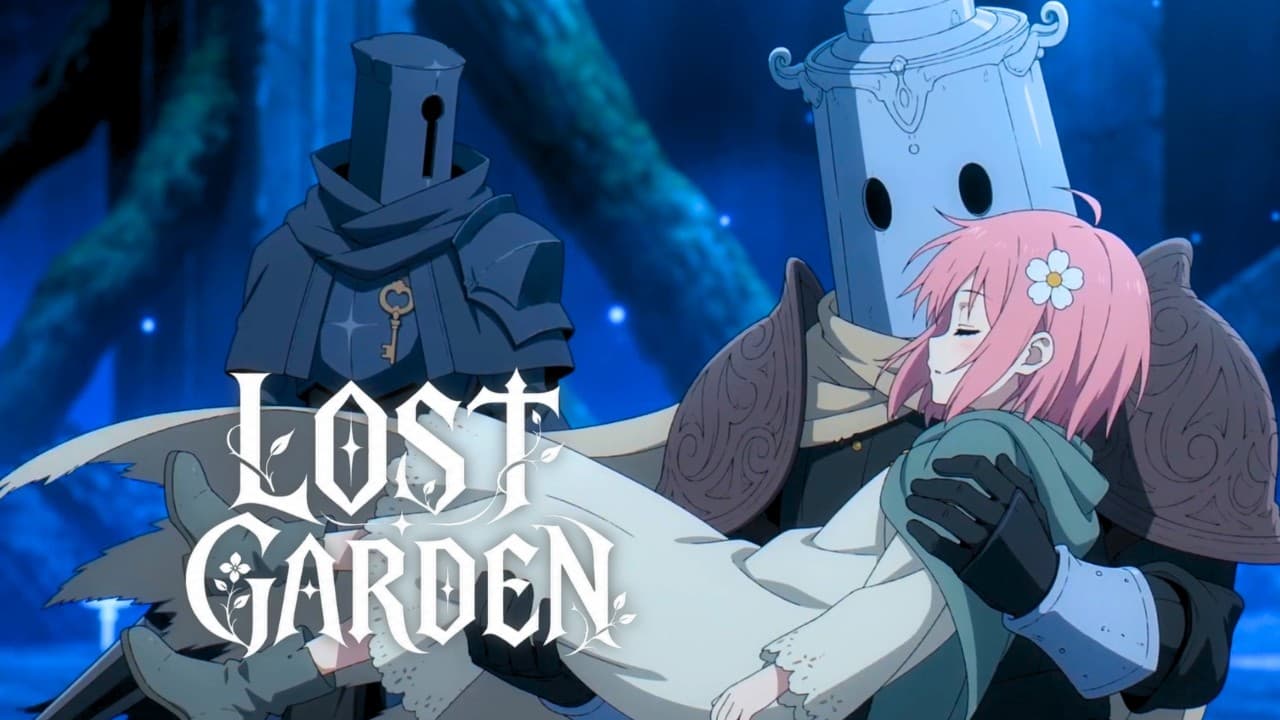
Lost Garden · Episode 2

Independent guide. ScreenWeaver does not organise Karlovy Vary IFF and is not affiliated with Film Servis Festival Karlovy Vary. Rules read on 1 October 2026. Official rules (60th edition)

Available today in ScreenWeaver: free screenwriting, and a storyboard generated from your screenplay with Storyboard Beta, $9.99 a month.

Rolling out: video generation of each shot, powered by Seedance, with the Filmmaker plan.

The rules on one card

What Karlovy Vary asks of a film.

Karlovy Vary is a FIAPF-accredited competitive festival for feature films. Its rules never mention artificial intelligence, so an AI feature is read like any other, and the barriers are length, premiere and timing.
Next edition
61st KVIFF, 2 to 10 July 2027
Rules in force
The 60th edition's: the 61st are not published
Competitions
Crystal Globe and Proxima, features only
Minimum length
60 minutes, no shorts or medium-length films
Premiere
World premiere to be considered
Completion
Within 12 months before the festival starts
Fee in the 60th cycle
€60 early, €80 regular, €100 late
AI rule
None in the 60th edition rules

Source: Rules and Regulations of the 60th Karlovy Vary IFF (three pages) and the film entry page on kviff.com, read on 1 October 2026. The 2 to 10 July 2027 dates come from the festival's own announcement. The 61st edition's rules, fees and call are not published.

What the rules say about AI

No clause, and a wall at 60 minutes.

The Rules and Regulations of the 60th edition run three pages and never mention artificial intelligence. The festival does talk about AI, in its industry programme. Here is where the line sits.
  • The Rules and Regulations

    Programme, pre-selection, selected films, prizes and juries, in six parts. No AI clause and no disclosure rule. Article I.1 describes a non-specialized festival accredited by FIAPF for competitive feature films. We read the whole document on 1 October 2026.

  • The film entry page

    It lists the three fee windows and says submissions to the 60th edition are closed. It says nothing about AI. We opened it on 1 October 2026.

  • AI in the programme, not in the selection

    KVIFF's press release of 1 July 2026 names “technological transformation and storytelling in the era of artificial intelligence” as a key theme of the 60th edition. It announced an industry block, a panel and a hands-on tools workshop with Plot Next on 8 July.

  • Feature length is the hard rule

    Article III.4 asks for at least 60 minutes and says the festival does not accept short and medium-length films, up to 60 minutes. An AI short has no door here. An AI feature does.

  • Completion and release

    Article III.3 asks for a film completed within the 12 months before the festival and not released anywhere, internet included, more than 12 months before it. A film left online for a year can be out.

  • What is not eligible

    Films that are solely promotional, educational or scientific. An AI brand film or a tutorial will not pass, whatever its quality.

Key dates

The 60th calendar, a guide to the 61st.

The 61st call is not announced. Its predecessor ran as follows, which is the best guide we have.
  1. By 7 Dec 2025

    Early bird

    €60 per film for entries completed by this date.

  2. 8 Dec to 28 Feb

    Regular window

    €80 per film, ending on 28 February 2026.

  3. 1 to 31 Mar 2026

    Late window

    €100 per film. The call closed on 31 March.

  4. Early June 2026

    Selection known

    The film entry page promised an answer by the beginning of June at the latest. The online screener had to stay valid until 10 June.

  5. 2 to 10 Jul 2027

    The 61st edition

    The dates KVIFF has announced for the next edition. The 60th ran from 3 to 11 July 2026.

Who decides

A committee, two juries, an audience.

The rules say who selects and who judges. None of them owes you an explanation.
  • A committee that advises one man

    Article III.2: films are selected by a commission of experts acting as an advisory body to the Artistic Director, Karel Och, who signs the rules. Taste sits with a small team.

  • Two international juries

    One for the Crystal Globe, one for Proxima: people from culture, film theory and film journalism, plus filmmakers and producers, none of whom worked on a film in the competition they judge. Their decisions are final.

  • No feedback, no reasons

    Article III.8: the festival owes no comments, no information on how a film was reviewed and no reasons for a refusal. A silent refusal is not a verdict on the film.

  • The Právo Audience Award

    Chosen by audience vote, for a feature-length film shown in any official section that meets the open submission criteria.

Sections

Four places a feature can land.

Karlovy Vary has sections, not themes. You submit one film and the Selection Committee decides where it plays. Under each section, the angle we would take.
  • 01

    Crystal Globe Competition

    A non-specialized international competition for feature-length fiction and documentary films, world and international premieres only. The Grand Prix carries $25,000.

    The flagship. An AI feature must stand as cinema first: no jury rewards a method.

  • 02

    Proxima Competition

    Room for new voices, with works by upcoming filmmakers and adventurous works by renowned auteurs. The Grand Prix carries $15,000.

    The natural room for an experimental feature. Adventurous is the word of the brief, and AI is one way to be adventurous.

  • 03

    Non-competitive sections

    Focuses, retrospectives and tributes sit beside the competitions, outside the prize rules.

    You do not pick the section. Read the past programmes to see where films like yours were placed.

  • 04

    Industry Days

    Panels, workshops and tool presentations for professionals, including the 2026 AI block.

    Not a place to submit a finished film. It is where producers hear about AI, so go as a delegate if you want that conversation.

The 60th edition

What last year's prizes say.

The Crystal Globe went to Fruit Gathering by Aung Phyoe, and the Proxima Grand Prix to Lover, Not a Fighter by Martina Buchelová, according to press reports of the closing ceremony on 11 July 2026.

  1. 01

    Prizes go to films, not to methods. The rules describe juries of cultural figures, theorists, journalists and filmmakers. A technique alone will not impress them.

  2. 02

    The money is real. The Crystal Globe Grand Prix is $25,000 and the Proxima Grand Prix $15,000, each shared equally by director and producer.

  3. 03

    A premiere is a prerequisite, not a bonus. Both competitions are for world or international premieres, and the Crystal Globe excludes films that already competed in another international competition.

  4. 04

    The 12 month window rewards pace. A film must be completed within 12 months of the festival, so even a long AI production has to land in the right year.

The film behind the page

Lost Garden: six shots from episode 2.

A feature needs 60 minutes, and a series can get there episode by episode. This is the opening of Lost Garden, episode 2, an animated series by the ScreenWeaver team made with Seedance. Each shot comes as a screenplay line, a storyboard frame and a final image.

Logline. A newborn knight whose inner light is leaking away crosses a world that has stopped hoping, to find the one blacksmith who can seal his armor.

Screenplay · episode 2 · page 1

INT. UNDERGROUND CAVERN - LOWER PATH - CONTINUOUS

Blue mushrooms the size of houses. LANTERN, a small knight with a lantern for a helm, walks alone.

He presses a hand to his chest. Sparks of light slip between his fingers.

SERRURE

Hold on. You're losing something.

Serrure lifts the edge of the cloak. A gash in the armor. Blue light leaks out like smoke.

SERRURE

That's your energy. What keeps you standing.

He grips Lantern's shoulder. Two knights alone among the crystals.

SERRURE

A suit that leaks goes out. Eventually.

Under the giant mushrooms, the road climbs into the dark.

SERRURE

So. We follow the road.

Serrure points the way. Lantern follows.

CUT TO:

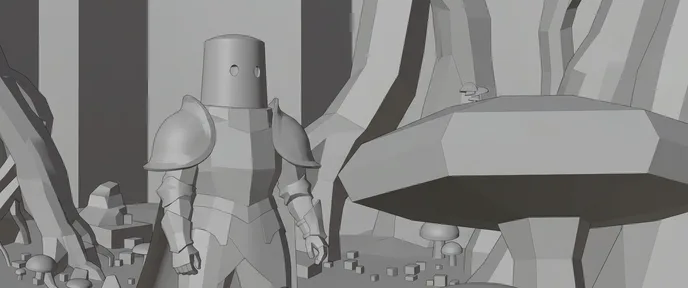
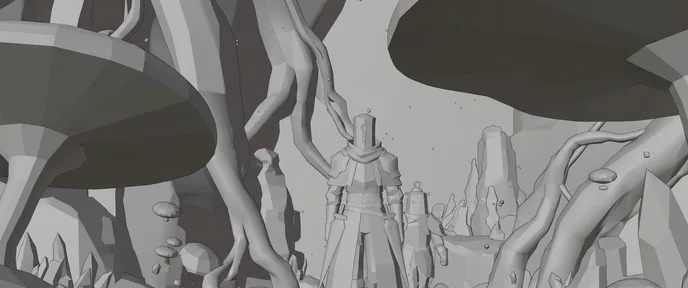
  1. A small knight with a lantern helm stands by a giant glowing blue mushroom in a crystal cavern
    Storyboard frame of the same wide shot, in grey
    01

    Wide · the world

    Wide shot, Lantern alone by a giant glowing blue mushroom, crystal cavern, roots, drifting spores, cold blue light

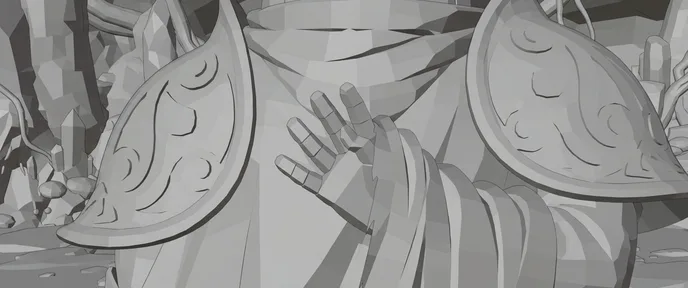
  2. Close-up of an armored chest under a cream cloak, a gloved hand, a spark of light
    Storyboard frame of the chest close-up, in grey
    02

    Close-up · the chest

    Close-up on Lantern's chest, his gloved hand pressed to the cloak, a spark of light escaping between the fingers

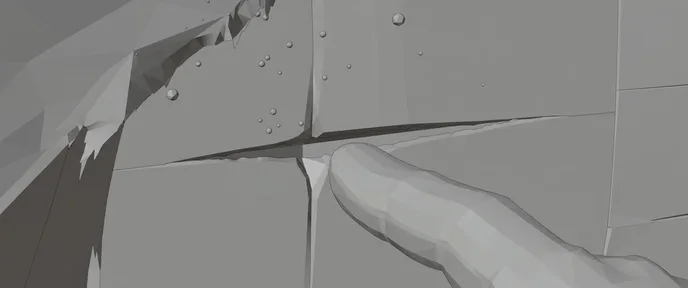
  3. A torn gash in an armor plate leaking bright blue light, a finger pointing at it
    Storyboard frame of the wound insert, in grey
    03

    Insert · the wound

    Extreme close-up, Serrure's finger near a torn gash in the back plate, blue light leaking out like luminous smoke

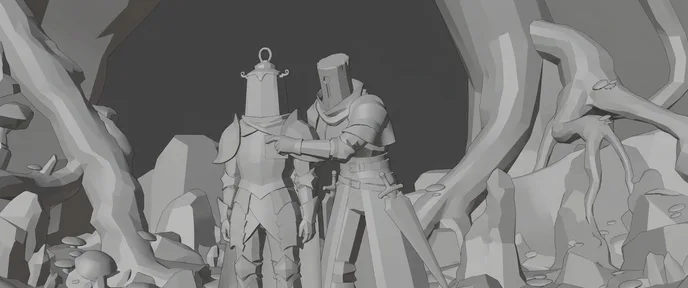
  4. Two armored knights side by side, one with a hand on the other's shoulder, in a crystal cavern
    Storyboard frame of the two-shot, in grey
    04

    Two-shot · the bond

    Medium two-shot among crystals and roots, Serrure's hand on Lantern's shoulder, faceless armors, emotion through posture only

  5. Two small knights walk beneath two giant glowing blue mushrooms
    Storyboard frame of the wide shot, in grey
    05

    Wide · the scale

    Wide low angle, the two knights tiny beneath two giant glowing mushrooms, blue crystals in the foreground, mist

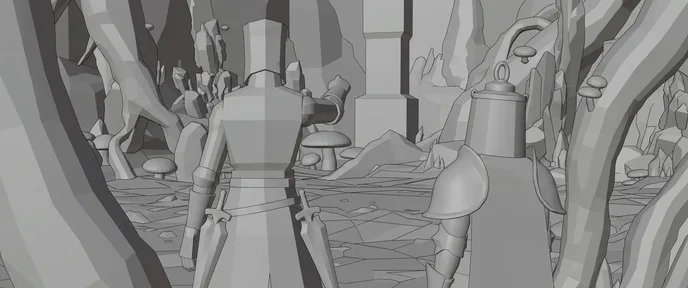
  6. Seen from behind, a tall dark knight points ahead while the small lantern knight looks on
    Storyboard frame of the over-the-shoulder shot, in grey
    06

    Over the shoulder · the road

    Over-the-shoulder from behind, Serrure points ahead into the cavern, Lantern beside him, roots framing the path

Lost Garden, episode 2 runs 21 minutes. Three episodes of this length would reach 63 minutes, but KVIFF's rules speak of feature-length films and say nothing about episodes: ask the festival before cutting a series as a film. The series' first episode was an AI London Festival finalist. Hit play to start from this sequence.

The script

A 65 minute feature in five movements.

Aim above the line: 65 minutes, about 65 screenplay pages and 650 to 780 shots of 5 to 6 seconds. A cut that loses three minutes in the edit still clears 60.
  1. 0:00 to 5:00

    The first world

    Place, tone and a person. A selection committee sees many features, so the first five minutes must hold.

  2. 5:00 to 18:00

    The want

    What the person wants and why it is hard. Reveal the rules of the world through action, not lecture.

  3. 18:00 to 44:00

    The long middle

    Twenty-six minutes, where most AI features lose their shape. Vary place, light and pace, and give every sequence its own question.

  4. 44:00 to 58:00

    The reckoning

    The choice and its price. Let one scene breathe without dialogue.

  5. 58:00 to 65:00

    The aftermath

    A last movement that changes the meaning of the first. Then the credits.

The preview screener goes in its original version: no subtitles if the film is in Czech or English, English or Czech subtitles for any other language. Selected non-English films also deliver English subtitles.

Month by month

From now to a feature.

Nothing is announced for the 61st edition. The 60th call closed on 31 March, so a spring 2027 deadline is likely. The film must be completed within 12 months of the festival's start, which for July 2027 means no earlier than July 2026.
  1. 01

    October 2026

    Read the 60th rules

    Read the three pages once and mark articles III.3 to III.8. Open a log of tools, versions and tasks for the film.

  2. 02

    November 2026

    A screenplay of sixty pages

    Write the feature, or the arc of a mini-series, free in ScreenWeaver. Decide now whether it is one film or episodes cut together.

  3. 03

    December 2026

    Locked references, then storyboard

    Lock one reference for each character and place. Generate the shot breakdown and the storyboard, then adjust each shot by hand.

  4. 04

    January to March 2027

    Generate in sequences

    Generate sequence after sequence with Seedance in ScreenWeaver once video generation reaches your plan. Review each sequence before the next. Keep every prompt.

  5. 05

    March 2027

    A rough cut for the late window

    The rules let you flag a screener as a work in progress. If the early windows have passed, a cut of at least 60 minutes can enter at the late fee, if the 61st call follows the 60th.

  6. 06

    April to June 2027

    Finish for the screener

    The online screener must stay valid, with the same password, until about 10 June. Finish edit, sound and subtitles, and keep the link alive.

Ways to lose a slot

Eight ways to be out before anyone watches.

Everything below sits in three pages of rules. A short film is out before anyone watches it.
  • A film under 60 minutes

    The festival does not accept short and medium-length films, up to 60 minutes. A polished 13 minute pilot has no entry here.

  • A premiere already spent

    A world premiere is required to be considered. Article II.1 lets the competitions take international premieres too, so ask the festival if your film has screened once elsewhere.

  • Released more than a year earlier

    No release anywhere, whether festival, DVD, television or internet, more than 12 months before the festival. A film left on YouTube is released.

  • Competing elsewhere first

    A Crystal Globe film must not have taken part in another international competition before Karlovy Vary. Non-competitive festivals do not count against it.

  • A promotional, educational or scientific film

    Films that are solely one of the three are not eligible. A brand film made with AI belongs elsewhere.

  • A screener that stops working

    Online screeners only, valid with the same password until 10 June in 2026. A dead link or a wrong password can mean disqualification with no refund.

  • The wrong language version

    Send the original version: no subtitles for Czech or English, English or Czech subtitles for any other language. Say whether the screener is final or a work in progress.

  • Sending the same cut again

    A film submitted in an earlier year can enter again only if it has changed significantly. The festival may refuse it without a refund.

Why ScreenWeaver

A clear shape: one feature, made in a year.

Karlovy Vary imposes no tool and no AI quota. It asks for a feature, a premiere and a film made within twelve months. ScreenWeaver is one connected project for that scale: screenplay, storyboard and footage side by side.
  • Sixty minutes is a continuity problem

    A feature runs to 600 shots or more. Characters, locations and references carry from shot to shot, so the last reel looks like the first.

  • A series that can become a feature

    One project holds episodes and the feature cut. Writing episodes first lets you test the world before you commit 60 minutes.

  • A traceable year of work

    Every shot keeps its link to its scene, its storyboard frame and its prompt. If the festival asks how a long film was made, the project answers.

  • Free to start this week

    The Screenwriter plan is $0 with no end date. Storyboard Beta costs $9.99 a month, and Seedance video generation follows with the Filmmaker plan.

Real productions

International festival-recognized films have been written and produced with ScreenWeaver.

ScreenWeaver is already being used as a creative workspace for real AI film productions, from cinematic shorts to animated series pilots selected, nominated, and awarded by international festivals.

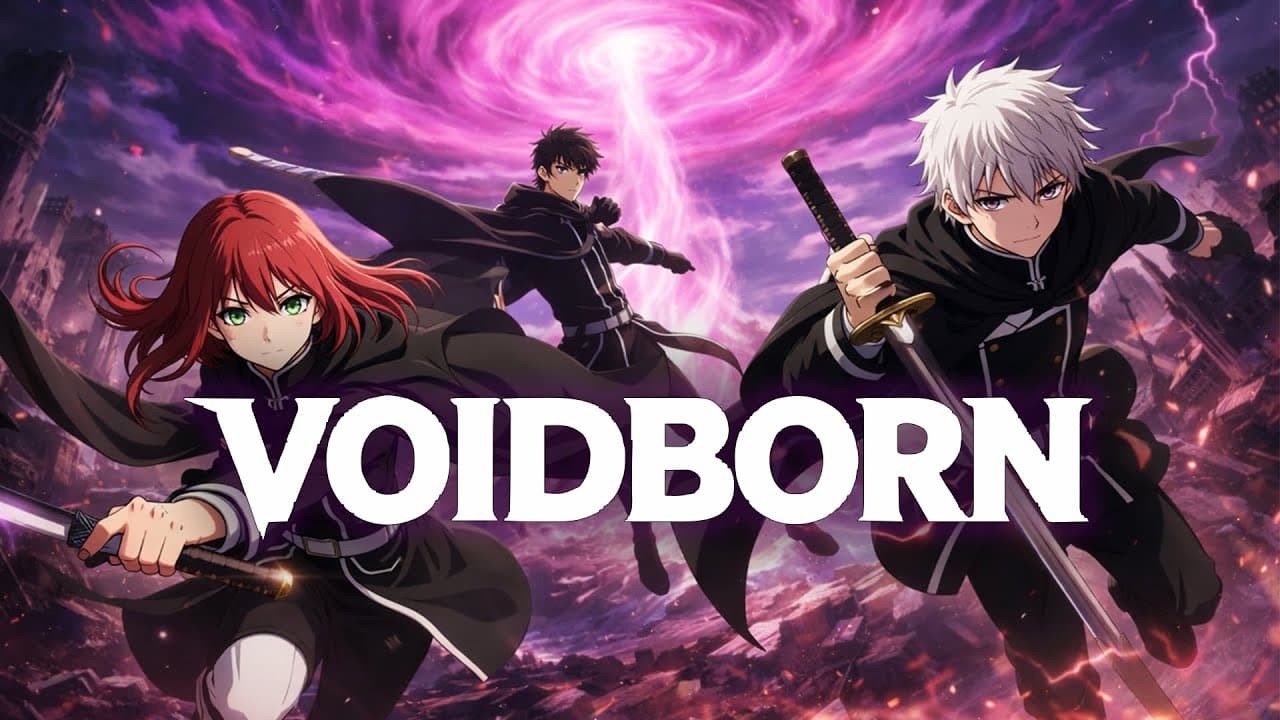
  • Video thumbnail for VOIDBORN

    VOIDBORN

    AI animated / cinematic short

    Festival recognition

    • 1st Place Silver

      Mondial Chroma Awards

    • 2nd Place Dreamina

      Mondial Chroma Awards

    • Award Winner

      Seoul International AI Film Festival

  • Video thumbnail for Les Fils du Vinnana

    Les Fils du Vinnana

    AI short film

    Festival recognition

    • Honorable Mention

      Top Quark Film Festival

    • People's Choice Nominee

      Illuminate Oneness of Humanity

    • Nominee

      ALTFF Supershort

  • Video thumbnail for Lost Garden

    Lost Garden

    AI animated series pilot

    Festival recognition

    • Finalist

      AI London Festival

The pipeline

Write. Board. Produce.

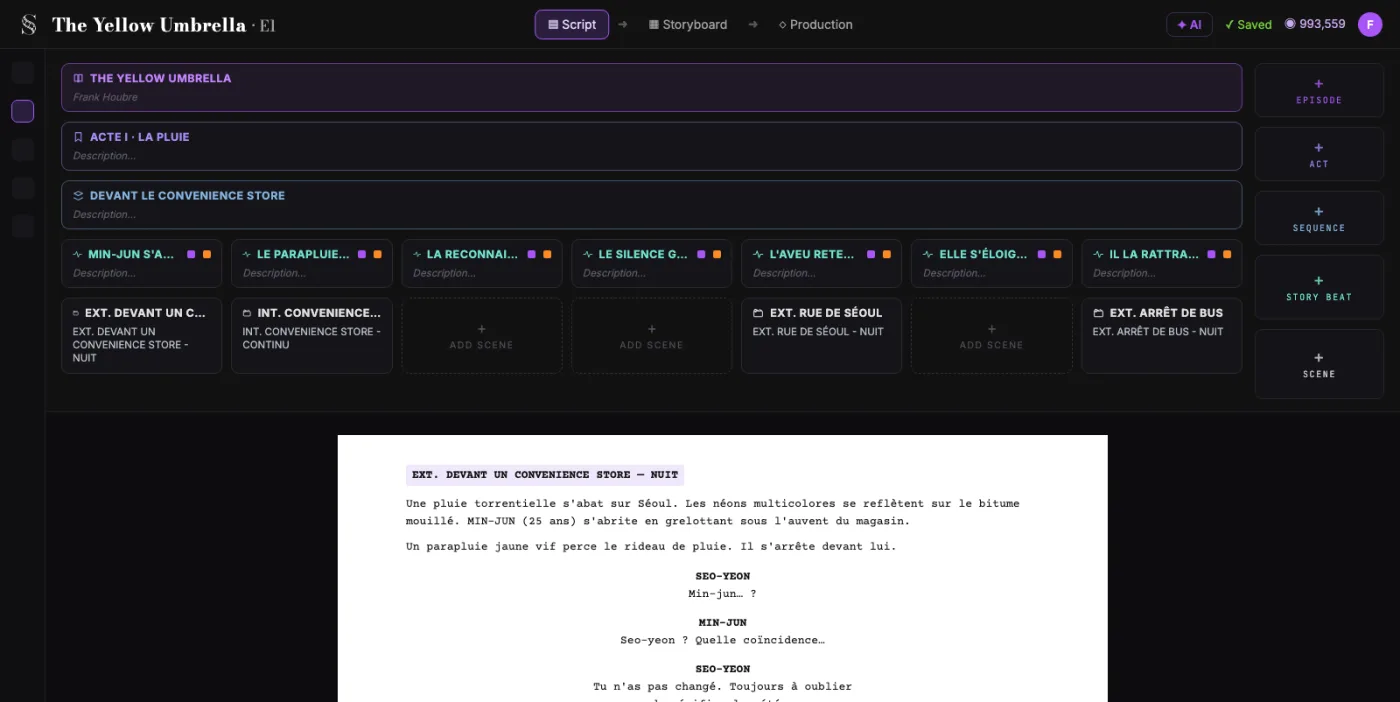
  1. ScreenWeaver screenplay editor: acts, sequences and beats above the formatted script of The Yellow Umbrella

    01The screenplay, enriched

    An industry-standard screenplay editor, and more: a visual outline and beat editor, your writing inspirations (notes, photos, audio) kept next to the page, and an AI researcher to support your writing, not replace it.

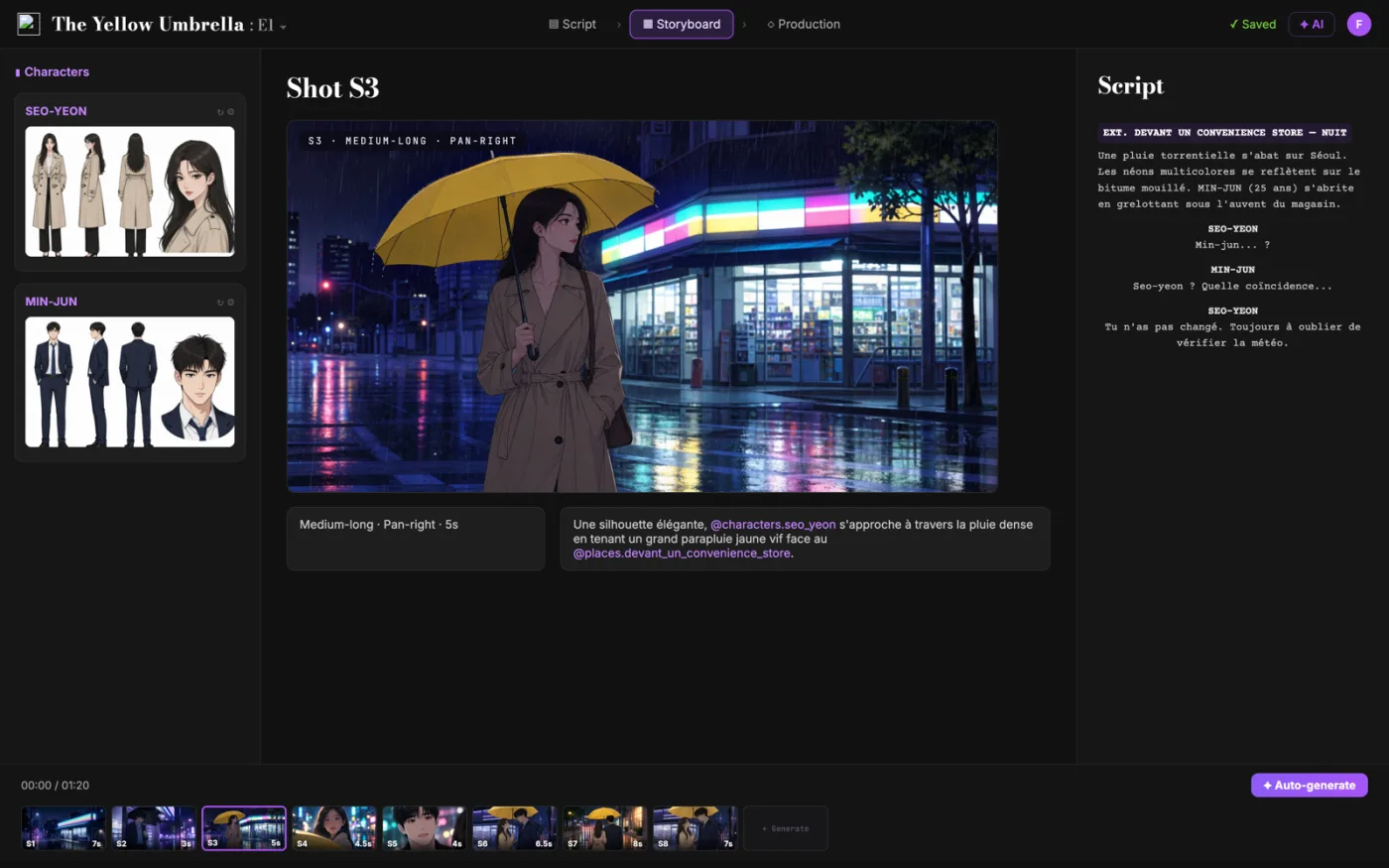
  2. ScreenWeaver storyboard: shot S3 of The Yellow Umbrella with characters, shot settings and the script beside it

    02The storyboard, made easy

    Shot breakdown generated from your screenplay, manual control over every shot (frame, angle, movement, duration), and generative AI previsualization in one click.

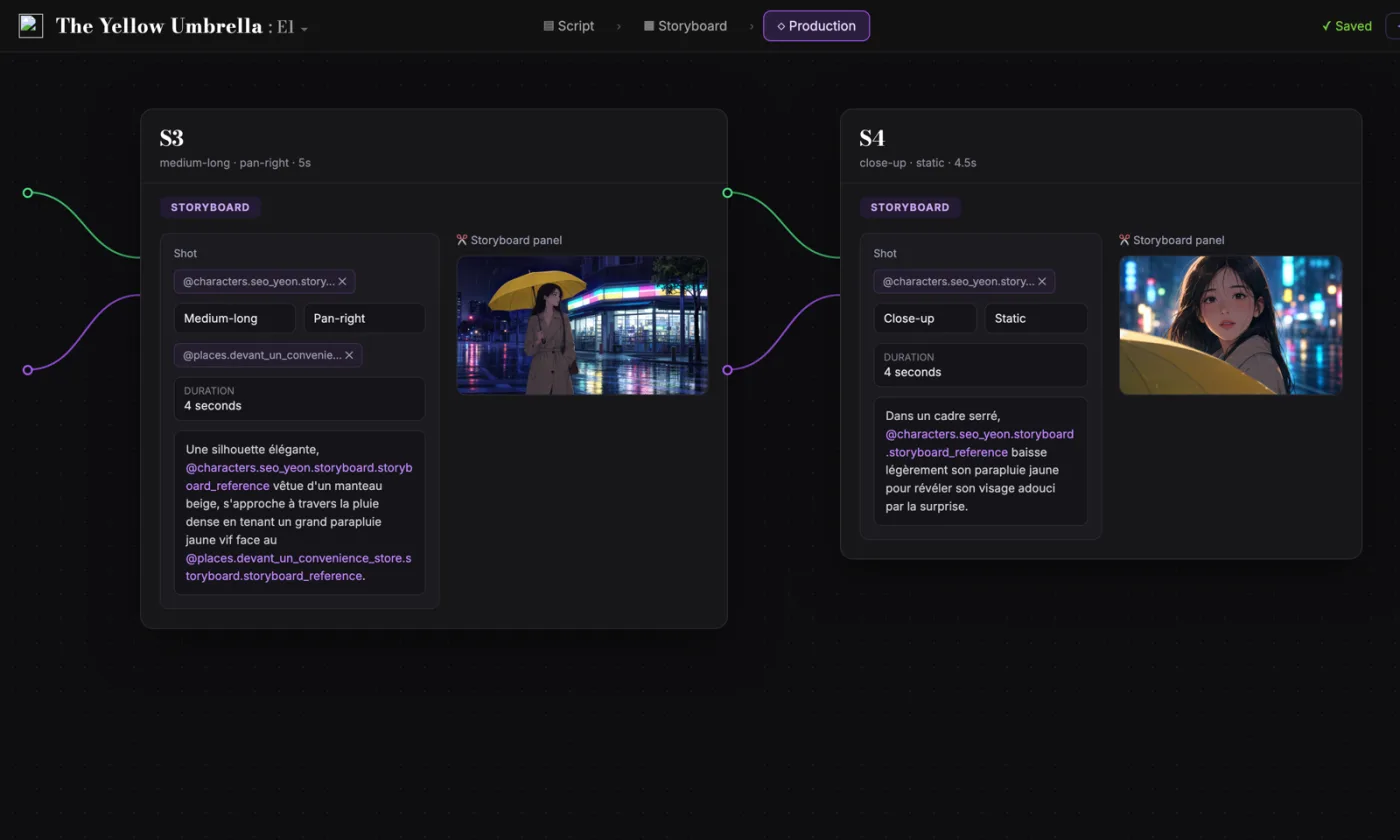
  3. ScreenWeaver production canvas: shots S3 and S4 as connected nodes carrying their storyboard panels and prompts

    03AI production, with finesse

    Footage generation pipelines connected to your screenplay and storyboard. Optimized out of the box, fully editable workflow.

FAQ

Karlovy Vary and AI films, your questions

Can you submit an AI film to Karlovy Vary?
Yes, if it is a feature of at least 60 minutes. The 60th edition's rules contain no clause on AI, no ban and no disclosure rule. Short and medium-length films are not accepted, AI or not.
Does Karlovy Vary ask for AI disclosure?
Not in the rules we read. The entry form itself sits behind the submission system. Say how the film was made in your notes: an honest line beats a surprise at a festival that discusses AI openly.
Has the 61st call been announced?
Not announced. The 60th call ran until 31 March 2026, and KVIFF says the 61st edition takes place from 2 to 10 July 2027, so a similar calendar is likely.
What does it cost?
In the 60th cycle, €60 early bird, €80 regular and €100 late, per film. The 61st edition's fees are not published.
Do I need a world premiere?
To be considered, yes: Article III.4 asks for a world premiere. The Crystal Globe and Proxima competitions say world or international premieres, so ask the festival about a film that has screened once before.
Can a series be cut into a feature?
The rules speak only of feature-length films of at least 60 minutes and say nothing about episodes. Write to festival@kviff.com before you cut a series as a film.
Does Karlovy Vary work with AI at all?
Yes, in its programme. The 2026 Industry Days included a block on building stories in the age of AI and a hands-on AI tools workshop. That is separate from selection, which follows the rules above.
Who picks the films and the winners?
A Selection Committee of experts advising the Artistic Director. Two international juries then award the Crystal Globe and Proxima prizes. The festival owes no feedback on films it rejects.

A feature starts on page one.

Begin the screenplay free today, then storyboard it and generate it sequence by sequence with Seedance.