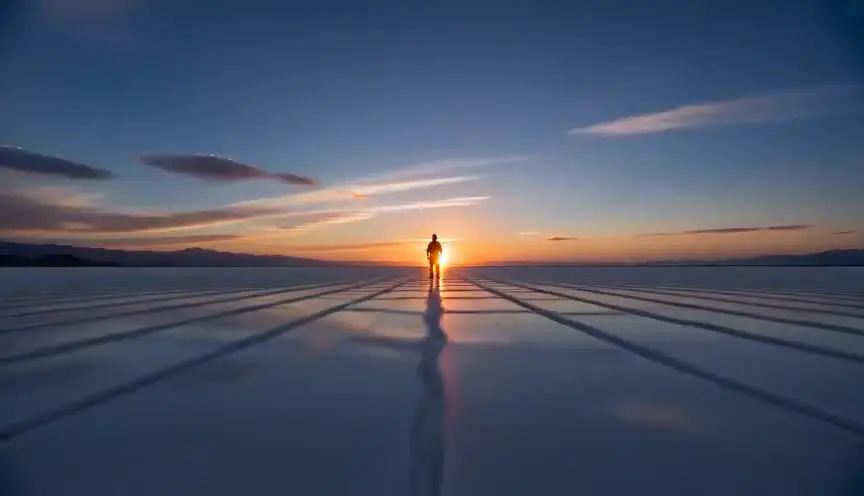
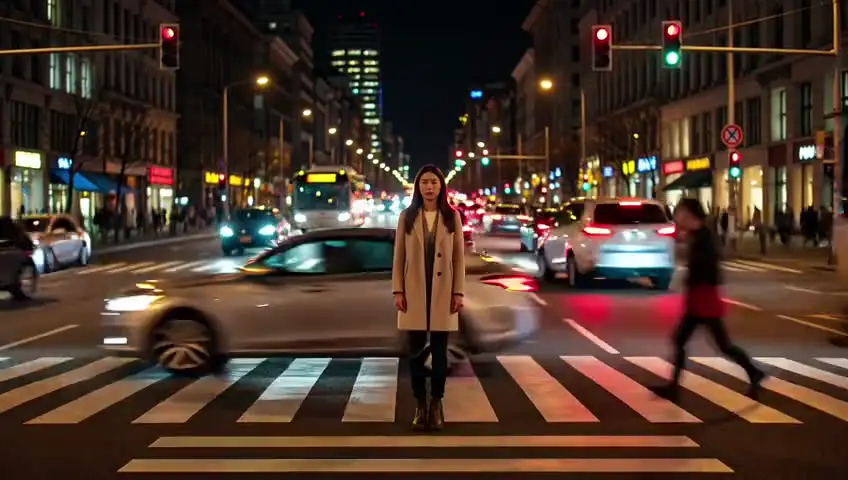
Slit-scanLight stretched into a tunnel
Slit-scan builds an image by exposing it through a narrow moving slit, so shapes and lights stretch into long streaks that rush toward or past the viewer. The audience feels speed, transition and the passage through something beyond ordinary space or time.
Also calledStar gate effectStretch printingSlit-scan photography
Optical effects
Why it works on screen
Use it when a character crosses a threshold that normal images cannot show. Slit-scan suits journeys through wormholes, time jumps, drug trips, memories flooding back, or the moment someone enters a digital world. It serves transcendence, disorientation, awe and the pure sensation of velocity. It also works in title sequences, where it carries the audience into the story's world. A scene earns it when the crossing is a turning point and the audience should feel dragged through it. Used as a quick transition between ordinary scenes, it feels like a leftover from a science fiction trailer.
The shot list line
- Size
- Wide shot or abstract full frame
- Angle
- Eye level, looking straight ahead
- Movement
- Push forward into the tunnel of light
- Lens
- Wide, or a virtual camera in 3D
- Duration
- 4 to 10 s
Decide early whether the effect is built with a physical rig, an animation pass or a digital process, and match the colors to the scenes on either side.
Screenplay
On the page
Do not write "slit-scan" in a spec script. Describe the passage in sensory terms: the lights of the harbor stretch into lines, the world pours past her, a tunnel of color opens ahead. That gives the director the emotional target without prescribing a method. Keep it to one or two lines, since long effect descriptions slow reading. The rig, the rendering method, the timing and the color design are for the shot list and the effects team.
INT. SUBWAY CAR, NEW YORK - 3 A.M.
MARISOL VEGA (19, headphones, a bakery uniform under her coat) is the only passenger.
The train enters the tunnel and does not stop accelerating.
The lights outside the windows stretch into long bands of gold and blue, pulling away from her into a single point.
Her reflection in the glass stays perfectly still.
Then darkness, and a station she has never seen.
Storyboard
In the storyboard
Draw a one-point perspective frame with long converging lines radiating from a bright center, shaded in the planned colors. Place any sharp element, such as the character or their reflection, in solid line in the foreground. Add a forward arrow for the push and a note on speed, for example accelerating, then holding. Label the entry and exit panels on each side, so the effect sits clearly between two scenes.
Pairs well with
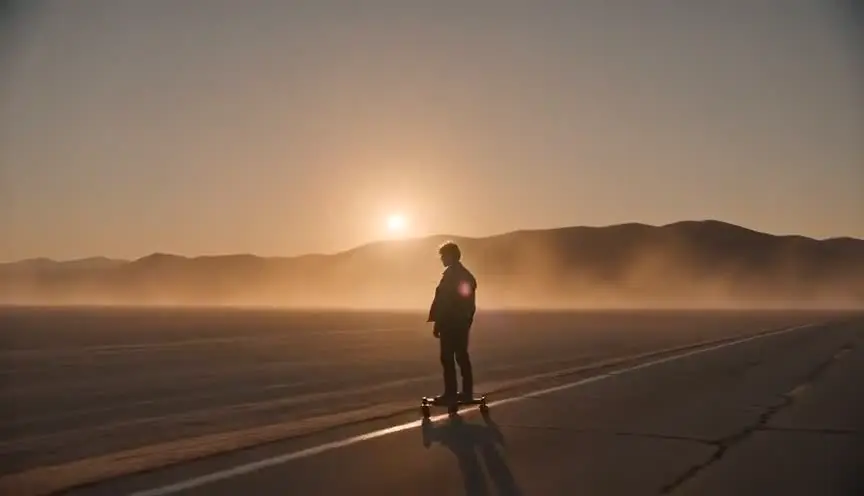
A slow dolly in on the character before the effect prepares the forward pull. The audience is already moving toward the threshold when the world stretches into streaks.
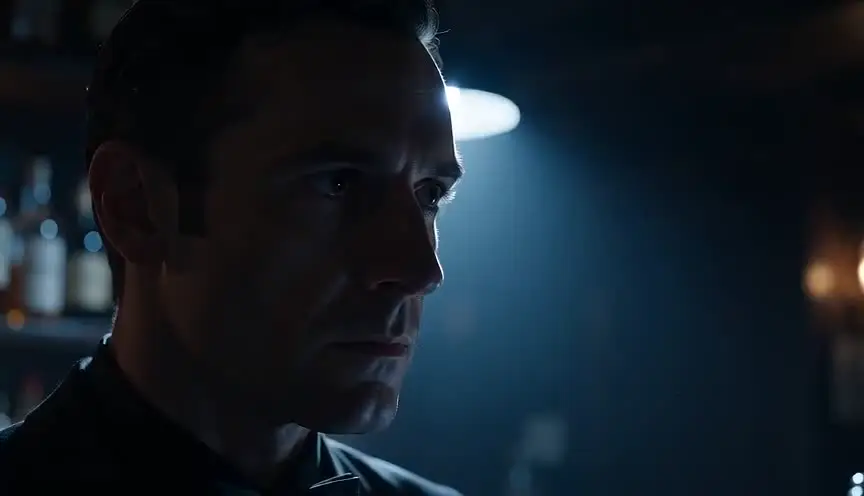
A smash cut out of the slit-scan into a quiet, static shot of the new place ends the rush abruptly, making the arrival feel as sudden as the journey was overwhelming.
Reference
Watch it in
2001: A Space Odyssey (1968)
For the Stargate, Douglas Trumbull's slit-scan machine transforms flat colored artwork into rushing corridors of light around the astronaut.
Superman (1978)
The opening credits streak through space as stretched lines of light, a use of the same method that 2001 made famous.
Star Trek: The Motion Picture (1979)
When the ship enters the wormhole, slit-scan photography pulls the space around it into streaks of color flying outward.
ScreenWeaver
Set it up in ScreenWeaver
Describe the passage in your screenplay in sensory terms, and ScreenWeaver breaks the scene into shots automatically. Open the transition shot, set a wide framing at eye level, choose a forward push as the movement and give it four to ten seconds, then note the slit-scan look in the shot description. Characters and references carry from shot to shot, so the character before and after the passage stays consistent. Use the AI previsualization to time the entry and the exit.
Start writing for freeThe prompt behind this clip
This is the exact prompt that rendered the clip at the top of the page. Keep the description of the camera and the light, change the subject and the place.
Slit-scan effect: the camera pushes straight toward a fishing harbor at dawn as the lanterns on moored boats and the reflections on the wet dock elongate into long radiating streaks of amber and blue light, stretching into a bright tunnel that narrows toward the horizon. The boats themselves stay sharp and still while every light source smears into thin converging lines that pulse outward past the lens. The motion accelerates smoothly, the tunnel of streaked light widening as the camera speeds forward, then holds steady in the final second. No text.
Common mistakes
- 01
No anchor
A full screen of streaks with nothing to hold on to becomes a screensaver. Keep a character, a reflection or a vehicle stable in the frame as a reference.
- 02
Too long
The rush loses its force if it lasts too long. Most slit-scan passages work best under ten seconds, unless the whole sequence is built as an experience.
- 03
Colors that clash
Streaks in random colors can break the palette of the film. Design them to match the world on either side of the transition.