DuplicationOne actor, several people in frame
A duplication shot puts the same actor in the frame two or more times, as twins, clones or versions of one person. The audience accepts the copies as separate people and reads the scene through the differences between them.
Also calledClone shotMultiplicity effectSelf-duplicationTwinning shot
Optical effects
Why it works on screen
The technique serves stories about identity. Twins who share a face but not a fate, a character split by a choice, a lonely person who meets their own past self, a comedy of clones that gets worse with every copy. It turns inner conflict into a conversation the audience can watch. A scene earns it when the copies need to talk, touch or compete in the same space, because a simple shot-reverse-shot could fake that. The payoff comes from performance: each version needs its own posture, rhythm and wants, or the effect is only a trick. Keep the story's question clear, which one is the real one.
The shot list line
- Size
- Medium or full shot, wide enough to hold every copy
- Angle
- Eye level, fixed for every pass
- Movement
- Locked off, or a repeatable motion-control move
- Lens
- 35mm prime, same focus distance for each pass
- Duration
- 5 to 10 s
Shoot a clean plate first, then one pass per copy with a stand-in giving eyelines, and never touch the camera, lights or lens between passes.
Screenplay
On the page
The screenplay should state the story fact, not the method. If a character has a twin or a clone, introduce them as separate people with their own names and descriptions, and let the reader forget one actor plays both. Write their interaction as ordinary action and dialogue. Mention that the same actor plays both only in a casting note if it matters to the concept. Split lines, plates, doubles and motion control belong in the shot list and the VFX breakdown.
INT. AMPONSAH TAILORING - ACCRA - NIGHT
ESI AMPONSAH (30s, measuring tape around her neck) finishes a hem alone at the sewing machine.
A second ESI steps out of the fitting room in the same kente dress, hands on hips.
A third ESI sits on the cutting table, eating groundnuts from a paper cone.
SECOND ESI
You promised the client Friday. Which one of us is sewing?
The first Esi keeps her foot on the pedal and does not look up.
Storyboard
In the storyboard
Draw the full frame with every copy in place and a dotted split line where the plates will join, placed across empty space rather than a body. Number each copy (A, B, C) and write which pass records it. Mark eyelines with small arrows between the copies. Add a note for the clean plate and for any overlap, such as a hand passing an object, which will need a double or a digital face.
Pairs well with
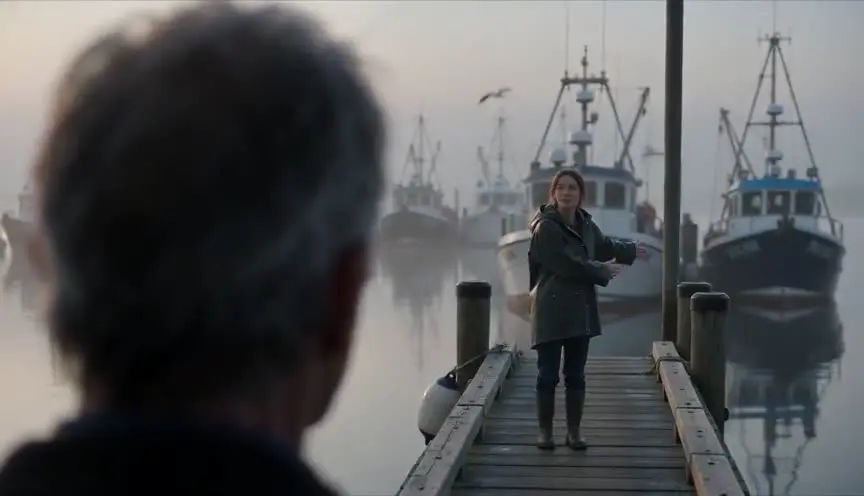
An over-the-shoulder with a body double in the foreground, cut after the wide duplication shot, lets the copies argue in close coverage without a composite on every angle.

Starting on a two-shot where both copies are visible proves the effect once. Later coverage can then cut freely, because the audience already believes the two people share the room.
Reference
Watch it in
Multiplicity (1996)
A whole comedy grows from one actor copied several times over, each clone a little dimmer than the last, all crowding the same rooms.
Adaptation (2002)
One actor plays twin screenwriters sharing a room again and again, sold by locked frames and carefully matched lighting between passes.
The Social Network (2010)
Face replacement and compositing let one actor play both Winklevoss brothers standing side by side in the same shots.
ScreenWeaver
Set it up in ScreenWeaver
Write the copies as separate characters in your screenplay, and ScreenWeaver breaks the scene down into shots automatically. Create one character reference and reuse it for every copy, then give each a distinct costume or prop note so they stay readable. In the storyboard, set the wide shot to a static movement at eye level with a framing that holds everyone, and choose a duration that fits the exchange. Check the blocking and eyelines in the AI previsualization.
Start writing for freeThe prompt behind this clip
This is the exact prompt that rendered the clip at the top of the page. Keep the description of the camera and the light, change the subject and the place.
Duplication shot in a car repair garage: a static locked-off camera on a tripod frames a mechanic in gray overalls standing at a workbench on the left, tightening a bolt on an engine part, while an identical copy of the same mechanic stands at the open car hood on the right, wiping his hands with a rag. Both figures share the same fluorescent overhead light and concrete floor, moving independently but never touching or overlapping. The camera does not pan, tilt or zoom for the full four seconds. No text.
Common mistakes
- 01
Moving the camera between passes
A tiny shift in the tripod or a focus pull breaks the join between plates. Lock the camera, mark the floor and the lights, and use motion control if the shot needs to move.
- 02
Copies that overlap the split
When an arm crosses the dividing line, the composite fails or needs expensive rotoscoping. Block the actors so each copy stays in its own zone, unless you planned a double for that moment.
- 03
Identical performances
If every copy moves and speaks the same way, the audience stops believing they are different people. Give each version a posture, a tempo and a costume detail of its own.