Deep focusThe whole story in one frame
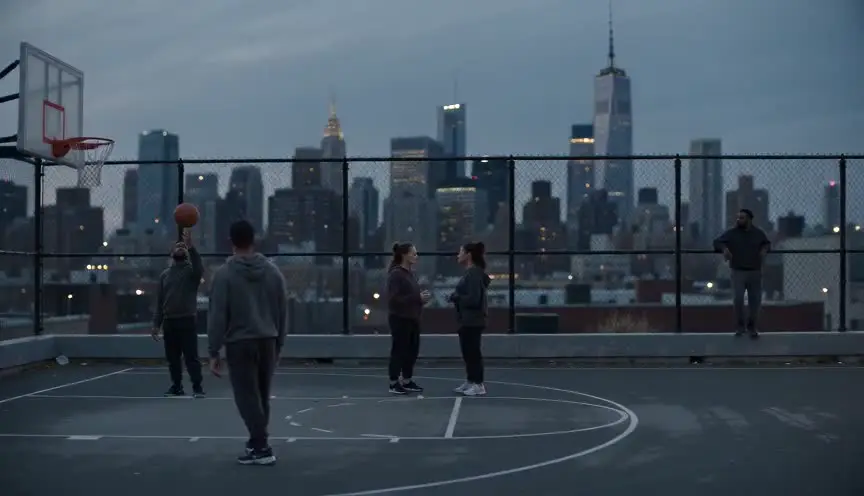
Deep focus keeps the foreground, the middle ground and the background all sharp at once, so several actions can play in a single shot. The audience chooses where to look, and the relationship between near and far becomes the drama.
Also calledDeep depth of fieldEverything-in-focus shot
Optical effects
Why it works on screen
Use it when the story lives in the distance between people. Deep focus can show a child playing outside the window while the adults decide his future, a worker at a desk while the boss watches from the far office, a friend at a piano while two others make a choice in the background. It serves power, irony, tension and social observation. A scene earns it when two or more actions at different depths need to be seen together, without cutting, so their connection stays alive. When the scene is one person's private feeling, the extra information can dilute it.
The shot list line
- Size
- Wide shot or medium wide shot
- Angle
- Eye level or slightly low
- Movement
- Static
- Lens
- 18mm to 28mm, aperture f/8 to f/16
- Duration
- 6 to 15 s
Light every layer strongly enough for a small aperture, and block the actors so each plane stays readable without covering the others.
Screenplay
On the page
Do not write "deep focus" in a spec script. Stage the scene in depth through your action lines instead: say what is close, what is in the middle and what is far, and let things happen at each layer at the same time. That staging is a writer's tool, and a director will see the shot. The lens, the aperture, the lighting level and the exact positions of each actor are decisions for the shot list and the floor plan.
INT. FARMHOUSE KITCHEN, IOWA - DAY
In the foreground, a letter from the bank lies open on the table.
At the sink, RUTH HALVORSEN (50s, work gloves tucked in her belt) scrubs a pot, not looking at it.
Through the window beyond her, her son EZRA (12) drives the old tractor in careful circles across the yard, proud.
Ruth watches him. Then the letter. Then him again.
RUTH
One more lap, then chores.
Storyboard
In the storyboard
Draw the frame with three clear layers: a large object or face in the foreground, a character in the middle and an action far in the background, all in firm lines with the same level of detail. Add a small overhead diagram showing camera position and each actor's distance. Mark the eye path with a dotted line if the audience should look from one layer to the next, and note the aperture and focal length under the panel.
Pairs well with
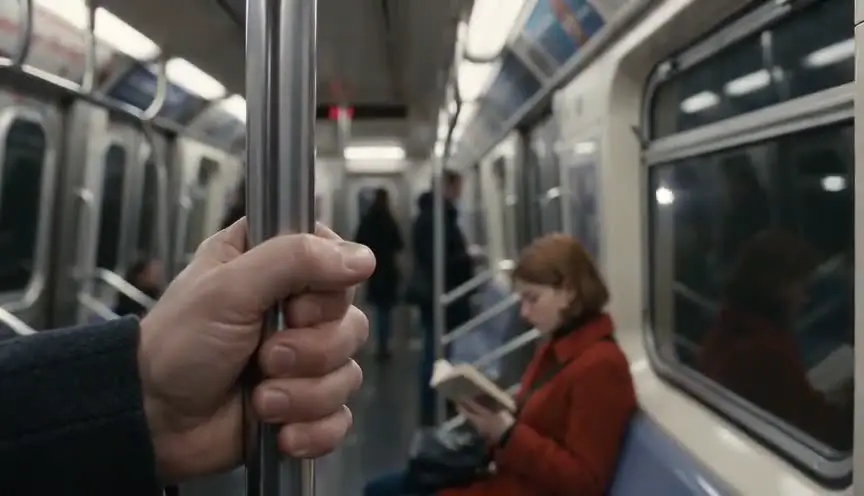
Layered composition places meaningful elements in foreground, middle ground and background. Deep focus keeps all of them sharp, so the audience can read the whole arrangement as one statement.
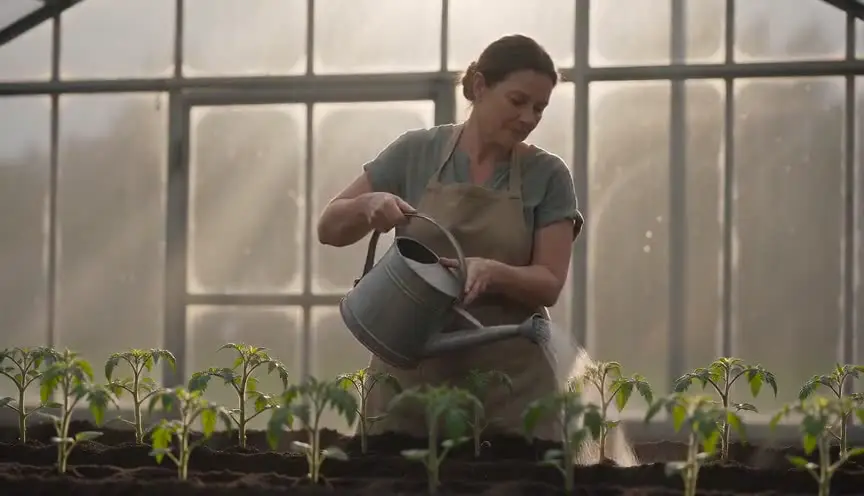
A static camera gives the audience time to look around a deep frame and notice what happens at each distance, rather than being pulled along by camera movement.
Reference
Watch it in
Citizen Kane (1941)
Gregg Toland's camera holds an object near the lens, an actor in the middle and another far back all sharp, letting scenes play across depth.
The Best Years of Our Lives (1946)
In the bar, Homer plays piano up front while Fred makes a painful phone call in the far booth, both sharp, so the audience watches two stories at once.
ScreenWeaver
Set it up in ScreenWeaver
Describe what happens at each distance in your screenplay's action lines, and ScreenWeaver breaks the scene into shots automatically. Open the deep shot, set a wide framing at eye level, a static movement and a duration long enough for the audience to explore, six to fifteen seconds. Characters and locations carry from shot to shot, so each person stays recognizable in the depth of the frame. Use the AI previsualization to check that every layer reads before you plan the lighting.
Start writing for freeThe prompt behind this clip
This is the exact prompt that rendered the clip at the top of the page. Keep the description of the camera and the light, change the subject and the place.
Deep focus shot on an Icelandic black sand beach at midday, camera locked on a tripod at knee height. In the foreground, wet volcanic rocks sit sharp just centimeters from the lens; in the midground, a woman in a dark wool coat walks slowly along the shoreline, fully in focus; in the background, jagged sea cliffs and crashing waves remain crisp all the way to the horizon. Flat, bright overcast light with no haze. Nothing blurs at any distance, the whole frame stays evenly sharp for the full four seconds, only the woman and the waves move. No text.
Common mistakes
- 01
Not enough light
Small apertures need a lot of light. Without it, the image turns noisy or the focus plane collapses. Plan lighting for f/8 or smaller from the start.
- 02
Nothing happens in depth
A sharp background is useless if nothing meaningful happens there. Stage each layer with a purpose so the audience knows why they can see it.
- 03
Competing actions
If every layer is equally busy, the eye does not know where to go. Use light, movement and sound to guide attention across the frame.