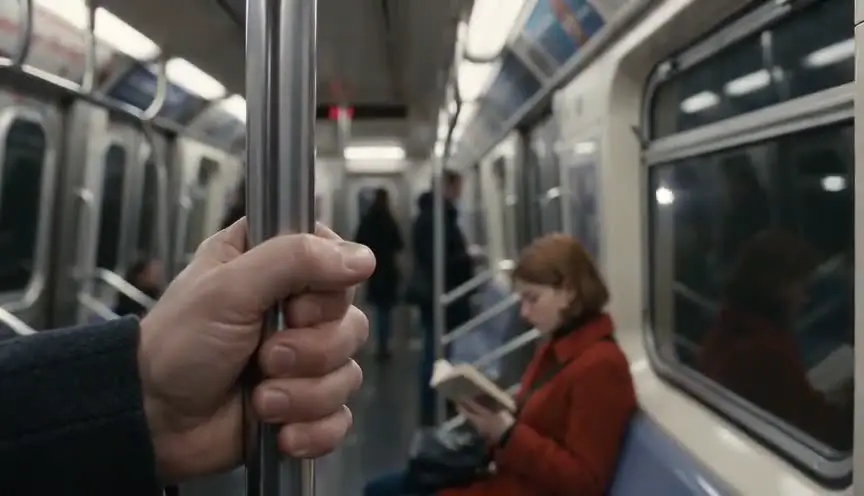
Leading linesGuide the eye to the story
Leading lines are roads, rails, walls, fences or shadows that run through the frame and point toward the subject. The audience follows them without thinking and arrives exactly where the director wants them to look.
Also calledConvergent linesVanishing linesGuiding lines
Composition
Why it works on screen
Lines give a shot direction, and direction gives it purpose. A road that narrows toward a small figure says journey. Rails that converge behind a runner say pursuit or destiny. A corridor that pulls the eye toward a closed door says threat. Use leading lines when the story needs the audience to see a goal, a danger or a destination at the far end of the frame. They serve departures, chases, approaches and the slow walk toward something the character fears. A scene earns them when the geography itself tells us where the story is going.
The shot list line
- Size
- Wide shot
- Angle
- Low, close to the rails
- Movement
- Static or slow push along the lines
- Lens
- 24mm or 28mm
- Duration
- 4 to 6 s
Place the camera so the lines start in the frame corners and converge on the subject or the point they walk toward.
Screenplay
On the page
Do not write "leading lines" in a screenplay. Choose locations that contain them and describe those locations plainly: a straight railway, a pier running out to sea, a long fence, a hallway lined with doors. When the action happens along those lines, a director will find the angle. If a character walks toward or away from something, write the destination, since the eye will need a point to reach. Specific angles and lenses belong in the shot list.
EXT. RAILWAY LINE - OUTSIDE NAKURU - MORNING
Two steel rails run dead straight to the horizon, shimmering in the heat.
OKELLO WANJIKU (11, school shorts, bare feet) balances on one rail, arms out.
Far ahead, where the rails meet, a speck. A train, or maybe not.
He keeps walking toward it.
His sister AMANI (15) shouts from the embankment behind him. He does not turn.
Storyboard
In the storyboard
Rule the lines first with a straightedge, starting from the corners or edges of the panel and meeting at a vanishing point. Place the subject on or near those lines, and mark the point they lead to with a small cross. If the camera or the subject moves along the lines, draw an arrow in perspective. Note the lens, the camera height and what waits at the end of the lines, since the shot depends on it.
Pairs well with
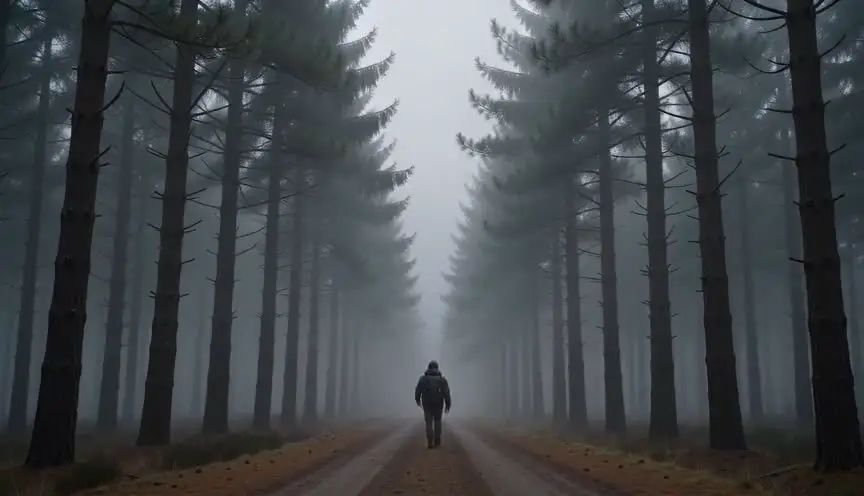
Leading lines often resolve into one-point perspective. Move from an angled view to a centered one along the same corridor to make the destination feel suddenly inevitable.

Cut from a character looking down a road to their point of view along it. The lines now come from their eyes, so the audience shares the goal or the dread.
Reference
Watch it in
The Shining (1980)
The patterned carpet and corridor walls draw the eye down the hallway, so fear builds before anyone rounds the corner.
1917 (2019)
Trenches, roads and broken walls stretch away from the camera and guide the eye forward as the soldiers push through the ground.
ScreenWeaver
Set it up in ScreenWeaver
Set the scene in a place with strong lines and describe it in the action, and ScreenWeaver breaks it down into shots automatically. Open the shot, set a wide framing with a low angle close to the lines, choose a static movement or a slow push along them, and a duration that lets the eye travel. The location carries from shot to shot, so the lines stay consistent across coverage. Check in the AI previsualization that they point where you intend.
Start writing for freeThe prompt behind this clip
This is the exact prompt that rendered the clip at the top of the page. Keep the description of the camera and the light, change the subject and the place.
Leading lines: a wide shot of an Icelandic black sand beach at dawn, where two parallel rows of wet volcanic rock form a straight path from the bottom left corner of the frame toward the center horizon. A lone woman in a dark green coat walks along the path, away from camera, growing smaller as she nears the point where the rocks converge against pale gray sky and distant sea stacks. The camera stays locked off on a tripod, 24mm lens, level horizon, soft overcast light, no camera movement, only her steady walking motion carries the shot forward. No text.
Common mistakes
- 01
Lines that lead nowhere
Converging lines with nothing at their end make the audience search for a subject that is not there. Put a person, a door or a light where the lines meet.
- 02
Lines leading out of frame
Diagonals that run toward a corner pull the eye off the image. Unless you want that sense of escape, keep lines pointing inward to the subject.
- 03
Too many competing lines
A frame full of rails, wires and fences in every direction becomes noise. Choose one strong set of lines and simplify the rest with angle, lens or light.