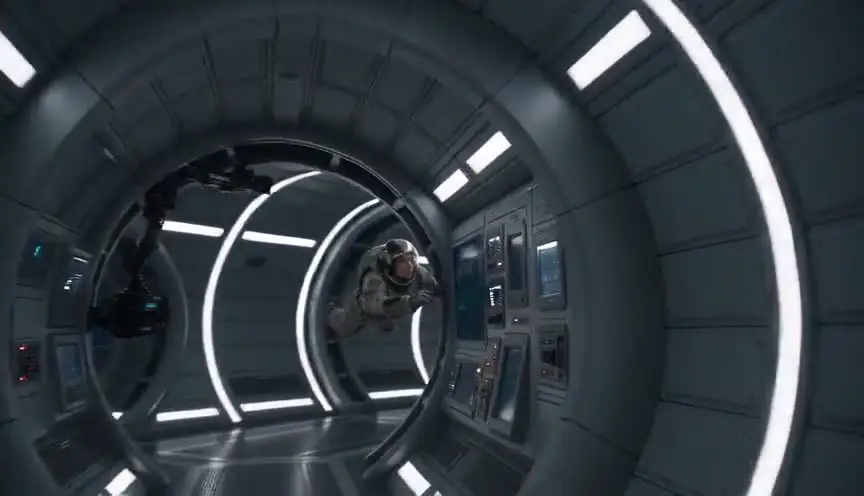
Pedestal shotRising through a scene, eyes level
A pedestal shot raises or lowers the whole camera straight up or down while it keeps looking level, without tilting. The audience glides between floors, heights or layers of a scene as if riding a quiet elevator.
Also calledPed upPed downVertical dolly move
Camera movement
Why it works on screen
The pedestal is about levels that coexist. It can travel from a child's height to an adult's, from the ground floor of a house to the attic, from a table top to the faces above it. Because the angle never changes, the move feels calm and orderly, almost diagrammatic, like reading a cross-section. It serves reveals of hidden layers, gentle transitions from detail to face, and stylized, dollhouse-like worlds. A scene earns it when stacking matters: who lives above whom, what sits under the table, how the story is organized floor by floor.
The shot list line
- Size
- Medium shot, held constant
- Angle
- Eye level to the subject at each height, no tilt
- Movement
- Pedestal up or down on a studio pedestal, jib or crane
- Lens
- 32mm to 50mm prime
- Duration
- 4 to 10 s
Keep the tilt locked at zero through the whole move, and mark each level where the camera must pause or pass a subject.
Screenplay
On the page
A spec script should not say "ped up". Describe the space in vertical layers instead: what is on the floor, what is on the table, who stands above it, or what happens on each floor of a building. That order suggests a vertical move without prescribing it. Keep it for scenes where levels carry meaning. If you direct, list the start height, the end height and the timing in the shot list, since the grip needs all three.
INT. PARISH HALL, KIBERA, NAIROBI - SUNDAY MORNING
Under the front pew, a pair of small bare feet swings. Sandals kicked off.
They belong to AMANI (6), lying on the floor, humming along.
Above him, on the pew, his mother WANJIRU (30s, choir robe) pretends not to notice.
Above her, on the risers, the choir hits the chorus, forty voices, arms up.
Amani hums louder.
Storyboard
In the storyboard
Draw a tall vertical panel showing the full stack of the scene, then draw the frame rectangle at the start height and again at the end height. Draw a straight vertical arrow between them, labeled PED UP or PED DOWN, and write NO TILT beside it. Note the height of each stop in centimeters or feet, the subject at each level, and the duration.
Pairs well with

Start on an insert of an object at floor or table level, then pedestal up to the person it belongs to. The vertical move links the detail to its owner without a cut.

A pedestal shot on a symmetrical set keeps the frame balanced as it rises, which makes each floor feel like a panel in a cutaway. The two together give a stylized, storybook order.
Reference
Watch it in
Rope (1948)
For the long unbroken takes, Hitchcock's crew built a rig that rose and sank between the actors while walls and furniture slid out of the way.
The Life Aquatic with Steve Zissou (2004)
The tour of the ship moves straight up and down through a cutaway set, showing one deck above another like an architect's drawing.
Moonrise Kingdom (2012)
At the start, the camera glides level between floors of the family house, discovering rooms and children as if inside a dollhouse.
ScreenWeaver
Set it up in ScreenWeaver
Write the scene layer by layer in your screenplay, and ScreenWeaver breaks it down into shots automatically. Open the shot, set the framing to medium, keep the angle at eye level, choose a pedestal up or down as the movement and give it a duration that lets each level register. Characters and the location carry from shot to shot, so the rooms and people on each level stay consistent. Review the rise in the AI previsualization before you finalize the shot list.
Start writing for freeThe prompt behind this clip
This is the exact prompt that rendered the clip at the top of the page. Keep the description of the camera and the light, change the subject and the place.
Pedestal shot. The camera rises straight up vertically, without tilting, like an elevator, beside a tall bookshelf in an old library: it starts at floor level on the lowest shelf of leather books and climbs smoothly up the shelves until it reaches a woman on a wooden ladder at the top, reading. The camera angle stays perfectly level the whole time. Warm lamp light, realistic. No text.
Common mistakes
- 01
Tilting by accident
If the camera tilts even slightly during the move, the calm diagram effect turns into a crane shot. Lock the tilt and check the horizon on a monitor at both ends.
- 02
Nothing on the way
A pedestal that passes only blank wall between two subjects feels empty. Stage something at every level, or shorten the move so it links the two subjects directly.
- 03
Confusing it with a tilt
A tilt changes the angle, a pedestal changes the height. Writing the wrong one in the shot list gives you the wrong shot. Name it precisely and draw a straight arrow.