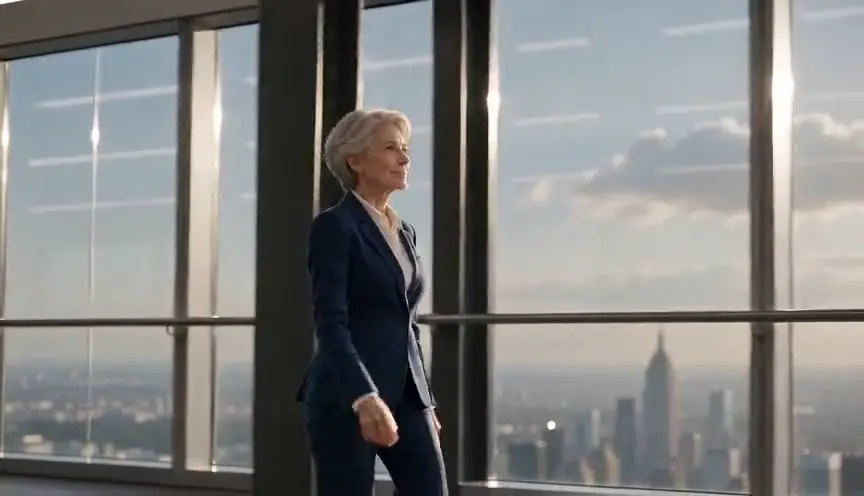
Parallax shotLayers that make space breathe
A parallax shot moves the camera past several layers of depth, so near objects slide quickly while distant ones barely move. The audience feels the volume of a place, as if they were travelling inside it rather than looking at a picture.
Also calledParallax panDepth trucking shotMulti-plane shot
Camera movement
Why it works on screen
Parallax serves immersion and discovery. Moving past trees toward a hidden clearing, sliding along market stalls toward a face in the crowd, drifting over rooftops toward one lit window: the layers pull the audience into the world before the scene begins. It serves wonder, stealth, longing and the sense of a watcher among things. In animation it turns flat artwork into a place. A scene earns it when the space itself matters, when the story wants the audience to cross a threshold, or when a character is being observed from behind cover and the foreground becomes the hiding place.
The shot list line
- Size
- Wide shot
- Angle
- Eye level
- Movement
- Lateral truck past foreground trunks toward the subject
- Lens
- 35mm to 50mm
- Duration
- 6 to 8 s
Dress at least three depth layers on the camera path and keep the subject in the background layer sharp, so the eye has a destination as the foreground slides past.
Screenplay
On the page
Parallax is a camera and design choice, so it has no name in a spec script. What the writer controls is the layering of the world. Write the foreground, middle and background as the audience would pass through them: branches, a fence, a figure beyond. Two or three concrete layers in an action line give the director and the designer the material. In animation scripts, a short note on layered depth is acceptable when the page is also a production document.
EXT. PINE FOREST - LAPLAND - LATE AFTERNOON
Snow-heavy trunks, one after another, dark against the low sun.
Between them, a wire fence sags under ice.
Beyond the fence, in a white clearing, AILA LUKKARI (12) kneels beside a reindeer calf tangled in the wire, working the knot with bare fingers.
She freezes. Somewhere behind the trees, a snowmobile engine idles.
Storyboard
In the storyboard
Draw the frame as three stacked layers: a foreground band very close to the lens, a middle band, and the subject in the distance. Add arrows of different lengths above each layer, long for the foreground, short for the background, to show their relative speeds. Draw start and end panels with the foreground objects in different positions. Note the camera direction, the distance travelled and the duration.
Pairs well with

Parallax depends on something close to the lens. Planning a strong foreground element, a branch, a railing, a curtain, gives the move its depth and can also hide the subject until the right moment.
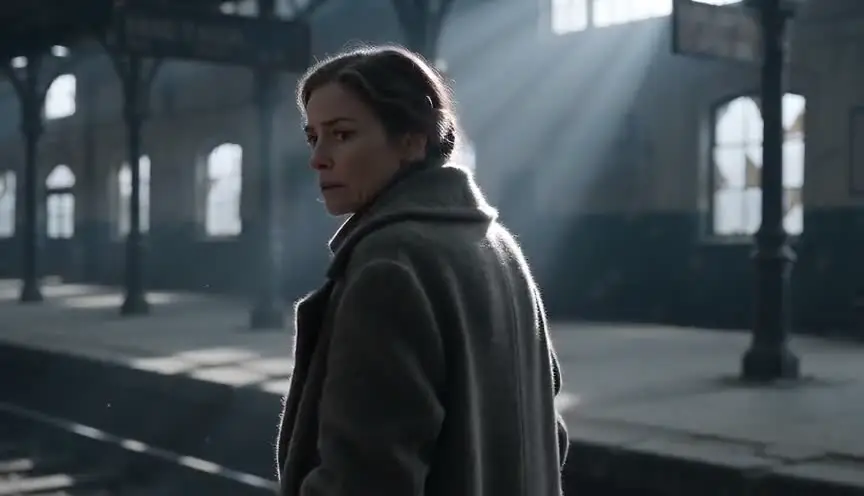
After the parallax brings the audience through the layers, a medium close-up on the subject delivers the scene. The journey through space ends on a person and their emotion.
Reference
Watch it in
The Old Mill (1937)
Disney's multiplane camera glides past stacked painted layers of reeds, birds and the old building, so near elements slide faster than the distant ones.
Pinocchio (1940)
The opening travels across a painted village of roofs, streets and windows, each layer shifting at its own rate as it approaches Geppetto's house.
Bambi (1942)
The film opens by drifting into a forest built from layers of trunks, leaves and mist, giving painted woods a deep, living volume.
ScreenWeaver
Set it up in ScreenWeaver
Describe the layers of the place in your action lines, near, middle and far, and ScreenWeaver breaks the scene down into shots automatically. Open the establishing move, set a wide framing at eye level, choose a lateral truck or a push forward, and give it six to eight seconds. The location and its references carry from shot to shot, so the forest or the street stays consistent when you cut closer. Check the depth in the AI previsualization.
Start writing for freeThe prompt behind this clip
This is the exact prompt that rendered the clip at the top of the page. Keep the description of the camera and the light, change the subject and the place.
Parallax shot: inside a laundromat at night, the camera trucks smoothly left to right on a slider at a steady pace. In the foreground, a row of spinning washing machines close to the lens streaks past quickly, coin slots and dials briefly catching the light. In the midground, a woman in her 50s folds towels at a counter, drifting past at a moderate speed. In the deep background, a wall of dryers and a flickering neon open sign glide by slowly. Cool fluorescent light overhead, warm neon glow from the sign, damp linoleum floor reflecting both. No text.
Common mistakes
- 01
Nothing in the foreground
A move across an open space with no near objects shows almost no parallax. Place or find something close to the camera, even out of focus, to make the depth visible.
- 02
Foreground too busy
If near objects fill the frame, the subject disappears and the move becomes a blur. Leave gaps between layers so the destination stays readable throughout the shot.
- 03
Moving straight toward the subject
A push directly along the lens axis creates little sideways shift. Parallax is strongest with lateral or diagonal movement, so angle the path across the layers.