Earth zoomFrom the planet to one person
An earth zoom dives from a view of the whole planet through clouds, countries and city blocks down to a single street, roof or face. The audience travels from the largest possible scale to one life, and learns that this small place is where the story lives.
Also calledSatellite zoomPlanet zoomOrbital diveMap zoom
Camera movement
Why it works on screen
Use it to locate a story with a sense of scale or irony. It can open a film by saying: of all the people on earth, this one. It can mock the self-importance of spies and generals, or place a tiny act of kindness against the size of the world. In reverse, pulling out from a face to the planet, it can end a story on smallness or connection. It serves wonder, fate, surveillance and satire. A scene earns it when the idea of scale matters to the theme, not just the geography, and when the landing point is a character we will care about.
The shot list line
- Size
- Extreme wide shot descending to a medium shot
- Angle
- Overhead, bird's eye view, tilting to a high angle at the end
- Movement
- Continuous vertical descent from orbit to the subject
- Lens
- Virtual camera, wide field of view narrowing near the ground
- Duration
- 6 to 12 s
Plan the handoff between satellite imagery, aerial footage and the live-action plate, and match the light and time of day at every transition.
Screenplay
On the page
Keep camera language out, but you can write the journey as images, because the scale is the idea. A short sequence of places, from the planet to the country, the city, the street, one roof, reads clearly and tells the director what the opening wants. Keep it to three or four lines. The exact path, the speed and whether it is built from satellite imagery, 3D or drone footage stay in the shot list and the effects breakdown.
EXT. SPACE - NIGHT
The Earth turns, half in darkness. East Africa glitters with scattered lights.
The lights of Nairobi. A tangle of highways. A rooftop in Kibera, corrugated iron under a sagging water tank.
EXT. ROOFTOP - KIBERA - CONTINUOUS
WANJIRU MWANGI (11) aims a flashlight at the sky, clicking it on and off in patient bursts.
WANJIRU
Three short. Three long. Three short. Answer me.
Storyboard
In the storyboard
Draw a vertical strip of five or six small panels: the planet, the region, the city, the neighborhood, the roof, the character. Keep a small target circle at the center of every panel so the landing point stays aligned. Mark the altitude beside each panel and the time it takes to reach the next. Indicate with a note where each source of imagery hands off to the next.
Pairs well with
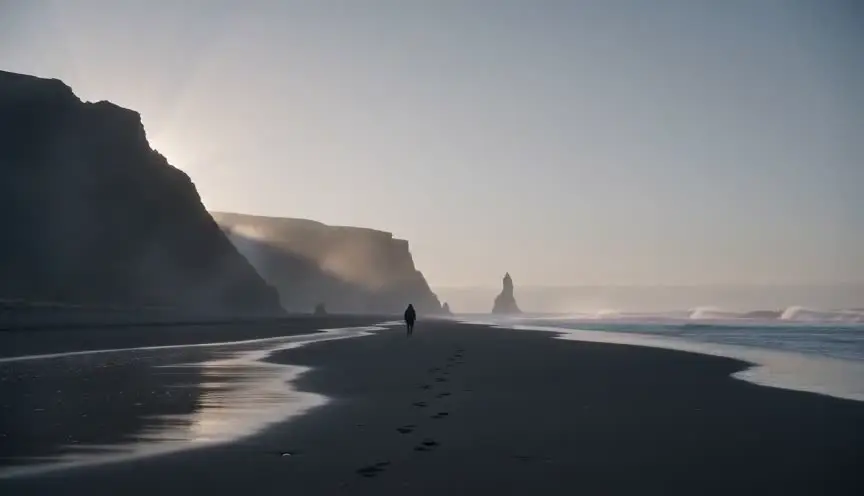
Once the dive lands, a conventional establishing shot at human height fixes the location in detail. The earth zoom gives scale, and the establishing shot gives texture.
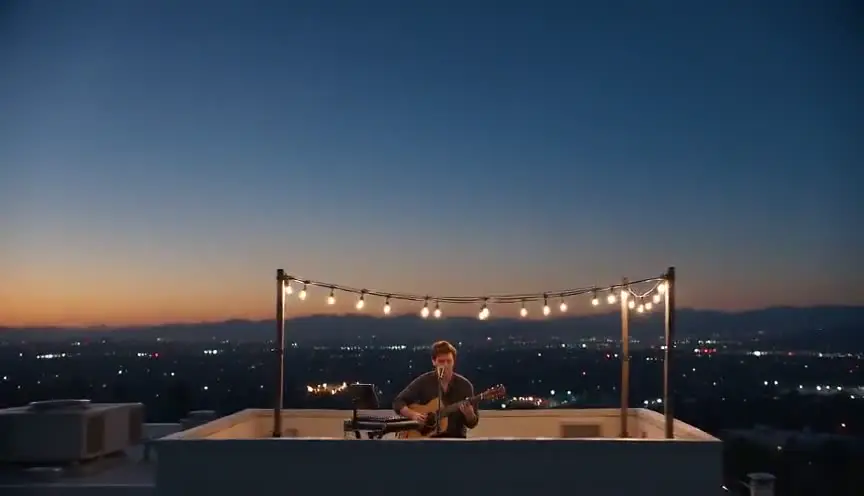
An aerial pullback at the end of a film mirrors an opening earth zoom. The story begins by diving into one life and closes by returning that life to the size of the world.
Reference
Watch it in
Burn After Reading (2008)
The film opens high above the planet and plunges toward CIA headquarters in Virginia, poking fun at the grand surveillance views of spy thrillers.
Powers of Ten (1977)
Having climbed to the scale of galaxies, the short film reverses and falls back to a couple's picnic in Chicago, the model for every later version.
ScreenWeaver
Set it up in ScreenWeaver
Write the journey as a short sequence of places in your opening, and ScreenWeaver breaks it down into shots automatically. Open the descent, set an extreme wide framing with an overhead angle, choose a downward movement, and give it six to twelve seconds. The location and the character carry from shot to shot, so the roof you land on matches the scene that follows. Use the AI previsualization to time the dive against the first line of dialogue.
Start writing for freeThe prompt behind this clip
This is the exact prompt that rendered the clip at the top of the page. Keep the description of the camera and the light, change the subject and the place.
Earth zoom: one continuous shot beginning from high orbit, showing the curved edge of the planet against black space with thin white clouds drifting below. The camera dives straight down through the cloud layer, accelerating smoothly, atmosphere thickening into gray storm haze, until it breaks through into a coastal seascape at dusk. It keeps descending without a cut, revealing crashing waves and rain, and settles on a stone lighthouse on a rocky cliff, its beam sweeping through the storm, ending in a static wide framing. No text.
Common mistakes
- 01
Landing on nothing
A dive that ends on an empty street wastes the promise of scale. Land on a character in the middle of an action, so the audience knows why this place was chosen.
- 02
Wrong geography
Audiences recognize coastlines, rivers and cities. Check that the path from orbit crosses real, consistent geography, or invent a clearly fictional world. A wrong river bend or a misplaced coast breaks the spell for anyone who knows the place.
- 03
Too slow in the middle
The flight over clouds and suburbs can drag. Accelerate through the middle altitudes and slow down only near the ground, where detail appears. The descent should feel like a dive, not a commute.