Bird's-eye viewSee the whole board at once
A bird's-eye view looks straight down on a scene from high above, so people become small shapes on a flat plane. The audience stops living the moment and starts reading it, like a map, a pattern or a verdict.
Also calledTop shotTop-down shotGod's eye viewOverhead wide shot
Camera angles
Why it works on screen
The straight-down view removes the horizon, and with it the character's point of view. What is left is geography and fate. Use it when the story wants distance: after a violent act, when a search spreads across a field, when a character is lost in a maze of streets, or when a crowd forms a pattern no single person can see. It serves detachment, judgment, scale, isolation and design. A scene earns it at a turning point that should be seen whole, when the audience needs to understand the layout, or when the film steps back to look at what its characters have done.
The shot list line
- Size
- Wide shot to extreme wide shot
- Angle
- Bird's-eye view, 90 degrees straight down
- Movement
- Static, or a slow drift or rotation
- Lens
- 18mm to 35mm
- Duration
- 4 to 8 s
Point the lens straight down, not at a slant, and square the frame to the strongest lines on the ground, like rows, tiles or road markings.
Screenplay
On the page
You rarely write "bird's-eye view" in a spec script. When the layout is the story, describe the arrangement from above in plain terms: volunteers in a long line across a field, two cars in an empty parking lot, a figure lying in the middle of a painted court. The reader forms the image and the director sees the shot. Some writers use "from above" once at a key moment, which is acceptable. The height, the rig and any drone permits go in the shot list.
EXT. CORNFIELD, SOUTHERN NEBRASKA - LATE AFTERNOON
Forty volunteers stand in a single line, arm's length apart, across a field of dry stalks that goes on for miles.
A sheriff's whistle. The line moves forward as one.
At the far end, one figure stops. DARLENE KOWALSKI (50s), the missing boy's aunt.
The line keeps going without her. The gap grows.
She kneels and picks up a small red sneaker.
Storyboard
In the storyboard
Draw the scene as a flat map: no horizon, no sky, shapes seen from the top. Show people as heads and shoulders, with cast shadows to give scale. Use the patterns on the ground, rows, lines, tiles, to organize the panel. Add a side diagram with the camera directly overhead and the height noted. If the camera drifts or rotates, draw a curved arrow around the frame. Note the rig (drone, crane, rooftop) and the beat.
Pairs well with
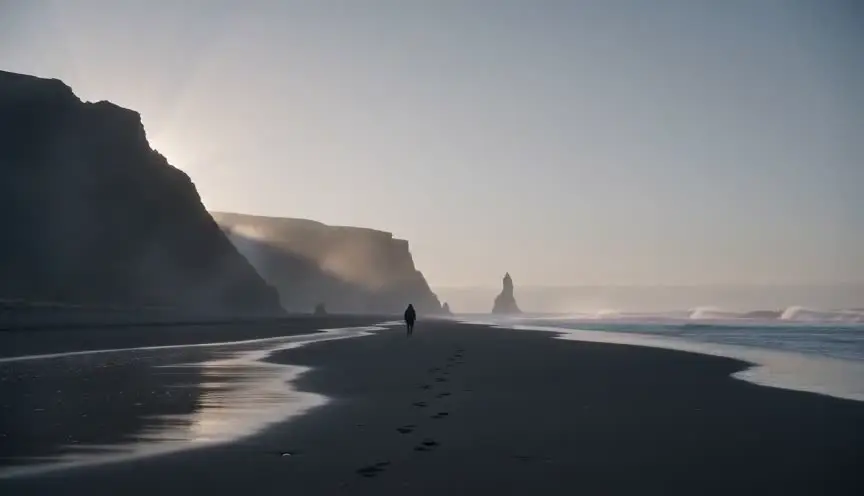
A bird's-eye view can open a sequence as a pure layout, before an establishing shot at a slant brings in the horizon and the mood. The pair moves the audience from map to place.
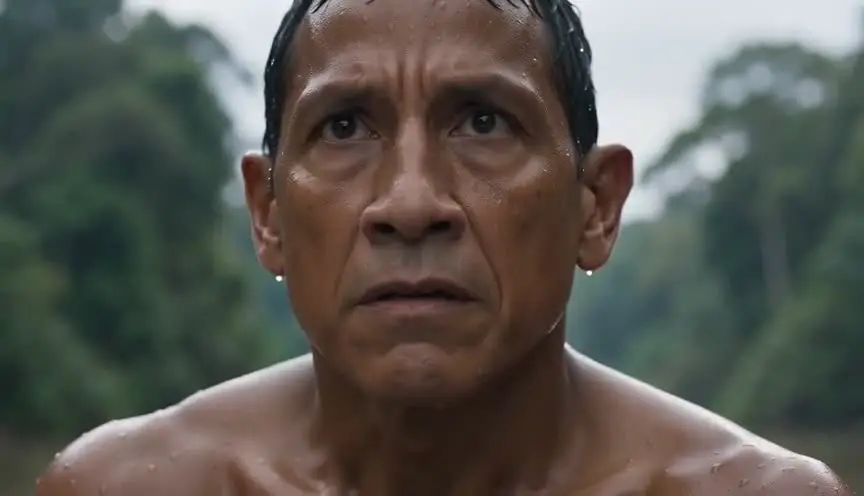
Drop from the top shot into a close-up on one face. The cut from detached geometry to a single human reaction turns the pattern back into a person and lands the emotion.
Reference
Watch it in
42nd Street (1933)
Busby Berkeley's camera looks straight down on rows of dancers, who fold and open into kaleidoscope shapes, a trademark of his musical numbers.
Psycho (1960)
Hitchcock jumps high above the landing as Arbogast is attacked, keeping us at a distance and hiding who the killer is.
Taxi Driver (1976)
After the shootout, Scorsese's camera looks down and glides across the bloody rooms, cold and judging, like an observer above the scene.
ScreenWeaver
Set it up in ScreenWeaver
Describe the layout of the scene in the action lines, and ScreenWeaver breaks it down into shots automatically. Open the shot you want seen from above, set the framing to a wide or extreme wide shot, choose the bird's-eye angle looking straight down, keep the movement static or a slow drift, and give it four to eight seconds. The characters and the location carry from the ground-level shots. Use the AI previsualization to check that the pattern reads clearly.
Start writing for freeThe prompt behind this clip
This is the exact prompt that rendered the clip at the top of the page. Keep the description of the camera and the light, change the subject and the place.
Bird's-eye view: the camera looks straight down from high above a Venetian canal at midday. Gondolas and small boats glide along the green water between terracotta rooftops, tiny people cross a stone bridge, the whole scene laid out like a map. The camera slowly rises higher while staying perfectly vertical. Realistic, sunny, sharp detail. No text.
Common mistakes
- 01
A slant instead of straight down
A camera tilted at 60 degrees is a high angle, not a bird's-eye view. The flat, map-like effect only comes when the lens looks straight down. Check with a level on the camera.
- 02
Nothing to read from above
Without patterns, lines or clear shapes, a top shot is a blur of rooftops or grass. Stage the action so it forms a readable arrangement on the ground.
- 03
Losing the characters
From very high, the audience cannot tell who is who. Use costume color, a distinct prop or movement against the crowd to single out the character that matters.