CSFCCA AI Film Festival · Taipei · Guide

How to win the CSFCCA AI Film Festival.Quarterly seasons. One Golden Mars.

A Taipei festival with two juries, awards for AI screenwriters and character designers, and an annual Golden Mars Grand Prize. The Fall 2026 call closed on 30 September. Here is what the official pages say, and how to be ready for the next season.
  • Next season: dates not announced
  • Dual jury: film masters and industry
  • Awards for screenwriting and character design
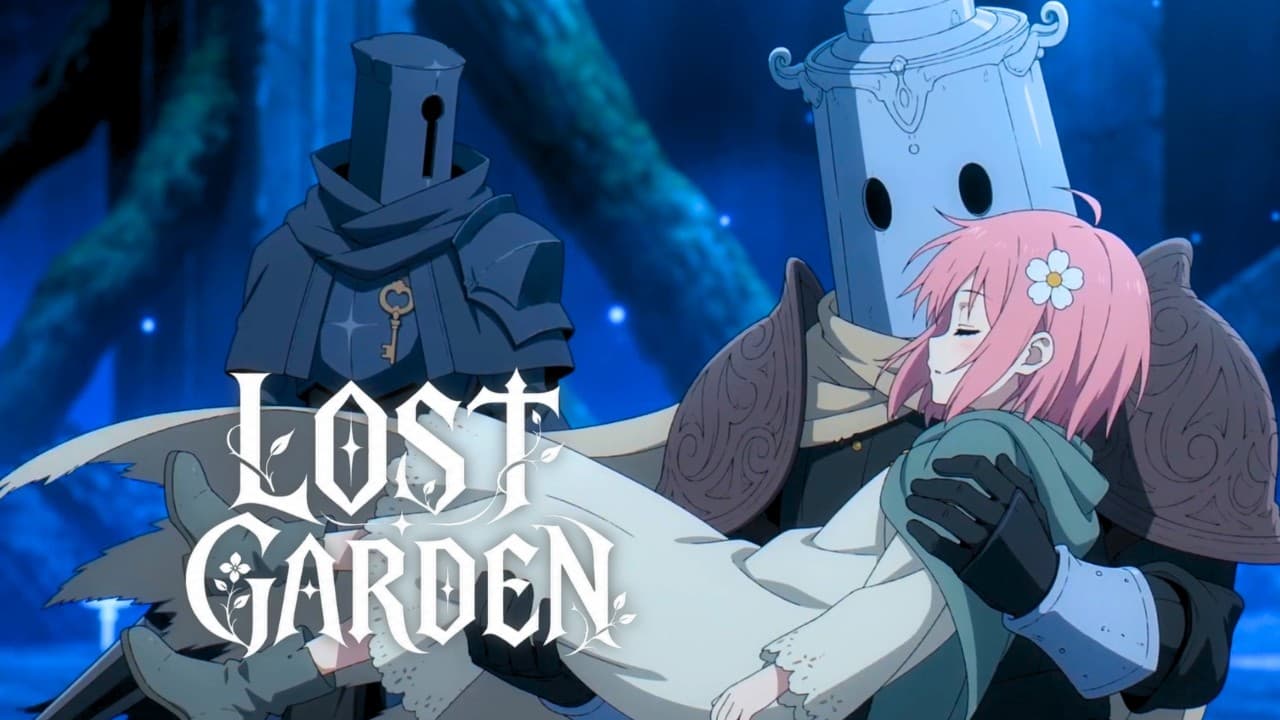
Lost Garden · Episode 2

Independent guide. ScreenWeaver does not organise the CSFCCA International AI Film Festival and is not affiliated with CSFCCA. Rules read on 1 October 2026. Official site

Available today in ScreenWeaver: free screenwriting, and a storyboard generated from your screenplay with Storyboard Beta, $9.99 a month.

Rolling out: video generation of each shot, powered by Seedance, with the Filmmaker plan.

The rules on one card

What the festival publishes.

CSFCCA grew out of a science fiction and cultural creativity association founded in 2023. The festival began in 2026 and is run in seasons. It is open worldwide, judged online and ends in an event in Taipei.
Organiser
CSFCCA, science fiction and cultural creativity, Taipei
Format
Seasonal editions, quarterly awards, one annual Grand Prize
Fall 2026 deadline
30 September 2026, closed
Winners announced
15 November 2026
In-person event
Taipei, reported for 20 November
Where to submit
FilmFreeway, with an English synopsis
Language
English subtitles for non-English films
Reported length and fee
3 to 15 minutes, $25 to $28

Source: the official site csfccaaifilm.com (home, season, submit, awards and jury pages), read on 1 October 2026. The length, the fee and the 20 November date are not on those pages: they come from aifilmcontests.com and kajimelo.com, and the FilmFreeway listing blocks automated reading. Confirm them on FilmFreeway.

Key dates

A season closed. The next one is not announced.

These are the dates of the Fall 2026 edition. The site does not yet publish the next call.
  1. 1 Jul 2026

    Fall 2026 opened

    The call for original AI films, animated shorts, music videos, commercials, comics and experimental works.

  2. 10 Sep 2026

    Regular deadline

    The regular cut-off of the Fall season, ahead of the final deadline on 30 September.

  3. 30 Sep 2026

    Final deadline

    The last day to enter the Fall season. It has passed.

  4. 30 Oct 2026

    Official Selection notified

    Selected films are told. The site says all official selections go through jury review.

  5. 15 Nov 2026

    Winners announced

    Followed by the in-person screening and industry event in Taipei.

How films are judged

Two juries, six things they look for.

The festival lists the criteria of each jury and gives no weights. The masters jury leads on the highest honours with four criteria. The industry jury adds execution, industry relevance and real-world impact to creativity and artistic excellence.
  • Narrative depth

    A masters jury of directors and producers reads a film for story first. Give the film a want, a cost and a consequence, and let the images serve it.

  • Aesthetic expression

    A distinctive visual identity. The festival speaks of forging distinctive visual styles, so a recognisable look beats a polished generic one.

  • Emotional impact

    The site says it values meaningful works with emotional depth. One scene where a character feels something, in a face rather than a line of dialogue, does more than three spectacle shots.

  • Innovative value

    A new use of the medium: a form, a method, a way of telling. The Technical Innovation award asks for your workflow in full, so document how you made the film as you go.

  • Execution

    The industry jury judges technical and craft awards, and weighs execution next to creativity. Consistent characters, clean motion and a finished mix are what it sees.

  • Industry relevance and real-world impact

    Could a studio, a platform or a brand use this creator? The industry recommendation program passes selected works to studios and distributors, so show range, not only one lucky shot.

Ties are settled on creativity, overall execution and development potential. Awards can be withheld if nothing meets the standard, and the festival keeps the right to assign juries and categories.

Who decides

Film masters on one side, industry leaders on the other.

The festival runs a dual jury system. It lists the backgrounds of both panels on its site, and both can sit on different categories.
  • The award-winning masters jury

    Directors, producers, visual storytellers and musicians honoured at the Golden Horse Awards, Golden Bell Awards, Golden Melody Awards, Hong Kong Film Awards and others. They lead the Grand Prize, the Jury Grand Prize and the Quarterly Best Film award.

  • The industry leaders jury

    Founders and senior executives with more than twenty years in filmmaking, animation, visual effects, post-production, music, advertising, branding, technology and digital content. They judge technical, craft and category-specific awards.

  • A path beyond the prize

    Jury selections and some winners join the CSFCCA Industry Recommendation Program, recommended to film companies, studios, streaming platforms, distributors and brands. The festival says it cares where a work can go next.

The awards

Pick the award that fits your strength.

There is no imposed theme, and the festival welcomes narrative films, animation, music videos, experimental work and commercials. Its award list is long and unusually specific about craft. Several awards ask for supporting material, so choose early. Six that suit a film made in ScreenWeaver.
  • 01

    Best AI Film and Best AI Director

    Overall achievement, and directorial vision in integrating AI with cinematic storytelling.

    The Best AI Director award speaks of a distinctive visual language and rhythm, turning AI from a tool into an extension of expression. Show a single directing hand across the film.

  • 02

    Best AI Screenwriter

    A well-structured screenplay with compelling characters, written with AI-assisted tools.

    The award page lists a world, a story outline and descriptions of the main characters. A screenplay in industry format with a clean outline is exactly the file you would write in ScreenWeaver’s free plan.

  • 03

    Best AI Character Design

    An outstanding character design, with a distinctive identity and personality.

    The award page lists character sheets, a three-view turnaround and expression sheets. Build the sheet before the film: it is both the submission and the reference for every shot.

  • 04

    Best AI Production Team

    Collaboration and a systematic AI workflow.

    A short written workflow statement and the list of software are part of the entry. A pipeline that is already recorded in one project is the easiest to write up.

  • 05

    Best AI Technical Innovation

    An inventive use of AI tools, workflow integration, character consistency and post-production.

    The full workflow and the software list are required. Character consistency is named in the award text: measure and show it, for example the same face in the first and last shot.

  • 06

    Best AI Visual Achievement

    A distinctive visual identity through composition, lighting, colour and environment design.

    The award text lists aesthetic direction, lighting and colour. Choose one palette and one light, and make each frame look like it belongs to the same film.

The first Golden Mars

What Be the Light shows.

The winners page lists one title as the 1st Golden Mars Grand Prize: Be the Light, credited to AI director Lee Shin Ju and Bulky Pictures. A page on the same site writes it up as a sci-fi music video a little over four minutes long. We have not judged the film. Here is what the festival’s own write-up praises.

  1. 01

    A world, not a location. The write-up praises a layered setting: amethyst alien ruins, a wrecked metropolis, an ancient desert dome. Variety of place, held in one visual style.

  2. 02

    Two leads who stay the same. It singles out two contrasting heroines whose features hold from shot to shot, and calls this a real technical difficulty. Character consistency is a stated criterion here.

  3. 03

    One human payoff. The ending is a face in tears before a rocket launch. The write-up praises the facial micro-expressions, the emotional core of a film full of machines.

  4. 04

    Picture built on the music. The cuts follow the beat of a symphonic score. The write-up credits the match between music and picture.

  5. 05

    The competition is wide. The Autumn season map on the site counts more than 385 films and creative works from 43 regions. A short list of strong ideas beats a long list of effects.

A film to read closely

Lost Garden: two characters, six shots.

Here is the first scene of Lost Garden, episode 2, from the ScreenWeaver team’s Seedance-made series, read through the festival’s craft awards: the character designs, the single colour world of blue light, the screenplay page that all of it comes from. The same two knights carry from the wide shot to the close-up.

Logline. A newborn knight whose inner light is leaking away crosses a world that has stopped hoping, to find the one blacksmith who can seal his armor.

Screenplay · episode 2 · page 1

INT. UNDERGROUND CAVERN - LOWER PATH - CONTINUOUS

Blue mushrooms the size of houses. LANTERN, a small knight with a lantern for a helm, walks alone.

He presses a hand to his chest. Sparks of light slip between his fingers.

SERRURE

Hold on. You're losing something.

Serrure lifts the edge of the cloak. A gash in the armor. Blue light leaks out like smoke.

SERRURE

That's your energy. What keeps you standing.

He grips Lantern's shoulder. Two knights alone among the crystals.

SERRURE

A suit that leaks goes out. Eventually.

Under the giant mushrooms, the road climbs into the dark.

SERRURE

So. We follow the road.

Serrure points the way. Lantern follows.

CUT TO:

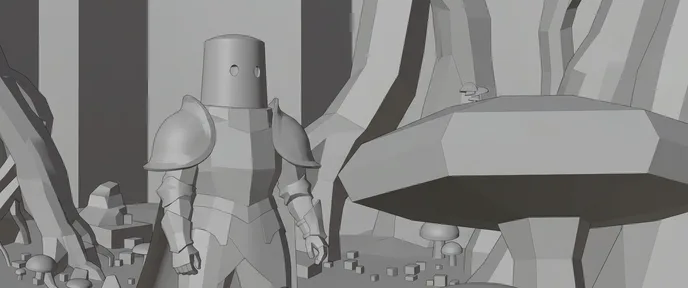
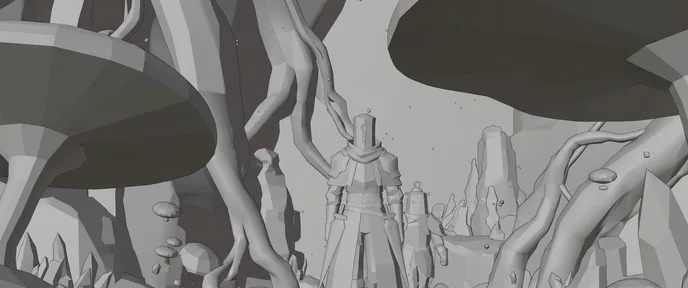
  1. A small knight with a lantern helm stands by a giant glowing blue mushroom in a crystal cavern
    Storyboard frame of the same wide shot, in grey
    01

    Wide · the world

    Wide shot, Lantern alone by a giant glowing blue mushroom, crystal cavern, roots, drifting spores, cold blue light

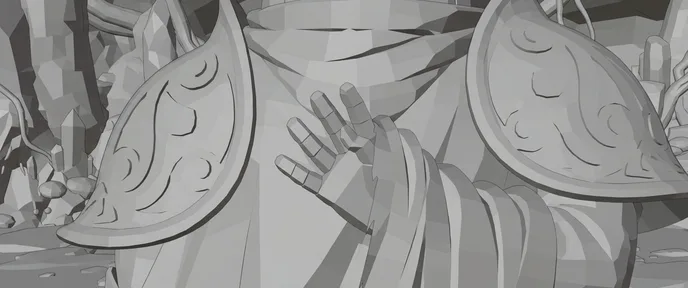
  2. Close-up of an armored chest under a cream cloak, a gloved hand, a spark of light
    Storyboard frame of the chest close-up, in grey
    02

    Close-up · the chest

    Close-up on Lantern's chest, his gloved hand pressed to the cloak, a spark of light escaping between the fingers

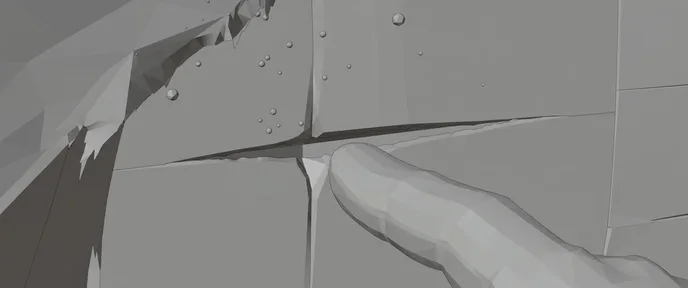
  3. A torn gash in an armor plate leaking bright blue light, a finger pointing at it
    Storyboard frame of the wound insert, in grey
    03

    Insert · the wound

    Extreme close-up, Serrure's finger near a torn gash in the back plate, blue light leaking out like luminous smoke

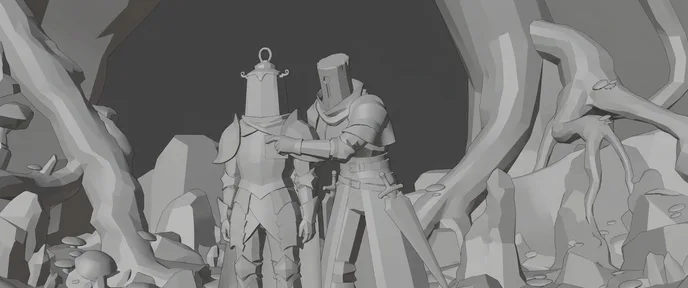
  4. Two armored knights side by side, one with a hand on the other's shoulder, in a crystal cavern
    Storyboard frame of the two-shot, in grey
    04

    Two-shot · the bond

    Medium two-shot among crystals and roots, Serrure's hand on Lantern's shoulder, faceless armors, emotion through posture only

  5. Two small knights walk beneath two giant glowing blue mushrooms
    Storyboard frame of the wide shot, in grey
    05

    Wide · the scale

    Wide low angle, the two knights tiny beneath two giant glowing mushrooms, blue crystals in the foreground, mist

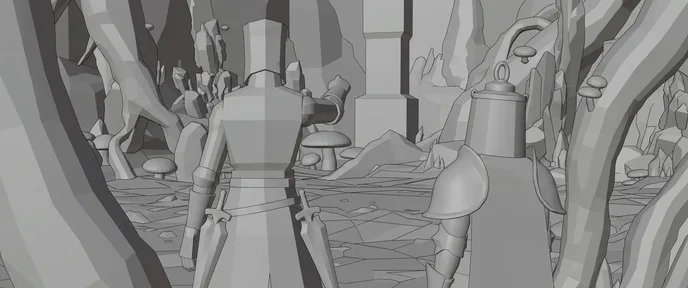
  6. Seen from behind, a tall dark knight points ahead while the small lantern knight looks on
    Storyboard frame of the over-the-shoulder shot, in grey
    06

    Over the shoulder · the road

    Over-the-shoulder from behind, Serrure points ahead into the cavern, Lantern beside him, roots framing the path

At 21 minutes, Lost Garden, episode 2 is far longer than a festival short. For CSFCCA, the scene is a study in consistency: two armoured characters, one cavern and one blue light, held across every angle. Made by the ScreenWeaver team with Seedance. Playing it lands you in the same cave.

The script

A seven minute film, built in five beats.

Seven minutes sits in the middle of the 3 to 15 minute range reported by aggregators. It is about 7 pages and 80 to 120 shots, enough for a world, a heart and an ending.
  1. 0:00 to 0:30

    The signal

    One strange image of the world, held long enough to register. Give the film its look in the first shot.

  2. 0:30 to 1:30

    The two of them

    Introduce the leads in contrast: one calm, one driven. Their different silhouettes are what keep them apart on screen.

  3. 1:30 to 4:00

    The journey

    Three places, each different, all in the same visual style. This is where a film shows its worldbuilding.

  4. 4:00 to 6:00

    The loss

    The want costs something. Stay close on a face for the emotional impact the masters jury weighs.

  5. 6:00 to 7:00

    The light

    An ending image that gives the world a meaning. Leave a door open for the industry audience: this could be a series.

Write the film as a world bible and a screenplay together: the Best AI Screenwriter award asks for a world, an outline and the main characters, and a film that can show all three is a stronger entry in every category.

Be ready

Six steps to the next season.

The site has run a May 2026 selection and a Fall 2026 call, and it describes itself as quarterly. No date is published for the next one, so prepare the film, not a deadline.
  1. 01

    Now

    Read the awards and the jury pages

    Choose the film award you aim for and one craft award that suits your strength. They need different materials, so decide before you write.

  2. 02

    October

    Write the screenplay and the world

    Write it in ScreenWeaver, in industry format, with a short outline and a world note. This is already the file the Best AI Screenwriter award asks for.

  3. 03

    November

    Character sheets

    A turnaround and a set of expressions for each lead, approved once. The same sheet serves the Character Design award and every shot of the film.

  4. 04

    December

    Storyboard every shot

    Let ScreenWeaver break the screenplay into shots, then fix framing, angle, movement and length for each frame by hand.

  5. 05

    January to February

    Generate, cut and mix

    Generate scene by scene, working from the storyboard and the approved sheets. Log every tool and version for the workflow statement.

  6. 06

    When a season opens

    Submit with your supporting files

    On FilmFreeway: an English synopsis, a screening link that stays live, English subtitles if needed, and the files each award requires.

What costs a film

Six traps in a festival with long rules.

The festival’s pages are detailed and in two languages. The awards page is the one people skip.
  • Guessing the next dates

    Nothing is published for the season after Fall 2026. Follow the festival’s site and FilmFreeway listing instead of planning around a date you have heard.

  • Entering a craft award with no supporting file

    Screenwriter, Character Design, Production Team and Technical Innovation each list extra material: an outline, character sheets, a workflow statement and software list. Without it you are out of that award.

  • A screening link that goes dead

    The links must stay accessible for the whole evaluation period. A private file or an expired link ends the entry quietly.

  • No English subtitles or synopsis

    Films not in English need English subtitles, and the form asks for an English synopsis. Do both even if your festival jury speaks your language.

  • Aiming only at the Golden Mars

    The annual Grand Prize is chosen once a year by the official jury. Quarterly awards are the realistic first target, and selected works can be recommended to industry.

  • One lucky shot instead of a film

    The industry jury weighs execution and relevance. A reel of impressive shots shows one skill. A finished story with a stable cast shows a creator a studio could work with.

Why ScreenWeaver

A festival with awards for screenwriters and character designers.

CSFCCA rewards writers, designers and workflows as well as films. ScreenWeaver ties screenplay, storyboard and footage together in one project, so each of those materials already exists.
  • The writing awards are built in

    The Best AI Screenwriter award wants a world, an outline and character descriptions. Industry-format screenplays, an outline with beats and character notes are what the free Screenwriter plan produces, at $0 with no expiry.

  • Consistency you can demonstrate

    Characters, places and references follow you from shot to shot. That is what the Character Design and Technical Innovation awards ask you to show, and it is what the masters jury notices first.

  • A workflow that writes itself up

    Every shot stays tied to its scene and storyboard frame, because the footage pipelines are connected to the script. The Production Team award wants a workflow statement. Yours is already in the project.

  • Seedance, rolling out

    The footage pipelines run on Seedance 2.0 and 2.5 and are rolling out with the Filmmaker plan. Storyboard Beta, at $9.99 a month, covers the preparation in the meantime.

Real productions

International festival-recognized films have been written and produced with ScreenWeaver.

ScreenWeaver is already being used as a creative workspace for real AI film productions, from cinematic shorts to animated series pilots selected, nominated, and awarded by international festivals.

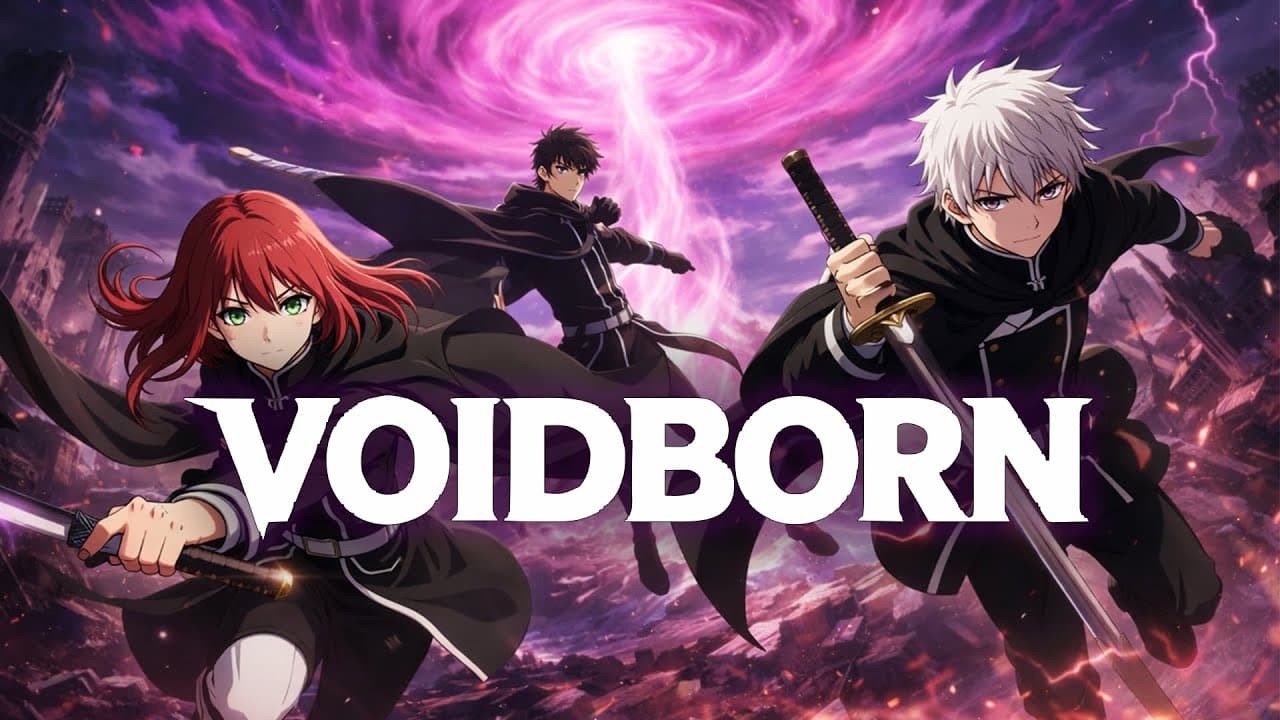
  • Video thumbnail for VOIDBORN

    VOIDBORN

    AI animated / cinematic short

    Festival recognition

    • 1st Place Silver

      Mondial Chroma Awards

    • 2nd Place Dreamina

      Mondial Chroma Awards

    • Award Winner

      Seoul International AI Film Festival

  • Video thumbnail for Les Fils du Vinnana

    Les Fils du Vinnana

    AI short film

    Festival recognition

    • Honorable Mention

      Top Quark Film Festival

    • People's Choice Nominee

      Illuminate Oneness of Humanity

    • Nominee

      ALTFF Supershort

  • Video thumbnail for Lost Garden

    Lost Garden

    AI animated series pilot

    Festival recognition

    • Finalist

      AI London Festival

The pipeline

Write. Board. Produce.

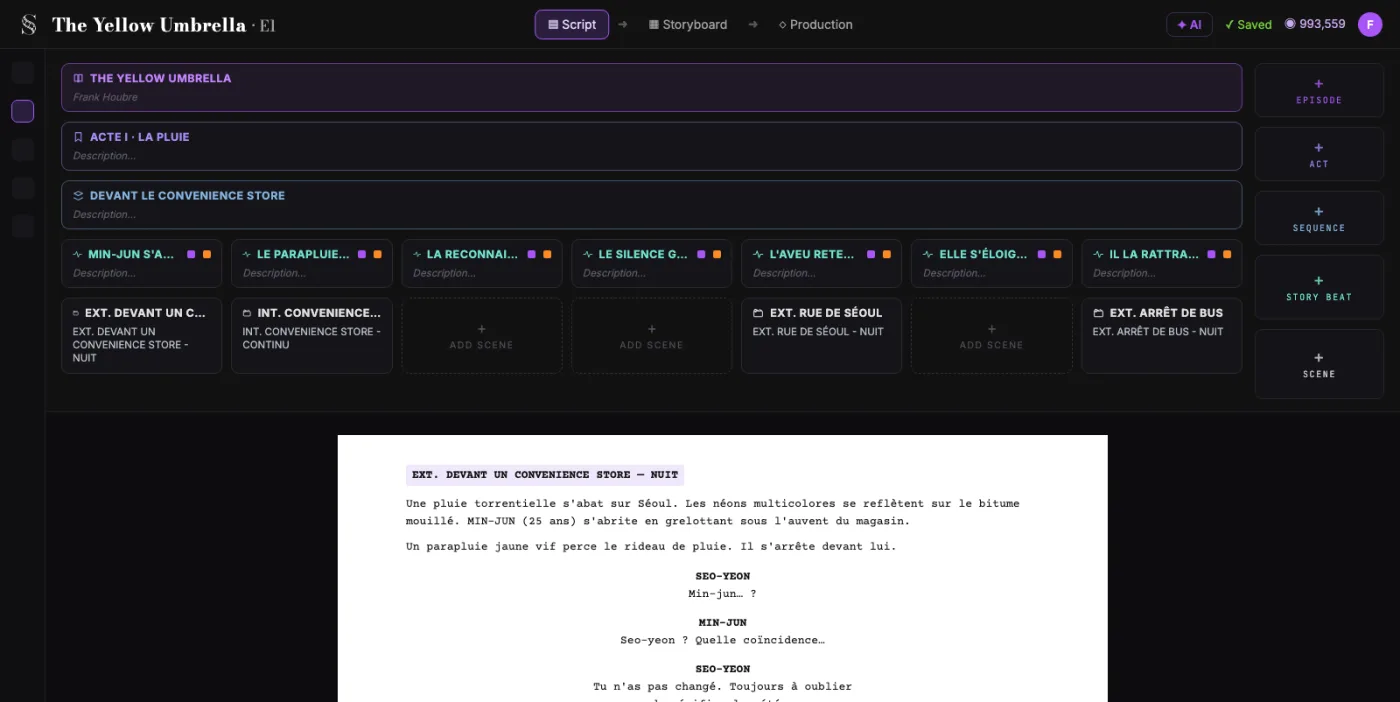
  1. ScreenWeaver screenplay editor: acts, sequences and beats above the formatted script of The Yellow Umbrella

    01The screenplay, enriched

    An industry-standard screenplay editor, and more: a visual outline and beat editor, your writing inspirations (notes, photos, audio) kept next to the page, and an AI researcher to support your writing, not replace it.

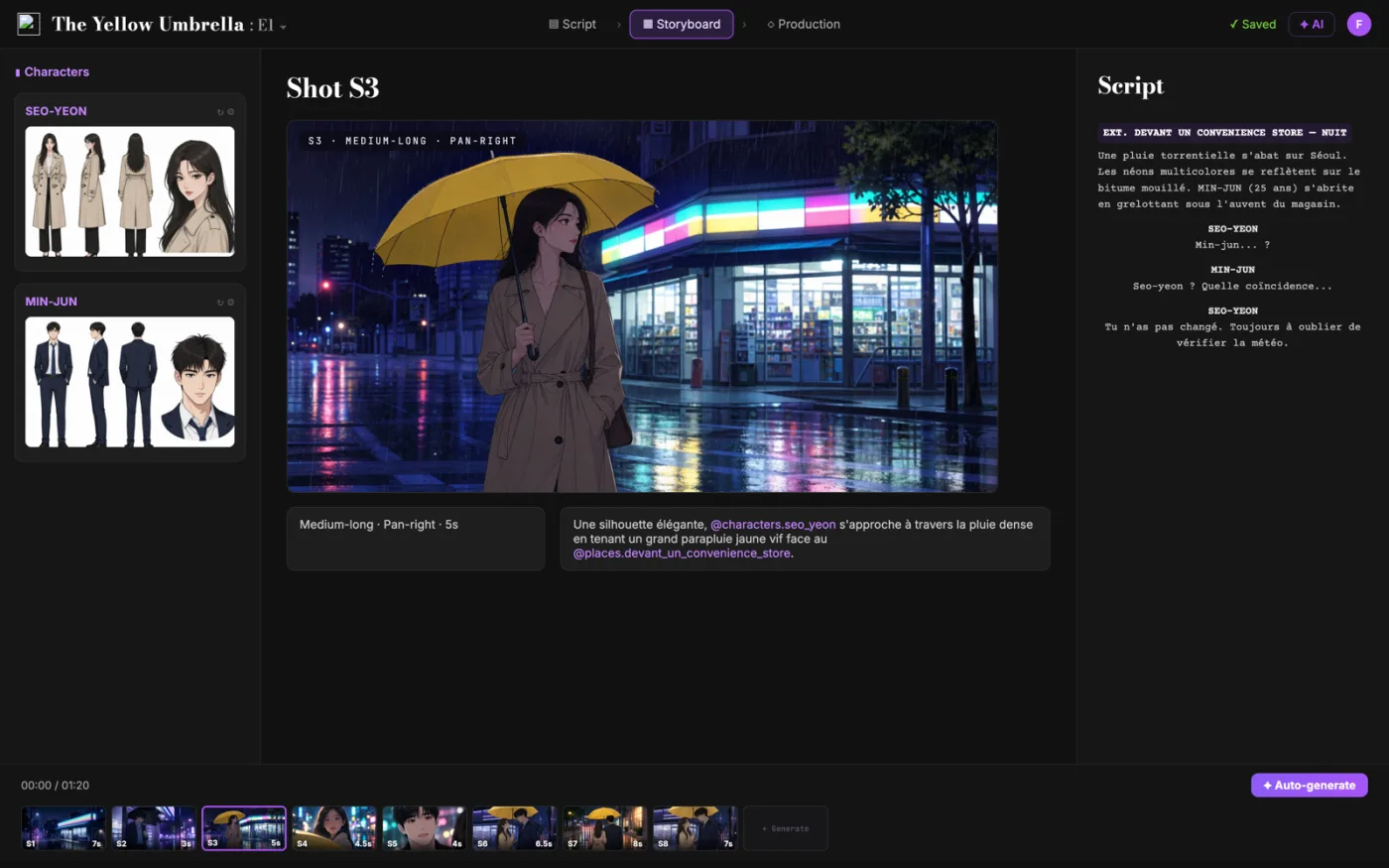
  2. ScreenWeaver storyboard: shot S3 of The Yellow Umbrella with characters, shot settings and the script beside it

    02The storyboard, made easy

    Shot breakdown generated from your screenplay, manual control over every shot (frame, angle, movement, duration), and generative AI previsualization in one click.

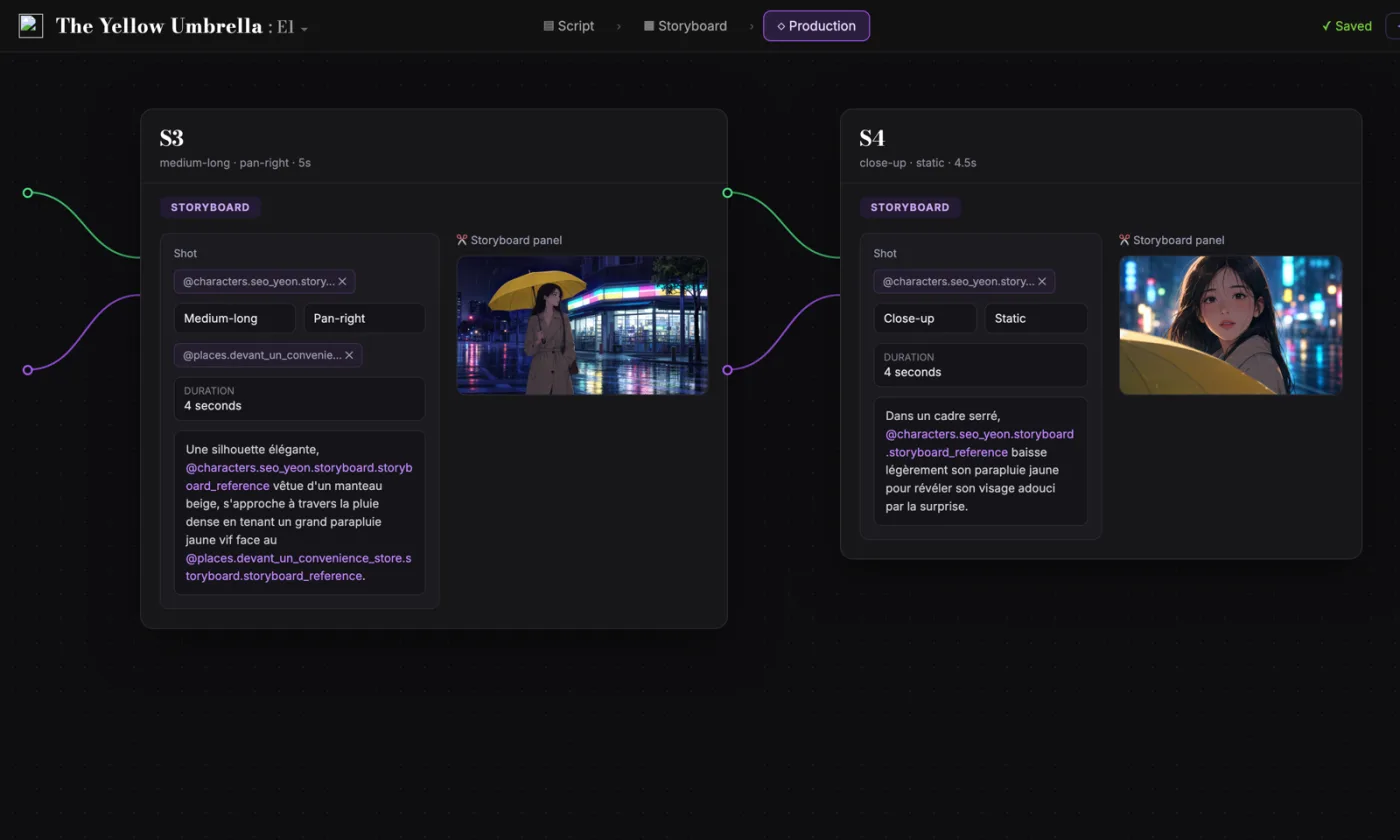
  3. ScreenWeaver production canvas: shots S3 and S4 as connected nodes carrying their storyboard panels and prompts

    03AI production, with finesse

    Footage generation pipelines connected to your screenplay and storyboard. Optimized out of the box, fully editable workflow.

FAQ

CSFCCA AI Film Festival, your questions

How do you win the CSFCCA International AI Film Festival?
Two juries decide. A masters jury judges the highest honours on narrative depth, aesthetic expression, emotional impact and innovative value. An industry jury judges craft awards on execution, innovation, relevance and impact. Make a finished story with a distinctive look and a stable cast.
Can I still enter the CSFCCA AI Film Festival?
The final deadline for the Fall 2026 season was 30 September 2026. The festival describes itself as run in seasonal editions, but it has not published the next dates. Watch its website and FilmFreeway listing.
What is the Golden Mars Grand Prize?
The festival’s highest honour, awarded once a year by an official jury to works of exceptional artistic merit and innovation in storytelling, visual expression and the creative use of AI. The first one is listed for a film called Be the Light.
Does the festival have awards for screenwriting?
Yes. Best AI Screenwriter honours a writer who combines original creative vision with AI-assisted tools, and asks for a well-structured screenplay plus a world, an outline and main character descriptions.
How long can the film be, and what does it cost?
The official pages we read do not state either. According to aifilmcontests.com the running time is between 3 and 15 minutes, and according to kajimelo.com the fee is about $25 to $28. Confirm both on FilmFreeway.
How much of my film must be AI?
The official pages do not say. According to aifilmcontests.com, AI must meaningfully shape at least half of the work. Check the FilmFreeway rules before you submit.
Can ScreenWeaver help with the craft awards?
Yes: screenplay, character notes and storyboard today, and footage on Seedance 2.0 and 2.5 as the Filmmaker plan rolls out. No tool is imposed, and the craft awards ask you to list your software.
Who is on the jury?
The jury page lists individual members of the masters jury. The site describes the second panel by background: founders and senior executives from film, animation, visual effects, music, advertising, technology and digital content.

Ready before the next season.

A screenplay, a character sheet, a storyboard: the first three things the next season will ask for. Start them free.