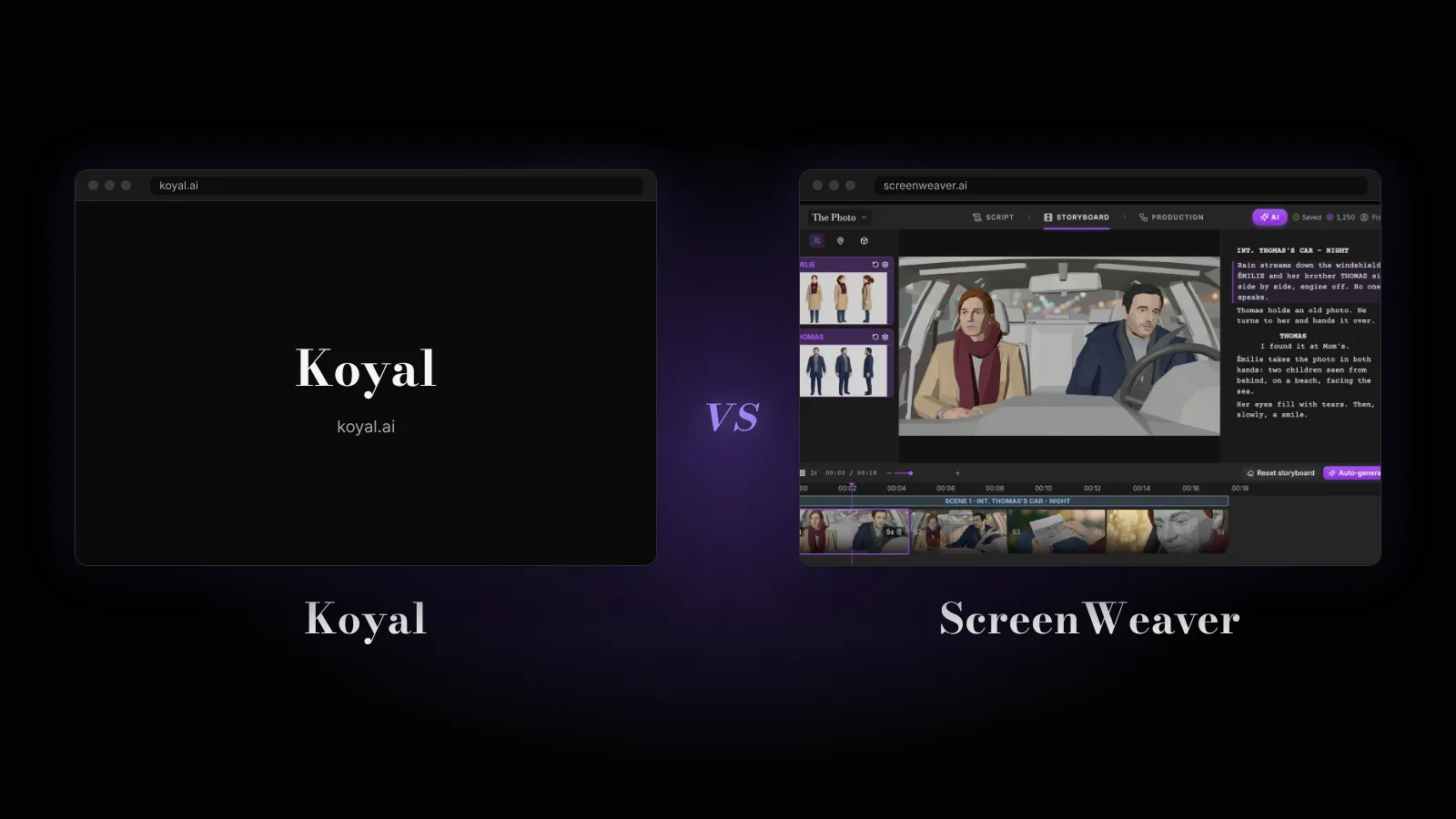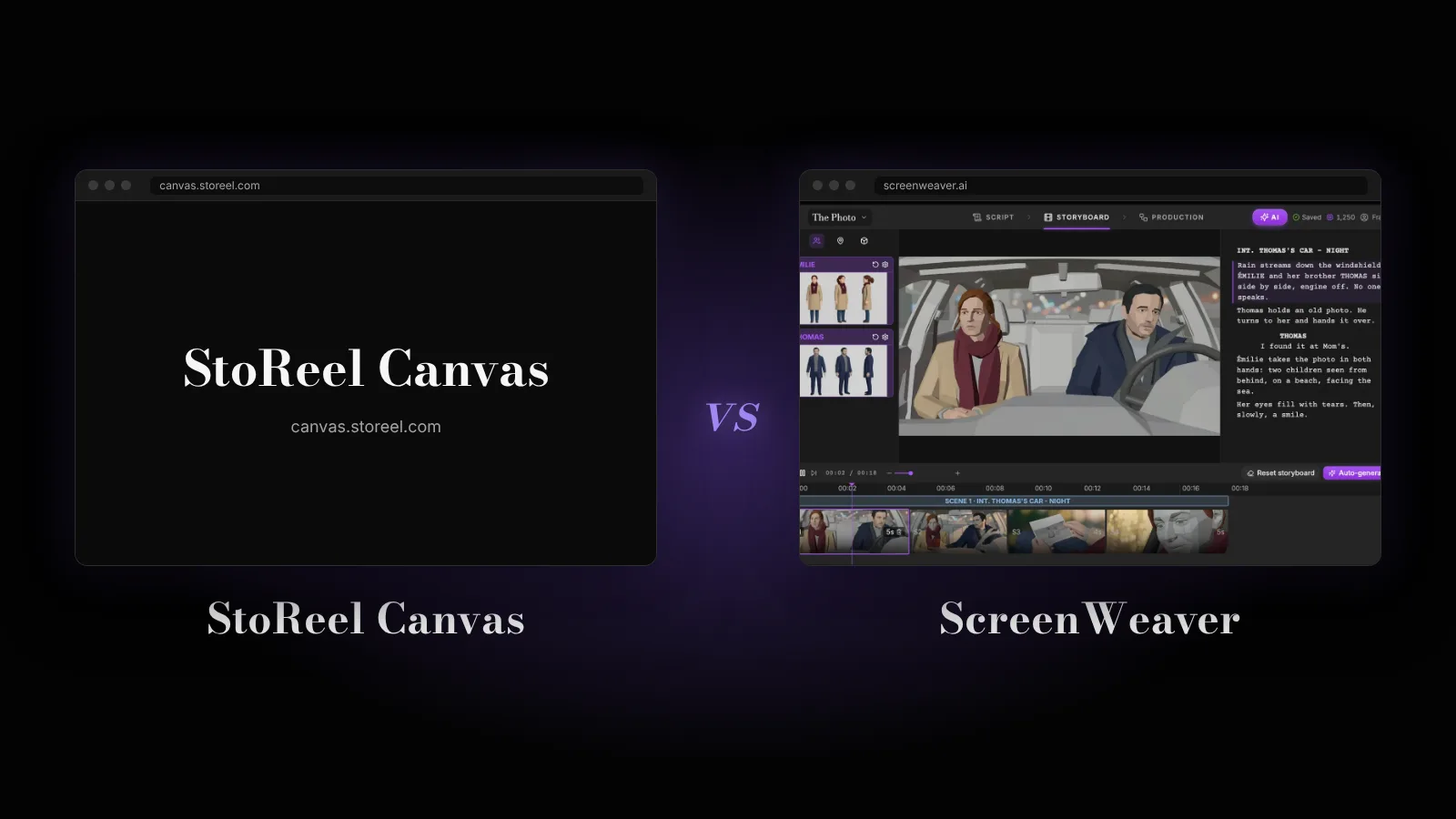

StoReel Canvas is the AI production tool of StoReel, a microdrama platform that raised $34M in 2026. You upload a script (TXT, DOCX or PDF), it breaks it into episodes, scenes and shots, then generates the storyboard, voices and video with Seedance 2.5, and StoReel may distribute the series on its own app and share the revenue. No price list is public. ScreenWeaver also writes the screenplay and lets you pick the video model shot by shot.
The verdict: pick StoReel Canvas if you want to sell vertical series inside StoReel's app. Pick ScreenWeaver if you want to own the script, the boards and the finished episodes and publish them anywhere.
Every StoReel fact below comes from canvas.storeel.com (home, feature, model, compare and terms pages), TheWrap, Xataka, wwwhatsnew and medianews4u, all read on 11 November 2026.
What StoReel Canvas is
StoReel describes itself as an AI-native short drama platform: an app where people watch vertical series, most of them made with AI. Canvas, launched at the end of June 2026, opens its production pipeline to outside creators. The home page sums it up as "All-in-One Creation. Global Distribution. Seamless Monetization." The terms name the company as StoReel (Hong Kong) Limited.
Its Script to Video page lists the steps: upload the script, let the AI split it into "episodes, scenes, shots", characters and props, prepare the storyboard script, organise reusable assets, refine the direction, then generate connected scenes. It says "No rigid screenplay template is required." Character Consistency links each character asset to the script and carries it into the video. The only video model Canvas names is Seedance 2.5, ByteDance's audio-video model. A "Team Mode" splits accounts into director and producer roles.
The money is what makes it unusual. Medianews4u reported on 26 March 2026 a $9M seed led by Play Ventures plus $25M of user-acquisition financing from PVX Partners: $34M in total. Canvas is built to feed StoReel's own catalogue, which the company says passed 80 series by July.
What the headlines leave out:
- Distribution is StoReel's call. Xataka and wwwhatsnew both read the model the same way: StoReel decides whether your series is distributed and on what terms, and you are paid only if it is. No revenue-share percentage is published.
- There is no public price list. The terms mention "free trials and paid subscription plans" and say purchased credits are "in principle, non-refundable". TheWrap reports 300 free credits per user and spent about $150 of credits on four test episodes; Xataka counts 288 credits just to generate the characters. The $19.99 a week often quoted is the viewer subscription to the StoReel app, not a Canvas plan.
- The rights are wide. You keep ownership of what you upload, but you grant StoReel a "worldwide, royalty-free, irrevocable, and sublicensable license".
StoReel Canvas vs ScreenWeaver, side by side
| StoReel Canvas | ScreenWeaver | |
|---|---|---|
| Made by | StoReel (Hong Kong) Limited, $34M raised | ScreenWeaver |
| Can you use it? | Yes, sign-up on canvas.storeel.com, 13+ | Yes, open to everyone |
| Price | No public price list; free credits, then paid plans (11 Nov 2026) | Writing free, Auteur $39.99/mo, Studio $149.99/mo |
| Starts from | A script in TXT, DOCX or PDF | A blank page or your script (PDF, Final Draft, text) |
| Screenplay editor | No, it reads your script | Yes, a full script editor, free |
| Breakdown | Yes: episodes, scenes, shots, characters, props | Yes: scenes, shots and story elements |
| Storyboard | Yes, sequenced frames | Yes, shot by shot, with framing, camera move and duration |
| AI video | Yes, Seedance 2.5 (the only model named) | Yes: Seedance 2.5, Kling 3.0, Veo 3.1 and more, per shot |
| Distribution | Inside the StoReel app, if StoReel picks the series | You export and publish where you want |
| Export | Not stated on its pages | Video, plus scripts to PDF and .fdx |
| Collaboration | Team Mode (director, producer) | Studio plan, real-time, unlimited seats |
What ScreenWeaver does that StoReel Canvas does not
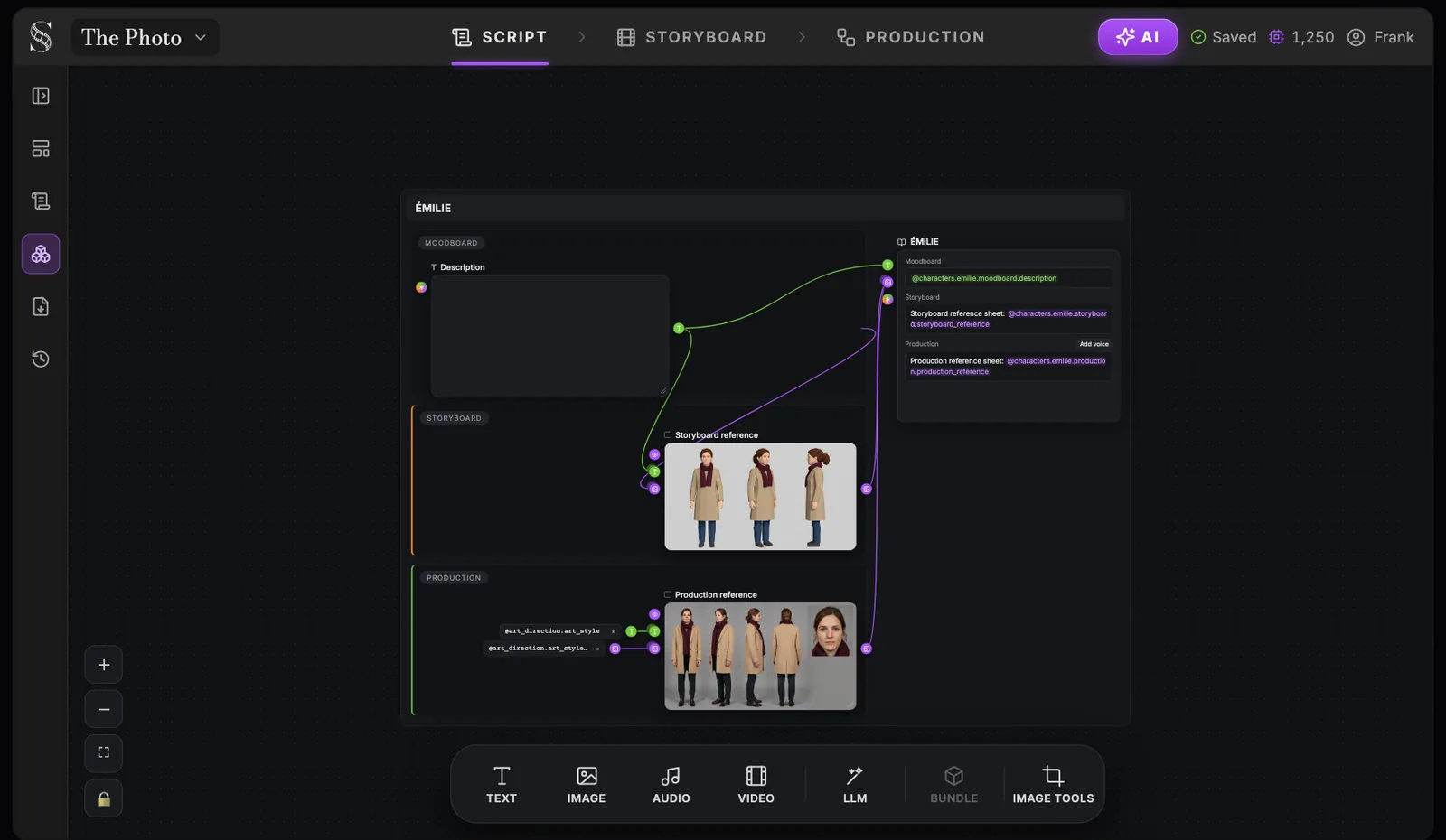
You write the series where you board it. Canvas starts from a finished script. ScreenWeaver includes a screenwriting editor, free forever, so the hook, the cliffhanger and the rewrites live in the same project as the shots. Our guide to short drama episode structure shows how to plan a season before episode 1.
Your series, your channel. In ScreenWeaver nobody decides whether your episodes get released. You export them and post them on TikTok, YouTube Shorts, or pitch them to any vertical platform. The AI short drama generator page shows a 9:16 episode opening, from the page to the cut.
More than one model. Seedance 2.5 runs in ScreenWeaver too, next to Kling 3.0, Veo 3.1 and others, and you choose per shot. When one shot fails, you redo that shot with the model that suits it. The AI storyboard generator page shows the steps.
A published price. Auteur is $39.99 a month for 6,000 credits; Studio is $149.99 a month for 25,000 credits with real-time collaboration. Both are on the pricing section. Before you spend any, the character consistency sheet tool helps you lock your cast for free.
Try it free
Try ScreenWeaver for free on your script
It is free. Import your existing project, get a clearer view of your outline, and regain control of your story structure in minutes.
Start FreeWhat StoReel Canvas does better
Canvas comes with an audience. If StoReel picks your series, it goes out to viewers who already pay for microdramas, and you share in the revenue without buying a single ad. No production tool, ScreenWeaver included, gives you that. Voices are part of the same pipeline too, so a creator with no crew can go from script to a voiced episode in one place.
Which one fits you?
- A creator who wants to earn from microdramas without building an audience: StoReel Canvas, if you accept that StoReel decides what gets released and on what terms.
- A writer or director building their own series or IP: ScreenWeaver. You write, board and film every episode, keep the files and choose where they air. Our post on what a short drama costs to make helps you budget it.
- A studio comparing all-in-one AI pipelines: see also Utopai vs ScreenWeaver and Flick vs ScreenWeaver.
FAQ
Is StoReel Canvas free? You get free credits to start (300, according to TheWrap), then paid plans. StoReel's pages did not show a price list when we read them on 11 November 2026.
Who makes StoReel Canvas? StoReel, an AI-native microdrama platform (StoReel (Hong Kong) Limited in its terms), co-led by co-CEO Angela Yu and backed by Play Ventures and PVX Partners.
Does StoReel pay creators? Only if StoReel distributes the series. The press describes a revenue share, but StoReel has not published the percentage.
Which AI model does StoReel Canvas use? Its pages name Seedance 2.5 from ByteDance. ScreenWeaver runs Seedance 2.5 as well, among other models you pick per shot.
Can I import my screenplay into StoReel Canvas? Yes, as TXT, DOCX or PDF. ScreenWeaver also imports PDF and Final Draft (.fdx) scripts, and lets you keep writing them.
Is StoReel Canvas better than ScreenWeaver? For selling a microdrama inside StoReel's app, Canvas is the shorter path. For writing, owning and directing your series shot by shot, ScreenWeaver does more.
Sources: StoReel Canvas, Script to Video, Seedance 2.5 on Canvas, Terms, TheWrap, 24 June 2026, Xataka, 26 July 2026, wwwhatsnew, 28 July 2026, medianews4u, 26 March 2026. Read on 11 November 2026.
From script to shots
Turn your script into a film, shot by shot
Write the scene, get its storyboard, then generate each shot with consistent characters. You direct every step.
Start your film free