
A live-action short drama costs what a crew, a cast and locations cost for the shoot days a season needs, which is why the platforms commission them and creators rarely self-fund one. An AI short drama costs generation retries plus voices plus your time: tens of dollars per 90-second episode on current models at three tries per shot, low thousands for a 70-episode season before anyone is paid. The number that decides the AI bill is the retry rate, not the model's per-second price.
This article does the arithmetic for both. The workflow it prices is in how to make a short drama with AI.
The live-action model
Vertical platforms do not publish what they pay per series, and the figures that circulate on distribution blogs are unsourced, so this section is a budget model, not a market quote. What a live-action season costs is driven by shoot days, and shoot days are driven by episode count and pages per day.
| Line item | Driver | Model assumption |
|---|---|---|
| Shoot days | 105 script pages at 8 to 12 pages a day | 9 to 13 days for a 70-episode season |
| Crew | Director, DP, sound, gaffer, AC, HMU, PA, producer | 8 to 12 people per day |
| Cast | 2 leads, 2 to 4 supporting, day players | Leads on every day |
| Locations | 5 or 6 recurring interiors | Rented by the day, or owned |
| Post | Edit, colour, sound, music, 70 deliverables | Weeks, not days |
Multiply a day rate by 12 days and a crew of 10 and the shoot alone is tens of thousands before cast, locations and post. That is the whole reason the commissioning model exists: a platform pays for the season, owns it, and gates it. invideo's own micro drama guide quotes "$1,000 per episode all-in" for a three-person AI-assisted team making ten episodes in three days, and "$500 to $650 per finished minute", as a comparison against what it calls a standard pipeline; those are its numbers for one production with people included, not a market rate.
The AI model: four lines, one multiplier
| Line item | What it covers | 90-second episode | 70-episode season |
|---|---|---|---|
| Storyboard frames | One frame per shot plus variants | A few dollars | Low hundreds of dollars |
| Video clips | One clip per shot, times retries | Tens of dollars | Low thousands |
| Voice and music | AI voices per character, a music track | A few dollars | A subscription or two, or a recorded cast |
| Your time | Grid, scripts, references, prompting, edit | Half a day to a day | Weeks |
The video line dominates and the retry multiplier dominates the video line.
Retries: the number that matters
A 90-second episode cut every three seconds is 30 shots. Published model prices are per clip and assume every clip is a keeper. Creators report two to five generations per shot that makes the cut, and verticals sit at the higher end because faces in close-up show every drift.
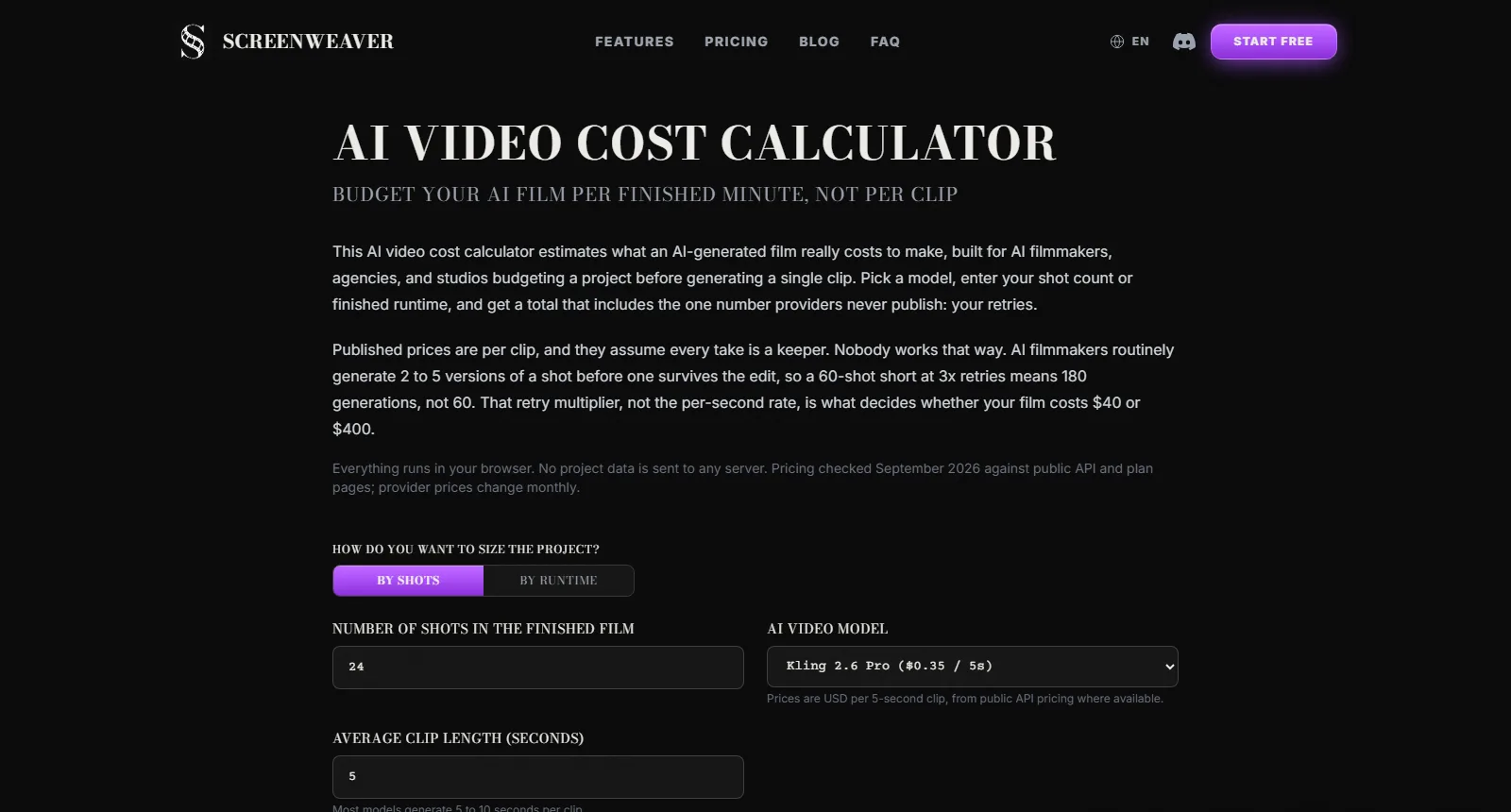
The AI video cost calculator on screenweaver.ai, captured 3 September 2026. Prices are checked monthly against public API pages; the retry multiplier is the input that decides the total.
At the calculator's listed rate for Kling 2.6 Pro, $0.35 per 5-second clip, and shorter clips priced proportionally on most models, here is what the multiplier does:
| Project | Shots | Retries | Generations | Video cost at $0.35 per clip |
|---|---|---|---|---|
| One 90 s episode, locked references | 30 | 2x | 60 | $21 |
| One 90 s episode, typical | 30 | 3x | 90 | $32 |
| One 90 s episode, faces drifting | 30 | 5x | 150 | $53 |
| Ten-episode social pilot | 300 | 3x | 900 | $315 |
| 70-episode season, dialogue-led | 2,100 | 3x | 6,300 | $2,205 |
| 70-episode season, sloppy references | 2,100 | 5x | 10,500 | $3,675 |
Swap the model and every row moves by two to three times in either direction: a 480p budget model is a third of that, a top-tier 1080p model with native audio two to three times it. The model picker keeps the current rates, and picking a cheaper model for reaction shots and inserts, which are half the season, is the easiest saving there is.
The gap between the 3x and 5x rows of the season is $1,470, and it is entirely reference quality. That is the case for spending a day on the cast sheets before generating anything.
Storyboard frames: the cheap money that saves the expensive money
Image generation runs at a few cents per frame on current models. A 70-episode season at 30 shots with three variants each is around 6,000 frames, which is in the low hundreds of dollars. It is the best money in the budget, because a locked board with a chosen frame per shot is what pulls the retry rate from 5x toward 2x.
Generate the variants, pick the on-model frame, and send only that one to video. In ScreenWeaver the storyboard is open to every account with a starter pack of credits, at half a cent a credit, so a ten-episode pilot's board fits inside a free account's allowance.
Voice and music
| Option | Cost per season | Trade-off |
|---|---|---|
| AI voices per character | A monthly subscription in the tens of dollars covers a season's lines | Fast, consistent, and noticeable across 100 minutes |
| Recorded cast | Free to a few hundred dollars per episode block, depending on who | Better performances, scheduling, and you own the recordings |
| Generated music | Included in some video models, or a music subscription | Fine for social. Check the licence before a paywalled release |
| Licensed tracks | Tens to hundreds of dollars each | Safe for anything commercial |
Record voice before generating video. The line durations set the clip durations, and a clip generated at the wrong length is a retry you paid for.
Try it free
Try Screenweaver for free on your script
It is free. Import your existing project, get a clearer view of your outline, and regain control of your story structure in minutes.
Start FreeYour time is the largest line
For one person with references already built:
| Task | 90 s episode | 10-episode pilot | 70-episode season |
|---|---|---|---|
| Season grid | Once | Half a day | One day |
| Scripts | One hour | One to two days | One to two weeks |
| Cast and location references | Once per series | Two days | Reused |
| Storyboard and selection | One hour | Two days | Two weeks |
| Voice lines | Half an hour | One day | One week |
| Generation and retries | Two to three hours | Three to five days | Four to six weeks |
| Edit, sound, music | One hour | Two days | Two weeks |
A ten-episode pilot is two to three weeks for one person. A 70-episode season is three to four months solo, or six weeks for two people splitting writing and generation. That is still faster than a live-action season gets from greenlight to delivery, and the whole thing costs less than one live-action shoot day.
What the tools cost
Generation is billed by the provider through whatever tool routes it, so tool subscriptions are the small line: Morphic's plans run $9 to $170 a month by credit allowance, ImagineArt sells credit tiers, and ScreenWeaver's writing is free, with storyboard and video generation on the Auteur plan at $39.99 a month, 6,000 credits included. The generators compared article has the detail. Whatever you pick, the retry rate is the bill.
A first budget
For a creator testing a premise:
- Ten episodes of 60 to 90 seconds, one trope, three characters, two locations, published to a social feed with no paywall.
- Generation: $200 to $400 at a typical 3x retry rate on a mid-range model, including storyboard frames.
- Voice: one month of a voice subscription, or friends and a microphone.
- Tools: a free tier or one month of a storyboard plan.
- Time: two to three weeks.
Under $500 and a month to find out whether people watch episode 4. If they do, the episode planner scales the same grid to 70.
FAQ
How much does it cost to make a short drama with AI?
Roughly $20 to $50 of generation per 90-second episode at two to five tries per shot on a mid-range model, plus a few dollars of storyboard frames and voice. A ten-episode pilot runs $200 to $400; a 70-episode season low thousands, most of it retries. Your time is the larger cost at any size.
How much does a live-action short drama cost?
Platforms do not publish per-series figures and circulating numbers are unsourced. The cost is driven by shoot days: a 70-episode season is about 105 pages, 9 to 13 shoot days, a crew of 8 to 12 and a cast on set every day, which puts the shoot alone in the tens of thousands before post. That is why the platforms commission rather than creators self-fund.
What is the biggest cost driver in an AI short drama?
The retry multiplier. The difference between 3x and 5x on a 70-episode season is about $1,500 at a mid-range model's rate, and it comes down to reference sheet quality. Storyboard frames, which cost cents, are what pull the rate down.
Is it cheaper to make a short drama in 9:16 than 16:9?
Per clip the price is usually the same. Verticals are cheaper because they are close-ups: fewer background elements to drift, fewer retries on framing, and fewer establishing shots. They are also faster to board.
Can I make a short drama for free?
A handful of episodes, with free credits on storyboard tools and free tiers on some video models. A ten-episode pilot with a real retry budget costs a few hundred dollars. A 70-episode season for free is not realistic.
Do AI voices cost extra?
A voice subscription in the tens of dollars a month covers a season of lines. Some video models generate speech natively, which removes the separate voice step for dialogue clips; the model picker filters for native audio.
Final Step
Build your next script with Screenweaver
Move from ideas to production-ready pages faster with timeline-native writing and AI-assisted story flow.
Try Screenweaver