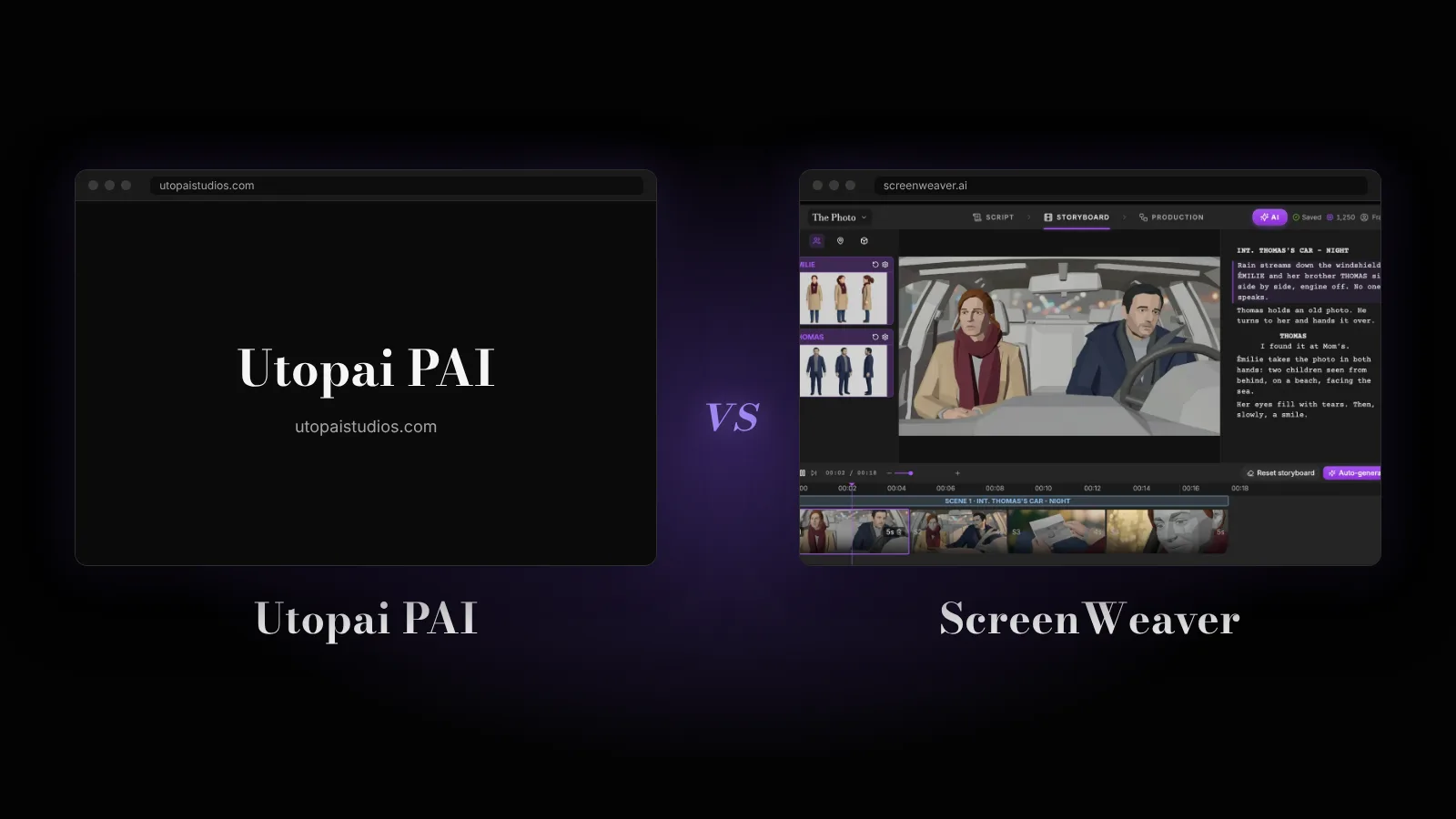

Utopai PAI is the AI video production platform of Utopai Studios, a Mountain View AI film studio valued at $1 billion. PAI reads a finished script, breaks it into shots and generates up to 4K video with its own model, Utopai X, from $15 a month for 1,000 credits, with no free plan listed. ScreenWeaver starts earlier: you write the screenplay in it, then board and generate.
The verdict: pick PAI if your script is locked and you want long, polished AI sequences. Pick ScreenWeaver if you are still writing, or want a storyboard before you spend credits on video.
Every Utopai fact below comes from utopaistudios.com (the PAI page with its pricing, the news page and its launch posts), Business Wire, Post Magazine, Señal News and AI Weekly, all read on 8 November 2026.
What Utopai PAI is
Utopai calls PAI, short for Production Assistive Intelligence, its "production intelligence platform for cinematic AI video and short films". It is not a side project: Utopai Studios is first a studio, spun out of the 3D world startup Cybever, with more than 20 films and series in progress for release from 2027, according to AI Weekly's summary of a report by The Information, which also gives the round: $60 million at a $1 billion valuation. Utopai's own site confirms the $1 billion figure.
The timeline, from Utopai's posts:
- 5 March 2026: public access opens. PAI handles "up to 16 shots in a single narrative flow", clips of up to one minute, up to 4K.
- 15 April 2026: three-minute 4K videos and a stronger Story Agent.
- 2 June 2026: PAI 2.0, an "agent-first" platform with a Canvas workspace and a timeline. Post Magazine and Señal News report $11 million in annual recurring revenue at that point.
- 29 September 2026: the "all-new PAI" with Utopai X, which Utopai says ranks second on the Artificial Analysis text-to-video leaderboard with audio, at an Elo of 1,150, nine points behind Wan 3.0.
What it does, from the PAI page: it "reads your script" and breaks it into characters, scenes, locations and props, then a shot list. Reference images keep characters and places stable across shots. You edit in plain language, compare versions, and export "in 4K" or send the rough cut to Premiere Pro or DaVinci Resolve. Teams get a shared canvas with comments and approvals; the Enterprise plan adds review workflows and private deployment. Utopai says PAI blocks copyrighted characters and the likeness of public figures, and that it does not train its models on copyrighted material.
Prices on the PAI page in November 2026, billed monthly: Basic $15 for 1,000 credits, Plus $49 for 3,500 credits (adds 4K and voice input), Pro $129 for 10,000 credits, Ultra $379 for 35,000 credits. Yearly billing lowers them to $13.50, $45, $119 and $349 a month.
The number the launch coverage leaves out is what a credit buys. Utopai X costs 93 credits per second at 1080p. Basic therefore buys about 10 seconds of Utopai X footage a month, Plus about 37 seconds, Pro under two minutes. The cheaper Standard model at 480p costs 9 credits per second, about 110 seconds on Basic. A three-minute film in Utopai X at 1080p is 16,740 credits, more than the Pro plan, before any retakes. Price your film with our AI video cost calculator before choosing a plan.
Utopai PAI vs ScreenWeaver, side by side
| Utopai PAI | ScreenWeaver | |
|---|---|---|
| Made by | Utopai Studios, an AI film studio | ScreenWeaver |
| Can you use it? | Yes, public sign-up since March 2026 | Yes, open to everyone |
| Price | $15 to $379/mo, no free plan listed | Writing free, Auteur $39.99/mo, Studio $149.99/mo |
| Starts from | A finished script and reference images | A blank page or your script (PDF, Final Draft, text) |
| Screenplay editor | No, it reads a script you bring | Yes, a full script editor, free |
| Storyboard | Shot list and keyframes inside the video flow | Generated from the script, scene by scene |
| Animatic | Partly, a timeline of generated clips | The sequencer plays your shots like a rough cut |
| AI video | Yes, its own Utopai X model, up to 4K | Yes, Kling 3.0, Seedance 2.5, Veo 3.1 and more |
| Export | 4K video, Premiere Pro and DaVinci Resolve | Video, plus scripts to PDF and .fdx |
| Collaboration | Shared canvas, comments, approvals | Studio plan, real-time, Owner/Editor/Viewer roles |
| Phone | No app found | Any mobile browser |
What ScreenWeaver does that Utopai PAI does not
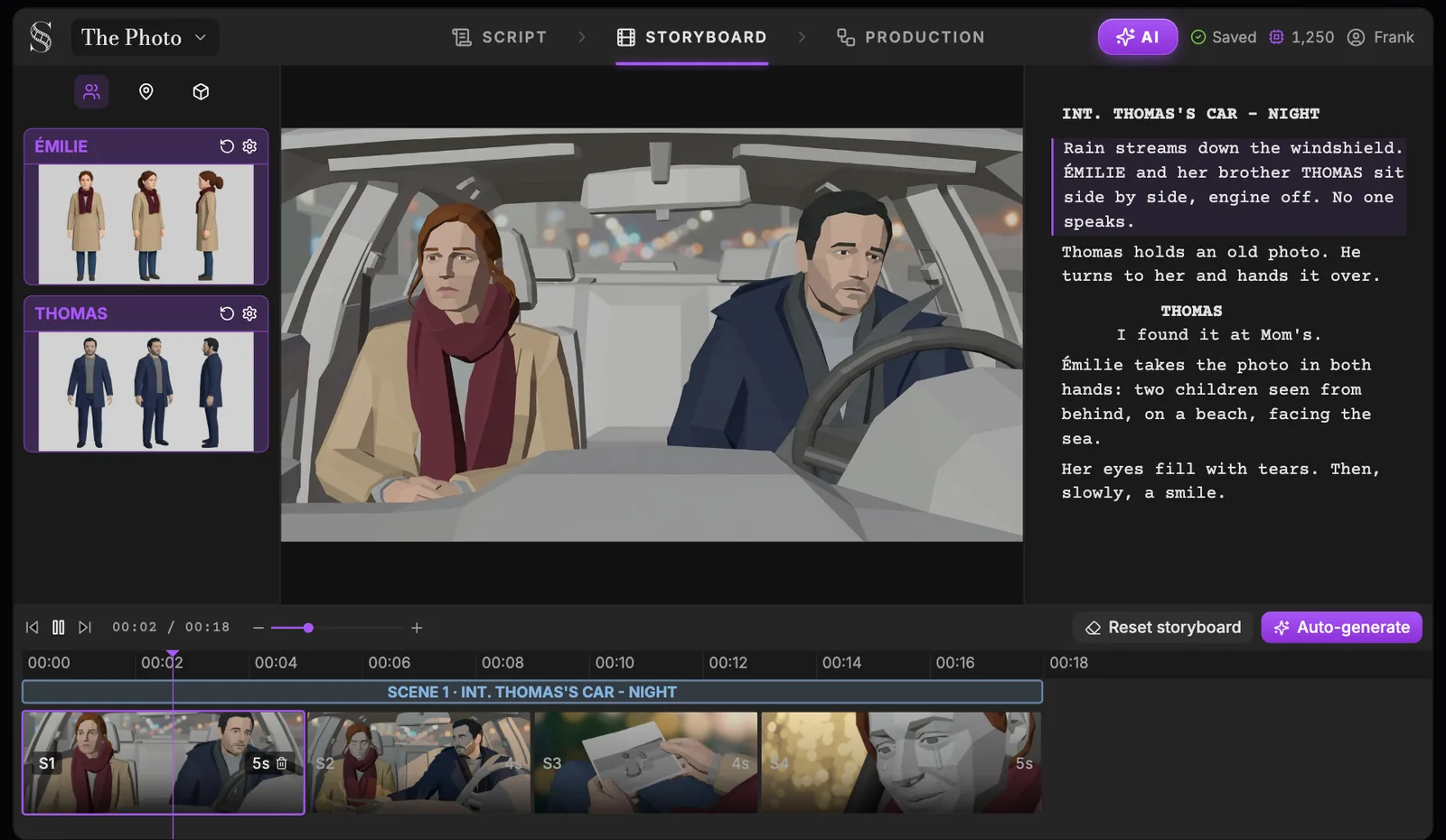
You write the script here. PAI needs a script to start. ScreenWeaver includes a full screenplay editor, free forever on the Screenwriter plan, with Final Draft and PDF import and export, and an AI screenplay writer when you are stuck on a draft.
Boards before video. In ScreenWeaver the storyboard is a stage of its own: panels per shot, with framing, movement and duration, that you can fix cheaply before a single second of video is generated. The AI storyboard generator page shows the steps. In PAI, keyframes are part of the video generation.
Your choice of model, shot by shot. ScreenWeaver runs Kling, Seedance, Veo and other models, so you pick the one that suits each shot instead of one house model.
Free to start. Writing costs nothing, and the paid plans include credits for images and video.
Try it free
Try ScreenWeaver for free on your script
It is free. Import your existing project, get a clearer view of your outline, and regain control of your story structure in minutes.
Start FreeWhat Utopai PAI does better
PAI is built by a company that makes films with it, and it shows in the length and finish of the output: three-minute sequences, 4K, and a model Utopai ranks second on a public leaderboard. Its export to Premiere Pro and DaVinci Resolve hands the cut to a real editor, and its copyright blocks and prompt ledger answer questions a studio's lawyer will ask. If your script is locked and you want the most polished generated footage, PAI is a serious option.
Which one fits you?
- Your script is final and you want long, high-end AI footage: PAI, on Plus or above, once you have priced the seconds you need.
- You are still writing or rewriting: ScreenWeaver, where the script, the boards and the video stay in one project. The guide to making an AI film walks through each step.
- You want to test the story before paying for video: board it in ScreenWeaver, then compare the plans and credits.
For other script-to-video tools, read our LTX Studio alternative page and the Flick comparison, the YC-backed canvas for AI filmmakers.
FAQ
Is Utopai PAI free? No free plan is listed on the PAI page in November 2026. Basic costs $15 a month for 1,000 credits, or $13.50 a month on a yearly plan.
How much video do PAI credits buy? With Utopai X at 1080p, 93 credits a second: about 10 seconds on Basic, 37 seconds on Plus and 107 seconds on Pro. Standard 480p video costs 9 credits a second.
Does Utopai PAI write the screenplay? No. PAI reads and breaks down a script you bring. ScreenWeaver has a full screenplay editor and AI writing help.
Who is behind Utopai PAI? Utopai Studios, an AI film and television studio in Mountain View, California, valued at $1 billion. Its leadership includes CEO Cecilia Shen and co-founders Jie Yang and Zijian He.
Can I export from PAI to Premiere Pro? Yes. Utopai says you can export in 4K or bring the rough cut into Premiere Pro or DaVinci Resolve.
Is Utopai PAI better than ScreenWeaver? For polished, long AI sequences from a locked script, PAI is strong. For writing the script, storyboarding it and choosing a model per shot, ScreenWeaver does more of the work.
Sources: Utopai PAI and pricing, PAI public access, Utopai on Utopai X, Business Wire, April 2026, Post Magazine, PAI 2.0, Señal News, AI Weekly. Read on 8 November 2026.
From script to shots
Turn your script into a film, shot by shot
Write the scene, get its storyboard, then generate each shot with consistent characters. You direct every step.
Start your film free