
The best AI short drama generators come in two kinds. Either an all-in-one studio that takes a story idea and returns finished vertical episodes with a saved cast and AI voices, or a script-first pipeline where you write the season, lock the references, board each shot in 9:16 and route it to a video model. The first is faster to a demo. The second is what survives episode 30. This is a comparison of both, with what each one asks of you.
The workflow behind the second route is in how to make a short drama with AI. This article is about the tools. To see that route on a real episode opening, with the screenplay, the 9:16 boards and the final shots, open the AI short drama generator page.
The two routes
| All-in-one drama studio | Script-first pipeline | |
|---|---|---|
| Input | A story idea, a script, character descriptions | A season grid, scripts per episode, reference sheets |
| Output | Finished 9:16 episodes with voices | Board frames, then clips you cut yourself |
| Character consistency | Saved character with appearance and voice | Reference sheets referenced by name in every prompt |
| Model choice | The studio's | Per shot: dialogue model, motion model, cheap model for inserts |
| Time to first episode | Under an hour | A day, most of it building references |
| Time to episode 30 | Same as episode 1 | Faster than episode 1, because the references and grid exist |
| Where it breaks | The story. A prompt produces a slideshow with a cliffhanger-shaped ending | Your own discipline. Skip the grid and it breaks the same way |
| Who it fits | Testing a premise, a social pilot, a pitch reel | A season, a pitch with sample episodes, anything with a paywall |
ImagineArt AI Drama Studio
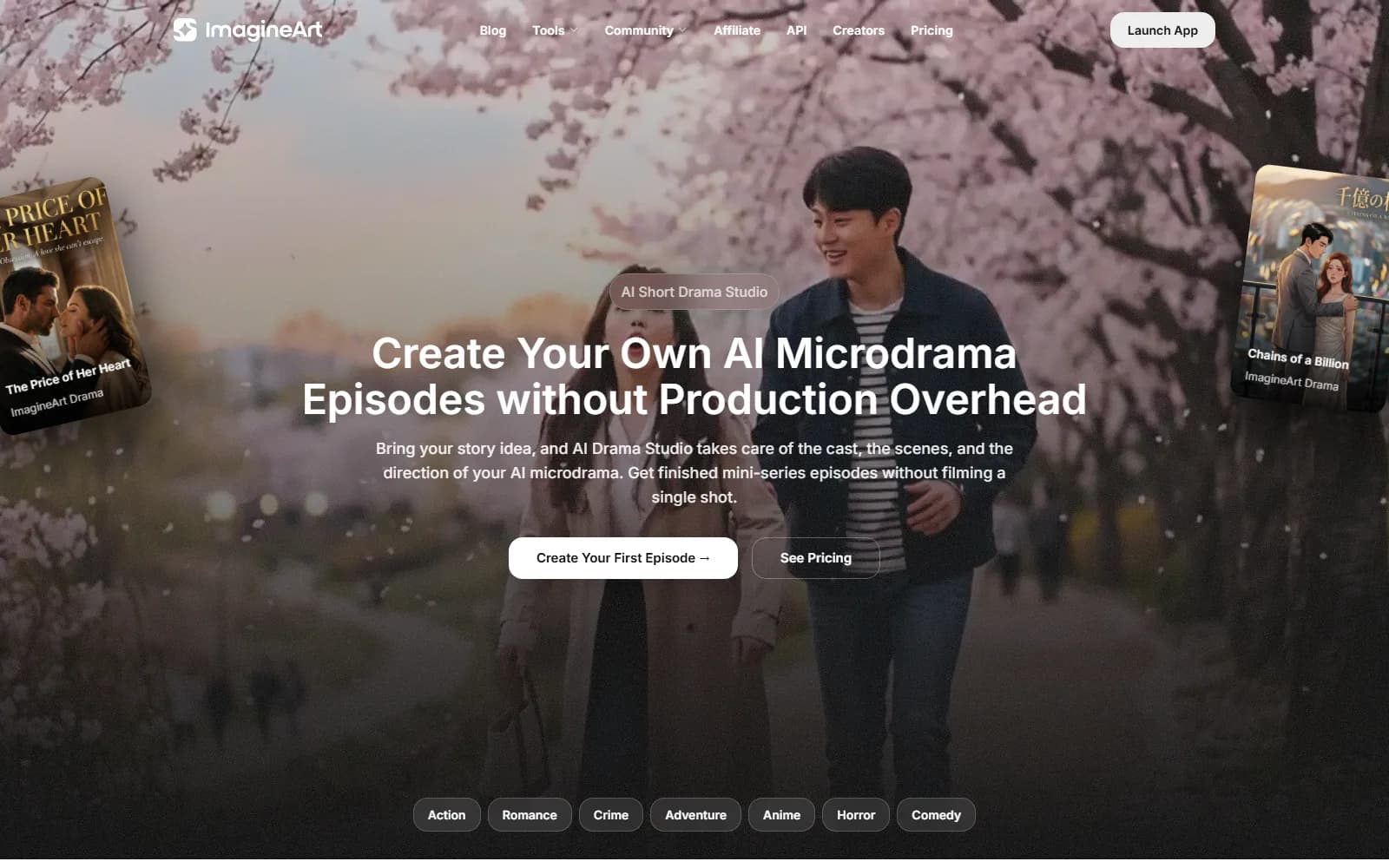
ImagineArt's AI Short Drama Studio landing page, captured 3 September 2026. Genre buttons run from action and romance to anime and horror.
The most complete of the all-in-one studios. You bring a story idea or a script and character specifications, and it produces vertical episodes. Its product page describes the pieces that matter for a series: each character's appearance and AI voice saved as a reusable element and used across every scene and episode, lip-synced dialogue, multi-language dubbing, and episodes of one to three minutes. It also claims a finished episode in under thirty minutes from concept and quotes the standard season at 60 to 70 episodes. Pricing is four subscription tiers with monthly credit allowances, shown in local currency on the page.
What it does well is exactly what a solo creator needs first: a cast that stays the same. What it cannot do is write the season, and a generated episode from a prompt has a cliffhanger-shaped ending without a season-shaped reason for it. Use it with a grid built elsewhere, and paste scripts, not ideas.
Morphic
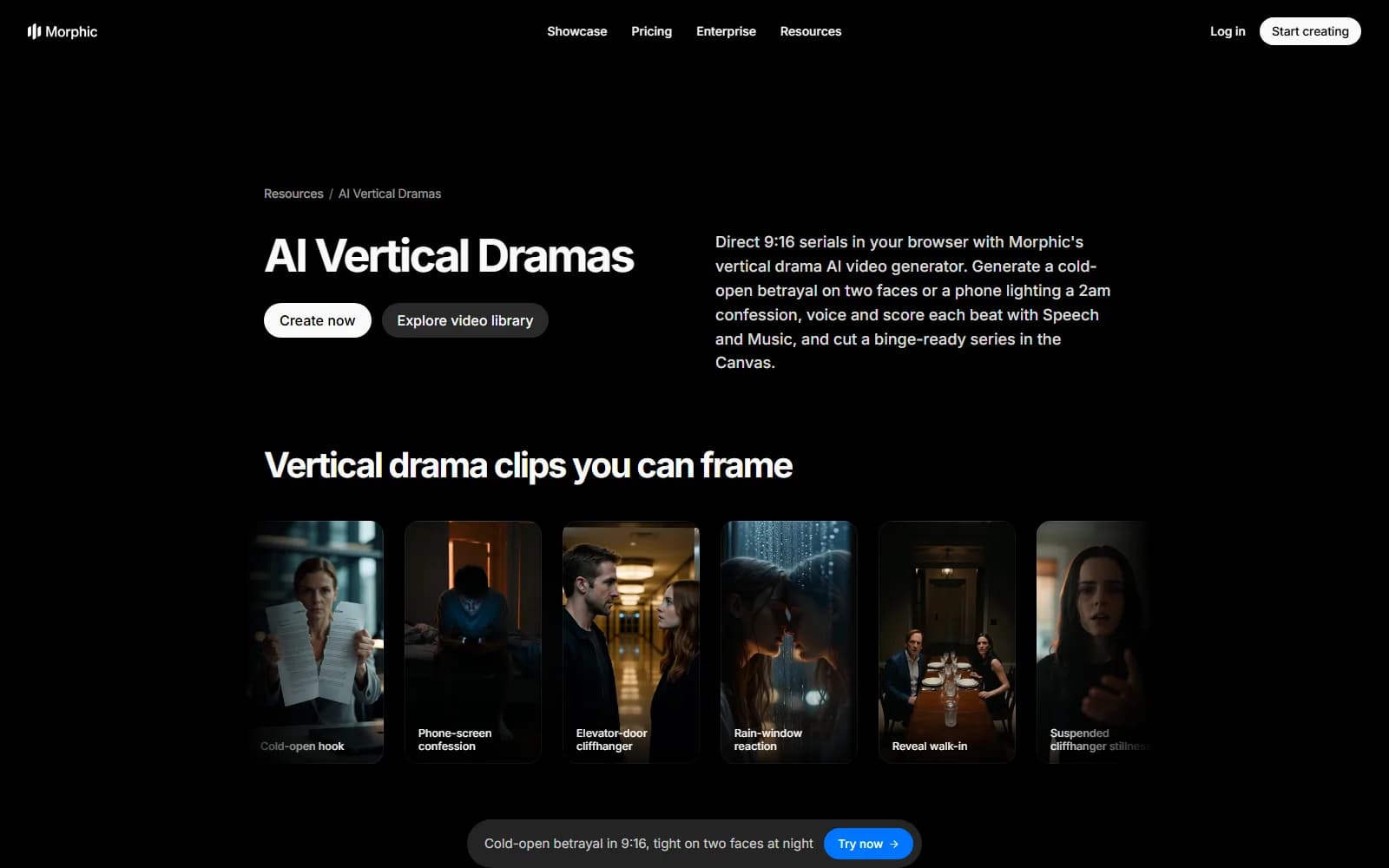
Morphic's vertical drama page, captured 3 September 2026. The sample clips are labelled by structural beat, which tells you the product understands the format.
Morphic is a browser editor that generates 9:16 clips from text, with a Character Lineup workflow that locks a character's wardrobe, face and posture across episodes, a Speech tool for dialogue and voiceover, a Music tool for scoring beats, and a canvas to assemble a series. Its page advises framing faces tight and keeping key gestures in the centre column, which is the right vertical grammar. Pricing runs from a free tier with 20 monthly credits through paid plans from $9 to $170 a month.
It sits between the two routes: clip-first rather than episode-first, so you still cut, but with the cast locked for you. A good fit for a creator who has scripts and wants the generation and the assembly in one place.
invideo
invideo's micro drama guide, captured 3 September 2026.
invideo's approach is agents: a creative producer agent that holds the series bible, a storyboard agent that breaks episodes into shot lists, a DOP agent that routes shots to video models (it names Veo, Kling and Seedance 2.0), then assembly. Character consistency comes from reference sheets ("front, side, three-quarter angles plus close-ups") stored as context, with Seedance 2.0's reference-to-video mode doing the holding. The guide settles on 1.5 to 2 minute episodes and claims $1,000 per episode all-in for a three-person team producing ten episodes in three days, and $500 to $650 per finished minute.
Those numbers are invideo's own for a specific production and include people. The generation share of an episode is far lower; the production cost article separates the two.
The script-first route: ScreenWeaver plus a model picker
The route this blog is built on starts from the script, because the script is where the season lives.
- Season grid in the short drama episode planner: five movements, a cliffhanger shape per episode, the paywall episode pinned.
- Scripts in ScreenWeaver, with the Episode level of the outline holding one node per episode, in the format the platforms read.
- Story elements for the cast and the locations, each with a reference sheet built from a description or from your own images.
- Storyboard generated per shot in 9:16 from the script, with the prompts referencing the story elements by name.
- Production routed per shot to the model that fits: one with native speech for dialogue, one that respects references for the cast, a cheap one for inserts. The AI video model picker filters current models by native audio, clip length, resolution, image-to-video and price.
- Edit the clips to the recorded lines, cliffhanger and next hook as a pair.
Writing and outlining are free. The storyboard and video generation both come with the Auteur plan at $39.99 a month, with 6,000 credits a month, and both are available today. It is slower to a first episode than the studios and faster to episode 30, because nothing is rebuilt.
Try it free
Try Screenweaver for free on your script
It is free. Import your existing project, get a clearer view of your outline, and regain control of your story structure in minutes.
Start FreeChoosing, by what you are making
| You are making | Use |
|---|---|
| A 60-second test of a premise for a social feed | An all-in-one studio, from a script, not a prompt |
| A ten-episode social pilot | Morphic or the script-first route, with a grid |
| Sample episodes for a platform pitch | Script-first. The platform reads the script and the grid before the video |
| A 70-episode paywalled season | Script-first, with a model picker per shot type and a retry budget |
| A pitch reel for a live-action series | Any of them. The reel sells the tone, the script sells the show |
What none of them do
- Write a season grid. Every tool generates from what you give it, and what you give it has to contain the paywall episode, the midpoint and the finale.
- Keep a costume consistent across 70 episodes unless the costume is in the reference, not the prompt.
- Handle two bodies touching, a door into a new location, or a long lip-synced speech. The pipeline article lists the workarounds.
- Replace the edit. Cliffhanger and next hook are cut as a pair by a person who has read the grid.
FAQ
What is the best AI short drama generator?
For a finished episode from a script with a saved cast and voices, ImagineArt's AI Drama Studio is the most complete all-in-one. For clips with locked characters that you assemble, Morphic. For a season you intend to finish, a script-first pipeline: grid, scripts, reference sheets, 9:16 storyboard, then a model per shot type.
Can an AI generator write the short drama for me?
It can write episodes from a prompt, and they will have the shape of a short drama without the spine of one. The paywall episode, the midpoint reversal and the finale are decisions about the whole season, and no per-episode generator makes them. Write the grid, then generate.
Which AI video model is best for vertical drama?
It changes monthly, and the right answer is per shot type: a model with native speech for dialogue, one that respects references for the cast, a cheap one for inserts and establishing shots. The model picker keeps the current roster filtered by those needs.
How do these tools keep characters consistent?
All of them save a character and reuse it: ImagineArt as a reusable element with a voice, Morphic through its Character Lineup, invideo through reference sheets held as context, ScreenWeaver through story elements with reference sheets referenced by name in each shot prompt. The quality of the reference (three face angles, each costume, key expressions) matters more than the tool.
How much do AI short drama generators cost?
Morphic publishes a free tier and paid plans from $9 to $170 a month; ImagineArt sells four credit-based tiers; ScreenWeaver's writing is free, and storyboard and video generation come with the Auteur plan at $39.99 a month, 6,000 credits included. The tool subscription is the small line. Generation retries are the large one, and the cost article does that arithmetic.
Do I still need to storyboard if the generator makes whole episodes?
Yes, at least at the level of three frames per episode: the hook image, the turn, the cliffhanger. Those three are the frames the episode cannot survive without, and a generator that invents them from a prompt invents the wrong ones.
Final Step
Build your next script with Screenweaver
Move from ideas to production-ready pages faster with timeline-native writing and AI-assisted story flow.
Try Screenweaver