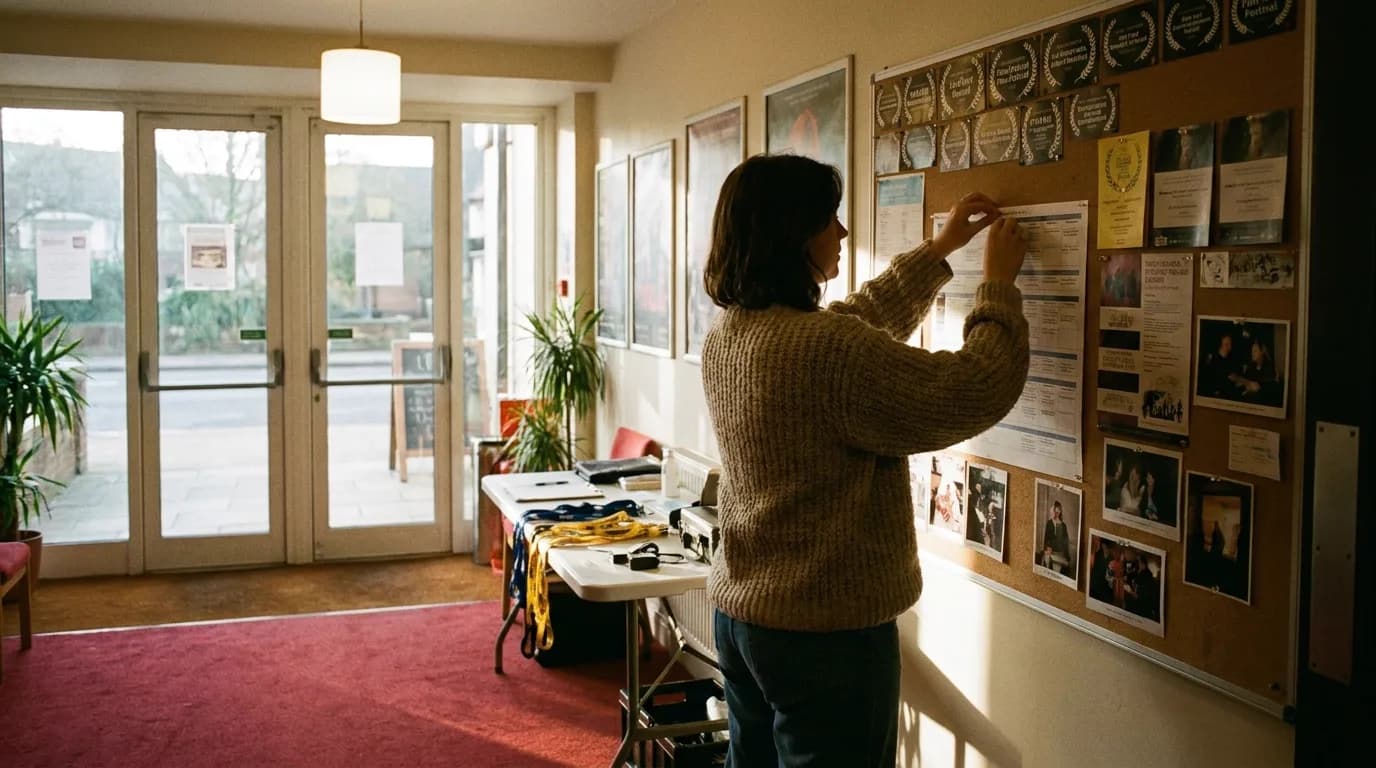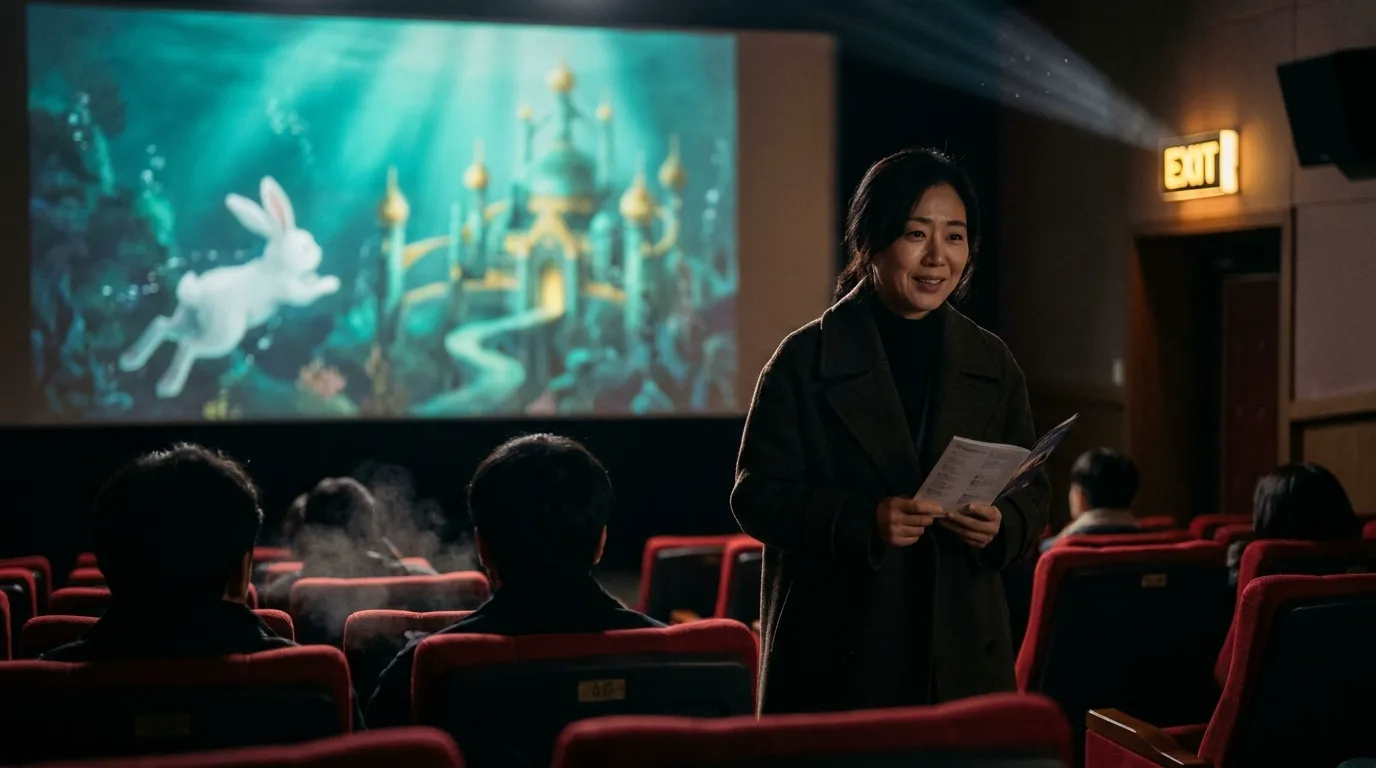
The 52nd Seoul Independent Film Festival, which runs from 25 November to 4 December 2026, will premiere seven short films made with generative AI by established Korean directors, Lee Myung-se among them. The films form a new AI Cinema Special section and get their own showcase at CGV Apgujeong in Seoul on 27 November.
The news comes from Korea JoongAng Daily, published on 4 November 2026 at 5:10 p.m. after the festival's press conference, and translated from a Korean report by Na Won-jeong. We read it on 6 November, along with the programme on the festival's own site, siff.kr, which lists the seven titles with their runtimes. We have not seen the films. What follows is what the festival and the paper say, and what we think it means for people who make films with AI.
What the festival announced
The Seoul Independent Film Festival (SIFF) is not an AI festival. It is Korea's long-running festival for independent cinema, now in its 52nd edition, hosted by the Korean Film Council and the Association of Korean Independent Film and Video, and this year it received a record 1,917 submissions for 129 new films: 86 shorts and 43 features. That is what makes the AI section news. An AI film festival showing AI films is routine. A major independent festival building a section for them, with names Korean audiences know, is a different signal.
According to JoongAng Daily, the festival launched the project "to explore the creative possibilities borne from using generative AI." Each of the seven directors worked with an AI creator, and they used "commercially available generative AI models selected to suit their film's subject matter and genre." The paper names the companies that provided the technology: Kling AI, BytePlus, TapNow, MiniMax and ElevenLabs. Kling's logo also sits among the sponsors on siff.kr.
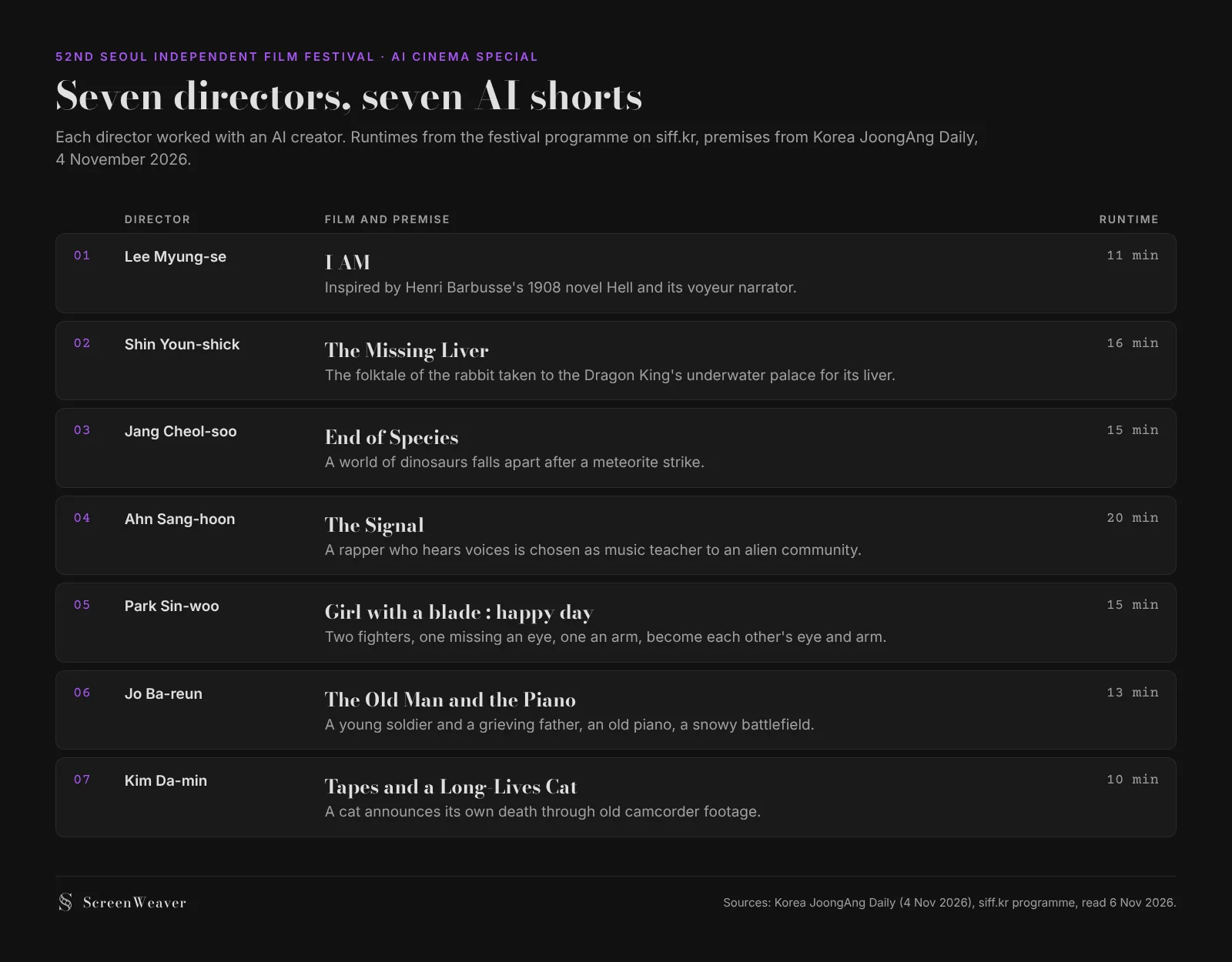
The seven films, as the paper describes them:
- I AM by Lee Myung-se, the director of Duelist (2005) and The Killers (2024). It draws on Henri Barbusse's 1908 novel Hell, narrated by a man who watches his neighbours through a hole in the wall. The paper calls the synopsis "particularly abstract."
- The Missing Liver by Shin Youn-shick, a retelling of the Korean folktale in which a rabbit is lured to the Dragon King's underwater palace because the ailing king wants its liver.
- End of Species by Jang Cheol-soo, about a world of dinosaurs that collapses after a meteorite strike.
- The Signal by Ahn Sang-hoon, in which a rapper with auditory hallucinations is picked as a successor, to become music teacher to an extraterrestrial community.
- Girl with a blade : happy day by Park Sin-woo, the director of White Night (2009). One protagonist has lost the left eye, the other the left arm, and they fight monsters by becoming each other's eye and arm.
- The Old Man and the Piano by Jo Ba-reun, about a young soldier and a man who lost his son, brought together by an old piano on a snowy battlefield.
- Tapes and a Long-Lives Cat by Kim Da-min, who recently directed the Netflix series Dead-End Job. A cat announces its own death through old camcorder footage.
The AI Cinema Special will also screen winning films from an AI film competition run by the Korea Racing Authority, and AI films made in the Korean Academy of Film Arts training programme. The paper gives no titles or prizes for either.
The dates
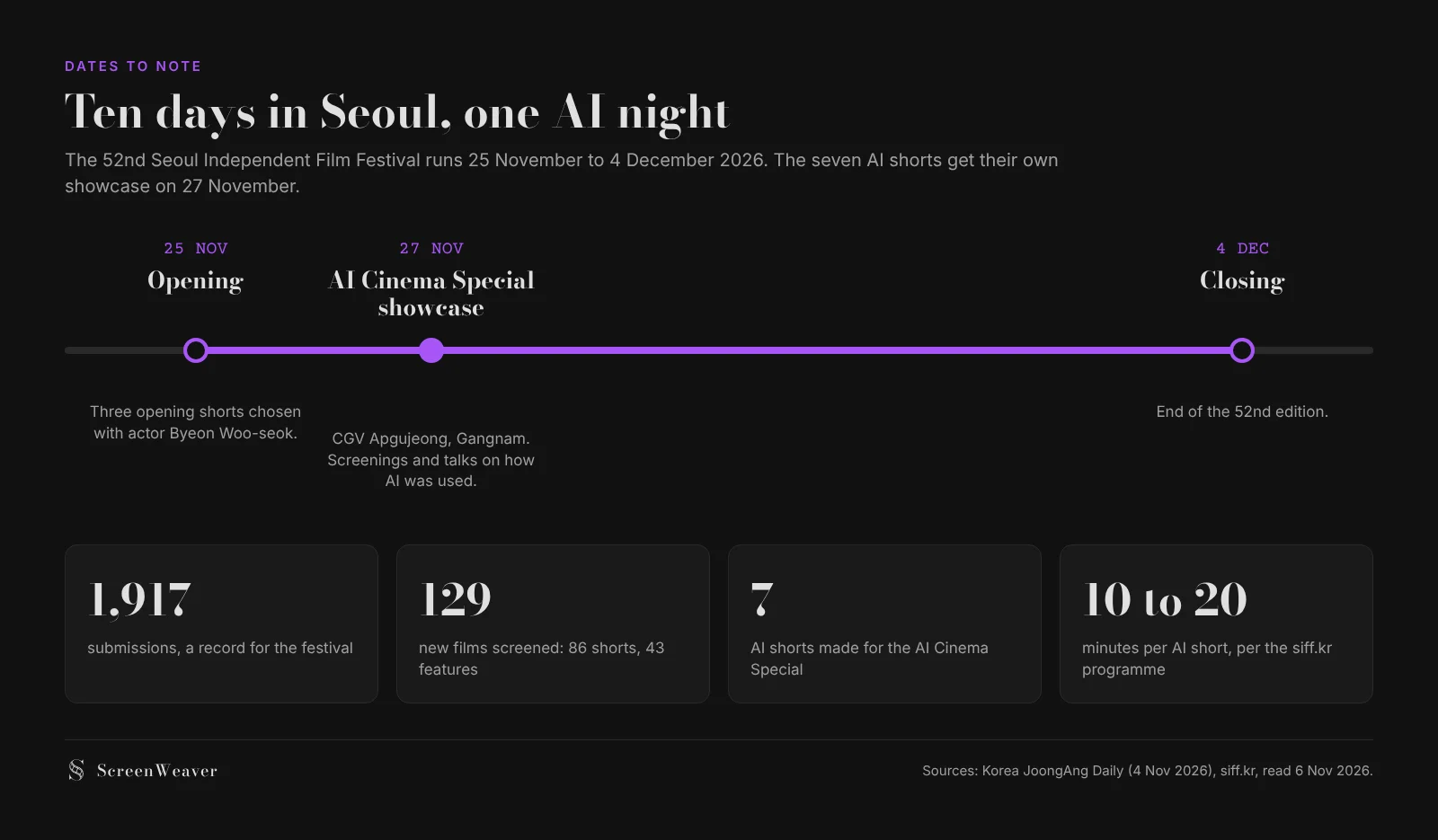
The showcase on 27 November at CGV Apgujeong, in Seoul's Gangnam District, combines screenings with talks on how each film was made and how AI was used. If you are in Seoul that week, that evening is the one to book: hearing seven directors explain where the tools helped and where they fought them is worth more than any trailer. The siff.kr homepage we read did not list individual screening times for the seven shorts.
What it says about AI filmmaking
The festival's executive director, Kim Dong-hyun, framed the project carefully at the press conference: "We believe that AI can serve as a meaningful assistant in the creative process rather than replace existing creators." He also said new technologies, including efforts to reduce production costs, are influencing how many films get made.
Three things stand out to us.
The director stays the author. The setup is a known filmmaker paired with an AI creator who runs the tools, a split that looks a lot like a director and a cinematographer. The siff.kr programme credits a second name on every short. For anyone trying to get an AI film into a mainstream festival, that is a useful model: the selling point is a voice and a story, and the tools are named as tools.
The stories are ones live action struggles to afford. Dinosaurs and a meteorite, an underwater palace, an alien community, monster fights, a snowy battlefield. None of these is a talking-heads drama. They are the genres where a small budget used to mean no film at all, which is exactly where independent directors are reaching for AI first.
These are long shorts. The programme lists runtimes from 10 to 20 minutes. Holding a face, a costume and a place steady for 20 minutes is much harder than for a 60-second piece, and it is where most AI films still fall apart. Our guide to character drift in AI video covers what breaks first.
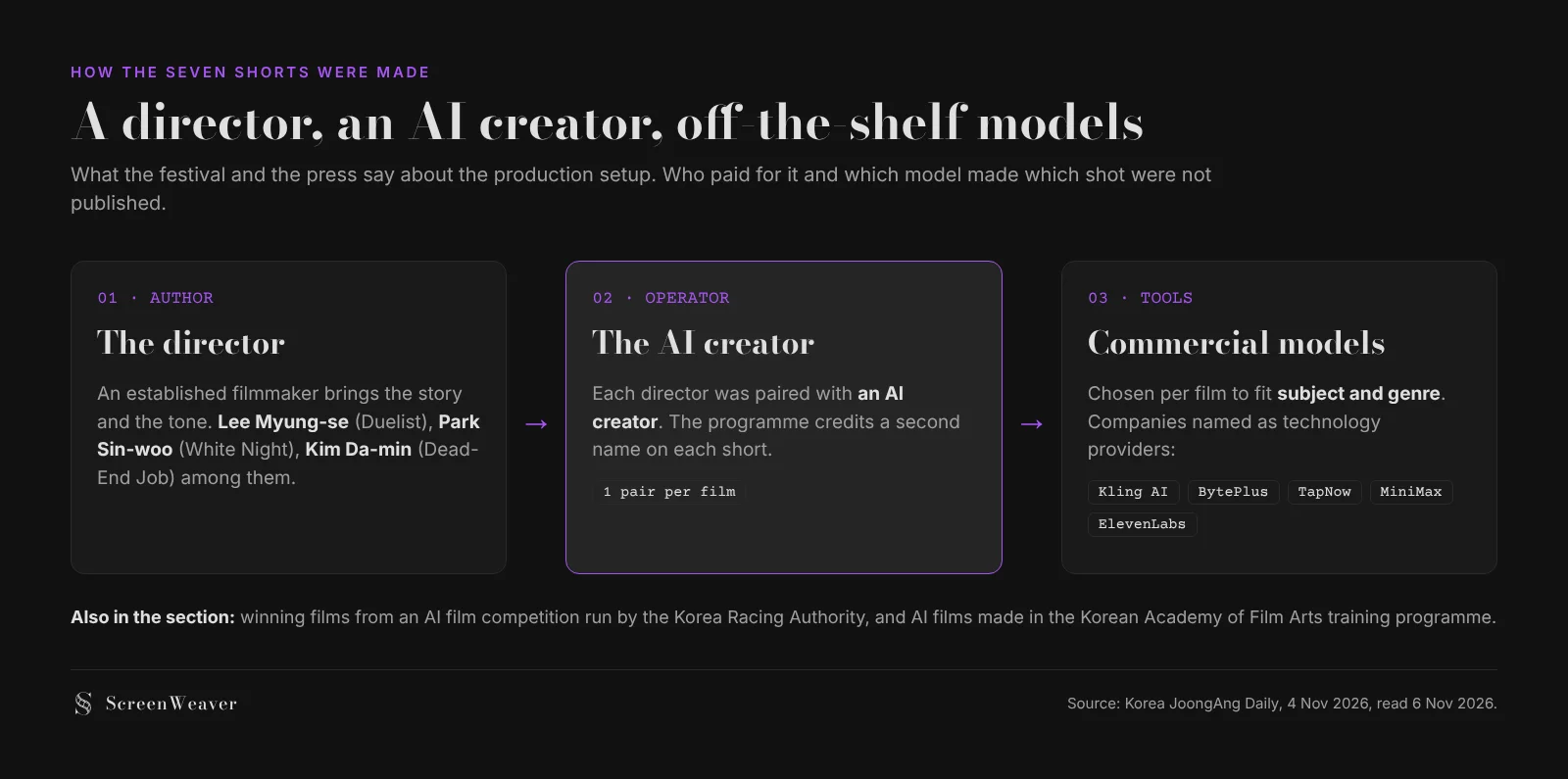
What we do not know yet: who paid for the seven films, how much each cost, and which model produced which shots. The paper lists the providers as a group. We will update this article if the festival publishes production notes after the showcase.
Try it free
Try ScreenWeaver for free on your script
It is free. Import your existing project, get a clearer view of your outline, and regain control of your story structure in minutes.
Start FreeWhere this fits among AI film festivals
Do not confuse SIFF with the Seoul International AI Film Festival, which is a dedicated AI event, or with the Korea AI Cinema Festival. Korea now has several AI-only festivals and mainstream festivals that are still working out their rules, as our page on AI films at Busan shows. The full list of open calls and deadlines is on our AI film festivals hub, and our guide to AI film festivals in 2026 explains how to choose where to submit.
The AI Cinema Special itself is curated and was not an open call. If you want to be in a section like this next year, the route is the one the seven directors took: a finished, coherent film with a clear authorial voice, and a crew that can explain its process on stage.
What this means if you work in ScreenWeaver
Two of the providers named by the festival are in ScreenWeaver's video node today: Kling 3.0 and MiniMax H3, next to Seedance 2.5, the ByteDance model that BytePlus distributes, which is the node's default. We have no link with the festival or its films, and nothing here says which of those models the seven directors used.
What carries over is the method. A 15-minute AI short holds together when the script is locked, every character and place has one reference image that each shot cites, and the storyboard is approved before a single clip is generated. That is the order our storyboard-first workflow describes, and the node canvas walkthrough shows how a shot pulls those references in.
Checklist if you are aiming at a section like this
- Write a script that stands without the AI: a premise a programmer can pitch in one sentence.
- Pick a story that live action could not afford at your budget, then make the tools serve it.
- Name your crew roles clearly: who directs, who runs the models, who edits and mixes sound.
- Build a reference sheet for every recurring character, place and prop before generating.
- Watch the full cut for drift at minutes 5, 10 and 15, not only in the first shot.
- Keep a short production note: tools used, what each did, what you did by hand. More festivals ask for one.
- Check each festival's AI rule before you pay a fee. Our festivals hub lists them.
FAQ
When is the 2026 Seoul Independent Film Festival? The 52nd edition runs from 25 November to 4 December 2026, according to the festival's site, siff.kr.
What is the AI Cinema Special? A section of this year's festival with seven short films made with generative AI by Korean directors, each working with an AI creator. It also screens winners of a Korea Racing Authority AI film competition and AI films from the Korean Academy of Film Arts training programme.
Which directors made AI films for the festival? Lee Myung-se, Shin Youn-shick, Jang Cheol-soo, Ahn Sang-hoon, Park Sin-woo, Jo Ba-reun and Kim Da-min, according to Korea JoongAng Daily.
When and where is the AI showcase? On 27 November 2026 at CGV Apgujeong in Gangnam District, Seoul, with screenings and talks on how the films were made and how AI was used.
Which AI tools were used? The directors used commercially available models chosen per film. Korea JoongAng Daily names Kling AI, BytePlus, TapNow, MiniMax and ElevenLabs as the companies that provided the technology, without saying which film used which.
Can I submit an AI film to the Seoul Independent Film Festival? The AI Cinema Special was a curated project, not an open call, and the 2026 programme is set. For festivals with open calls for AI films, see our AI film festivals hub.
From script to shots
Turn your script into a film, shot by shot
Write the scene, get its storyboard, then generate each shot with consistent characters. You direct every step.
Start your film free