
A micro-budget feature is not a short film with ambition. It is a feature-length story told inside a location budget that would embarrass a sitcom. Page count and locations are the two levers that decide whether your script becomes a movie or a fundraising mirage. At this tier, every new slug line is a potential company move, and every extra ten pages is another day you probably cannot afford.
This guide gives you practical page count targets and a location strategy that keeps drama intact while the production stays on its feet.
Free tool: use the Script Time Calculator to estimate your runtime from page count.
How It Works: The Micro-Budget Sandbox
Micro-budget features typically land between $50K and $250K all-in, often with deferred labor and donated locations. That reality implies:
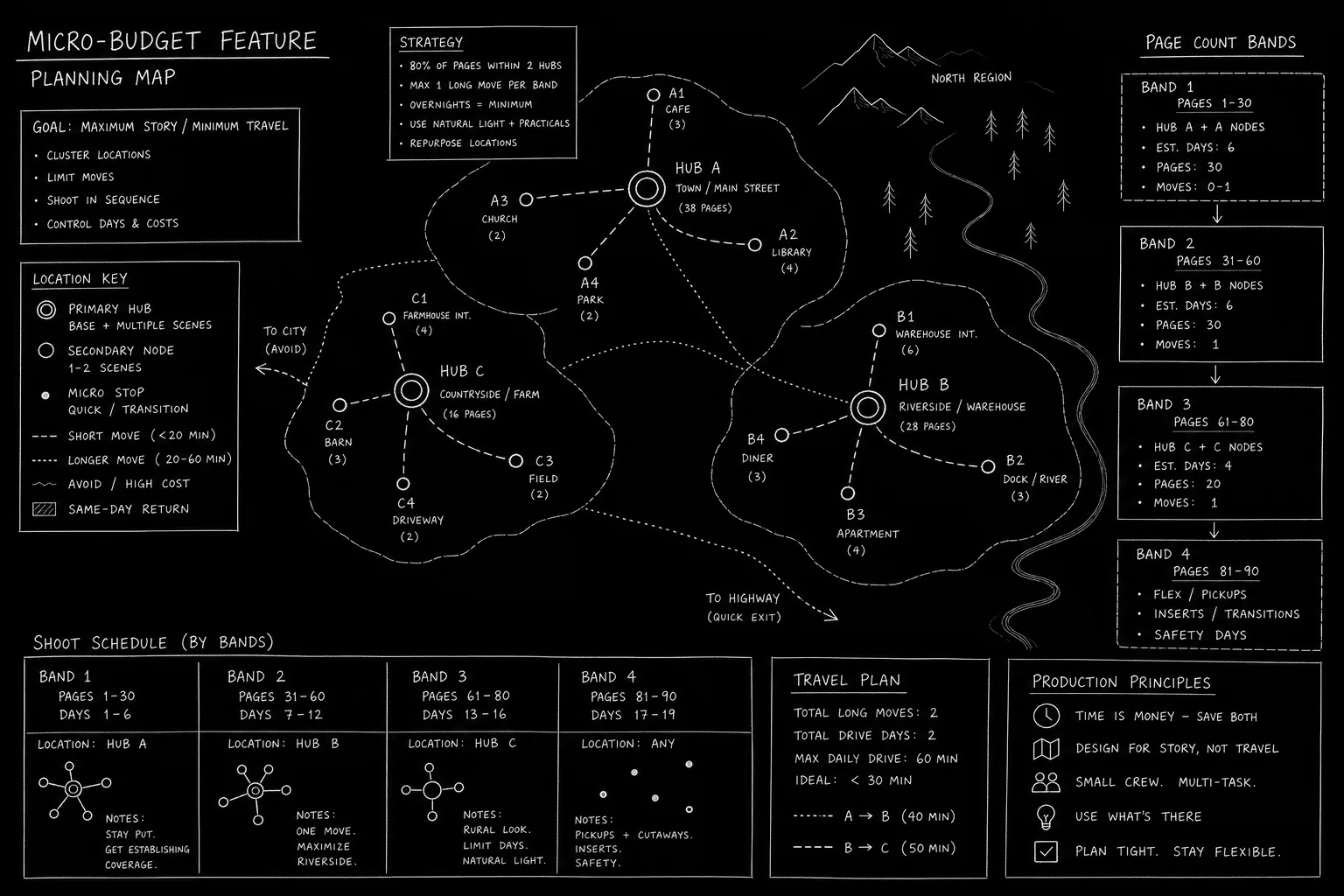
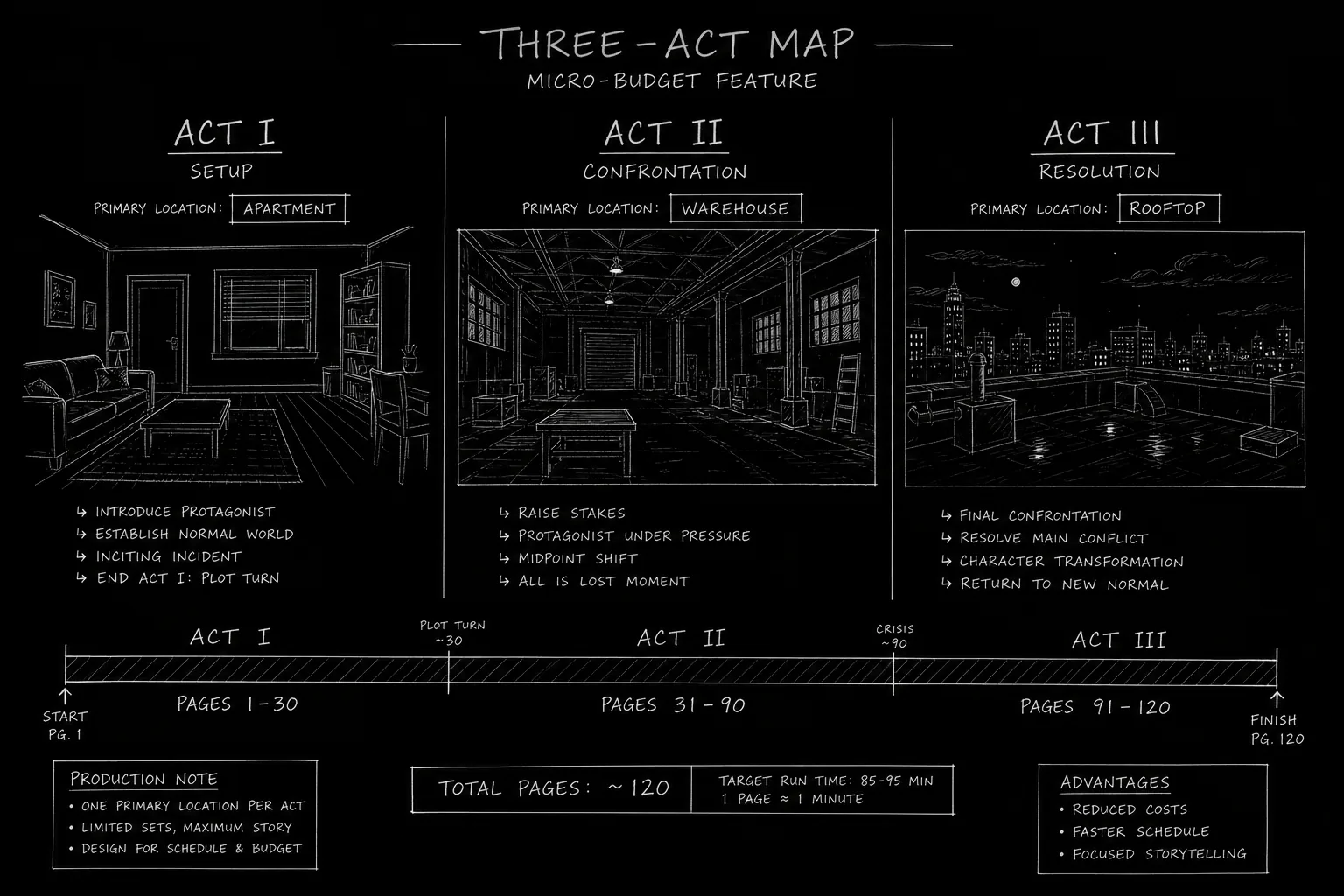
- 75-95 pages for many debut features (not 120 by default)
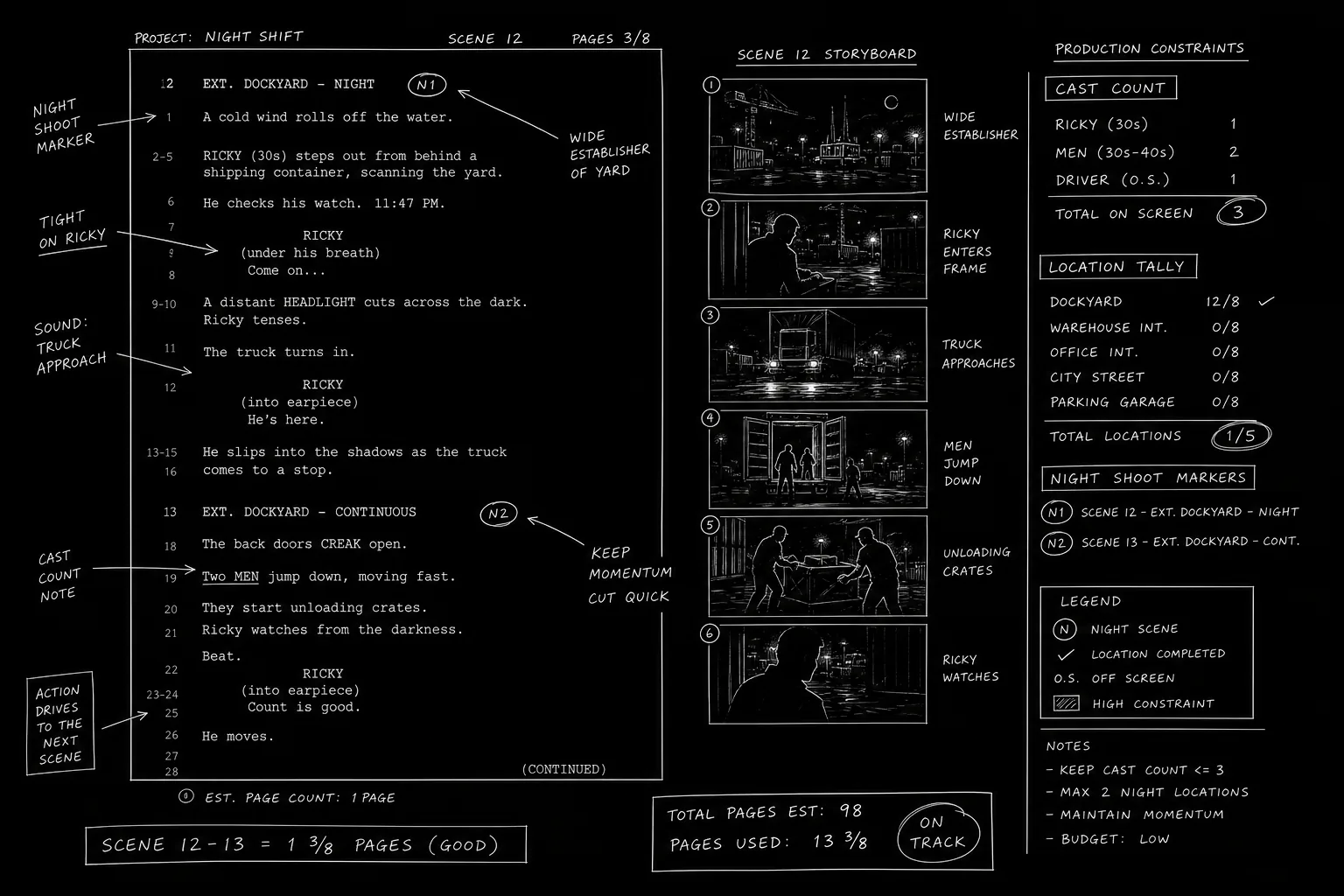
- 3-6 primary locations, plus controlled inserts
- Small speaking cast with layered non-speaking atmosphere where needed
- Day interior bias to avoid lighting night exteriors on a shoestring
Page count is not arbitrary compression. It is rhythm control. Shorter scripts force earlier inciting pressure and cleaner subplots. Location strategy is narrative geography: design the story world so characters naturally circulate inside places you can access for free or cheap.
Cross-reference low-budget screenplay rewrite for production constraints when finance notes arrive after your first draft lock.
Platform and Use-Case Sections
Festival-First Features
Festivals reward clarity and performance. A tight 85-page thriller in three locations often outperforms a sprawling 110-page drama that cannot be shot. Programming teams imagine completion.
Genre Micro-Budget (Horror, Thriller, Noir)
Genre gives you stock pressure: the house, the road, the clinic. One strong container plus one contrast location (wide exterior, public interior) can carry a full film.
Relationship Dramas
Two-handers and trios dominate micro-budget relationship work. Page count stays lean when the conflict is conversational and spatially contained.
Proof-of-Concept Features
Some teams shoot a micro feature to sell a larger version. Write the micro script as self-contained, not a truncated pilot. Investors hate "Chapter One" that does not resolve.
Relatable Scenario: The Inheritance Drama
Your first draft visits six family homes across two states. Micro rewrite: everyone must meet at one house for the reading of the will. Act I arrivals carry backstory; Act II revelations happen in the same dining room with different seating arrangements; Act III uses the backyard for the final walkout. Same themes, one primary location, eighty-nine pages.
Relatable Scenario: The Stalker Thriller
Thrillers tempt location sprawl: home, office, parking garage, subway, safe house. Micro version: protagonist is quarantined to one building (hotel, hospital, apartment complex) and the threat is inside the footprint. Page count drops because you are not writing transit. Tension rises because there is nowhere clean to run.
Location Strategy Table
| Strategy | Dramatic Effect | Production Win |
|---|---|---|
| Single-container | Claustrophobia | One company move |
| Hub-and-spoke | Return ritual | Reuse core set dressing |
| Day interior bias | Normalized life | Lighting speed |
| Digital scale | World feels big | Phone/laptop inserts |
| Public one-shot | Social pressure | One permit day |
Step-by-Step: Page Count and Location Design
Step 1 - Set a page ceiling before Act Two
Pick 80, 90, or 100 based on cast availability and financing path. Write the outline to that ceiling, not the other way around.
Step 2 - Audit locations in the outline
One location per act is a classic micro pattern: home (Act I), workplace or public (Act II), consolidated climax site (Act III). Variation is fine; sprawl is not.
Step 3 - Merge scenes by emotional function
If two scenes both deliver "protagonist loses trust," combine them in one slug with a turn at midpoint.
Step 4 - Cut travel
Characters should not drive across town between every beat unless the road is the point. Use phone, text, or off-screen mention per formatting phone calls when a face-to-face meeting is not essential.
Step 5 - Schedule-friendly day split
Design slugs so a company can shoot Location A morning and Location B afternoon without a company move on the same day when possible. Timing each scene with an eighths of a page calculator shows how those half days actually stack up.
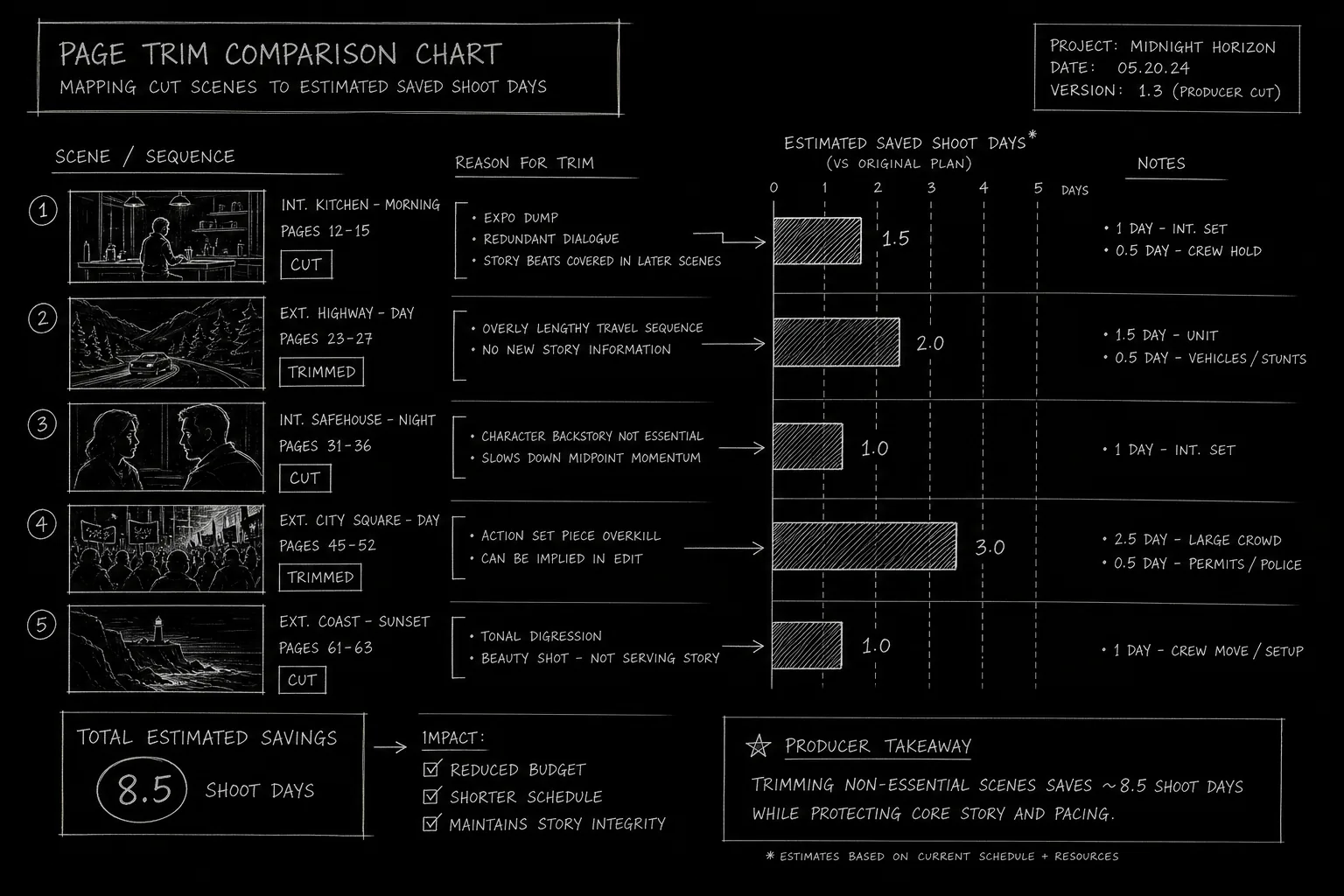
Step 6 - Final page trim pass
Cut 5-10 pages of connective tissue: repeat arguments, duplicate revelations, entrance scenes that could start mid-conflict.
[YOUTUBE VIDEO: Line producer walks through a real micro-budget script, highlighting how each removed location saved a company move and how page trim shifted pacing.]
Try it free
Try Screenweaver for free on your script
It is free. Import your existing project, get a clearer view of your outline, and regain control of your story structure in minutes.
Start FreeOperational Requirements: What Producers Need on the Page
Slug discipline: Clear INT/EXT, DAY/NIGHT. Ambiguous slugs become expensive guesses.
Cast list realism: Eight speaking roles is a soft ceiling for many micro shoots. Name only characters with lines that advance plot.
Action line economy: Micro budgets have little time for complex blocking. Write clear, shootable behavior without unfilmable abstraction.
Insert planning: Car interiors, mirrors, windows, and phone screens are cheap scale expanders if scripted intentionally.
Weather and season: Write for available season. Snow and heat waves cost money at this tier.
| Page Range | Typical Micro Use | Risk Profile |
|---|---|---|
| 70-80 | Tight genre, two-hander | Underdeveloped if theme-heavy |
| 81-95 | Festival sweet spot | Balanced |
| 96-105 | Ambitious single-location | Schedule creep |
| 106+ | Rare without finance bump | Red flag for debut |
Outcome: A Script That Can Actually Be Shot
When page count and locations align with micro reality, teams move from "love the writing" to "we have dates." Investors see a path: 12-18 shoot days, manageable cast offers, clear location agreements.
The creative outcome is focus. A 88-page thriller in four locations often feels more professional than a 115-page epic that dies in development.
Why It Matters: Feature Fantasy vs Shootable Feature
The old way: Write a 120-page debut with nine cities because that is what "real movies" look like on shelf. Hope someone else solves logistics.
The new way: Choose page count and location count as creative constraints in the outline phase. Design the film you can shoot this year.
Micro-budget success is not a lottery ticket. It is geography and length chosen on purpose.
Conclusion
Your micro-budget feature is built in the outline room, not the crowdfunding video. Set a page ceiling, cluster locations, merge scenes by function, and trim connective fat last. The script should make a line producer relax, not negotiate reality for you.
When you lock the draft, run the same discipline on exports with exporting production PDF and FDX so pagination matches the trimmed length. Write the movie you can shoot in two weeks and three houses. That movie gets made.
Page count discipline also improves festival Q&A. When audiences ask "how did you make this," you have a coherent answer: "We wrote it for the house we had." That story sells the next project more than visual effects ever could on this tier.
If your outline resists compression, ask whether you are writing a feature or a miniseries. Some stories need eight hours. Micro features punish that ambition. Honest recalibration early saves years of development fog.
Writers sometimes fear short page counts look "unprofessional." On the micro tier, the opposite is true. A 118-page micro script signals you have not thought about production. An 86-page script with location discipline signals you are ready to shoot. Program your outline template with location caps before you write slug one. Constraints first, prose second. That order is how micro-budget writers finish films instead of filing them.
Final Step
Build your next script with Screenweaver
Move from ideas to production-ready pages faster with timeline-native writing and AI-assisted story flow.
Try Screenweaver