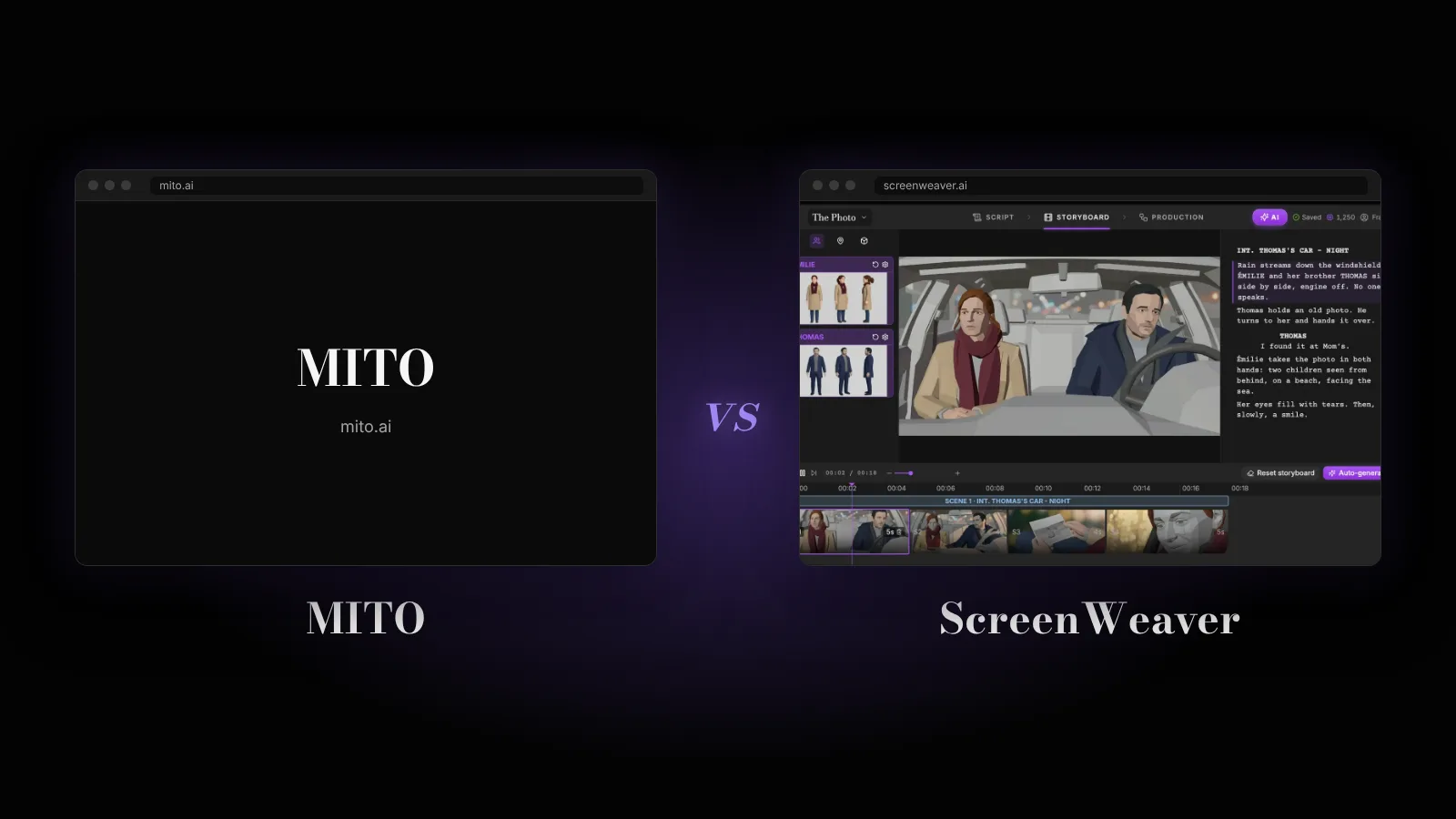

MITO (mito.ai) is a browser-based "agentic video platform" from a Madrid and San Francisco startup that raised a $4.5M pre-seed led by Lightspeed. Its Director agent turns a brief into a script, a shot list, a storyboard and a cut you can export to Premiere Pro or DaVinci Resolve. It is free to start (4,000 credits, once), then $45 a month for one person or $65 per seat for teams.
The verdict: pick MITO for brand films and ads made by an agency team from a brief. Pick ScreenWeaver if your story starts as a screenplay or a series.
Every MITO fact below comes from mito.ai (home, pricing, Director, canvas and timeline, collaboration, MCP pages, legal notice, blog posts of 10 July and 18 November 2026), its Business Wire release (29 January 2026), SiliconANGLE (30 January 2026), Wayra (16 July 2026), Marketing Directo (25 May 2026) and Reason Why (26 May 2026), all read on 21 November 2026.
What MITO is
MITO calls itself "your creative team, supercharged by AI agents" and targets "brands, agencies, and studios". You give it a brief ("images, videos, PDFs, scripts and brand guidelines"), and the work moves through five steps: Brief, Elements, Create, Assemble, Review & ship.
- Director, the agent. "Director reads the brief and your shots, then writes the script and the shot list." Every scene is then "laid out on the canvas, so you can change the story before a frame is made", each shot is made "with the model that suits it", and the shots are cut together with voices, music and sound.
- A canvas and a timeline. An "AI storyboard canvas" for ideas, then a timeline for video, audio and music. You "export the cut to Premiere Pro or DaVinci Resolve": an OpenTimelineIO ZIP for Premiere or an OTIOZ bundle for Resolve, or MP4 and ProRes files.
- Many models. The pricing page counts 23 image, 26 video, 11 audio and 4 avatar models, among them Seedance 2.5, Kling 3.0, Veo 3.1, Nano Banana Pro, FLUX.2 Pro, Lyria 3.5 and ElevenLabs.
- Built for teams. "Several people work on the same canvas and timeline at once." A comment on a shot "becomes a task for your team", clients can be invited to comment, and storyboards can be shared "for sign-off" before generation.
- An MCP server. Since 18 November 2026, "Claude, Claude Code, ChatGPT and Codex can work inside your MITO account", with no API key.
Who is behind it: Business Wire and SiliconANGLE report $4.5M led by Paul Murphy at Lightspeed, with Kibo, Kfund, Sequoia and a16z scouts and LifeX; Telefónica's fund Wayra invested in July 2026 (amount not disclosed). Danny Saltaren is cofounder and CPO; Wayra names Iñaki Berenguer as cofounder and CEO. MITO also has a production arm: Marketing Directo reports that Movistar's World Cup spot was "producido conjuntamente por ROMA y MITO AI". MITO's own case study says the 120-second spot was 95% AI and used over 5,130 generated assets; those are its figures.
What the pages leave out or contradict:
- Which price is the real entry price. The plan card shows Individual at $45 a month for 25,000 credits ("Was $56"). The FAQ says "Individual costs $18 per month for 10,000 credits". Read it as $18 for the smallest credit tier.
- Whether MCP is live. The 18 November blog post says it is; the MCP and Plugins product page still marks Claude and ChatGPT as "Coming soon".
- A screenplay editor. Director writes a script from your brief, but no page describes a formatted screenplay editor or Final Draft and Fountain import.
- A phone app. None found. MITO is a website.
- A clean free plan. "Watermark-free downloads" are not included on Free, and its 4,000 credits are "Given once. They don't refresh."
MITO vs ScreenWeaver, side by side
| MITO | ScreenWeaver | |
|---|---|---|
| Made by | MITO (legal notice: MITO Films Inc., Waltham, Massachusetts; contracts with MITO Films Innovations SL, Madrid) | ScreenWeaver |
| Can you use it? | Yes, in the browser | Yes, web, installable on any phone browser |
| Price (21 Nov 2026) | Free (4,000 credits once), Individual $45/mo (25,000 credits; from $18 for 10,000 per the FAQ), Team $65 per seat/mo, 2 seats minimum, Enterprise custom | Screenwriter free, Auteur $39.99/mo (6,000 credits), Studio $149.99/mo (25,000 credits, unlimited seats) |
| Starts from | A brief: images, videos, PDFs, scripts, brand guidelines | A blank page or your script (PDF, Final Draft, Fountain, text) |
| Screenplay editor | No, Director writes a script for you | Yes, a full script editor, free |
| Storyboard | Yes, on the canvas, shared for sign-off | Yes, shot by shot from the script, editable before any video |
| AI video | Yes, model per shot | Yes, model per shot: Seedance 2.5, Kling 3.0, Veo 3.1 and more |
| Editing | Timeline, export to Premiere Pro or Resolve (OTIO) | Storyboard and shots; script export PDF and Final Draft |
| Collaboration | Real time, comments as tasks, client review | Studio plan: real time, unlimited seats, Owner, Editor, Viewer roles |
| MCP | Yes, since 18 Nov 2026 per its blog | Yes, 25 tools from script to storyboard |
| Phone | No app found | Any mobile browser |
Try it free
Try ScreenWeaver for free on your script
It is free. Import your existing project, get a clearer view of your outline, and regain control of your story structure in minutes.
Start FreeWhat ScreenWeaver does that MITO does not
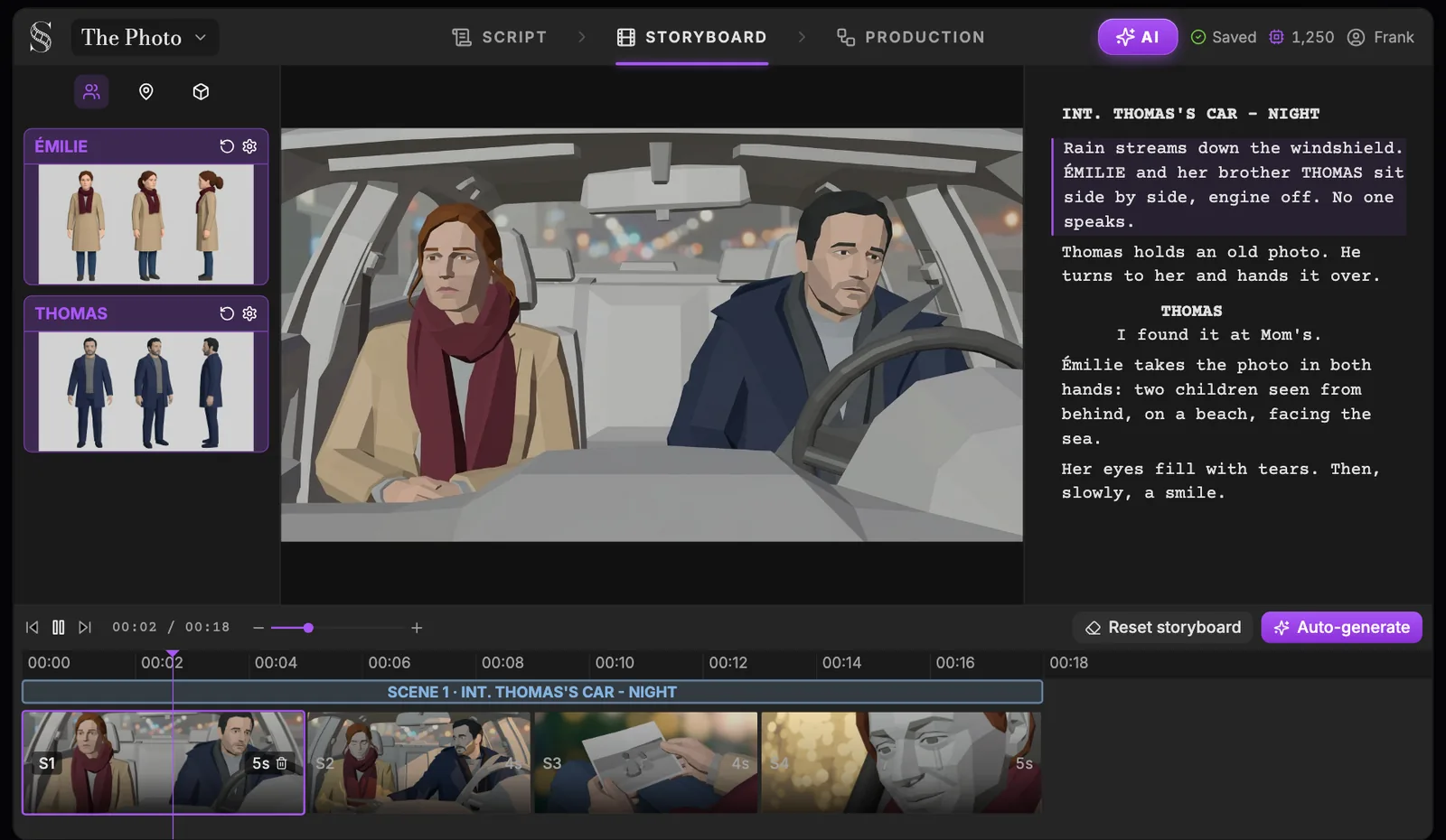
Your screenplay is the source, not a by-product. MITO's Director writes a script from a brief. ScreenWeaver gives you a full screenplay editor, free forever, imports your existing pages and builds the scenes, shots and story elements from them. For a short film, a feature or a series, that is the difference.
A team costs less past two people. MITO charges per seat: $130 a month for two, $195 for three, $325 for five. ScreenWeaver Studio is $149.99 a month with unlimited seats and 25,000 credits. See the pricing section, and estimate a whole film first with the free AI video cost calculator.
The storyboard is built from your script. Framing, camera move, duration and panel for every shot, then video only for the shots you approve. The AI storyboard generator page shows the steps, and the ScreenWeaver MCP server lets Claude or ChatGPT do them for you.
What MITO does better
MITO is made for agency work. Briefs with brand guidelines, client comments that turn into tasks, sign-off on the storyboard and a real timeline that exports to Premiere Pro or Resolve through OpenTimelineIO: if your film ends in an editing suite and goes through a client, that pipeline is well thought out. Its model list is also very wide, with avatar and lip-sync models ScreenWeaver does not focus on, and a solo user can start for $18 a month.
Which one fits you?
- An agency or brand team making ads and branded films from a brief: MITO. Brief Director, review the storyboard with the client, finish in your editor.
- A writer or director with a screenplay, a series or a micro drama: ScreenWeaver. Write or import the script, board every shot and make the film shot by shot; how to make an AI film walks through the whole workflow.
- Comparing other agent tools: see OpenArt vs ScreenWeaver for films made by chat and Flick vs ScreenWeaver for another canvas for AI films.
FAQ
Is MITO free? You can start free with 4,000 credits, given once, one seat, one generation at a time and no watermark-free downloads. Paid plans start at $18 a month for 10,000 credits according to its FAQ; the plan card shows $45 for 25,000.
What is MITO's Director? Its AI agent: it reads your brief, writes the script and shot list, lays out the storyboard on the canvas, generates each shot and assembles the cut with voices and music.
Is MITO better than ScreenWeaver? For an agency team making a brand film from a brief, with client review and a Premiere or Resolve finish, MITO fits well. For a story that starts as a screenplay, with every shot boarded before video, ScreenWeaver does more, and its Studio plan has unlimited seats.
Can I import a screenplay into MITO? Its brief accepts PDFs and scripts, but no page describes a screenplay editor or Final Draft and Fountain import. ScreenWeaver imports PDF, Final Draft, Fountain and text scripts.
Who owns MITO? A startup based between Madrid and San Francisco, backed by Lightspeed ($4.5M pre-seed, January 2026) and Telefónica's Wayra. Its legal notice names MITO Films Inc. and MITO Films Innovations SL.
Sources: MITO, MITO pricing, Director, Canvas and timeline, Collaboration, MCP and plugins, MCP launch post, Movistar case study, legal notice, Business Wire, 29 January 2026, SiliconANGLE, 30 January 2026, Wayra, 16 July 2026, Marketing Directo, 25 May 2026, Reason Why, 26 May 2026. Read on 21 November 2026.
From script to shots
Turn your script into a film, shot by shot
Write the scene, get its storyboard, then generate each shot with consistent characters. You direct every step.
Start your film free