AI Film Fest Amsterdam · Guide

How to win AI Film Fest Amsterdam.Ten minutes at most. Fifty points to earn.

The call closed on 25 September, but the festival comes back every year. Here are the rules we could read, the five-part score and a plan to be ready before the next call. Then build the film in ScreenWeaver, from the first page to the last shot.
  • Free entry, 1 to 10 minutes
  • Generative AI weighs more
  • Sound design is 20% of the score
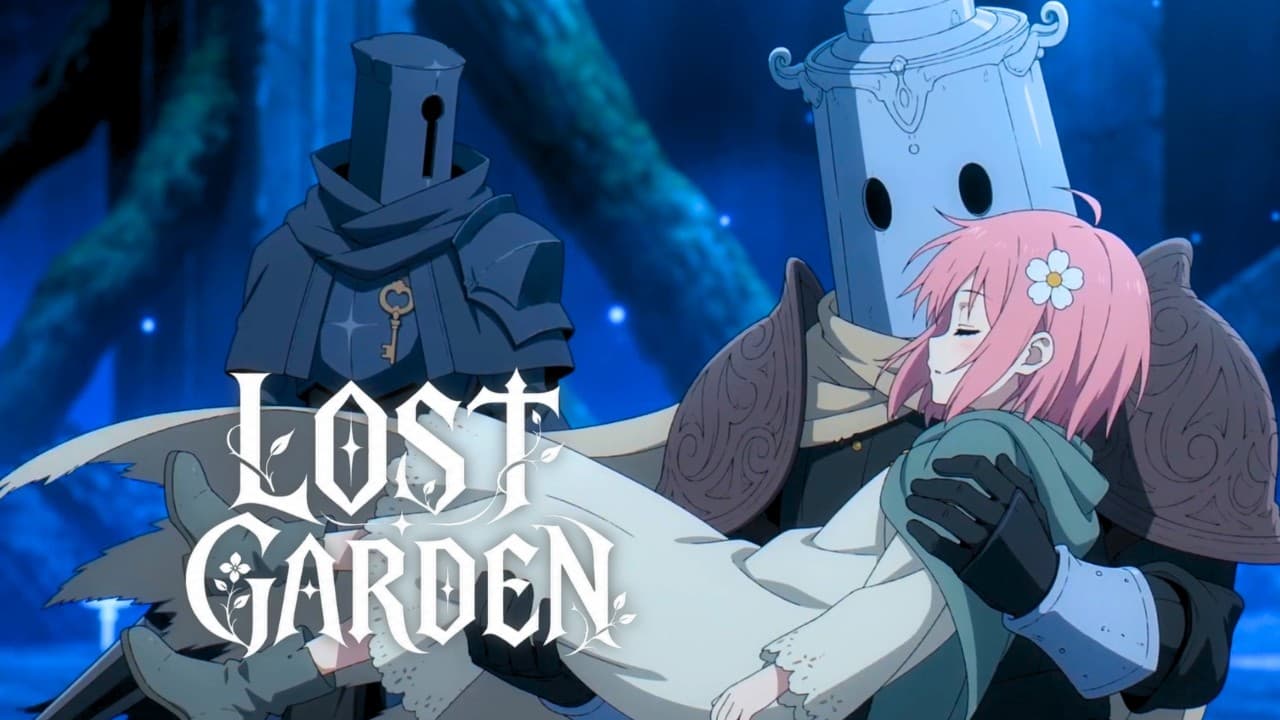
Lost Garden · Episode 1

Independent guide. ScreenWeaver does not organise AI Film Fest Amsterdam and is not affiliated with Stichting MadHatter. Rules read on 1 October 2026. Official site

Available today in ScreenWeaver: free screenwriting, and a storyboard generated from your screenplay with Storyboard Beta, $9.99 a month.

Rolling out: video generation of each shot, powered by Seedance, with the Filmmaker plan.

The rules on one card

What AI Film Fest Amsterdam asks for.

AI Film Fest Amsterdam is run by the Dutch foundation Stichting MadHatter, which also hosts a Dubai edition. It is a young festival with a short format, free entry and a grid that gives sound a full fifth of the score.
Organiser
Stichting MadHatter, The Hague
Festival night
5 December, Amsterdam
Submissions
Closed on 25 September
Entry fee
Free
Running time
1 to 10 minutes
AI requirement
Text to video or image to video, at some point
Who can enter
Anyone 18 or over, one entry each
Delivery
Google Drive link, 1080p or better

Source: the festival site (aifilmfest.io), its submission form and the rules document linked from the form, read on 1 October 2026. That document is titled 2026, but its entry period (14 November to 5 December 2025) and January shortlist describe the previous call. Use it as the best guide to the next one, and confirm details with info@aifilmfest.io.

What the rules say about AI

Four clauses that shape your film.

The festival is clear about what kind of AI work it wants. These clauses come from its rules document and its submission form.
  • Generative first

    The rules say the festival’s primary focus is generative AI. A film must have used text to video or image to video at some point. Real footage that AI only enhances is welcome, but it weighs less.

  • Say how, stage by stage

    The form asks which software you used for the story, the storyboard, the visuals and animation, and the sound. It also asks which kinds of AI you used. Answer with tool names, not with a general description.

  • Own every frame

    You warrant that you hold the rights to everything in the film, music included, and that nobody is owed royalties. A sound or an image you cannot clear is a reason to be disqualified, not a detail.

  • What you grant the festival

    A non-exclusive, perpetual licence to show the film and use it in promotion, with the right to edit it and a waiver of moral rights. You keep ownership. A film shown elsewhere can enter if you still hold the rights.

Key dates

A deadline that already moved once.

The site prints days without a year. These are the dates we could read, in the order they happened.
  1. 14 Nov to 5 Dec 2025

    The previous call

    The entry window printed in the rules document. A shortlist followed in the third week of January 2026.

  2. 30 Jul 2026

    Second-round deadline

    Written in the intro of the submission form. The site and the festival’s link page later moved the cut-off.

  3. 25 Sep

    Submissions close

    Listed on the site and called a new deadline on the festival’s link page. It has now passed.

  4. 5 Dec

    Festival night in Amsterdam

    The site lists it as coming up. Winners are announced on the day, then posted online in the days after.

How films are scored

Five grades, fifty points.

Every judge gives every film a grade from 1 to 10 on five criteria. Each criterion is worth a fifth of the total. The highest average across all judges wins, and the scores are never shared.
  • Overall quality

    20%

    Originality, consistency and creativity. Consistency is named in the rules, so a face, a costume or a street that changes between two shots costs you here first.

  • The story

    20%

    Originality, emotional appeal and completeness. Completeness is the word to watch in ten minutes: a film that stops at the setup scores below a small story that ends.

  • The visuals

    20%

    Originality and visual appeal. Choose a look you can hold for the whole film instead of the best single frame. One lens, one palette, one kind of light.

  • Sound design

    20%

    Originality, emotional appeal and creativity. Few AI festivals give sound a full fifth of the grade. Treat the mix as a scene of its own: room tone, silence, a motif that comes back.

  • AI techniques

    20%

    The rules list text to video, image to video, text to song, text to sound effect and video to video, and ask how the visuals were brought to life. A clear method, written well in your form, is part of the score.

Generative work outranks augmented footage. Inpainting, motion tracking or video to video on real footage is treated as a separate, lighter kind of AI use. The organiser can change the rules at any time.

Who decides

A shortlist, then judges who score alone.

The rules name no judges and say the organiser’s decisions are final. What they do describe is the path your film takes.
  • A shortlist first

    In the last cycle an initial shortlist was announced in the third week of January, and the winners were picked from it. Expect a first selection stage before any judge scores your film.

  • Judges who score alone

    Each judge grades every film from 1 to 10 on the five criteria, and the highest average wins. A film that splits opinion loses to one everybody finds solid. Ties are settled on individual scores, in an order the festival keeps private.

  • The People’s Choice

    One of the six awards. The rules do not say how the public votes, so ask before you plan a campaign. A title and a first minute that people remember help in any vote.

The six awards

Six prizes, one winner and one runner up each.

There is no imposed theme. There are six award categories, with cash prizes, credits for generative AI tools and a place in the festival’s film archive at the Eye Filmmuseum, according to the rules. Under each award, the angle we would take.
  • 01

    Best Film

    The overall prize, open to any style and any genre.

    The most contested award. Aim for the top grade on consistency and a story that finishes, the two things nobody can fake with one good shot.

  • 02

    Best Comedy

    Humour made with generative tools.

    Comedy lives on timing, and generated shots are hard to time. Keep the cast small, cut straight to the joke and write gags that do not depend on lip-sync.

  • 03

    Best Animated Film

    Animation, in any style.

    The most natural home for generative work, since there is no real footage to match. One art direction held to the last frame reads as authorship.

  • 04

    Best Documentary

    Non-fiction work.

    The rules favour generative AI over enhanced real footage, so a documentary still has to use text to video or image to video somewhere. Reconstruct what could not be filmed, and say plainly what is reconstruction.

  • 05

    Best Music Video

    Picture built around a track.

    The sound grade and the AI grade both bite here. Cut on the beat, and prove who owns the music: the rights clause covers it.

  • 06

    People’s Choice

    Decided by the audience.

    Emotion and clarity beat cleverness. A film a stranger can retell in one sentence travels furthest.

A scene, taken apart

The Source Tree, from page to picture.

Lost Garden, episode 1 is an animated series by the ScreenWeaver team, made with Seedance. This is its Source Tree scene: the screenplay as heard in the film, then each shot as a storyboard frame and as the final image. It is the kind of scene the story and sound grades reward, since the emotion comes from a voice and a pause.

Logline. A small knight wakes up in a dead world and learns he is the last guardian of a seed that could bring the garden back.

Screenplay · episode 1 · the Source Tree

INT. HEART OF THE ROOTS - NIGHT

Living roots coil around LANTERN and pin him down. A voice stops them.

THE SOURCE TREE

Stop. He is my guest.

A giant woman of roots and white lilies opens her arms over the cavern.

Her eyes open. Blue, and vast.

THE SOURCE TREE

Welcome to you, Lantern Knight.

She lifts him in her palm, like a lamp.

THE SOURCE TREE

Do not be afraid. I will not harm you.

In the dark, a seed of light opens. Inside the flower, a sleeping child.

THE SOURCE TREE

You must find yours. Protect her.

CUT TO:

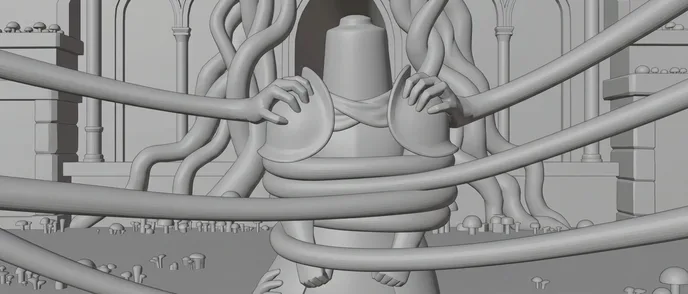
  1. A small lantern-helmed knight bound by thick roots in a ruined hall
    Storyboard frame of the trap shot, in grey
    01

    Medium · the trap

    Medium shot, Lantern bound by thick living roots in a ruined hall, glowing blue mushrooms on the floor, cold light

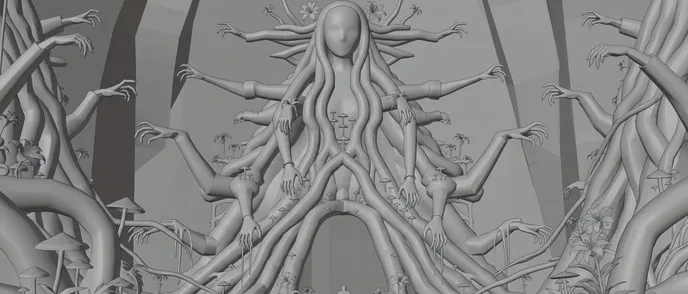
  2. A giant woman made of roots and white lilies spreads her many arms in a dark cavern
    Storyboard frame of the wide shot, in grey
    02

    Wide · the Source Tree

    Symmetrical wide shot, a giant woman made of roots, arms spread with many hands, white lilies, blue glyphs

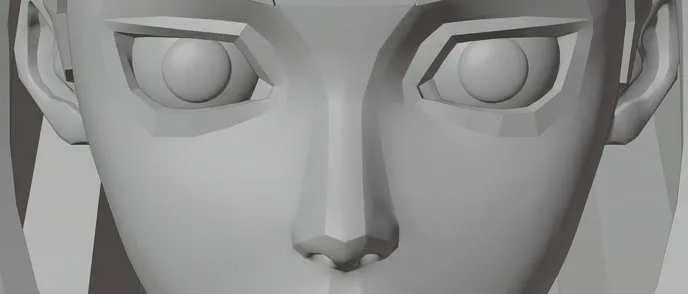
  3. Extreme close-up of a giant pale face with piercing blue eyes
    Storyboard frame of the eyes close-up, in grey
    03

    Extreme close-up · the eyes

    Extreme close-up on the giant's face, piercing blue eyes opening, pale skin, soft light from below

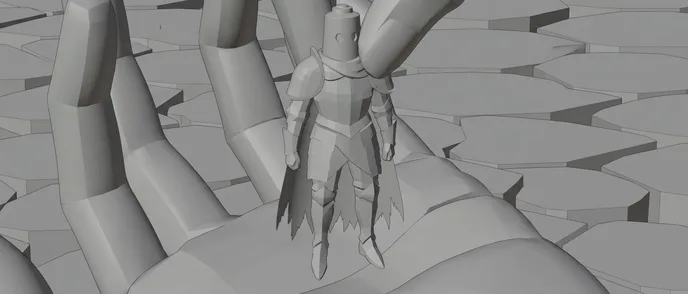
  4. A tiny armored knight stands in the middle of a giant open hand
    Storyboard frame of the palm shot, in grey
    04

    High angle · the palm

    High angle, the tiny knight standing in the center of a giant open palm, stone floor far below

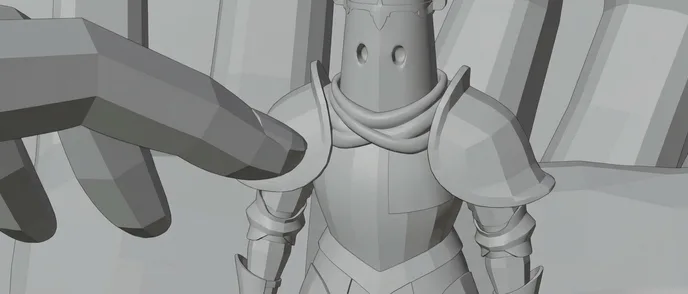
  5. A giant fingertip gently touches the chest of a small armored knight
    Storyboard frame of the touch close-up, in grey
    05

    Close-up · the touch

    Close-up, a giant fingertip gently touches the knight's armored chest, faceless helm, emotion through posture

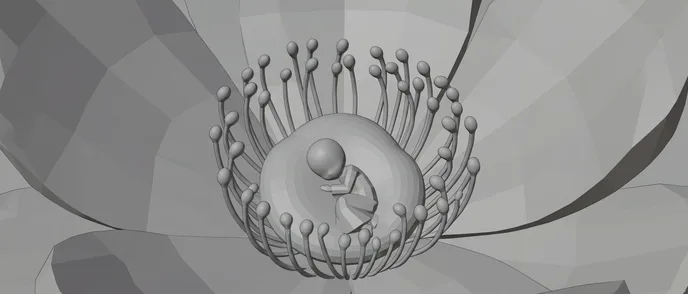
  6. A sleeping pink-haired child curled inside a glowing blue flower
    Storyboard frame of the seed insert, in grey
    06

    Insert · the seed

    Top-down insert, a glowing pale blue flower opening, a sleeping child with pink hair curled inside

Lost Garden, episode 1 runs 17 minutes, so a festival cut would have to lose seven. The Source Tree scene is a fair model for the sound grade: one voice, one cavern, and room to let a line breathe. The series was a finalist at the AI London Festival. The player starts at the Source Tree.

The script

A 9 minute film in five movements.

The limit is 10 minutes and nothing is gained by using all of it, so aim for 9. At three to five seconds a shot, that is roughly 110 to 180 shots, plus a sound plan written beside them.
  1. 0:00 to 0:45

    The cold open

    One striking image and one sound that sets the mood. No titles yet.

  2. 0:45 to 2:30

    The world

    Who we follow and what their place sounds like. Fix the look you will hold for nine minutes.

  3. 2:30 to 6:15

    The complication

    The want meets an obstacle, twice. Each escalation gets its own change in sound.

  4. 6:15 to 8:15

    The turn

    A choice that costs something. Save your best emotional beat for this scene.

  5. 8:15 to 9:00

    The close

    Finish the story, because completeness is part of the story grade. Let the last sound outlive the last image.

Plan generations scene by scene. Seedance 2.5 can carry several shots of one scene in a single generation, which keeps light and faces matched and leaves time for the sound pass the grid rewards.

Month by month

Use the gap before the next call.

No deadline is open today, so work backwards from the day the next call appears. The goal is a finished film waiting for it, not a rush on the last night.
  1. 01

    Now · this week

    Watch the Rewind

    The festival site shows a 2025 to 2026 Rewind video. Watch what reached the screen, and note how long the best films stay on a shot.

  2. 02

    October

    Write the film

    Nine pages at most, two locations at most. Write it free in ScreenWeaver, in industry format, and read it aloud against a stopwatch.

  3. 03

    November

    Storyboard and sound plan

    Break the screenplay into shots and storyboard each one. Add a sound note to every scene: it is the fifth of the grade people forget.

  4. 04

    Early December

    Follow the Amsterdam night

    Winners are announced on the day. Note who won what, how long their films ran and how they open.

  5. 05

    Winter

    Generate and cut

    Generate scene by scene, then cut to 9 minutes. Keep every prompt and version: the form will ask you to explain your AI use at each stage.

  6. 06

    When the call opens

    Fill the form well

    Have ready a public Drive link in 1080p or better, your stage by stage AI description, proof of rights for every sound and image, and a phone number that works for WhatsApp.

What loses points or the entry

Seven mistakes to avoid.

Most come straight from the rules document and the form. Read both twice, then read them again the week you submit.
  • Treating the 2026 call as open

    The site says submissions closed on 25 September. The date already moved once, so write to the organiser if you think an extension exists. Do not assume one.

  • Enhanced footage instead of generated footage

    Real footage touched up by AI is graded as a lighter kind of work. Use text to video or image to video for the core of the film.

  • Going over 10 minutes

    The format is 1 to 10 minutes. A film that runs long gives the organiser an easy reason to set it aside.

  • Content the rules rule out

    Material that glorifies firearms or violence, promotes illegal substances under Dutch law, or demeans a group is not accepted. Mark a film clearly if it is not for a general audience.

  • A vague AI description

    The form wants software named for story, storyboard, visuals and sound. An answer like I used AI throughout tells the judges nothing and costs you on the AI grade.

  • A link nobody can open

    The film travels as a Google Drive link set to anyone with the link. A private file is an empty entry. Quality should be 1080p at least, 4K if you have it.

  • Forgetting the sound

    A silent or generic mix wastes a fifth of the total. Budget time for music, effects and voice as carefully as for picture.

Why ScreenWeaver

The form asks for your pipeline. Keep it in one place.

ScreenWeaver covers the first two answers on the Amsterdam form: the story and the storyboard live in one connected project, and the footage pipelines are being added to it.
  • The first two stages, already written down

    The entry form asks for your tools at four stages: story, storyboard, visuals, sound. ScreenWeaver holds the first two in a single project, so your answers describe something you can show.

  • Generative from the first shot

    The festival weighs generative AI above augmented footage. ScreenWeaver’s footage pipelines run on Seedance 2.0 and 2.5, and they are rolling out with the Filmmaker plan.

  • Consistency has its own line in the grid

    Characters, locations and references carry from shot to shot, and every shot stays tied to its scene and storyboard frame. That is how a nine minute film keeps one face and one world.

  • No cost while you wait

    With no call open, the free Screenwriter plan is the right place to start: $0, no expiry. Add Storyboard Beta at $9.99 a month when the screenplay is ready.

Real productions

International festival-recognized films have been written and produced with ScreenWeaver.

ScreenWeaver is already being used as a creative workspace for real AI film productions, from cinematic shorts to animated series pilots selected, nominated, and awarded by international festivals.

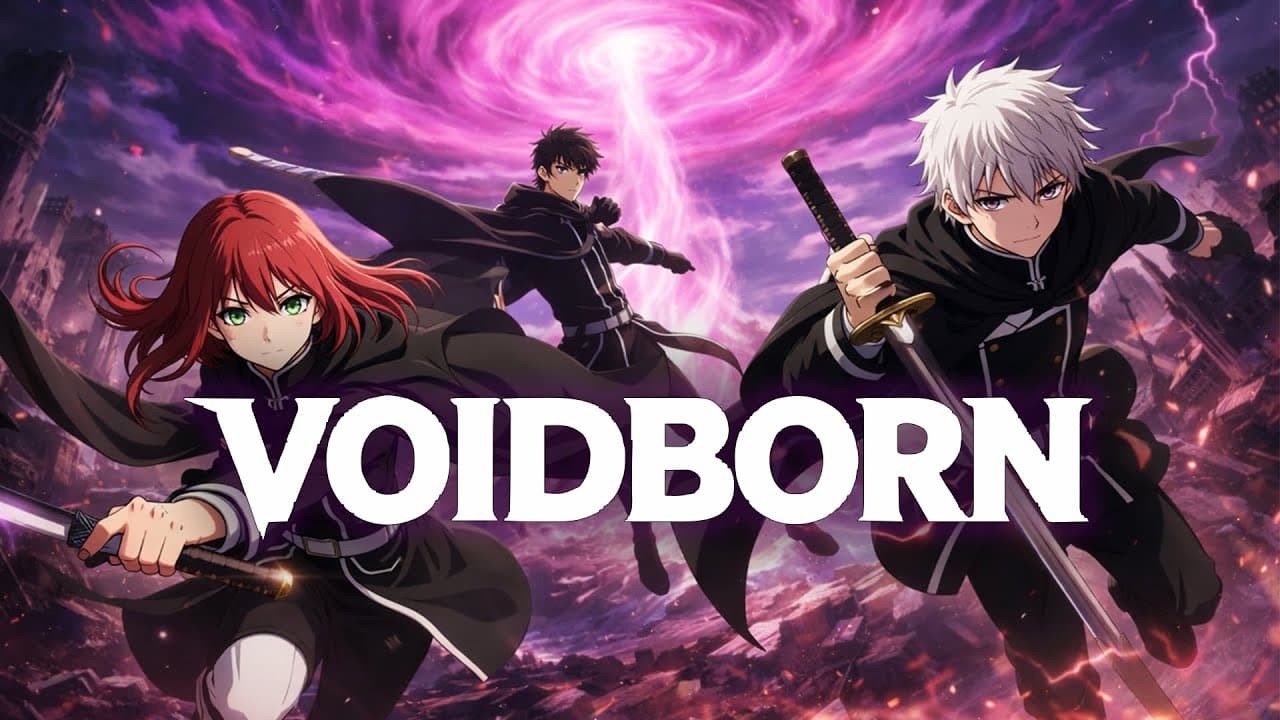
  • Video thumbnail for VOIDBORN

    VOIDBORN

    AI animated / cinematic short

    Festival recognition

    • 1st Place Silver

      Mondial Chroma Awards

    • 2nd Place Dreamina

      Mondial Chroma Awards

    • Award Winner

      Seoul International AI Film Festival

  • Video thumbnail for Les Fils du Vinnana

    Les Fils du Vinnana

    AI short film

    Festival recognition

    • Honorable Mention

      Top Quark Film Festival

    • People's Choice Nominee

      Illuminate Oneness of Humanity

    • Nominee

      ALTFF Supershort

  • Video thumbnail for Lost Garden

    Lost Garden

    AI animated series pilot

    Festival recognition

    • Finalist

      AI London Festival

The pipeline

Write. Board. Produce.

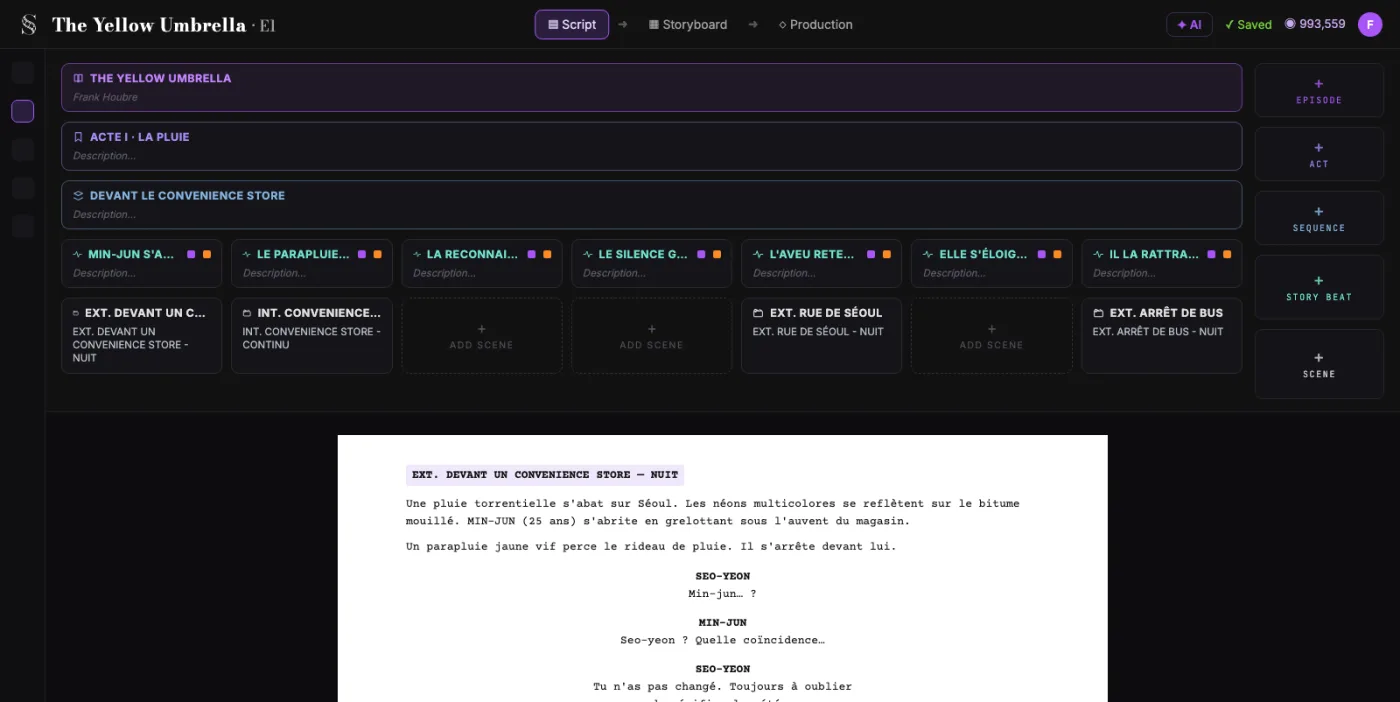
  1. ScreenWeaver screenplay editor: acts, sequences and beats above the formatted script of The Yellow Umbrella

    01The screenplay, enriched

    An industry-standard screenplay editor, and more: a visual outline and beat editor, your writing inspirations (notes, photos, audio) kept next to the page, and an AI researcher to support your writing, not replace it.

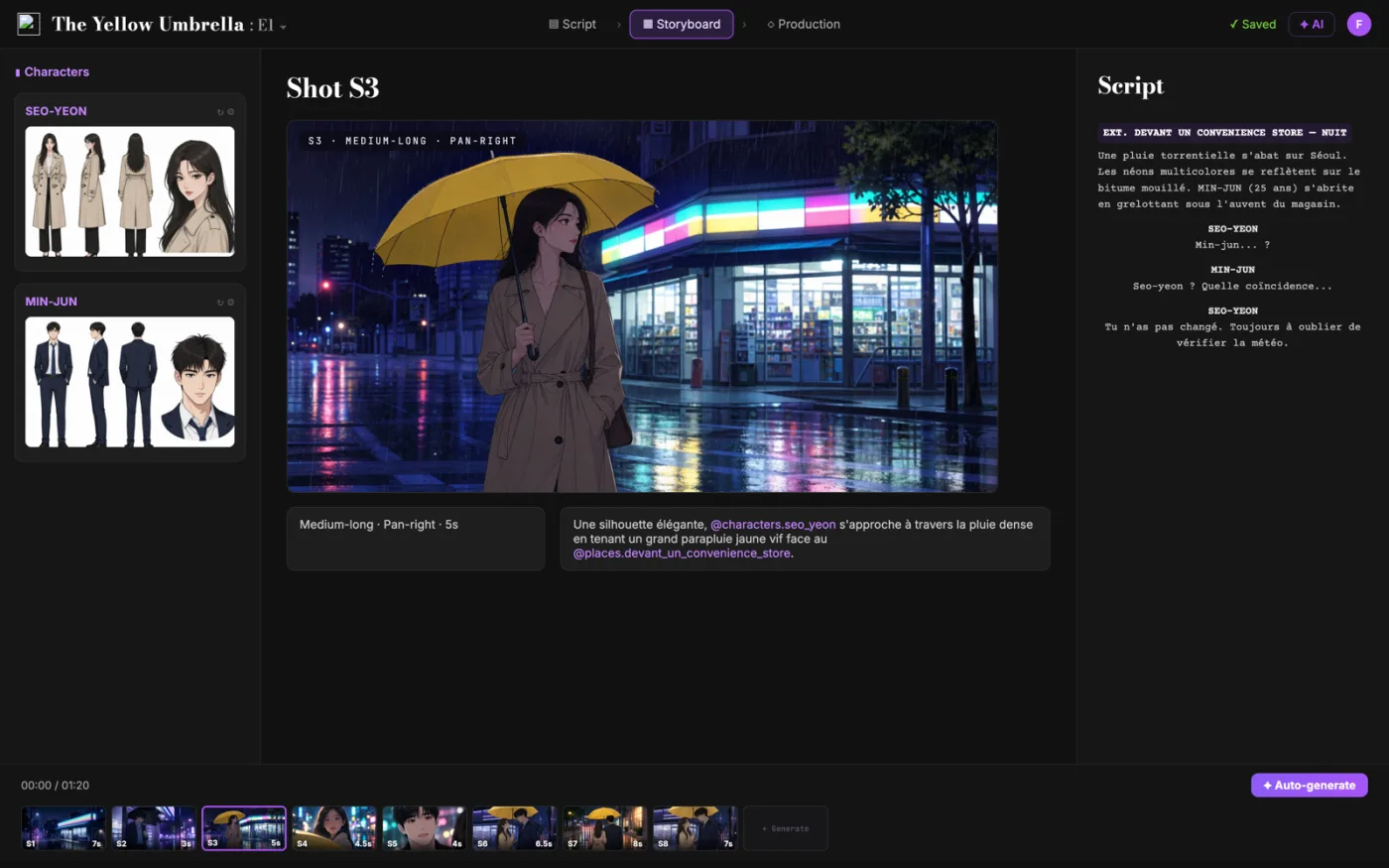
  2. ScreenWeaver storyboard: shot S3 of The Yellow Umbrella with characters, shot settings and the script beside it

    02The storyboard, made easy

    Shot breakdown generated from your screenplay, manual control over every shot (frame, angle, movement, duration), and generative AI previsualization in one click.

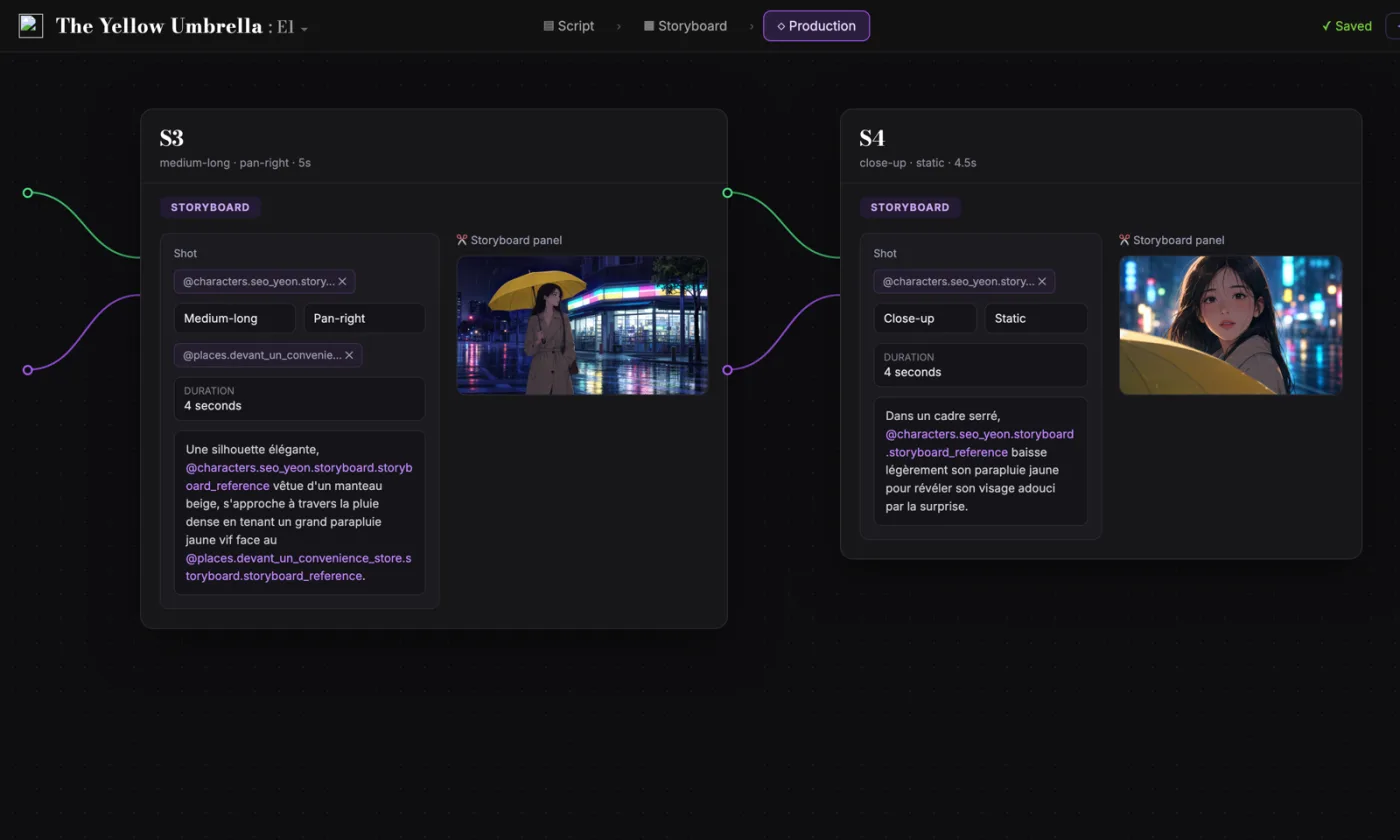
  3. ScreenWeaver production canvas: shots S3 and S4 as connected nodes carrying their storyboard panels and prompts

    03AI production, with finesse

    Footage generation pipelines connected to your screenplay and storyboard. Optimized out of the box, fully editable workflow.

FAQ

AI Film Fest Amsterdam, your questions

How do you win AI Film Fest Amsterdam?
Judges grade each film from 1 to 10 on five criteria: overall quality, story, visuals, sound design and AI techniques. The highest average wins. Make a complete, consistent story, give the sound as much care as the picture, and use text to video or image to video for the core of the film.
Can I still submit to AI Film Fest Amsterdam in 2026?
The site lists 25 September as the day submissions close, and that day has passed. The festival night is on 5 December. If you think the call may still be open, write to info@aifilmfest.io. Otherwise, prepare for the next call.
Does it cost anything to enter?
No. The rules state that entering is free of charge. Cash prizes and generative AI tool credits are listed for winners, with details to be announced on the festival site.
How long can the film be?
Between 1 and 10 minutes. The rules ask for a Google Drive link at 1080p or better, 4K if possible.
Do I have to use a particular AI tool?
No tool is imposed. The rules name Runway, Leonardo, Pika, Genmo, Eden, Emu and Stable Video as examples, and the form asks you to list the software you used at each stage. Text to video or image to video must appear at some point in the process.
Is ScreenWeaver a fit for AI Film Fest Amsterdam?
Yes for the screenplay and the storyboard today. For footage, the pipelines built on Seedance 2.0 and 2.5 are rolling out with the Filmmaker plan. Name every tool and version in your form.
Who is on the jury?
The rules do not name the judges. They describe a shortlist, then individual grades from each judge, averaged. Scores are not shared with entrants, and the decisions are final.
Who owns my film after I enter?
You keep ownership. By entering you grant the festival a non-exclusive, perpetual licence to show and promote the film, with the right to edit it, and you waive moral rights. Read that clause before you submit.

Be ready when the call reopens.

The next call will not wait for a screenplay. Write yours for free today, then storyboard it.