Runway AI Film Festival · Guide

How to win the Runway AI Film Festival.Rules, jury and winners, before the 2027 call.

No 2027 call is announced yet. This guide reads the 2026 rules and winners so you are ready when it opens: how films are scored, who judges, what the ten winners did, and a plan from screenplay to submission.
  • Grand Prix $50,000 and 1M credits
  • 3 to 15 minutes, generative video
  • 2027 call not announced
Voidborn · Episode 0

Independent guide. ScreenWeaver does not organise the Runway AI Film Festival and is not affiliated with Runway. Rules read on 1 October 2026. Official site

Available today in ScreenWeaver: free screenwriting, and a storyboard generated from your screenplay with Storyboard Beta, $9.99 a month.

Rolling out: video generation of each shot, powered by Seedance, with the Filmmaker plan.

The rules on one card

What the 2026 film track asked for.

The Runway AI Festival, known as AIF and formerly the Runway AI Film Festival, is run by Runway. The 2026 edition was its fourth and had six tracks. No 2027 call is announced, so these 2026 terms are the best guide to what comes next.
Edition
4th edition, 2026. Next one not announced
2026 entry period
28 January to 27 April 2026, 4:59 PM ET
Film length
3 to 15 minutes
Film rule
Generative video, a fully contained linear narrative
Grand Prix
$50,000 and 1,000,000 Runway credits
Ten film winners
Gold $15,000, Silver $10,000, 2 Honorees, 5 Merit, all with credits
Scoring
Four criteria, 1 to 10 each, 40 points per judge
To enter
A video file or a YouTube or Vimeo link, plus a written description of your AI techniques

Source: aif.runwayml.com and its Film Track Terms, read on 1 October 2026. These are the 2026 terms. Runway can change them for 2027, so read the new ones the day the call opens.

Key dates

The 2026 calendar, as a template.

Nothing is published for 2027. The 2026 dates show how long a call lasts and when the winners are named.
  1. 28 Jan 2026

    Entries open

    The film entry period began. It lasted about thirteen weeks.

  2. 27 Apr 2026

    Entries close

    The last minute was 4:59 PM Eastern Time, not midnight. A missed deadline is a stated ground for disqualification.

  3. 30 Apr 2026

    Winners announced

    The terms say winners are announced on or about 30 April.

  4. 11 Jun to 30 Jul 2026

    Gala screenings

    New York on 11 June, Los Angeles on 18 June and Tokyo on 30 July.

  5. 2027

    Next call not announced

    If the 2026 rhythm repeats, a call would open around the start of the year. That is our inference from the 2026 dates, not an announcement.

How films are scored

Four criteria, one quarter each.

Each judge scores every film from 1 to 10 on four criteria, for a maximum of 40 points per judge. The highest average wins, and a set order of judges settles ties. Three quarters of the grade is cinema, one quarter is how you used AI.
  • Quality of overall composition

    25%

    Framing, light, rhythm and the cut, read as one piece. Choose a look and keep it. Judges who make films notice a cut that hesitates.

  • Narrative cohesion and artistic message

    25%

    Does the film hold from first frame to last, and does it say something? The track asks for a fully contained, linear narrative: a complete story, not an extract or a montage.

  • Originality

    25%

    A film nobody else could have made. Start from a subject you know and give it a point of view. The 2025 Grand Prix imagined a space holding every possible image.

  • AI techniques: creativity, skills, incorporation

    25%

    How well and how inventively generative tools are built into the film. Write your short technique description as carefully as your logline: what the AI did, and why it was the right tool.

The terms give no separate mark for sound and no extra weight to any criterion. Music clearance, likeness and third-party rights are the entrant's responsibility.

Who decides

Nine jurors from film, tech and platforms.

The 2026 film jury had nine members, with titles as listed on the official page. Runway's own CEO sits beside people from cinema, post-production, streaming and hardware. No 2027 jury is announced.
  • Filmmakers and festival people

    Roger Avary, director and Oscar-winning screenwriter, and Jane Rosenthal, founder and CEO of Tribeca Enterprises. Kia Brooks, managing director of The Gotham Film and Media Institute, and Joel Kuwahara, co-founder of Bento Box Entertainment. They judge a story first.

  • The image and post-production side

    Bill Hensler (VP of Video, Audio and 3D at Adobe), Bruce Markoe (Head of Post and Image Capture at IMAX) and Richard Kerris (VP and GM of Media and Entertainment at NVIDIA) look at craft: image quality at full size, clean edges, stable motion. Check your master on a large screen.

  • A programmer's eye

    Randall Bobbitt works in alternative programming at Roku. That is a viewer's question: would this hold an audience that did not choose it? Make the first minute earn the second.

  • Runway's co-founder

    Cristobal Valenzuela, co-founder and CEO of Runway, sees every day what generative video can and cannot do. A juror who knows the tools from the inside spots a shortcut fast, so describe your techniques plainly.

The six tracks

Film is one track of six.

The 2026 festival ran six tracks: Film, New Media, Gaming, Design, Advertising and Fashion. This page covers Film. The other five each paid $10,000 and 500,000 Runway credits per winner under their terms.
  • 01

    Film

    3 to 15 minutes, generative video, a fully contained linear narrative. Ten winners, from Grand Prix to Merit.

    The track for a screenplay-first filmmaker, and the one where ScreenWeaver fits best: story, storyboard, footage.

  • 02

    Advertising

    2026 Best Advertising: Shaping New Futures, by UNVEIL®.

    A brand film is a short screenplay with a product in it. ScreenWeaver covers commercials too, but the Advertising terms are separate from the Film terms: read them.

  • 03

    New Media

    2026 Best New Media: SYNAPTICON, by Albert Barqué-Duran.

    A different kind of entry from a linear film. Read its terms before assuming a film qualifies.

  • 04

    Gaming

    2026 Best Gaming: Pluck 'Em, by Adam Prusinowski.

    Playable work. A trailer made in ScreenWeaver would not be judged as a game.

  • 05

    Design

    2026 Best Design: NESSUNO, by Ricardo Villavicencio.

    Villavicencio also took Silver in the 2025 film track, with ONE, made with Edward Saatchi. The festival keeps rewarding the same creators.

  • 06

    Fashion

    2026 Best Fashion: Puma: Memory Trace, by Dmytro Horeniuk.

    A visual brief for a brand, outside narrative film. Nothing in ScreenWeaver targets it.

The winners

What the Grand Prix winners teach.

The 2026 Grand Prix went to A Face Only A Mother Could Love, by Robert Gaudette, 7 minutes 50. The official site lists the ten film winners of 2026 and, in its screening room, the winners of 2023, 2024 and 2025.

  1. 01

    Winning runtimes sit between 4 and 9 minutes. The 2026 winners with a listed runtime run from 4:19 to 8:21, and the 2025 Grand Prix, Total Pixel Space, runs 9:28. None came near the 15 minute limit.

  2. 02

    One film won twice. A Face Only A Mother Could Love also took first place at the Reply AI Film Festival 2026. Reply's press release says it was made with Grok, Nano Banana and Seedance.

  3. 03

    One big idea can carry a film. Total Pixel Space, by Jacob Adler, is built on a single premise: a space that contains every possible digital image. A concept only generative video can show scores on originality and on technique together.

  4. 04

    Winners come back. Ricardo Villavicencio took Silver in 2025 with ONE and Best Design in 2026 with NESSUNO. Léo Cannone won in 2024 with Where Do Grandmas Go When They Get Lost? and was a 2026 Honoree with Costa Verde.

  5. 05

    The rules move every year. Two 2025 winners run 2:49 and 2:27, while the 2026 film track starts at 3 minutes. Read the new terms the day they appear instead of copying last year's runtimes.

From script to screen

Voidborn, framed shot by shot.

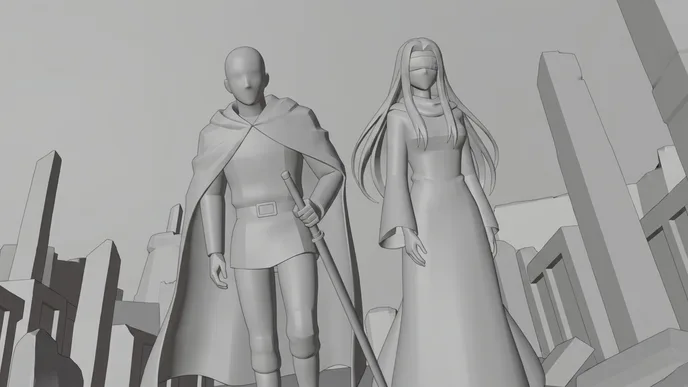
The opening of Voidborn, episode 0, made by the ScreenWeaver team. The first criterion is composition, and it is decided here: framing, angle and rhythm are chosen on the storyboard, then confirmed in the final image.

Logline. Every seven years, the Rift opens and swallows the world’s dreams. A swordsman sworn to a blind seer escorts her through its levels, toward a promise they made to a girl left behind.

Screenplay · episode 0 · English subtitles

EXT. RUINS OF THE FIRST LEVEL - NIGHT

Broken towers under a violet sky. SIM, a swordsman in a black cloak, walks beside LADY MARIA, blindfolded, all in white.

SIM

Tell me, Maria... do you think Leia believes we are still alive?

MARIA

We made a promise... the two of us.

A line of white automatons rises from the ruins.

AUTOMATON

The Rift will wait for no one.

SIM

What are machines doing at this level?

One automaton steps forward. Its face is blank.

AUTOMATON

We must return to the surface.

Its eyes ignite red.

SIM

I am Sim, guardian of Lady Maria... and I will proceed with your execution.

Steel meets steel. Lightning runs down the blade.

CUT TO:

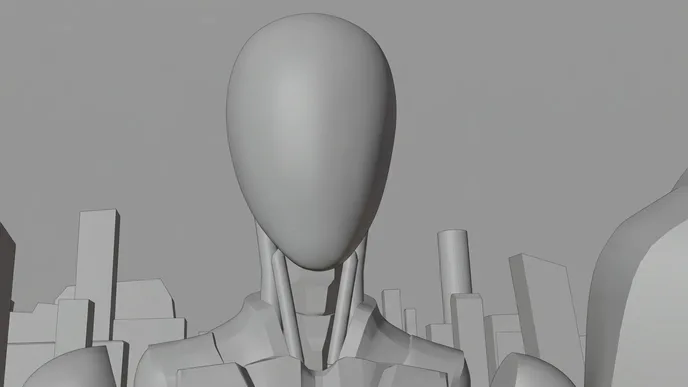
  1. A swordsman in a black cloak and a blindfolded woman in white walk through ruins at night
    Storyboard frame of the wide shot, in grey
    01

    Wide · the pair

    Wide shot, a bald swordsman in a black cloak and a blindfolded red-haired woman in white walk through night ruins

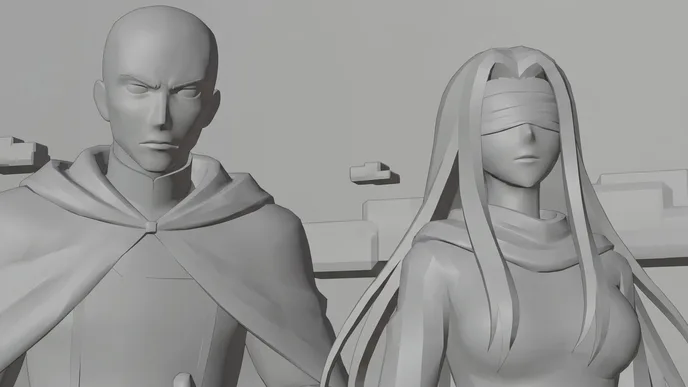
  2. Medium two-shot of a bald swordsman and a blindfolded red-haired woman
    Storyboard frame of the two-shot, in grey
    02

    Two-shot · the promise

    Medium two-shot, the swordsman and the blindfolded seer side by side, violet night sky, broken towers

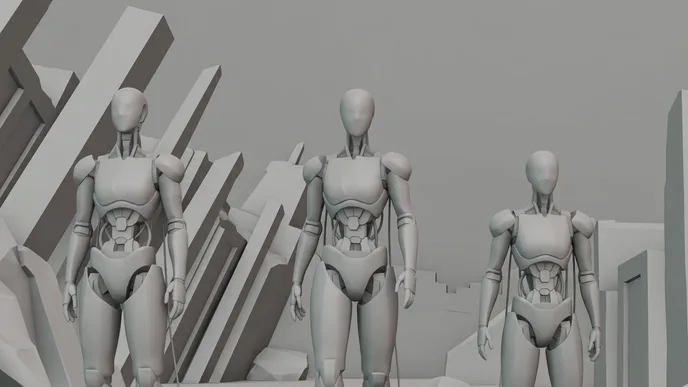
  3. Three white humanoid automatons stand in night ruins
    Storyboard frame of the automatons shot, in grey
    03

    Wide · the machines

    Wide low angle, three white humanoid automatons standing in the ruins, cold blue moonlight

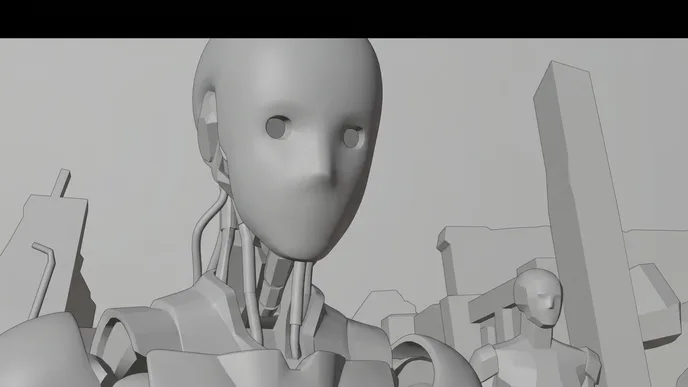
  4. Close-up of a white automaton with a smooth blank face
    Storyboard frame of the blank face close-up, in grey
    04

    Close-up · the blank face

    Close-up on an automaton's smooth faceless head, black eye slots, cables at the neck, ruins behind

  5. A white automaton's eyes glow red
    Storyboard frame of the red eyes close-up, in grey
    05

    Close-up · the red eyes

    Same framing, the automaton's eyes ignite red, the swordsman's shoulder out of focus in the foreground

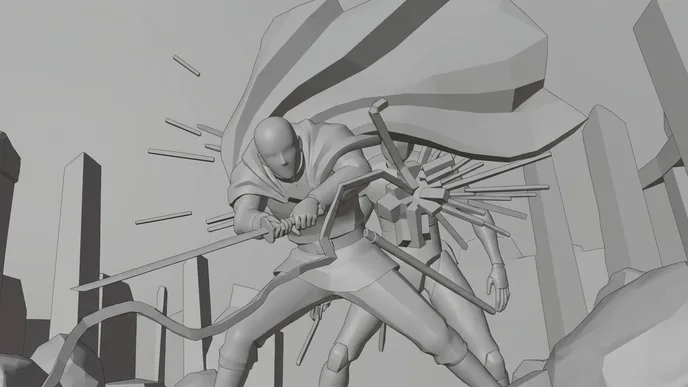
  6. A swordsman strikes with a katana wreathed in lightning and sparks
    Storyboard frame of the clash shot, in grey
    06

    Action · the clash

    Dynamic low angle, the swordsman strikes with his katana, lightning running along the blade, sparks, cape flying

Voidborn, episode 0 runs 13 minutes, inside the 3 to 15 minutes Runway asks for. It comes from the ScreenWeaver team and took prizes at the Mondial Chroma Awards and the Seoul International AI Film Festival. For Runway we would still cut it, since the 2026 winners with a listed runtime ran 4 to 9 minutes. Press play to start at this scene.

The script

A 7 minute film in five movements.

The 2026 winners with a listed runtime ran from 4:19 to 8:21. Aim for 7 minutes: about 7 screenplay pages and 90 to 120 shots of 3 to 5 seconds. The limit is 15, and nobody needs it.
  1. 0:00 to 0:30

    The first frame

    Judges score composition first. Open on the frame that shows the film's look and its question.

  2. 0:30 to 1:30

    One character, one want

    One person, one need, one world, in a few shots. The film must stand alone, so no one should need a previous episode.

  3. 1:30 to 4:30

    The turn

    Scenes that escalate, each with its own place or light, so the AI technique is visible and not repeated.

  4. 4:30 to 6:00

    The choice and its price

    The decision the film exists for. Keep it simple, and give it room.

  5. 6:00 to 7:00

    The ending

    A real ending, then credits. Leave a clean hold on the last image.

A fully contained linear narrative means no cliffhanger that needs episode two. Write an ending, even if the world could continue.

When the call opens

From a logline to the upload.

The 2026 call ran about 13 weeks and 2027 has no date, so this plan counts from the day the call opens. The first two steps can start now: they do not depend on the rules.
  1. 01

    Before the call

    A subject only you can film

    Write ten loglines. Keep the one with a point of view. The jury sees many competent films, so choose the idea only you would have.

  2. 02

    Before the call

    A seven page screenplay

    Free in ScreenWeaver, in industry format: one character, one want, a real ending. Read it aloud and time it.

  3. 03

    Weeks 1 and 2

    Characters, places, references

    Fix one reference for each character and each set. They carry into every shot and keep the film consistent over seven minutes.

  4. 04

    Weeks 3 and 4

    Storyboard, shot by shot

    Generate the breakdown and the storyboard from the screenplay, then set framing, angle, movement and duration. Composition is a quarter of the grade.

  5. 05

    Weeks 5 to 9

    Generate and keep every version

    Generate one scene at a time, from its storyboard frames and its references. Keep prompts and versions: they are the raw material of your technique description.

  6. 06

    Weeks 10 to 12

    Edit, sound, clearances, description

    Cut to length, mix, clear or generate the music, check every shot for logos and real faces, and write the technique description.

  7. 07

    Week 13, a day early

    Submit before the stated hour

    Send the file or the link and the form well before the cutoff. In 2026 it was 4:59 PM Eastern Time, not midnight.

Disqualification traps

Eight ways an entry gets disqualified.

They come from the 2026 Film Track Terms. Read the 2027 version the day it appears, since details can change.
  • Missing the hour

    The 2026 call closed at 4:59 PM Eastern Time on 27 April. Missing the deadline is a stated ground for disqualification. Submit a day early.

  • A film outside 3 to 15 minutes

    The track asks for 3 to 15 minutes, with generative video in the film. A 90 second piece or a 20 minute cut does not meet it.

  • Not a complete story

    The track asks for a fully contained linear narrative. A teaser, a reel of shots or an episode that stops mid-plot does not meet it.

  • A vague AI description

    The entry needs a short written description of your AI techniques. Name the tools, what each one made and where you worked by hand. A one-line "made with AI" wastes a quarter of the grade.

  • Clearances left to chance

    The terms put music, likeness and third-party content on you. Use licensed or generated music, invent your characters and check every shot for logos.

  • Content that breaks the policy

    No material that is indecent, obscene, hateful or defamatory, or that promotes violence, illegal conduct or animal cruelty. Check this before you write the climax.

  • Not original, or under 18

    The film must be original to you or your team. Entrants must be 18, or the local age of majority if higher. A team names one Captain.

  • A face that is not yours to use

    The terms ask you to comply with the laws on digital replicas and deepfakes. A character who resembles a real person needs that person's consent.

Why ScreenWeaver

The festival judges the film. ScreenWeaver builds it.

Runway judges what is on screen, not which app made it. ScreenWeaver is the production pipeline for that film: screenplay, storyboard and footage in one connected project.
  • Footage powered by Seedance

    The terms list Runway's models as examples of the tools expected and name no single mandatory tool. Our footage pipelines run on Seedance 2.0 and 2.5. If you are unsure, ask the organiser. And if Runway models are required in 2027, ScreenWeaver still covers screenplay, storyboard and planning, and you generate with the tool they ask for.

  • Composition decided on the storyboard

    A quarter of the grade is overall composition. ScreenWeaver gives you manual control of framing, angle, movement and duration for every shot, before any generation.

  • Cohesion from the first page

    Screenplay, shot breakdown and storyboard live in one project, so a missing payoff or a dropped character shows up before you spend a single generation.

  • Your technique description, already documented

    Each shot traces back to its scene, its frame and its prompt. The short description Runway asks for becomes a summary of what the project already holds. The Screenwriter plan has no expiry date.

Real productions

International festival-recognized films have been written and produced with ScreenWeaver.

ScreenWeaver is already being used as a creative workspace for real AI film productions, from cinematic shorts to animated series pilots selected, nominated, and awarded by international festivals.

  • Video thumbnail for VOIDBORN

    VOIDBORN

    AI animated / cinematic short

    Festival recognition

    • 1st Place Silver

      Mondial Chroma Awards

    • 2nd Place Dreamina

      Mondial Chroma Awards

    • Award Winner

      Seoul International AI Film Festival

  • Video thumbnail for Les Fils du Vinnana

    Les Fils du Vinnana

    AI short film

    Festival recognition

    • Honorable Mention

      Top Quark Film Festival

    • People's Choice Nominee

      Illuminate Oneness of Humanity

    • Nominee

      ALTFF Supershort

  • Video thumbnail for Lost Garden

    Lost Garden

    AI animated series pilot

    Festival recognition

    • Finalist

      AI London Festival

The pipeline

Write. Board. Produce.

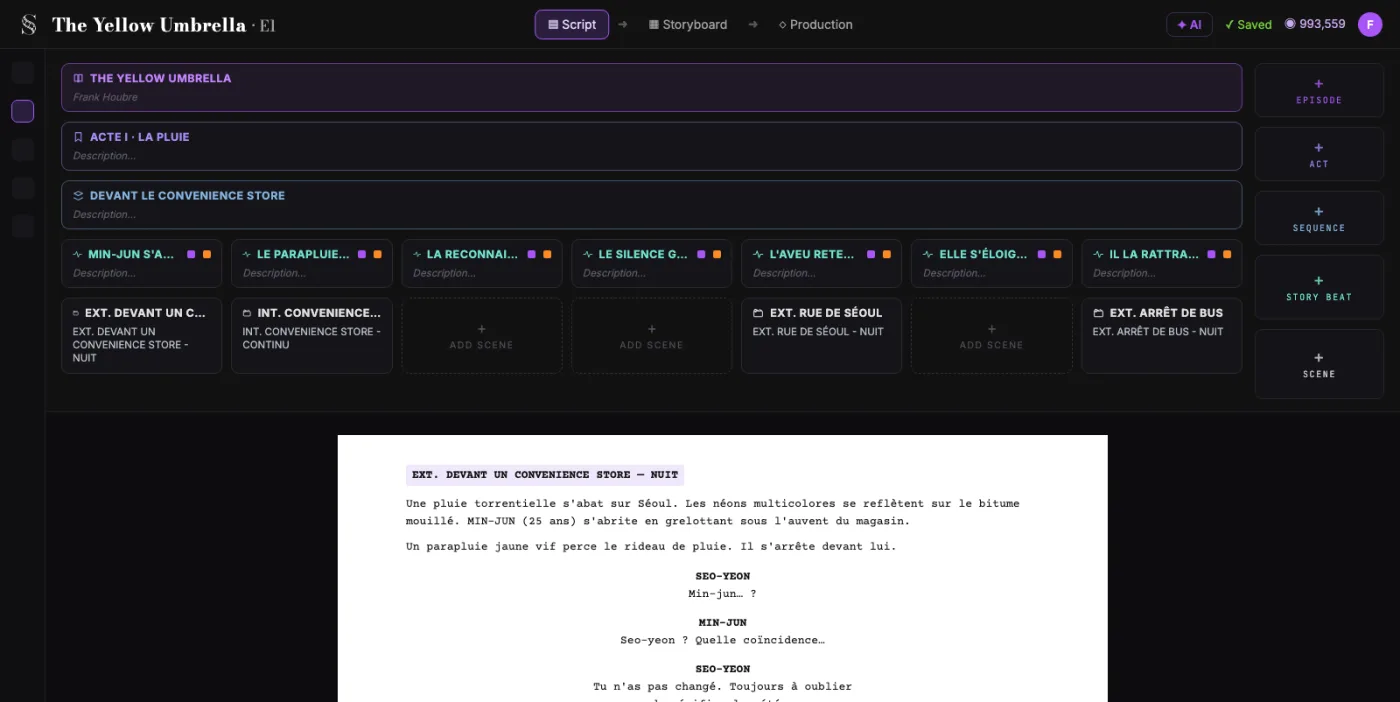
  1. ScreenWeaver screenplay editor: acts, sequences and beats above the formatted script of The Yellow Umbrella

    01The screenplay, enriched

    An industry-standard screenplay editor, and more: a visual outline and beat editor, your writing inspirations (notes, photos, audio) kept next to the page, and an AI researcher to support your writing, not replace it.

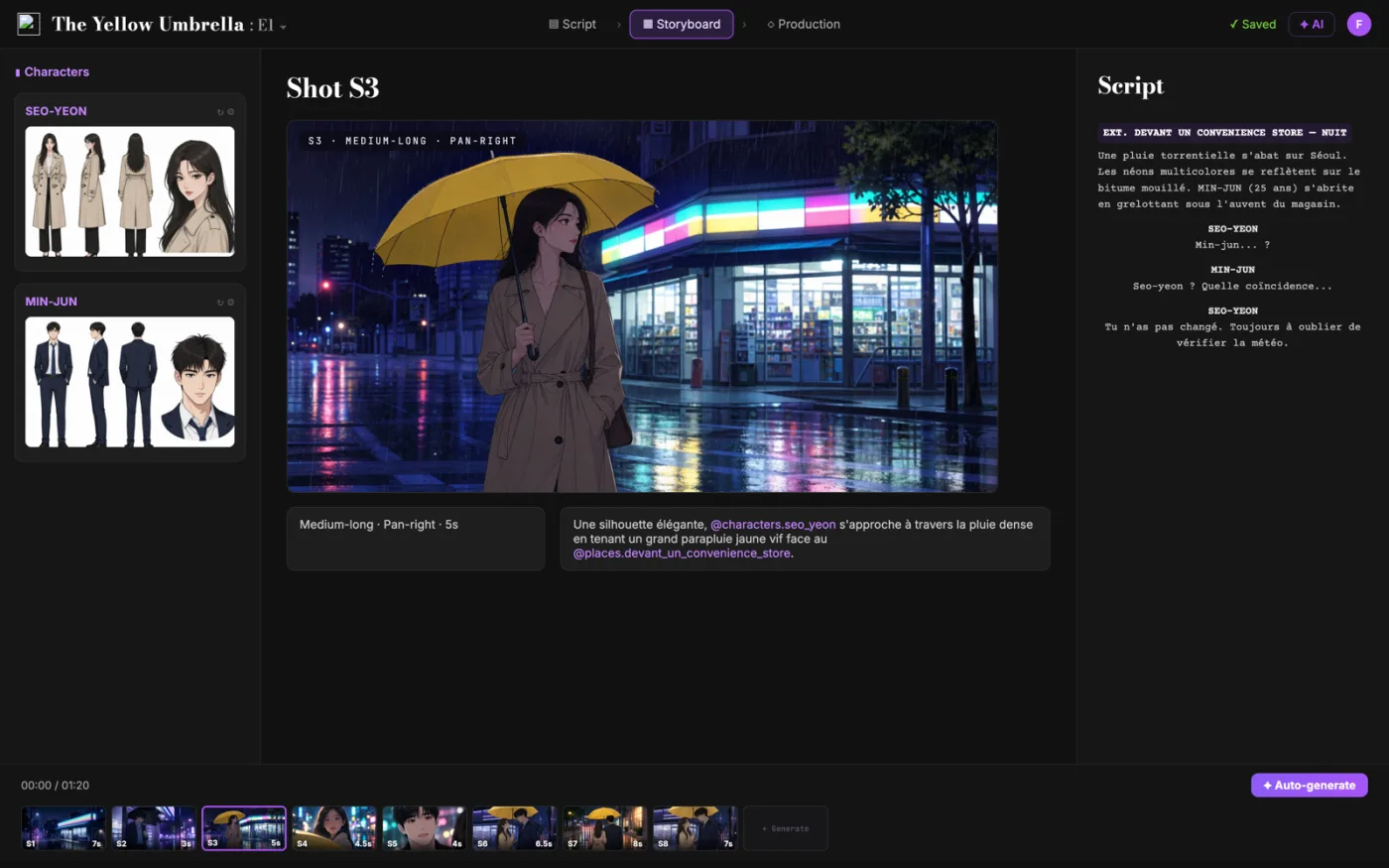
  2. ScreenWeaver storyboard: shot S3 of The Yellow Umbrella with characters, shot settings and the script beside it

    02The storyboard, made easy

    Shot breakdown generated from your screenplay, manual control over every shot (frame, angle, movement, duration), and generative AI previsualization in one click.

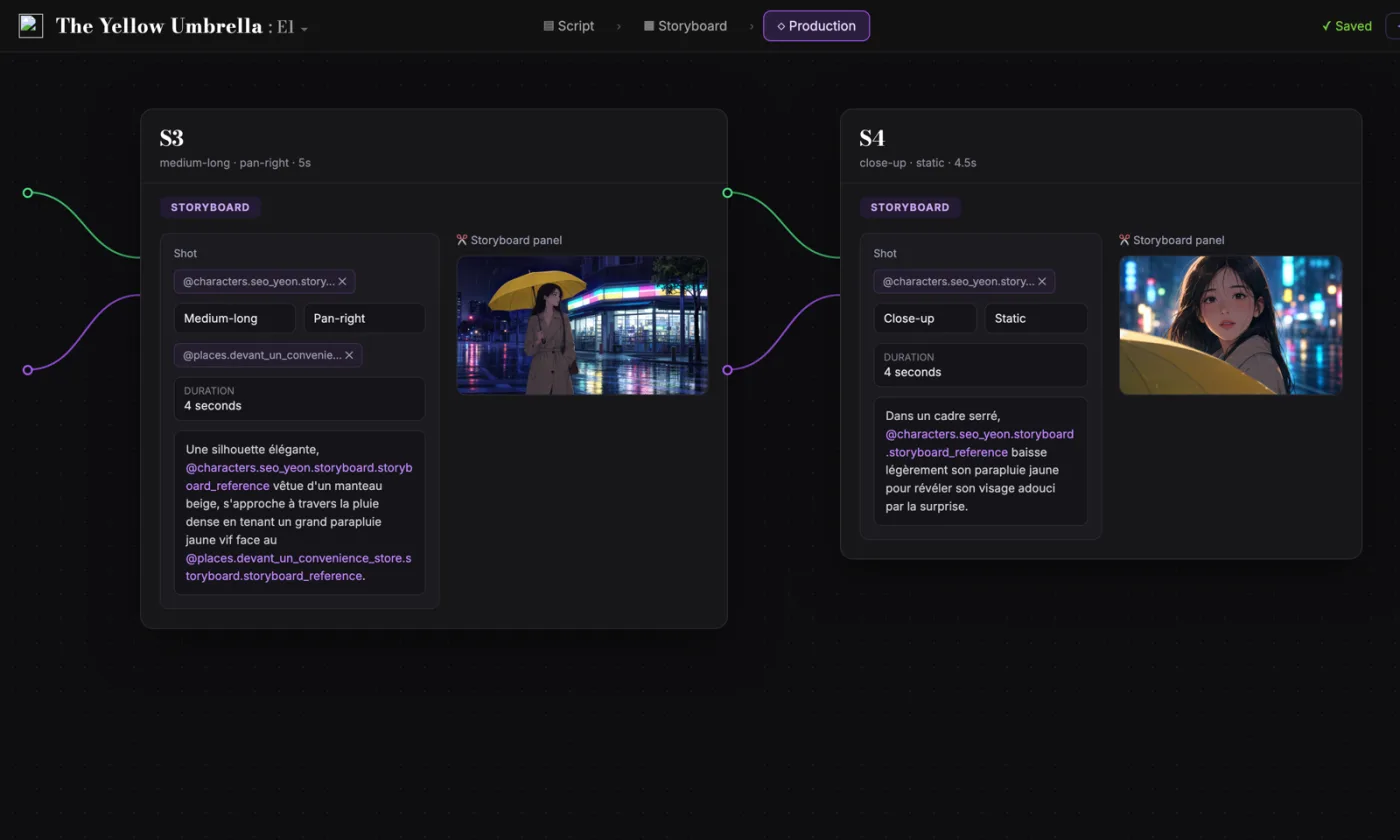
  3. ScreenWeaver production canvas: shots S3 and S4 as connected nodes carrying their storyboard panels and prompts

    03AI production, with finesse

    Footage generation pipelines connected to your screenplay and storyboard. Optimized out of the box, fully editable workflow.

FAQ

The Runway AI Film Festival, your questions

How do you win the Runway AI Film Festival?
Each judge scores a film from 1 to 10 on four equal criteria: overall composition, narrative cohesion and artistic message, originality, and AI technique. That is 40 points per judge, and the best average wins. Make a complete story of 4 to 9 minutes with one clear idea, and describe your techniques in detail.
When is the Runway AI Film Festival 2027?
Runway has not announced a 2027 call on its official site as of 1 October 2026. The 2026 entry period ran from 28 January to 27 April. If that rhythm repeats, a call would open around the start of the year, but that is an inference, not an announcement.
Do I have to use Runway to make the film?
The 2026 terms list Runway's models as examples and accept an upload from a Runway account, YouTube or Vimeo. They name no mandatory tool. The 2026 Grand Prix film used Seedance with Grok and Nano Banana, according to Reply's press release. Check the 2027 terms, and ask the organiser if unsure.
What running time does the film track allow?
Between 3 and 15 minutes, with generative video in the film, as a fully contained linear narrative. The 2026 winners with a listed runtime ran from 4:19 to 8:21.
How much is the prize?
Grand Prix: $50,000 and 1,000,000 Runway credits. Gold: $15,000 and 500,000 credits. Silver: $10,000 and 500,000 credits. Two Honorees get $1,000 and 100,000 credits each, and five Merit awards $500 and 100,000 credits each. The official site cites more than $135,000 across all tracks.
Who judges the film track?
For 2026: Roger Avary, Jane Rosenthal, Bill Hensler, Randall Bobbitt, Bruce Markoe, Kia Brooks, Joel Kuwahara, Richard Kerris and Cristobal Valenzuela. No 2027 jury is announced.
Can an episode of a series enter?
The film track requires a fully contained, linear narrative. An episode that needs the next one to make sense does not fit. Cut a self-contained story, or give your episode a real ending.
Who owns the film after I enter?
You keep ownership. You grant Runway a non-exclusive, perpetual, worldwide licence to use the submission in all media, and you waive moral rights. Clearances for music, likeness and third-party content are yours.

The next call is coming. Start with the page.

Write the screenplay for free today. Storyboard it, then film it with Seedance.