IA Play Madrid 2027 · Guide

How to win IA Play in Madrid.Up to 40 minutes. A gala on 20 March 2027.

A Madrid festival for films that use AI with intent, in four sections from 100% AI to hybrid. Submissions close on 1 January 2027. Here are the rules, the road to the Grand Finale and a plan from today to the deadline.
  • Deadline 1 January 2027
  • Films up to 40 minutes, €6 entry
  • Four sections, 100% AI to hybrid
Lost Garden · Episode 2

Independent guide. ScreenWeaver does not organise the IA Play International Film Festival and is not affiliated with Cultural Beast. Rules read on 1 October 2026. Official call

Available today in ScreenWeaver: free screenwriting, and a storyboard generated from your screenplay with Storyboard Beta, $9.99 a month.

Rolling out: video generation of each shot, powered by Seedance, with the Filmmaker plan.

The rules on one card

What IA Play asks for.

IA Play is a competition for audiovisual works that use artificial intelligence as a relevant part of their creative idea. It is open to creators worldwide, selects 100 films for an online screening, and ends with a gala in Madrid.
Gala
20 March 2027, Cine Artistic Metropol, Madrid
Deadline
1 January 2027
Entry fee
€6 per film, as many films as you like
Running time
Up to 40 minutes
Eligible works
Finished from January 2023, never entered in a past edition
Sections
100% AI, 100% AI Animation, Hybrid, Web Series and Video Art
Cash prizes
€1,200 in total, plus NFT awards
Subtitles
Spanish, if the film is not in Spanish

Source: the festival’s call on Festhome, read on 1 October 2026. We found no standalone website and no independent coverage, so every detail on this page comes from that call. The maximum duration and the technical formats are set by the organiser: confirm them in the entry form.

What the call says about AI

Five conditions on how you use AI.

The legal terms of the call are specific. They matter more here than at most festivals, because a film is admitted only if the use of AI is declared, owned and ethical.
  • Relevant, intentional, creative

    The film need not be generated entirely by AI. But the use of AI cannot be merely incidental or technical: it has to be part of the creative proposal.

  • A truthful disclosure

    You declare the AI tools used in any phase: image, video, sound, script, animation or postproduction. Say all of them, because the call asks for the full picture.

  • Rights over what AI generated

    You guarantee the rights to every element, AI-generated ones included, in line with each tool’s terms. If you used models trained on your own or third-party data, you declare that the data was obtained lawfully.

  • Real faces and voices

    Identifiable faces, voices or likenesses of real people, generated or altered with AI, deepfakes included, need express authorisation from the person.

  • Content that is refused

    Works that violate fundamental rights, spread misinformation, impersonate someone, promote hate or are otherwise illicit or ethically questionable are not admitted.

Key dates

From the call to the Grand Finale.

The festival runs in phases. Everything before the online screening depends on <b>your submission date</b>.
  1. 17 Jul 2026

    Submissions open

    The call opened on Festhome. You have until the first day of 2027.

  2. 1 Jan 2027

    Submissions close

    The last day to enter. The fee is €6 per film.

  3. 15 Jan 2027

    Official Selection announced

    On social media, and by email to film representatives. Once public, a selection cannot be withdrawn.

  4. 20 Jan to 10 Mar 2027

    Online screening

    One hundred films are shown online. A high quality screening copy is due by 20 January. Public voting runs during this period.

  5. 20 Mar 2027

    Gala in Madrid

    At Cine Artistic Metropol. The finalists are screened in person.

Who decides

A committee, a jury and the public.

The call publishes no judging grid and no jury names. It does describe three groups who decide at three different moments.
  • The selection committee

    Members of Cultural Beast read every submission and choose the 100 films of the Official Selection. At this stage, a clear AI declaration and a film that is finished keep you in the pile.

  • The public

    During the online screening, the audience picks five of the ten finalists and one of the winners, the Audience Award. Films with an immediate hook and a title people can repeat have the edge.

  • The official jury

    A jury of film industry personalities picks the other five finalists and one winner, the Jury Award. The two winners then go to the Grand Finale, against the winners of three other host cities.

The four sections

Choose the section before the story.

Every section has an open theme, so the section is your real choice. The organiser reserves the right to change them. Below, what each one rewards.
  • 01

    100% AI: fiction, documentary, experimental

    Works made with AI throughout, in any of the three modes.

    The widest field and the one most entrants will choose. Stand out with a finished, human story instead of a showcase of effects.

  • 02

    100% AI Animation

    Animation made with AI, with an open theme.

    A natural home for a consistent style, since nothing has to match real footage. A held art direction and a recurring character are your best assets.

  • 03

    Hybrid narrative: AI plus traditional production

    Fiction, animation, documentary or experimental work that mixes AI with other production methods.

    Your real footage is the strength here. Use AI for what a camera cannot do, and show the seam on purpose: a hybrid film that hides its method loses the point.

  • 04

    Web series, video art, new narratives

    Serial formats and experimental forms, in any genre.

    The place for a pilot of a series, or for a form that has no name yet. A strong first episode with a clear promise of what comes next suits an online screening.

Series in practice

Lost Garden, episode 2: the cave in six shots.

Lost Garden, episode 2 was made by the ScreenWeaver team with Seedance, and its first scene sits squarely in the 100% AI Animation section. Read the screenplay page, then follow each shot from storyboard frame to final image, and watch two characters stay the same from the first shot to the last.

Logline. A newborn knight whose inner light is leaking away crosses a world that has stopped hoping, to find the one blacksmith who can seal his armor.

Screenplay · episode 2 · page 1

INT. UNDERGROUND CAVERN - LOWER PATH - CONTINUOUS

Blue mushrooms the size of houses. LANTERN, a small knight with a lantern for a helm, walks alone.

He presses a hand to his chest. Sparks of light slip between his fingers.

SERRURE

Hold on. You're losing something.

Serrure lifts the edge of the cloak. A gash in the armor. Blue light leaks out like smoke.

SERRURE

That's your energy. What keeps you standing.

He grips Lantern's shoulder. Two knights alone among the crystals.

SERRURE

A suit that leaks goes out. Eventually.

Under the giant mushrooms, the road climbs into the dark.

SERRURE

So. We follow the road.

Serrure points the way. Lantern follows.

CUT TO:

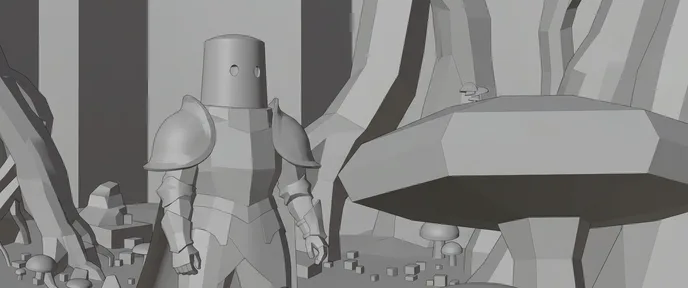
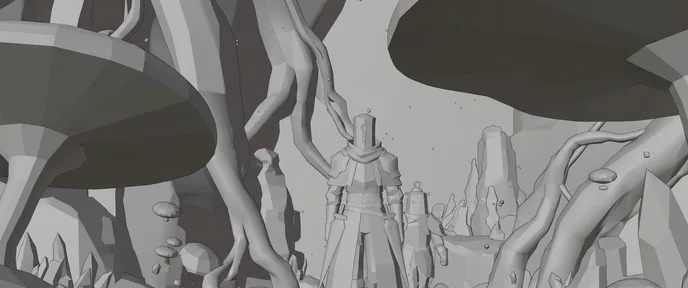
  1. A small knight with a lantern helm stands by a giant glowing blue mushroom in a crystal cavern
    Storyboard frame of the same wide shot, in grey
    01

    Wide · the world

    Wide shot, Lantern alone by a giant glowing blue mushroom, crystal cavern, roots, drifting spores, cold blue light

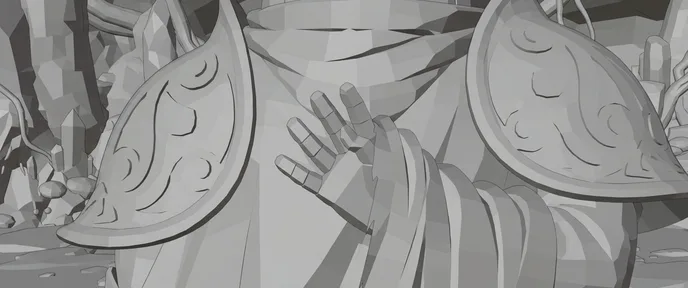
  2. Close-up of an armored chest under a cream cloak, a gloved hand, a spark of light
    Storyboard frame of the chest close-up, in grey
    02

    Close-up · the chest

    Close-up on Lantern's chest, his gloved hand pressed to the cloak, a spark of light escaping between the fingers

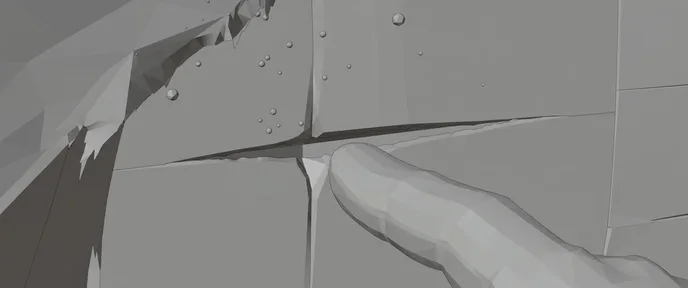
  3. A torn gash in an armor plate leaking bright blue light, a finger pointing at it
    Storyboard frame of the wound insert, in grey
    03

    Insert · the wound

    Extreme close-up, Serrure's finger near a torn gash in the back plate, blue light leaking out like luminous smoke

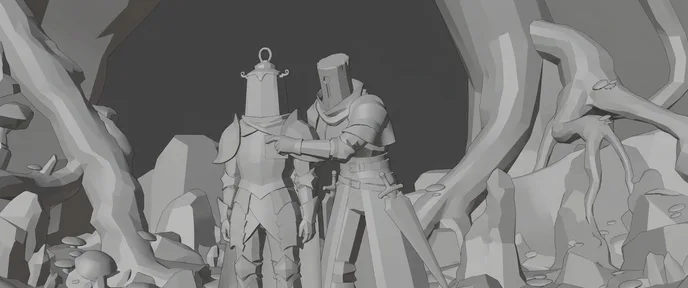
  4. Two armored knights side by side, one with a hand on the other's shoulder, in a crystal cavern
    Storyboard frame of the two-shot, in grey
    04

    Two-shot · the bond

    Medium two-shot among crystals and roots, Serrure's hand on Lantern's shoulder, faceless armors, emotion through posture only

  5. Two small knights walk beneath two giant glowing blue mushrooms
    Storyboard frame of the wide shot, in grey
    05

    Wide · the scale

    Wide low angle, the two knights tiny beneath two giant glowing mushrooms, blue crystals in the foreground, mist

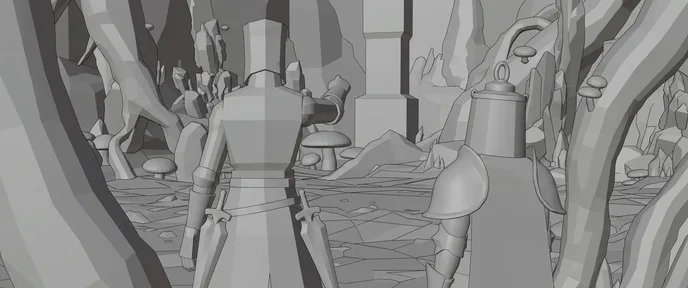
  6. Seen from behind, a tall dark knight points ahead while the small lantern knight looks on
    Storyboard frame of the over-the-shoulder shot, in grey
    06

    Over the shoulder · the road

    Over-the-shoulder from behind, Serrure points ahead into the cavern, Lantern beside him, roots framing the path

Lost Garden, episode 2 runs 21 minutes, about half of what IA Play allows. It is also episode two of a series, the format the Web Series section was made for. Made with Seedance by the ScreenWeaver team. The player begins in the cave.

The script

Five movements for a 12 minute film.

The ceiling is 40 minutes, but 100 films share an online screening and ten reach the stage. Twelve minutes is long enough to build something and short enough to keep a viewer to the end. It means about 12 pages and 140 to 200 shots.
  1. 0:00 to 1:00

    The promise

    An image, a tone and a question. A public vote rewards a first minute that people remember.

  2. 1:00 to 2:50

    The ordinary world

    Introduce the lead and the place. Show in one scene what the lead is missing.

  3. 2:50 to 7:30

    Three tests

    The longest movement. Each test is harder than the last and reveals something new about the lead.

  4. 7:30 to 10:30

    The break

    The lead fails or chooses. This is the stretch a jury will remember when it ranks ten finalists.

  5. 10:30 to 12:00

    The echo

    A last image that mirrors the first. In a hybrid film, this is where the two worlds can finally meet.

A short film for IA Play works as a pilot as well. End on an open door, not a locked one, and the same project can grow into the series the web section welcomes.

Month by month

Thirteen weeks to the first of January.

From 1 October to 1 January. Do not leave the edit for the holidays: aim to submit before Christmas and keep the last week as margin.
  1. 01

    October

    Section, logline, length

    Decide the section first, then the length. Write several loglines and keep the one you can say in one breath.

  2. 02

    Early November

    The screenplay

    Twelve pages or so, on the free Screenwriter plan. If you shoot real footage for a hybrid film, mark in the pages which shots are generated.

  3. 03

    Mid November

    References and storyboard

    Approve one reference per character and place, then storyboard each shot. Your storyboard is the plan the footage follows, and the record you can show.

  4. 04

    Late November to mid December

    Generate the footage

    One scene at a time. ScreenWeaver’s video generation, powered by Seedance, is rolling out with the Filmmaker plan. Keep a log of every tool and version, since the call asks you to declare them.

  5. 05

    17 to 28 December

    Edit, mix and subtitle in Spanish

    Cut to length, mix, and add Spanish subtitles if the film is not in Spanish. Write your AI disclosure while the details are fresh.

  6. 06

    By 1 January

    Submit on Festhome

    Enter on Festhome with the €6 fee. If you are selected on 15 January, you must send a high quality screening copy by 20 January, so keep the master ready.

What gets a film refused

Seven ways to be left out.

They all come from the conditions of the call. Several of them are easy to meet and easy to forget.
  • AI as a side effect

    If AI only cleans the audio or stabilises a shot, the film does not qualify. The call asks for a relevant, intentional and creative use of it.

  • No Spanish subtitles

    The call asks you to give the original language and to subtitle in the language the festival requires, which it names as Spanish. A film in English with no Spanish subtitles is incomplete.

  • A film finished before 2023

    Only works completed from January 2023 onwards are eligible. A film that has already been in an earlier edition of IA Play is not.

  • Planning to withdraw

    Once the organiser makes your selection public, you may not withdraw the film. Be sure you want the festival before you submit.

  • A screening copy that is not ready

    Selected films commit to sending a high quality copy by 20 January 2027. A master that still needs a re-export is a risk in the middle of winter holidays.

  • Real people without consent

    A famous face, a cloned voice or a deepfake of a real person needs express authorisation. An invented character costs nothing and breaks no rule.

  • An incomplete declaration

    Declare every AI tool, in every phase, and the origin of any data used to train a model you used. A partial list is a breach of the call, not a shortcut.

Why ScreenWeaver

A festival that asks for intent needs a project you can show.

IA Play wants AI used on purpose. ScreenWeaver connects the screenplay, the storyboard and the footage in a single project, so every use of AI can be traced.
  • A disclosure that writes itself

    The call wants every AI use declared, phase by phase. In ScreenWeaver, the screenplay, the storyboard and the footage live in one project, so the story of how the film was made is already there.

  • For the 100% AI and the hybrid sections

    Write and storyboard the whole film, then generate the shots you need and film the rest. The screenplay and storyboard serve both ways of working.

  • Long enough to need consistency

    At 12, 20 or 40 minutes, characters and places have to hold. Characters, locations and references carry from shot to shot, which is what lets a long film look like one film.

  • Start at no cost

    Writing costs nothing: the Screenwriter plan is $0, with no expiry date. Storyboard Beta adds the shot-by-shot board for $9.99 a month, and video generation, on Seedance 2.0 and 2.5, is rolling out with the Filmmaker plan.

Real productions

International festival-recognized films have been written and produced with ScreenWeaver.

ScreenWeaver is already being used as a creative workspace for real AI film productions, from cinematic shorts to animated series pilots selected, nominated, and awarded by international festivals.

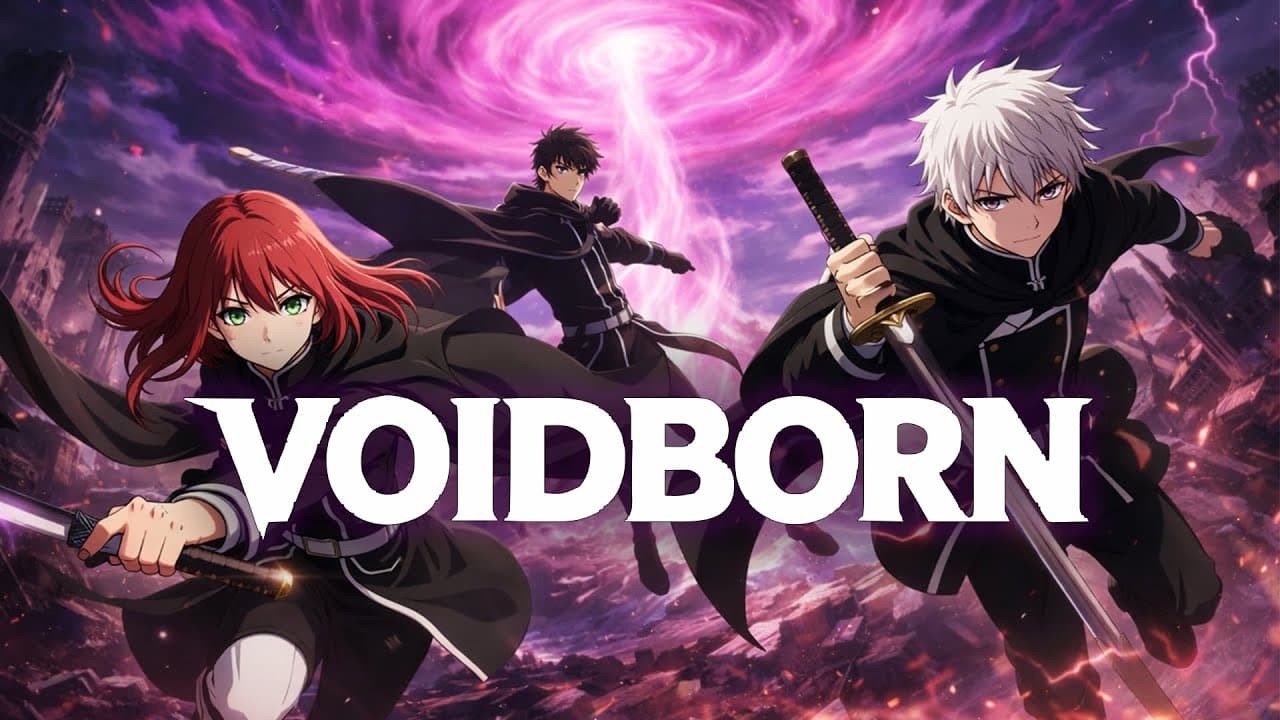
  • Video thumbnail for VOIDBORN

    VOIDBORN

    AI animated / cinematic short

    Festival recognition

    • 1st Place Silver

      Mondial Chroma Awards

    • 2nd Place Dreamina

      Mondial Chroma Awards

    • Award Winner

      Seoul International AI Film Festival

  • Video thumbnail for Les Fils du Vinnana

    Les Fils du Vinnana

    AI short film

    Festival recognition

    • Honorable Mention

      Top Quark Film Festival

    • People's Choice Nominee

      Illuminate Oneness of Humanity

    • Nominee

      ALTFF Supershort

  • Video thumbnail for Lost Garden

    Lost Garden

    AI animated series pilot

    Festival recognition

    • Finalist

      AI London Festival

The pipeline

Write. Board. Produce.

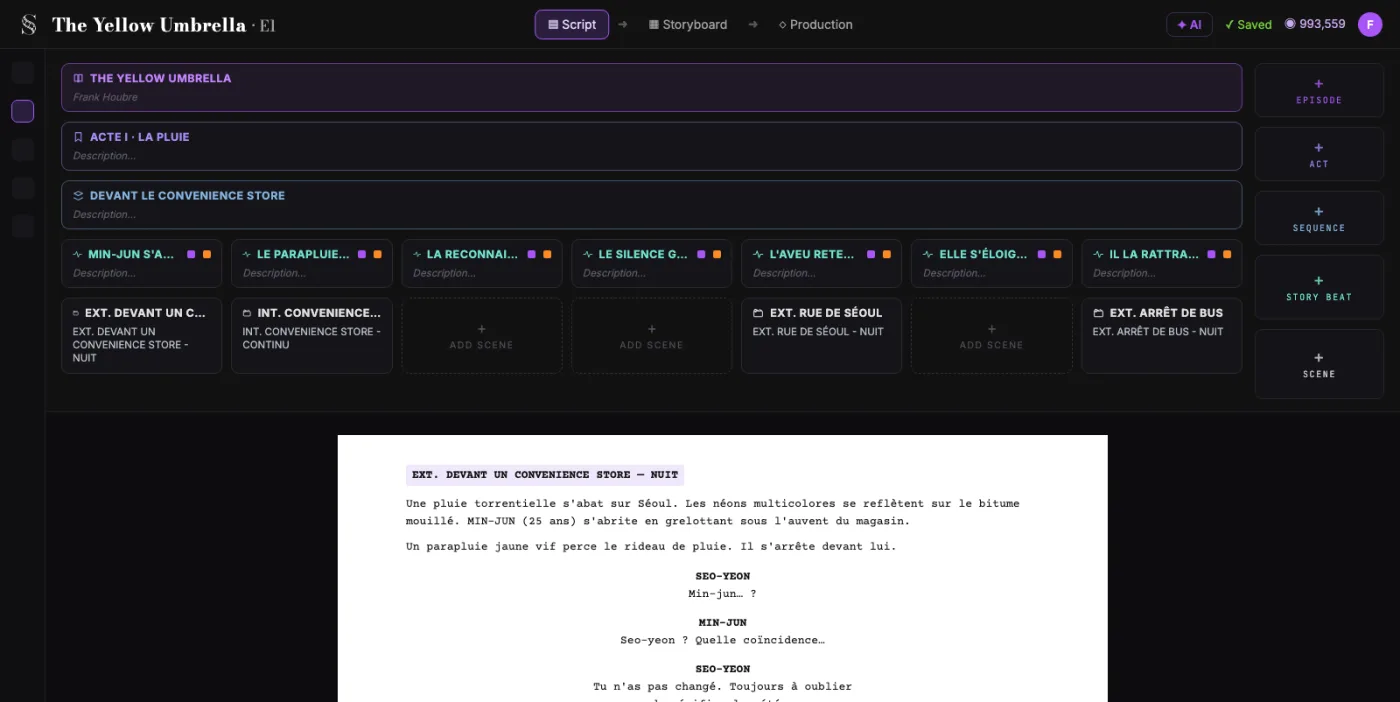
  1. ScreenWeaver screenplay editor: acts, sequences and beats above the formatted script of The Yellow Umbrella

    01The screenplay, enriched

    An industry-standard screenplay editor, and more: a visual outline and beat editor, your writing inspirations (notes, photos, audio) kept next to the page, and an AI researcher to support your writing, not replace it.

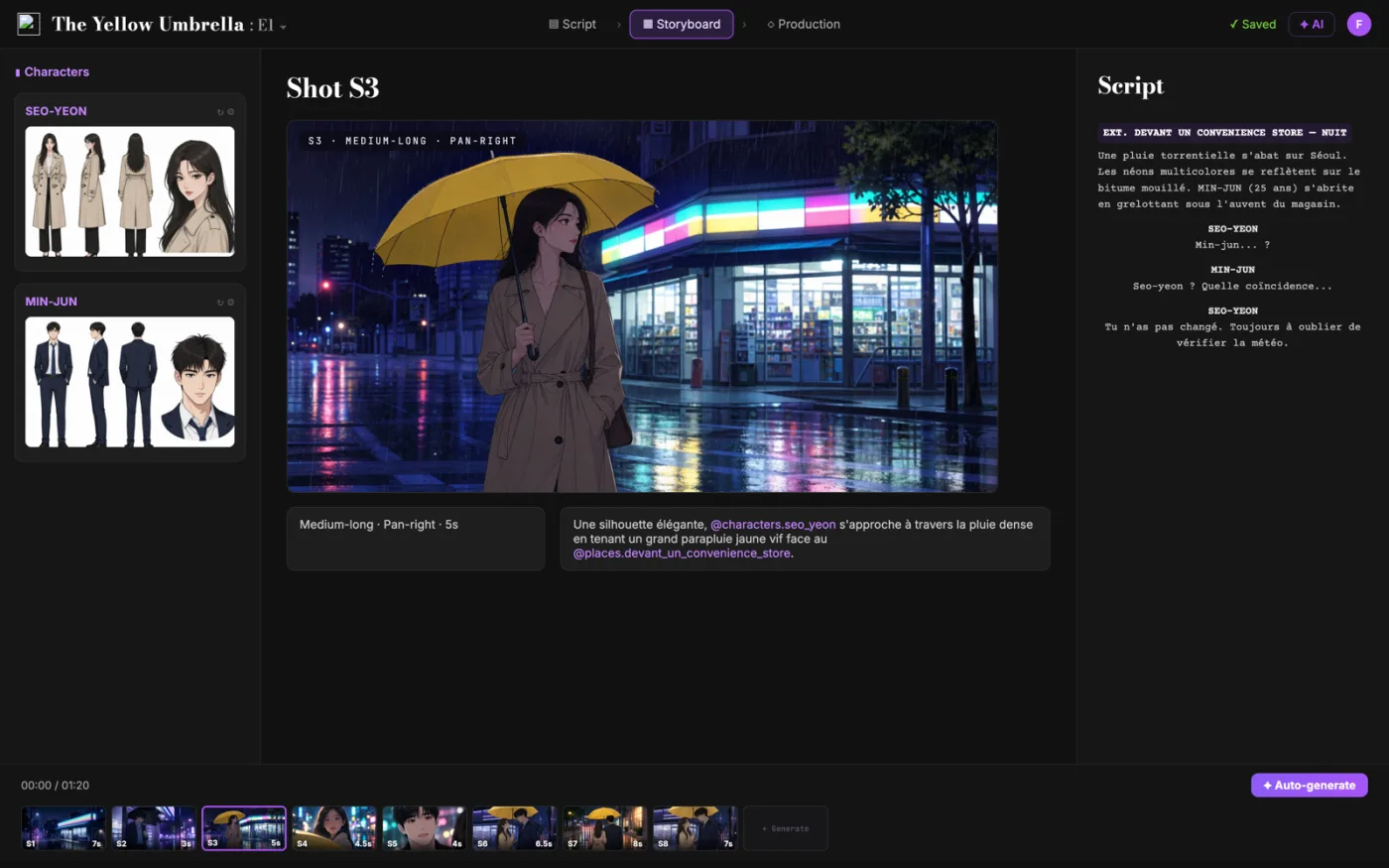
  2. ScreenWeaver storyboard: shot S3 of The Yellow Umbrella with characters, shot settings and the script beside it

    02The storyboard, made easy

    Shot breakdown generated from your screenplay, manual control over every shot (frame, angle, movement, duration), and generative AI previsualization in one click.

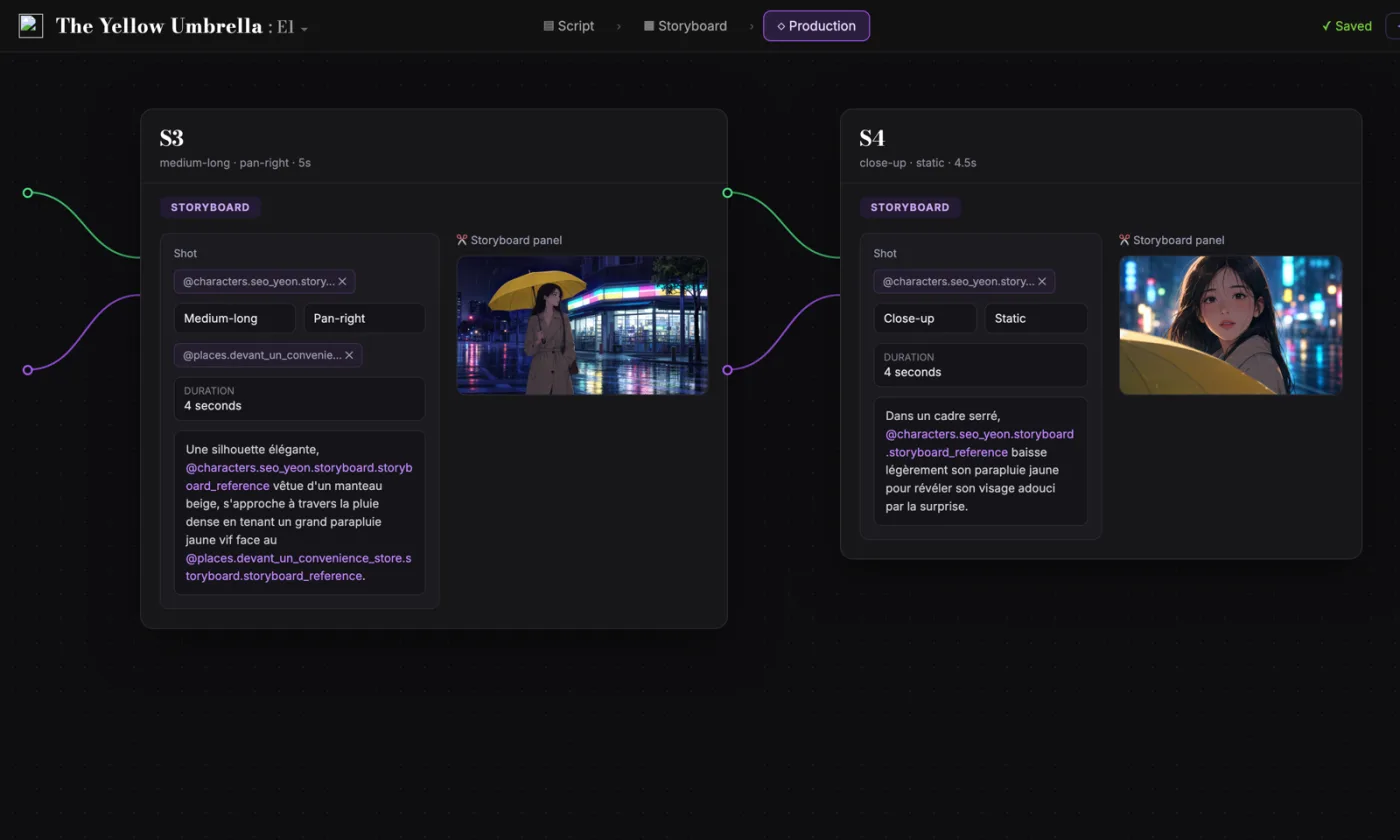
  3. ScreenWeaver production canvas: shots S3 and S4 as connected nodes carrying their storyboard panels and prompts

    03AI production, with finesse

    Footage generation pipelines connected to your screenplay and storyboard. Optimized out of the box, fully editable workflow.

FAQ

IA Play Madrid, your questions

How do you win the IA Play International Film Festival?
The Official Selection is 100 films shown online. Ten finalists follow, five chosen by the public and five by the jury, and one jury winner and one audience winner come out of them. The two winners go to the Grand Finale, against the winners of the other host cities.
What is the deadline for IA Play Madrid?
Submissions run from 17 July 2026 to 1 January 2027. The Official Selection is announced from 15 January 2027, and the gala is on 20 March 2027 at Cine Artistic Metropol in Madrid.
How much does it cost, and how many films can I enter?
The admission fee is €6 per film. There is no limit on the number of films you submit, but a film from a previous edition is not eligible.
Does my whole film have to be made with AI?
Not for every section. The call says it is not mandatory for the entire work to be generated by AI. But its use must be relevant, intentional and creative, and never merely incidental or technical. The Hybrid section is built for AI mixed with traditional production.
What are the prizes?
At each venue: Jury Award €250, Audience Award €150, plus awards for Best Creative Use of AI and Highest Impact. The Grand Finale pays €500 to the jury winner and €300 to the audience winner. All awards come with an Official NFT.
Does ScreenWeaver work for the IA Play sections?
For the screenplay and storyboard today, in the 100% AI and the hybrid sections alike. Footage from Seedance 2.0 and 2.5 comes with the Filmmaker plan, now rolling out. No tool is imposed, and you declare each one you used.
Can I withdraw my film after I am selected?
No. Once the festival has made the selection public, the film cannot be withdrawn, and you commit to sending a high quality screening copy by 20 January 2027.
Who is on the jury?
The call names no one. It says a selection committee from Cultural Beast chooses the 100 films, and a jury of film industry personalities picks the winners. The public votes alongside them.

Thirteen weeks. Write the first page.

A film for Madrid begins with its first page. Write it free, then storyboard it.