
Short answer: a shooting script title page keeps the same title, "Written by," and writer fields as a spec title page, but adds a production layer: a draft or revision label (often "Shooting Draft" or "Production Draft"), the current revision color and date, and sometimes a production company credit. The revision color itself lives mainly in the page headers of the changed pages, not the title page, but professional title pages usually note the current color and date so nobody on set is holding an outdated cover.
What changes from a spec title page
| Element | Spec title page | Shooting script title page |
|---|---|---|
| Title, "Written by," writer name | Present | Present, unchanged |
| Contact information | Often present | Usually replaced by production company |
| Scene numbers reference | Not applicable | Implied; script is fully numbered |
| Draft label | Rare | "Shooting Draft" or "Production Draft" common |
| Revision color and date | Not applicable | Noted, e.g. "Blue Revisions, 2/18/26" |
| Distribution restriction | Rare | Sometimes present ("Property of [production company]") |
For how a shooting script differs from a spec script beyond the title page, scene numbers, revision protocol, who controls the document, see Spec Script vs Shooting Script.
The standard revision color order
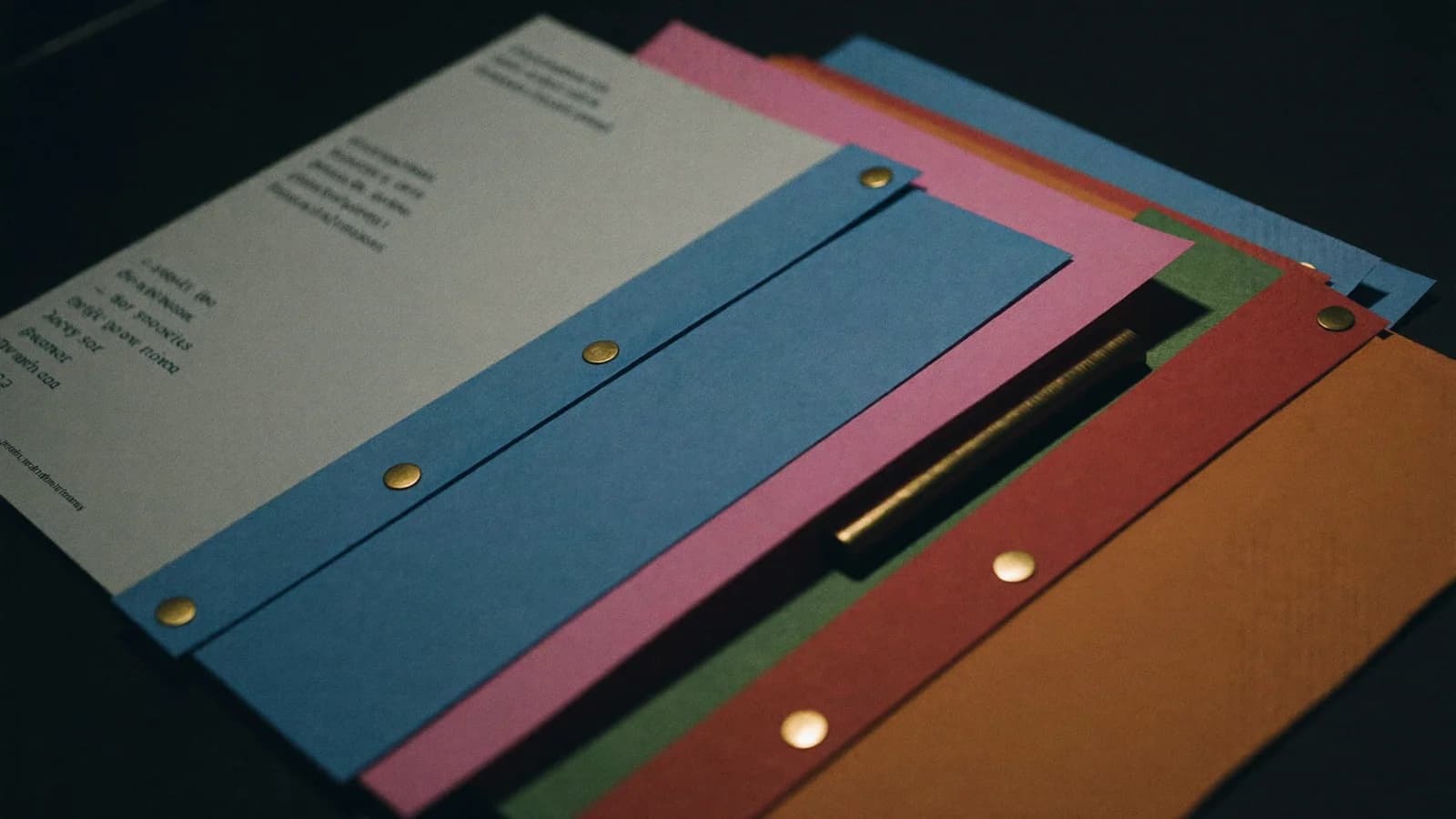
Hollywood productions have used a fairly consistent color sequence for decades so any crew member can tell a page's age at a glance, without reading a date.
| Order | Color | Order | Color |
|---|---|---|---|
| 1 | White (original) | 6 | Goldenrod |
| 2 | Blue | 7 | Buff |
| 3 | Pink | 8 | Salmon |
| 4 | Yellow | 9 | Cherry |
| 5 | Green | 10+ | Second White, Second Blue, cycle repeats |
Individual productions can adjust this order, always confirm with the production office rather than assuming the sequence above is universal for your show.
Try it free
Try Screenweaver for free on your script
It is free. Import your existing project, get a clearer view of your outline, and regain control of your story structure in minutes.
Start FreeThe nuance that changes the answer
The title page is not where revisions actually live. The real revision tracking happens on individual changed pages, each stamped with its color and date in the header, while unchanged pages stay on their original color. The title page's job is just to tell anyone who picks up the full script what the current overall state is, so it usually only needs updating when a new full draft is issued, not with every batch of colored pages.
"Property of" lines exist for a reason. Production scripts circulate to a large crew, and leaks are a real cost concern for a studio, especially before release. A distribution restriction line on the title page is not decoration, treat any shooting script you receive as confidential regardless of whether the line is present.
Build a clean production title page
Use the free screenplay title page maker to generate a shooting-script-style title page with draft labeling, then hand revision tracking over to your production office's actual protocol once scene numbers are locked. If the body of the script still lacks numbers, a spec to shooting script converter adds them along with the production draft label.
Free tool: the screenplay title page maker builds spec and production-style title pages in seconds, no signup.
FAQ
Does the revision color go on the title page or on individual pages?
Individual changed pages carry their own revision color and date in the header. The title page typically just notes the script's current overall state, useful context, not the detailed tracking mechanism.
What does "Rev. Blue, 2/18" mean on a script page?
It means that specific page was revised and reissued in the Blue revision batch, dated February 18. Pages without that stamp are still on their original color and have not changed since.
Is the revision color order the same on every production?
The white, blue, pink, yellow, green, goldenrod sequence is the traditional Hollywood standard, but individual productions can modify it. Always confirm the actual sequence with your production office rather than assuming.
Should a spec script ever include revision colors or a production draft label?
No. Revision colors and production draft labels signal a script already in or near production. Adding them to a spec reads as a formatting mistake, the same way scene numbers do, and should be left off until a project is actually greenlit.
Final Step
Build your next script with Screenweaver
Move from ideas to production-ready pages faster with timeline-native writing and AI-assisted story flow.
Try Screenweaver