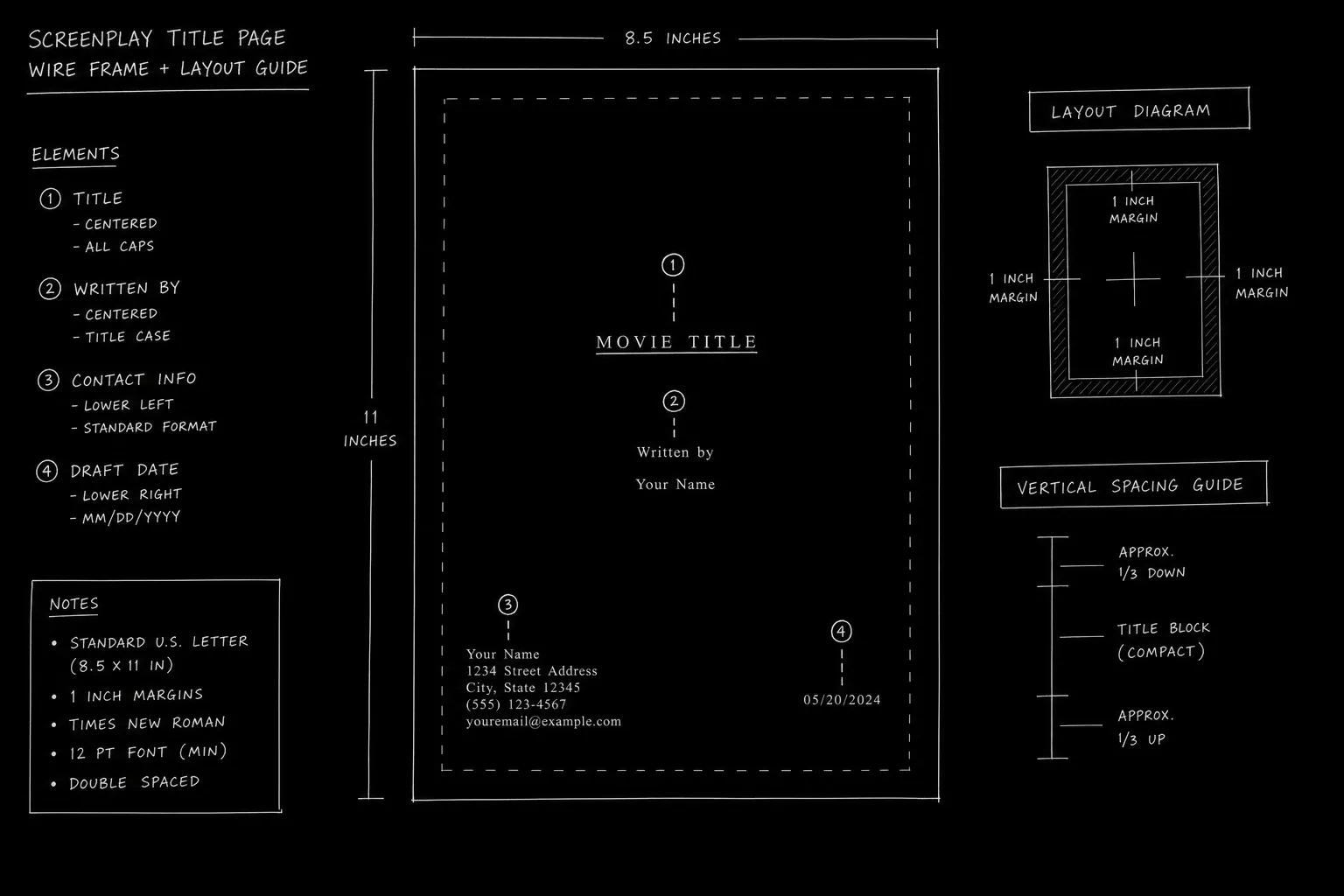

Short answer: there is no single correct screenplay title page, there are nine common ones, and which fields you include depends entirely on who is reading it: a contest, an agent, a producer, or a writers' room. Get the audience wrong and even a perfectly formatted page reads as a mistake, an anonymized contest entry with your phone number on it is a disqualification, not a detail.
The nine layouts, side by side
Each of these keeps the same core discipline, centered title, clean typography, minimal ornamentation, but changes what surrounds it.
| # | Layout | Key fields | When to use |
|---|---|---|---|
| 1 | Standard unrepresented spec | Title, "Written by", your name, contact bottom-left | Cold submissions, query responses |
| 2 | Represented spec | Title, "Written by", your name, agency contact instead of yours | Any script your rep is sending out |
| 3 | Anonymous contest entry | Title only, centered, no name or contact anywhere | Nicholl, Austin, PAGE, and most blind-read fellowships |
| 4 | Adaptation credit | Title, "Written by", your name, "Based on the novel by [author]" | Any script adapted from existing source material |
| 5 | Multiple writers | Title, "Story by" and "Screenplay by" on separate lines | Co-written scripts with distinct story and script credit |
| 6 | TV pilot | Series title top, episode title below it, "Written by" | Original pilots and spec pilot samples |
| 7 | Shooting/production draft | Title, revision color, draft date, production company | Scripts already in or near production |
| 8 | WGA-registered submission | Title, "Written by", your name, registration number line | Submissions where registration proof is expected |
| 9 | Staffing sample | Series name, episode title, "Written by", studio template fields | TV staffing packets following a specific show's format |
For the underlying rules behind every field on this list, spacing, capitalization, what belongs and what does not, see Script Title Page Format: Rules, Examples and Free Template. This page shows the variations; that one explains the discipline behind each.
The nuance that changes the answer
Two mistakes account for most title page problems, and neither is a formatting error.
Wrong audience, right formatting. A title page can be typographically perfect and still fail if it is the wrong layout for where it is going. Sending a contact-free anonymous layout to an agent reads as if you forgot your own name. Sending your home address to a blind-read fellowship gets the entry pulled before anyone reads page one.
One PDF trying to serve every reader. Writers who maintain a single title page for every submission end up either stripping contact info late, and forgetting, or leaving it in when a contest demanded anonymity. Keep separate exports for the layouts you actually use: one standard, one anonymized, one for your rep if you have one.
Try it free
Try Screenweaver for free on your script
It is free. Import your existing project, get a clearer view of your outline, and regain control of your story structure in minutes.
Start FreeBuild any of these in seconds
Do not fight margins and centering in a word processor for a one-page document. Use the free screenplay title page maker to fill in the fields for whichever layout you need and export a clean, industry-standard PDF.
Free tool: the screenplay title page maker builds any of these layouts and exports a standard-format PDF in seconds, no signup.
FAQ
Do all screenplay title pages need the writer's contact information?
No. Standard and represented specs typically include contact information, but anonymous contest and fellowship submissions specifically require its absence. Check each program's current rules before submitting, since requirements vary and change year to year.
What is different about a TV pilot title page versus a feature title page?
A TV pilot title page adds the series title above the episode title, both centered, while a feature title page has only one title. Staffing samples may follow a specific show's template with additional fields a spec pilot would not include.
Should my adaptation credit go on the title page or inside the script?
On the title page, directly under the "Written by" line: "Based on the novel by [author name]" or the equivalent for the source material's format. This is standard placement and readers expect to see it there, not buried inside the script.
Can I use one title page for every submission?
Not safely. Contest anonymity rules, representation contact swaps, and adaptation credits all change what the page should contain. Keep two or three versions ready, standard, anonymized, and represented if applicable, rather than editing one file under deadline pressure.
Final Step
Build your next script with Screenweaver
Move from ideas to production-ready pages faster with timeline-native writing and AI-assisted story flow.
Try Screenweaver