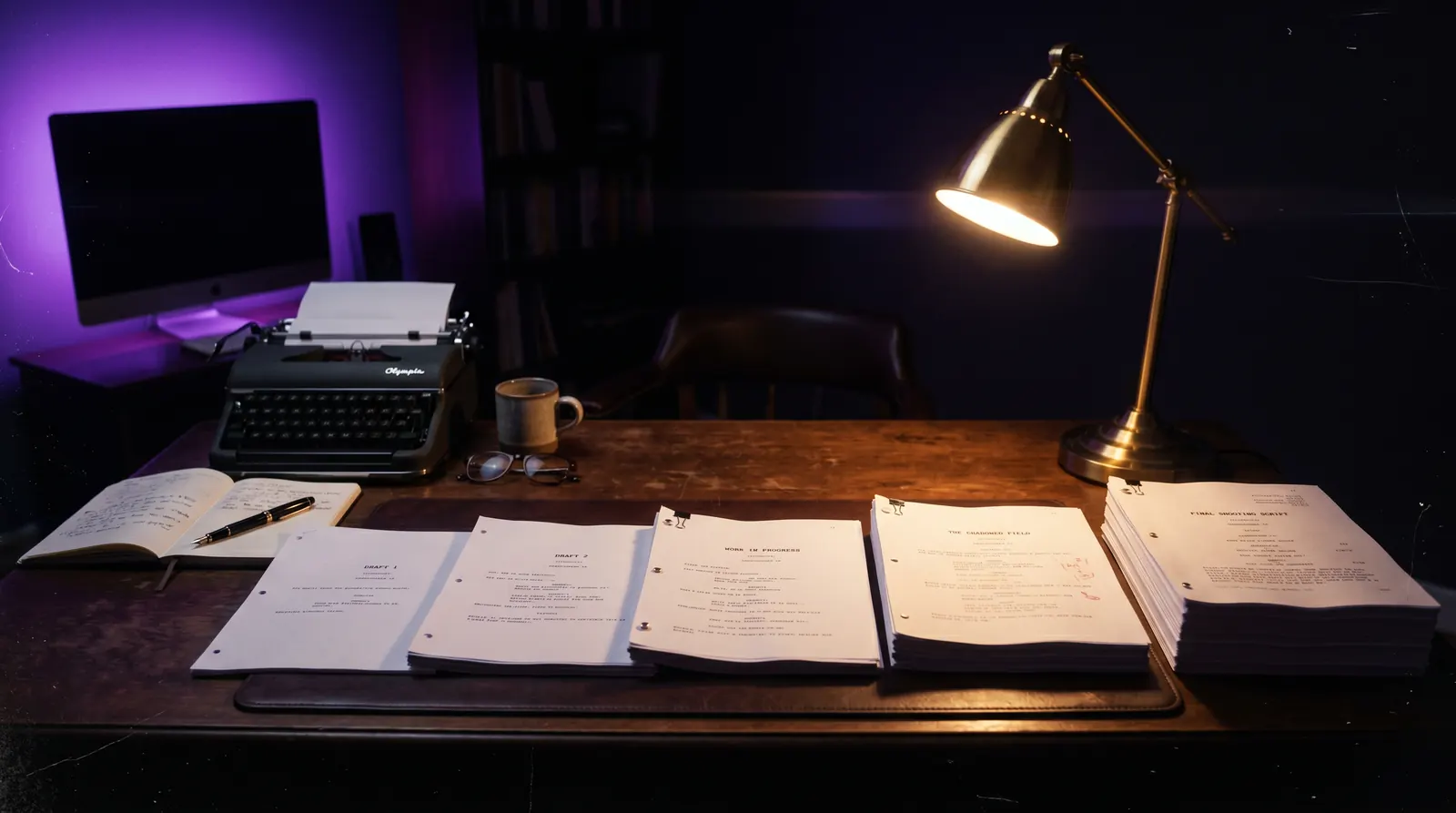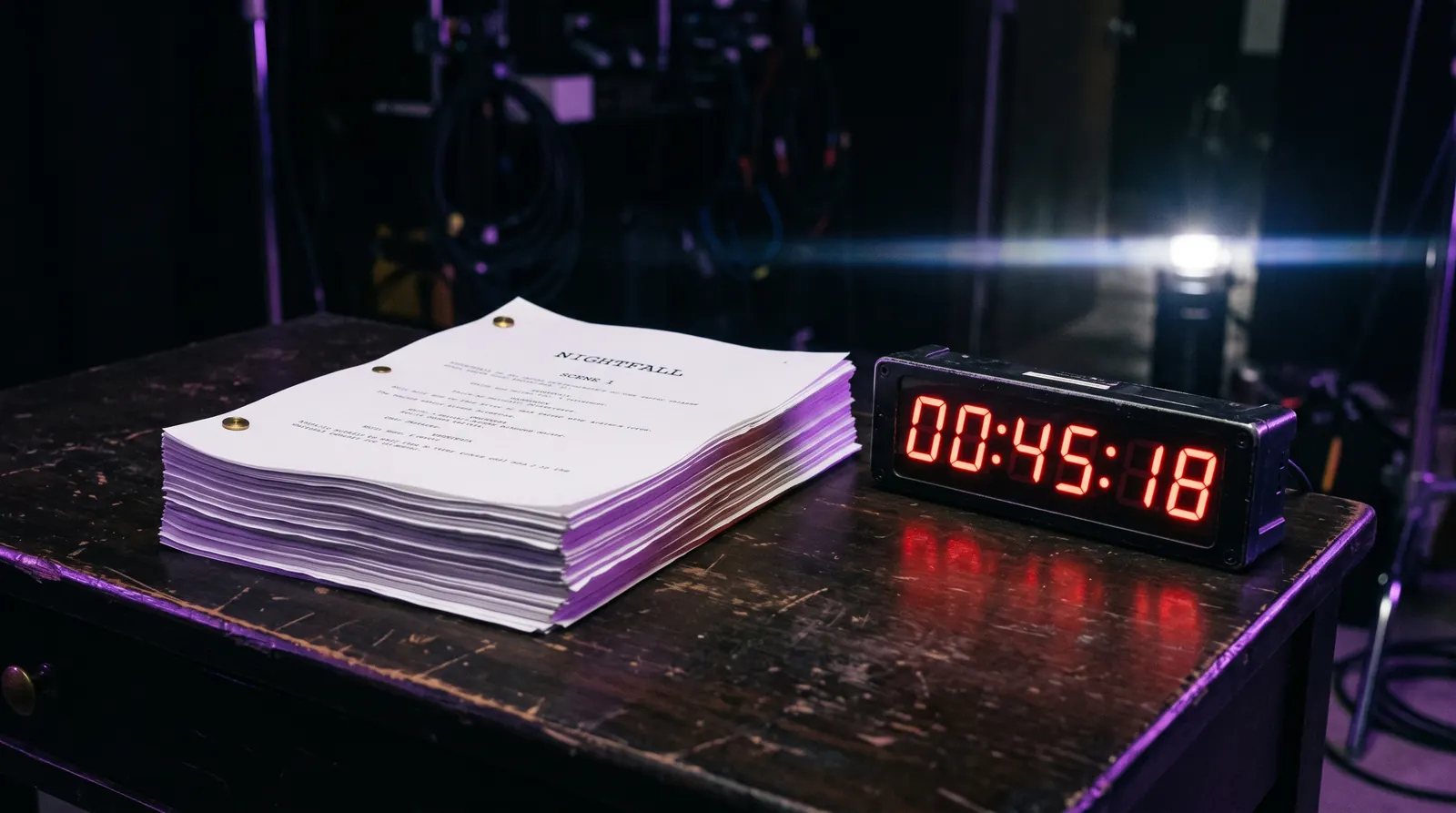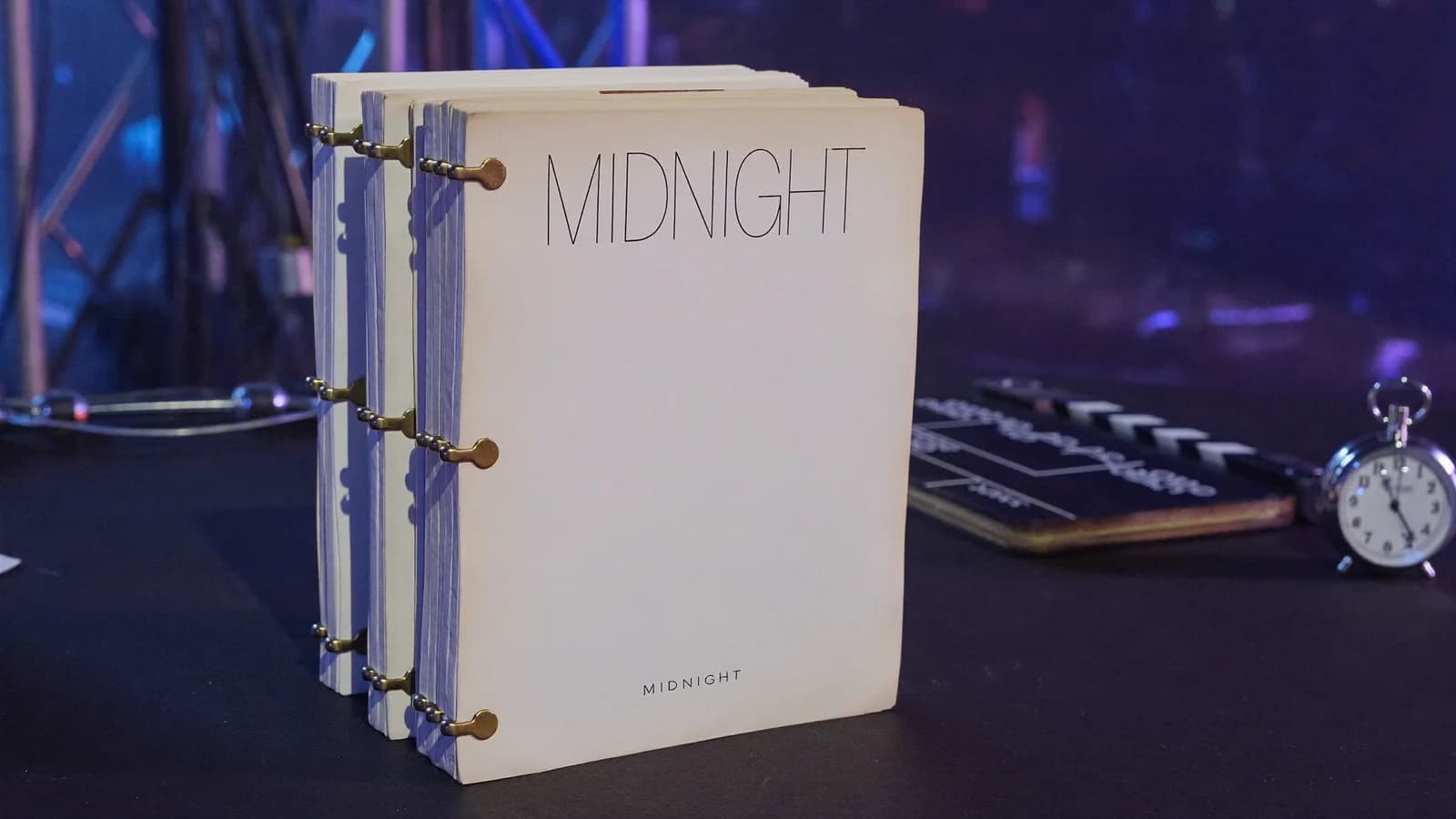

Short answer: a 2-hour (120-minute) movie script runs approximately 110 to 125 pages, following the one-page-per-minute convention that standard screenplay format is built around. The safest professional target sits at 118 to 122 pages: close enough to two hours to read as intentional, without printing a number that makes a reader brace for a bloated draft before they reach page one.
The precise answer, by genre
A flat "120 minutes" reads differently depending on what kind of film is asking for that runtime.
| Genre | Pages for ~120 minutes | Typical produced range | How the length reads |
|---|---|---|---|
| Action / thriller | 108-118 pages | Usually cut tighter than a flat 2:00 | Momentum expected; pages near 125 read slow |
| Comedy | 115-125 pages | Rarely runs the full two hours | Rapid dialogue plays fast, so two hours takes more pages; most comedies aim for 95 to 105 |
| Drama / ensemble | 115-128 pages | Comfortable pushing past 120 | Slower burn accepted at this length |
| Epic / historical | 125-145 pages | 120 pages reads lean for the genre | Scope justifies extra pages here |
| Horror | 95-110 pages | Two hours is already unusually long | Most horror lands under 105 |
For the complete range across every format, not just the 2-hour mark, see How Long Should a Script Be?. For the equivalent breakdown at a tighter 90-page runtime, How Long Is a 90-Page Script on Screen? covers the same logic at the other end of the feature range.
The nuance that changes the answer
Two hours of screen time does not lock a script to one exact page count, and the gap is not a formatting error.
The 125-page ceiling is partly psychological. A script that hits exactly 120 pages reads as confident. The same story at 132 pages, even if every scene earns its place, gets a reader asking what could be cut before they finish act one. Professional writers often trim toward 118 to 122 specifically to avoid that reaction, independent of whether the story needs the extra pages.
Content mix still moves the real runtime. A 120-page script heavy in action description can play past 125 minutes once shot and edited, since a reader's eye covers action lines faster than a camera executes them: one line of fight or chase can take a minute of screen time. A 120-page script built on rapid dialogue tends to play under 120 minutes, because quick exchanges fill a page faster than they fill the screen. If your story is action-driven, aim lower in the range; if it is dialogue-driven, you can sit higher. And if you are planning the shoot, 120 pages is also hundreds of camera setups to plan, which is where it helps to turn the script into a storyboard with AI and see the real coverage before anyone budgets it.
Try it free
Try Screenweaver for free on your script
It is free. Import your existing project, get a clearer view of your outline, and regain control of your story structure in minutes.
Start FreeHow to check yours in seconds
Do not assume your script hits two hours just because the footer says 120, especially if it was not written in standard screenplay format; a free screenwriting app handles the margins and spacing the page-per-minute rule depends on. Paste your script or type its word count into the free Script Time Calculator, set the pace from slow drama to fast action, and get a runtime estimate in minutes and seconds based on your actual text, not just its page count.
Free tool: the Script Time Calculator estimates runtime from pasted script text or a word count in seconds, no signup.
FAQ
Is a 120-page script exactly 2 hours?
Approximately, yes, following the one-page-per-minute convention standard format is built around. The real runtime can land a few minutes on either side depending on how dialogue-heavy or action-heavy the script reads once produced.
What is the longest a 2-hour movie script should run?
Most professional readers treat 125 pages as the practical ceiling for a script targeting two hours. Past that, expect a note asking what can be cut, even in genres like drama or epic that tolerate longer runtimes than average.
Is 110 pages too short for a 2-hour film?
Not necessarily. Action, thriller, and dialogue-light scripts commonly reach two hours of produced runtime at 108 to 115 pages, because their action pages play longer on screen than they take to read.
How do I check my script's runtime without counting manually?
Paste the text or type its word count into the free Script Time Calculator. It converts words into minutes and seconds at the pace you set, from slow drama to fast action, instead of treating every page as an identical minute.
Final Step
Build your next script with Screenweaver
Move from ideas to production-ready pages faster with timeline-native writing and AI-assisted story flow.
Try Screenweaver