
A short drama script is standard screenplay format with three additions: an episode header at the top of every episode, one to two pages per episode, and a page that runs about sixty seconds on screen instead of the feature minute. Every episode opens on a line of conflict, turns once, and ends on a line that asks a question. Here is the template, the math, and a worked episode.
The structure behind the format, the four cliffhanger shapes and where the milestones land, is in short drama episode structure. This article is about what goes on the page.
The template
Paste this into any Fountain-aware app (ScreenWeaver, Highland, Final Draft with the Fountain importer) and it formats itself. Bracketed notes are for you and do not print.
Title: THE CONTRACT BRIDE
Credit: Written by
Author: Your Name
Notes: Vertical drama, 9:16. 70 episodes x 90 seconds.

EPISODE 1

INT. PENTHOUSE KITCHEN - NIGHT

[[0:00 HOOK. Conflict in the first image. No establishing shot.]]

Mia stands at the counter in a wedding dress, scissors in hand, cutting the dress off her own body.

DAMON (O.S.)
You signed for a year.

MIA
I signed for a husband. You gave me a landlord.

[[0:54 TURN. The choice this episode exists for.]]

She drops the scissors, picks up the contract, and tears the last page off.

DAMON
That page was the only one that mattered.

[[1:25 CLIFFHANGER. Revelation. Cut before the reaction.]]

He turns the page over. A photograph is stapled to the back. Her mother.

EPISODE 2

INT. PENTHOUSE KITCHEN - CONTINUOUS

[[0:00 HOOK. Open on the reaction the last episode withheld.]]
Change the names, keep the shape. The short drama episode planner writes this skeleton for any episode length with the turn and cliffhanger timestamps already computed, and lays out the whole season around it.
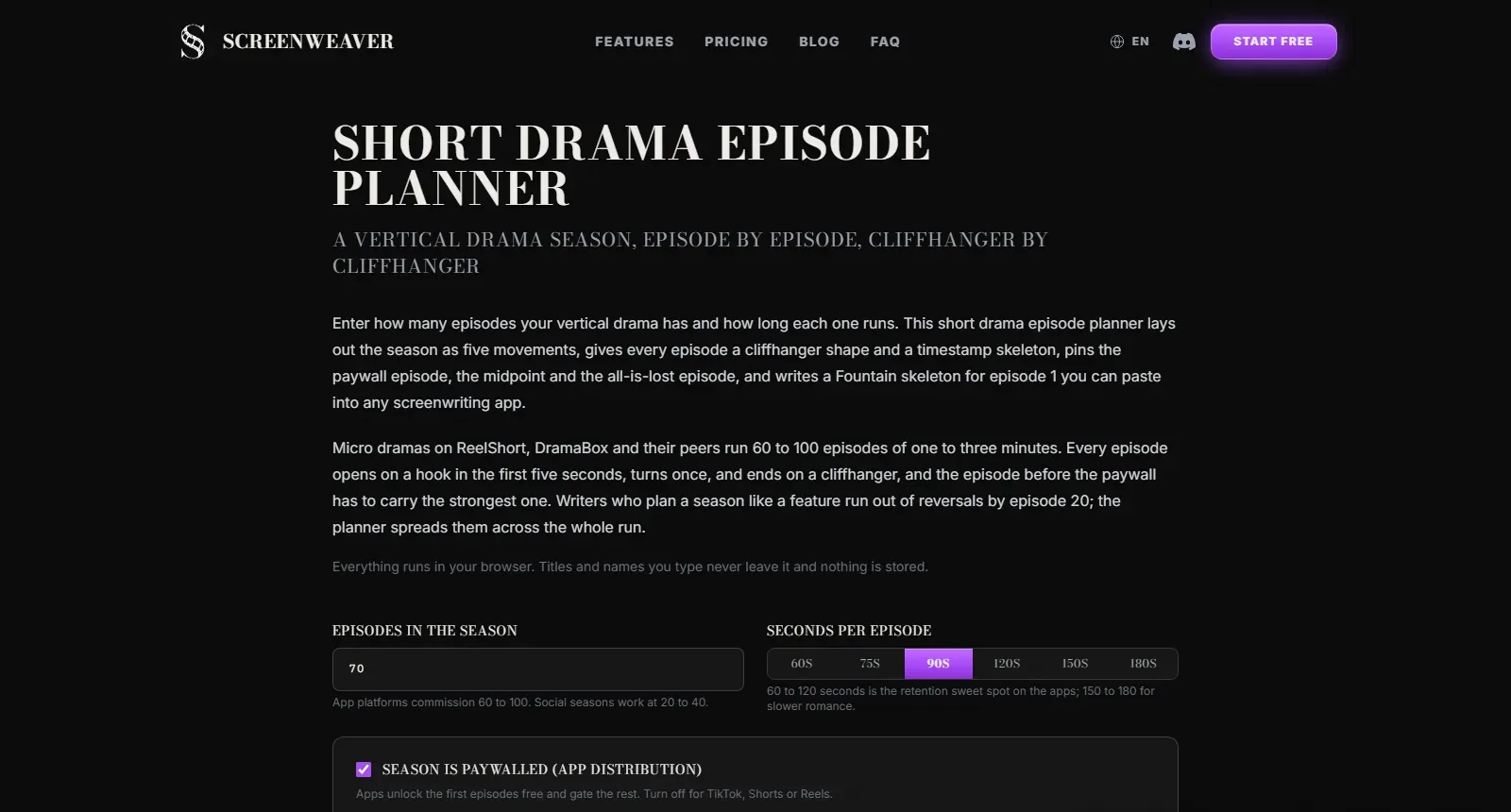
The short drama episode planner on screenweaver.ai, captured 3 September 2026. Episode count, episode length and the last free episode are the three inputs; the Fountain skeleton above comes out of it with the names filled in.
What is standard and what is not
Everything a screenwriter already knows still applies: scene headings, action, character cues, dialogue, parentheticals. The vertical additions:
| Element | Convention | Why |
|---|---|---|
| Episode header | EPISODE 12 on its own line, above the first scene heading | The producer reads by episode. Scene numbers mean nothing here |
| Episode length | 1 to 2 pages | 60 to 120 seconds on screen |
| First line of action | The conflict, already in motion | The viewer decides in five seconds whether to keep scrolling |
| The turn | One per episode, around 60% of the way through | An episode with no change is a scene, not an episode |
| Last line | A question, a reveal, an arrival, or a clock | The cliffhanger is the product. The apps sell the answer |
| Dialogue lines | Short. Two lines max per speech | Vertical viewers read faces, not monologues |
| Scene count | Usually one, sometimes two | A location change inside 90 seconds costs time you do not have |
| Camera notes | None, or one framing note per episode | Verticals are close-ups by default. Only flag the exception |
Final Draft added dedicated templates for this in 2026: a Micro Drama template and a ReelShort Vertical Drama template, both built around an Episode element that marks the start of each chapter, with episode headings centred and underlined in one and set in the left margin in the other. Their guide notes seasons of "40, 50, 60, or 100 episodes" of one to three minutes each. The Final Draft article is worth reading for the formatting choices; it says nothing about hooks, cliffhangers or the page-to-time ratio, which is what the rest of this piece is for.
The 60-second page
The feature film rule is one page per minute, and it is wrong for verticals in a useful direction. A vertical page is almost all dialogue between two people in close-up, with two-line speeches and one-line action. That page plays in about sixty seconds. Action-heavy pages play faster, so a 90-second episode is a page and a half of talk or two pages of movement.
| Episode length | Dialogue-led pages | Action-led pages |
|---|---|---|
| 60 s | 1 | 1.25 to 1.5 |
| 90 s | 1.5 | 2 |
| 120 s | 2 | 2.5 |
| 180 s | 3 | 3.5 to 4 |
Which means a 70-episode season at 90 seconds is around 105 pages: a feature-length script, delivered as 70 chapters that each have to work on their own. Nobody writes 105 pages of cliffhangers by instinct, which is why the grid comes before the pages.
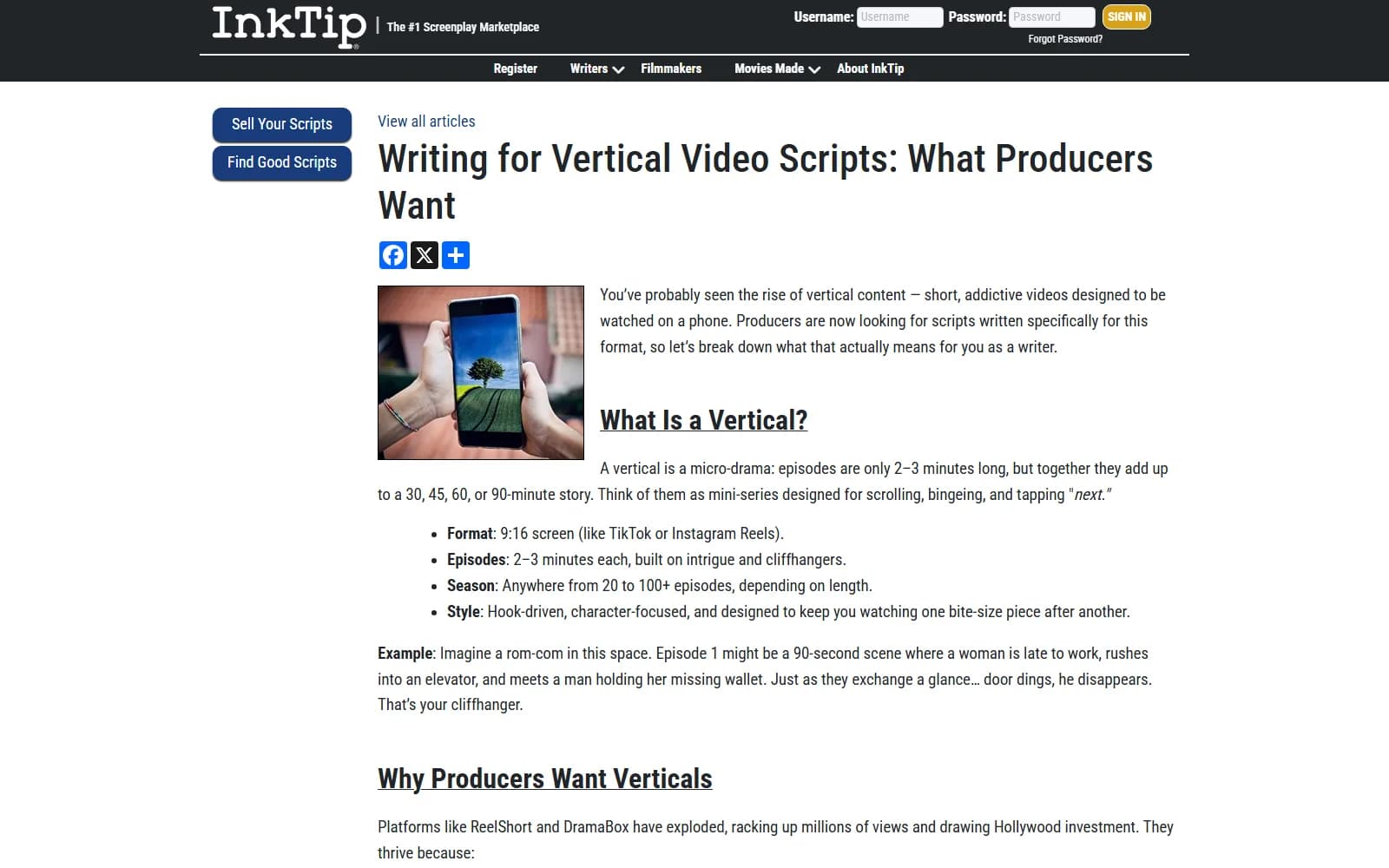
InkTip's producer-side guide, captured 3 September 2026. Its rules line up with the template above: two to three minute episodes in seasons of 20 to 100 or more, the first five seconds decide, one clear turn per episode, and cliffhangers that are a revelation, a reversal, a deadline or an intrusion.
Try it free
Try Screenweaver for free on your script
It is free. Import your existing project, get a clearer view of your outline, and regain control of your story structure in minutes.
Start FreeA worked episode, line by line
Take episode 1 of the template. Ninety seconds, one location, two characters.
| Timestamp | On the page | What it is doing |
|---|---|---|
| 0:00 | Mia cutting the wedding dress off her body | The hook. Conflict in the image, premise legible without a word |
| 0:05 | "You signed for a year." | The rules of the world in one line. Contract marriage, a clock |
| 0:12 | "I signed for a husband. You gave me a landlord." | Her want, her wound, the tone. This is the line people quote |
| 0:20 to 0:50 | The argument escalates | The middle. Each exchange raises the price |
| 0:54 | She tears the last page off the contract | The turn. She acts instead of reacting |
| 1:05 | "That page was the only one that mattered." | The price of the turn, spoken by the antagonist |
| 1:25 | The photograph on the back. Her mother | The cliffhanger. A revelation, cut before her reaction |
Everything before 0:20 is exposition disguised as a fight. Everything after 1:25 belongs to episode 2. If you find yourself writing her reaction at the end of episode 1, you have written the hook of episode 2 in the wrong place.
Dialogue rules that are specific to the format
- Two lines per speech, and the second line is the one that lands. Cut the first if it only sets up the second.
- No one explains the premise. It is in the first image and in the first accusation.
- Names in dialogue are allowed more than in features, because viewers join mid-season and need to know who is who.
- The last line of an episode is never said by the protagonist. The antagonist, or the world, gets the cliffhanger.
- Voiceover works for an opening recap, not for interiority. Faces carry the interior.
The dialogue guides on this blog cover subtext and rhythm generally; the vertical-specific rule is compression. If a line does not change the power in the room, it goes.
Writing it in ScreenWeaver
ScreenWeaver's outline has an Episode level above acts and scenes, so a 70-episode season is 70 outline nodes with their scenes underneath, and the script pane is standard screenplay format with Fountain import and PDF and FDX export. Set the project aspect ratio to 9:16 and the storyboard generates vertical frames per shot from the same script, with characters and locations as story elements that the prompts reference by name. The writing side is free; the pricing section covers the storyboard plan.
For a runtime check as you go, the script time calculator estimates runtime from pasted text, and reads high for verticals for the reason above: set it to a fast pace and expect a page to play in about a minute.
FAQ
What format do short drama scripts use?
Standard screenplay format with an episode header above each episode, one to two pages per episode, a hook in the first line of action, one turn, and a cliffhanger as the last line. Final Draft has Micro Drama and Vertical Drama templates; Fountain in any app works the same.
How many pages is a short drama episode?
One to two. A dialogue-led vertical page plays in about sixty seconds, so a 90-second episode is a page and a half and a 120-second episode is two pages. A 70-episode season lands around 105 pages.
Do I number scenes in a vertical drama script?
No. Number episodes. Most episodes are one scene, and the producer, the app and the edit all work by episode number. Scene headings stay, scene numbers go.
Is there a free short drama script template?
The Fountain template at the top of this article is free to copy. The short drama episode planner generates the same skeleton for any episode length and season size, with the turn and cliffhanger timestamps filled in.
Should the script include camera directions?
Almost none. Vertical dramas are close-ups by default; the only framing worth writing is the exception, such as a wide reveal or an insert of a phone screen. Write the emotion and the action, and let the frame follow.
How is a micro drama script different from a TV pilot?
A pilot is 30 to 60 pages with four to six act breaks. A micro drama is 60 to 100 episodes of one to two pages, each with its own act break. The TV pilot beat sheet shows the pilot grid; the episode planner shows the vertical one, and the difference is the number of cliffhangers.
Final Step
Build your next script with Screenweaver
Move from ideas to production-ready pages faster with timeline-native writing and AI-assisted story flow.
Try Screenweaver