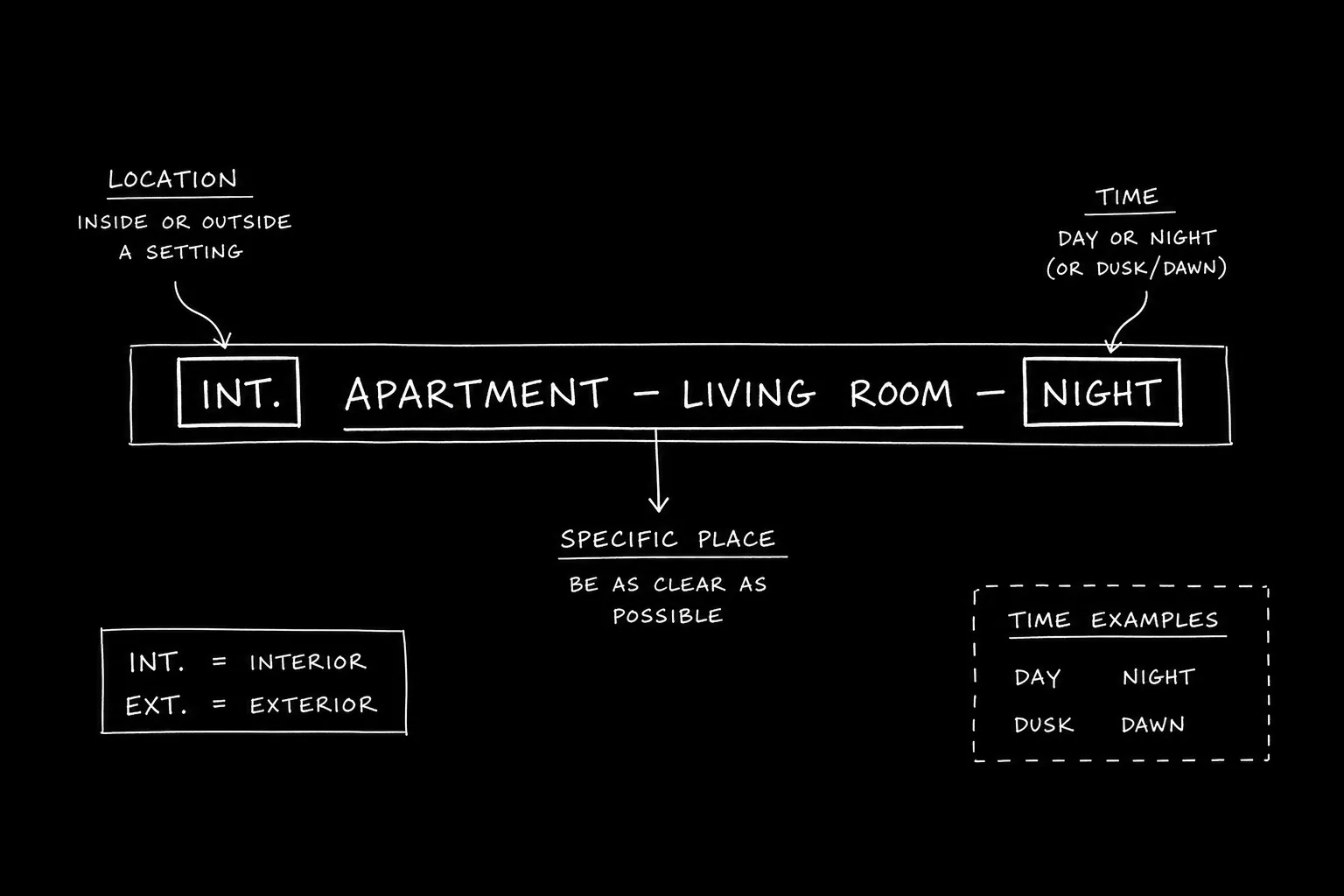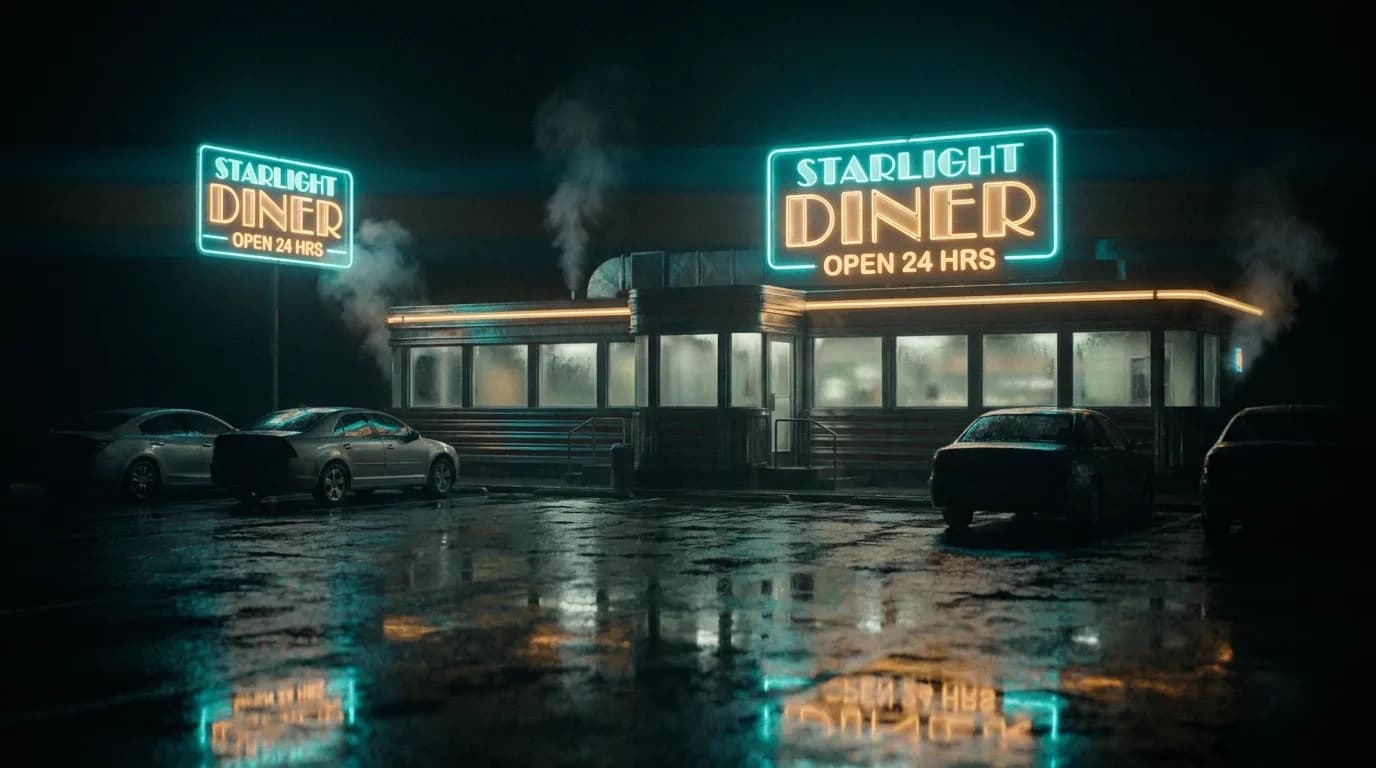

A slugline (also called a scene heading) is the capitalized line that starts every scene in a screenplay. It tells the reader three things in a fixed order: whether the scene is interior or exterior, where it takes place, and what time of day it is. EXT. DINER - NIGHT is a slugline. Everything else in this guide is detail on top of that one sentence.
The word comes from old print journalism, where a "slug" was the short label typesetters used to identify a story. Screenwriting borrowed the term for the label that identifies a scene. Some writers say slugline, some say scene heading, a few say slug. They all mean the same line.
The anatomy of a slugline
Every standard slugline has three parts, separated the same way every time:
EXT. DINER - NIGHT
1. INT. or EXT. Interior or exterior. This is not decoration. It tells the production team whether they are lighting a set or fighting the weather, and it tells the reader what kind of space the scene lives in. Use INT./EXT. (or I/E.) only when the scene genuinely crosses the boundary, like a conversation through a car window.
2. The location. Written in caps, specific enough to shoot: DINER, SARAH'S APARTMENT - KITCHEN, ABANDONED WAREHOUSE. If a location has sub-areas you return to often, name them consistently. SARAH'S APARTMENT - KITCHEN and SARAH'S KITCHEN read as two different sets to a script breakdown, and that costs someone an afternoon in pre-production.
3. The time of day. After a spaced hyphen: DAY, NIGHT, and when the story needs them, DAWN, DUSK, CONTINUOUS, LATER, MOMENTS LATER. Resist inventing poetic time stamps. THE HOUR OF THE WOLF might feel evocative, but the gaffer just needs to know if the sun is up.
Slugline examples you can copy
INT. HIGH SCHOOL GYMNASIUM - DAY

EXT. MOUNTAIN ROAD - DUSK

INT. SARAH'S APARTMENT - KITCHEN - NIGHT

INT./EXT. MOVING CAR - HIGHWAY - DAY

EXT. DINER PARKING LOT - CONTINUOUS

INT. WAREHOUSE - LATER
Each one follows the same skeleton: position, location from general to specific, time. That predictability is the point. A reader's eye learns to skip across sluglines without slowing down, which keeps the read fast, and a fast read is a professional read.
Primary sluglines vs mini-slugs
The full three-part line above is a primary slugline. Screenwriters also use a shorter form, sometimes called a mini-slug or secondary slugline, to move inside a location that has already been established:
INT. SARAH'S APARTMENT - NIGHT

Sarah drops her keys on the counter.

BEDROOM

She collapses face-first onto the bed, shoes still on.
BEDROOM is a mini-slug. It signals a new space without resetting the scene clock. Use mini-slugs when the action flows continuously through one location; start a fresh primary slugline when time jumps or the company would need to relight.
Try it free
Try Screenweaver for free on your script
It is free. Import your existing project, get a clearer view of your outline, and regain control of your story structure in minutes.
Start FreeThe formatting rules that actually matter
Sluglines follow the same mechanical rules as the rest of standard screenplay format: Courier 12pt, flush with the left margin at 1.5 inches, one blank line above and below. All caps, no bold, no underline in a spec script (bold sluglines exist in some shooting scripts, but a spec should stay plain).
Two conventions trip up new writers more than any others:
- The period after INT and EXT is required:
INT.notINT. Small, but it is one of the first things a trained reader notices. - The hyphen before the time of day has a space on each side:
DINER - NIGHT, notDINER-NIGHT.
If you would rather not police punctuation by hand, paste your headings into the free slugline formatter. It normalizes INT/EXT, caps, hyphens and time-of-day tags in one pass. And once a draft is done, the scene extractor pulls every slugline out of your script into a clean location list, which is exactly what a producer builds first when budgeting.
What a slugline is not
A slugline is not a stage direction, so it should not contain action: EXT. ROOFTOP - NIGHT - JOHN JUMPS is two thoughts crammed into one line. It is not a camera call either. ANGLE ON, CLOSE ON and friends are shots, not scenes, and most modern spec scripts avoid them. And it is not a chapter title. It carries logistics, not mood. The mood belongs in the action lines underneath.
The most common real-world slugline problems are consistency problems rather than format problems: the same kitchen named three different ways, DAY and NIGHT contradicting the dialogue, CONTINUOUS used after a time jump. We wrote a separate field guide for those failure modes, with a checklist you can run before sending pages: scene heading mistakes and how to catch them.
Why sluglines matter more than they look
For the reader, sluglines are navigation. They mark where scenes begin, which is how a reader senses pacing: lots of sluglines per page reads fast, few reads slow.
For production, sluglines are data. Breakdown software groups scenes by location and time of day straight from your headings, and the schedule, the budget and the location scout all inherit whatever you typed. A sloppy slugline does not just look amateur, it propagates errors into every document built from the script.
For you, sluglines are a discipline. Deciding INT or EXT, naming the space, committing to a time forces you to see the scene before you write it. If you cannot fill in the three slots, you probably do not know where the scene happens yet, and that is worth discovering on page 30 of the outline rather than day 3 of the shoot.
FAQ
What is a slugline in a script?
A slugline is the all-caps heading that opens every scene in a screenplay. It states whether the scene is interior or exterior (INT. or EXT.), the location, and the time of day, in that order: INT. CLASSROOM - DAY. It is also called a scene heading; the two terms are interchangeable.
What is an example of a slugline?
EXT. DINER - NIGHT is a complete slugline: exterior scene, at a diner, at night. A more specific one might read INT. SARAH'S APARTMENT - KITCHEN - NIGHT, moving from the general location to the exact room before the time of day.
Are slugline and scene heading the same thing?
Yes. Scene heading is the more formal term and slugline is the industry nickname, inherited from the "slugs" that labeled stories in print typesetting. Screenwriting software, contests and readers treat them as the same element.
Should sluglines be bold in a screenplay?
Not in a spec script. Standard spec format keeps sluglines in plain all-caps Courier 12pt. Bold sluglines appear in some shooting scripts and some writers' personal styles, but if you are submitting to contests, agents or fellowships, plain is the safe choice.
When should I use CONTINUOUS instead of DAY or NIGHT?
Use CONTINUOUS when the new scene picks up in unbroken time from the previous one, like a character walking from a hallway directly into an office. If any time has passed, even minutes, use LATER or a concrete time of day instead. CONTINUOUS after a time jump is one of the most common slugline mistakes.
Do I need a new slugline for every room?
Only when time or lighting changes. If the action flows continuously through one location, use a mini-slug (just the room name in caps, like BEDROOM) to move between spaces. Start a full new slugline when the story jumps in time or moves to a location that needs its own setup.
Final Step
Build your next script with Screenweaver
Move from ideas to production-ready pages faster with timeline-native writing and AI-assisted story flow.
Try Screenweaver