
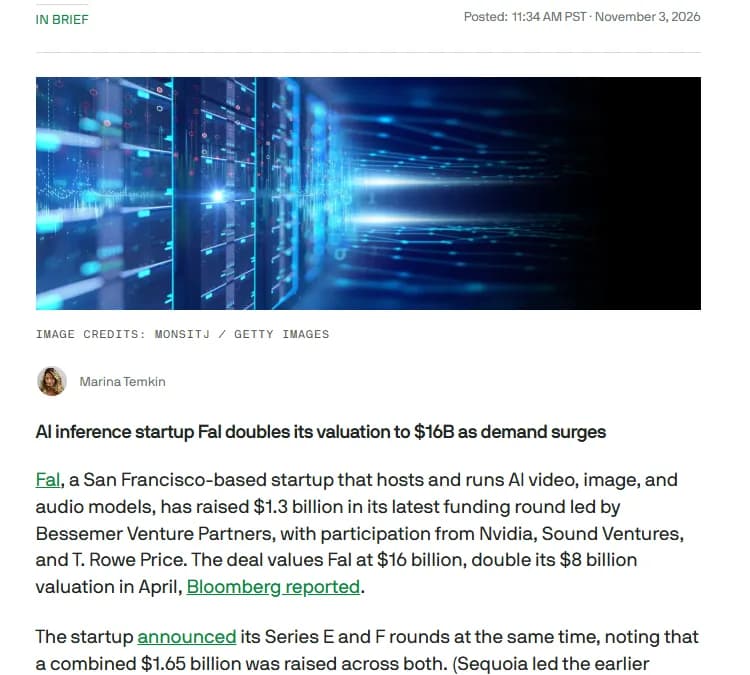
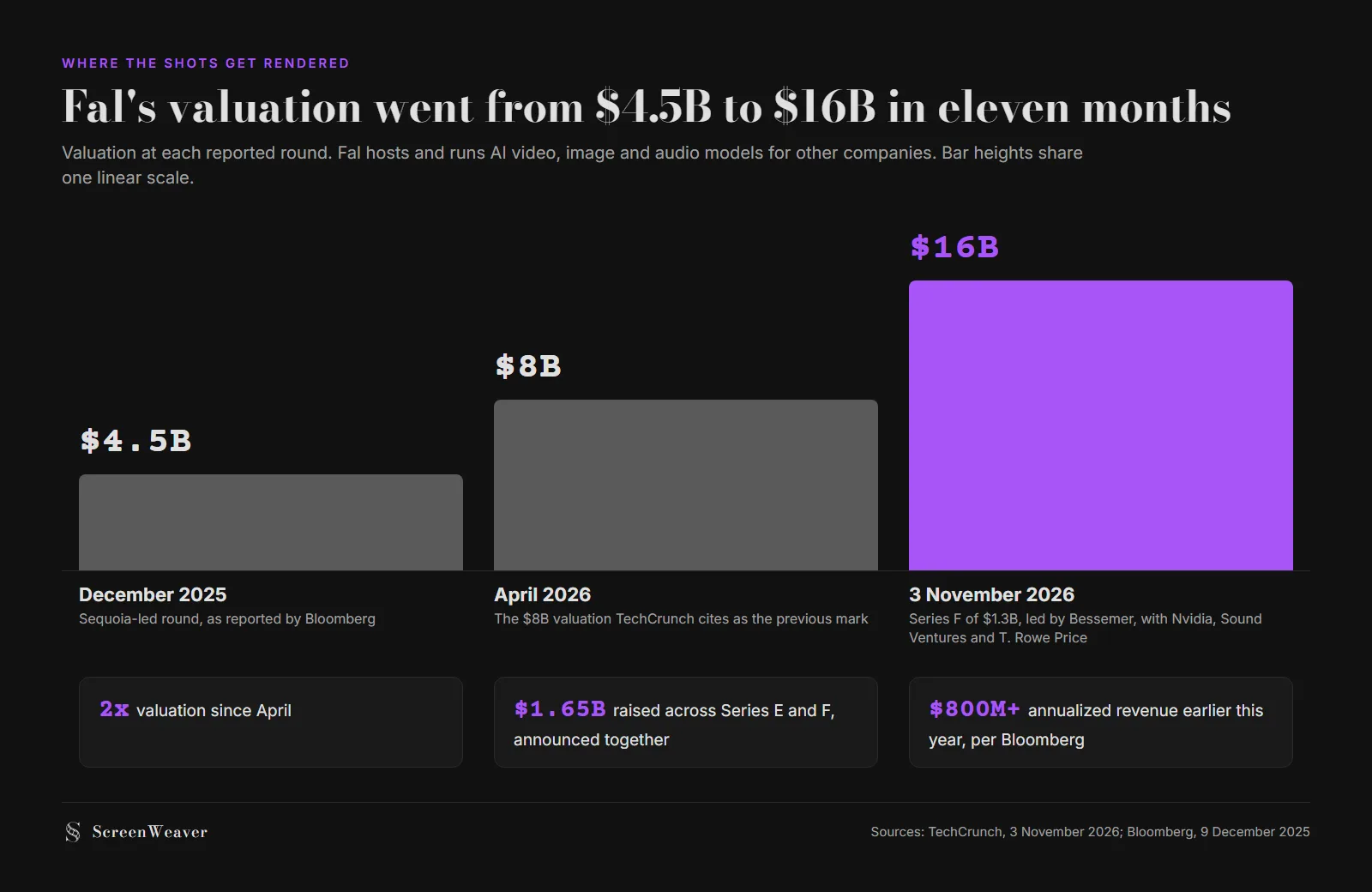
Fal, the San Francisco company that hosts and runs AI video, image and audio models, raised $1.3 billion on 3 November 2026 at a $16 billion valuation. That is double the $8 billion it was valued at in April. For anyone making films with AI video, it points at something easy to miss: the company that renders your shot is often not the company that built the model.
TechCrunch broke the news, written by Marina Temkin and posted at 11:34 AM PST on 3 November. We read it the same day.
What was announced
The round is a Series F of $1.3 billion, led by Bessemer Venture Partners with participation from Nvidia, Sound Ventures and T. Rowe Price. Fal announced its Series E and Series F together and says it raised $1.65 billion across both. Sequoia led the earlier round. The $16 billion figure comes from Bloomberg, which TechCrunch cites, and the same Bloomberg report says Fal passed $800 million in annualized revenue earlier this year.
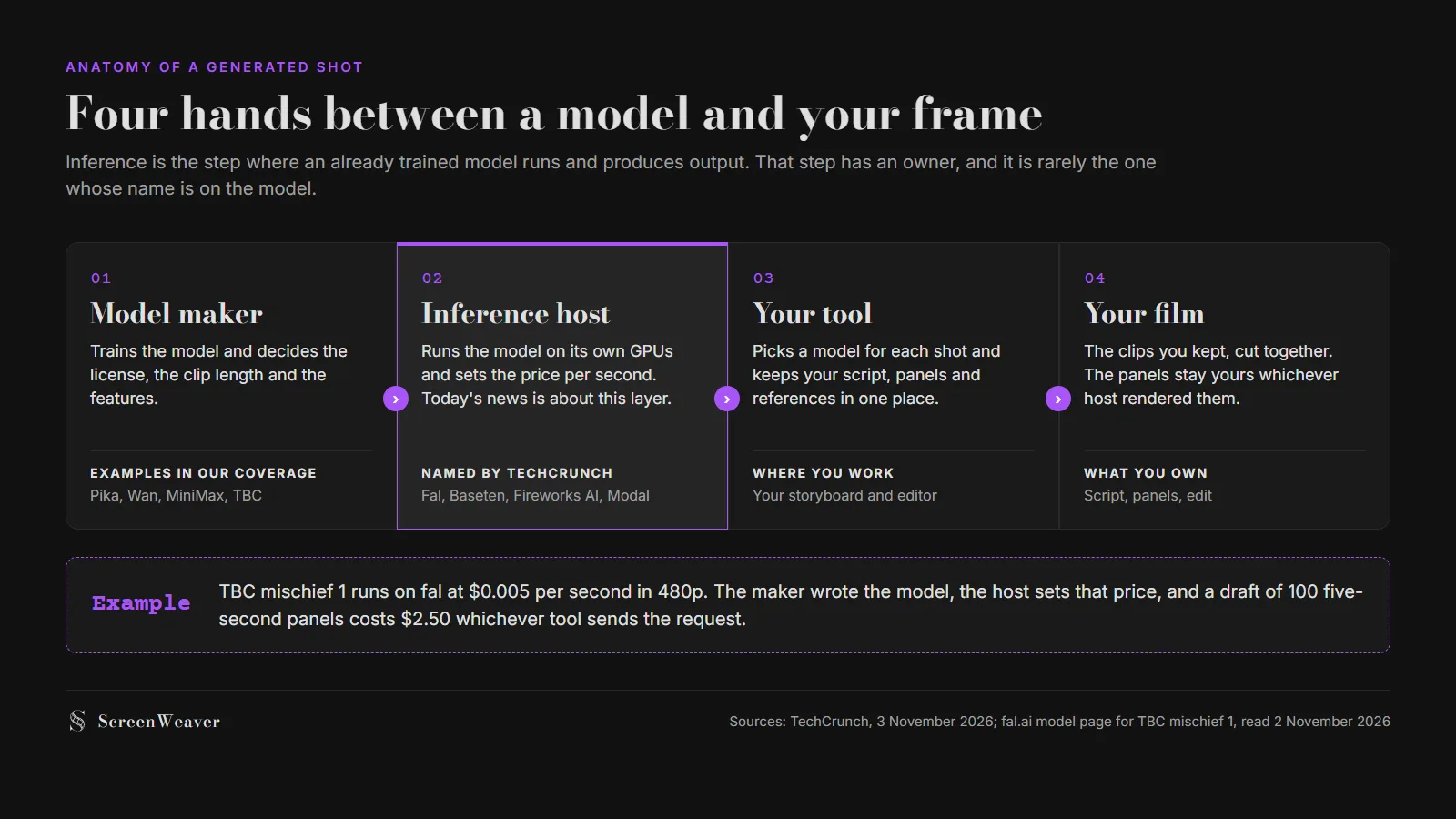
TechCrunch ties the jump to demand for inference, the step where a model that has already been trained runs and produces output, with particular pull from customers who rely on open source models. It names Baseten, Fireworks AI and Modal as peers that are also growing fast and raising large rounds, and adds that their gross margins stay thin because compute is expensive. Fal was founded in 2021 by Burkay Gur and Gorkem Yurtseven.
The company has not published a list of customers in the TechCrunch piece, and the article names no specific models. We did not find Fal's own announcement of the Series E and F rounds on its blog when we looked on 4 November, so the round details above rest on TechCrunch's reporting.
Why a film maker should care about an inference company
Open the model list in almost any AI video tool and you will see model names. Pika, Wan, MiniMax, Seedance. Those are the makers. Somewhere between that name and your clip sits a host with GPUs, and the host decides a few things you feel directly: the price per second, how fast a clip comes back, and whether a new model is available the day it launches.
We saw it last week. TBC's neuron-derived video model, mischief 1, launched on 30 October on fal at $0.005 per second in 480p. Our breakdown of that launch works out a 100-panel draft at $2.50, because the host's price sheet is where the number comes from. Our price comparison across video models is built on the same idea: compare the cost per useful second, not the headline rate.
What a $16 billion host changes, and what it does not
A valuation is the price investors put on future revenue. It is not a promise to anyone buying clips, so we would not read too much into it. Here is what could follow, and what will not.
- A host with fresh capital and Nvidia among its backers has reasons to add open-weight models quickly. That is our guess about incentives, not something Fal has said.
- TBC priced mischief 1 at half a cent per second. When hosts compete for volume, rock-bottom draft prices are likely to get more common, though margins are thin, as TechCrunch notes, so nobody can assume prices keep falling.
- If a large share of generated video runs through a few hosts, an outage or a price change at one of them reaches many tools at once.
- Quality does not follow. A host runs a model, and running it faster does not make it better at keeping a character's face the same from shot to shot. That still depends on the model and on how you build your references.
Try it free
Try ScreenWeaver for free on your script
It is free. Import your existing project, get a clearer view of your outline, and regain control of your story structure in minutes.
Start FreeWhat to do with this as a maker
You cannot control the infrastructure market, but you can keep your project from depending on it.
- Write the script and panels first, and keep them outside any one model. The panels are the part you own. A storyboard-first workflow lets you send the same panel to a different model if a host raises its prices or goes down.
- Draft cheap, finish on the model you picked for quality. Low-resolution passes are where a low per-second price helps most. Our guide to credits and budget planning shows how to set that up shot by shot.
- Note the host, not just the model, when you log a price. The same model can be sold at different rates by different hosts, so a price without a source goes stale.
- Re-check prices before a big render. Rates move. We took the TBC price from fal's model page, as cited in our earlier piece, and everything else here from TechCrunch on 4 November 2026.
FAQ
How much did Fal raise? $1.3 billion in its Series F, according to TechCrunch. Fal announced its Series E and F together and says the two rounds total $1.65 billion.
What is Fal's valuation? $16 billion, per Bloomberg as cited by TechCrunch. That is double its $8 billion valuation in April.
Who led the round? Bessemer Venture Partners led the Series F. Nvidia, Sound Ventures and T. Rowe Price also participated. Sequoia led the earlier round.
What does Fal actually do? It hosts and runs AI video, image and audio models, which TechCrunch calls inference. TechCrunch describes a company that runs other people's models at scale.
Will this make AI video cheaper? Nothing in the announcement says so. More competition between hosts can push per-second rates down, but TechCrunch points out that margins in this business are already thin because compute is costly.
Do I need to use Fal to make an AI film? No. Many tools reach the same models through different hosts. What matters is that your script and storyboard stay yours, so you can change model or host without redoing the project.
From script to shots
Turn your script into a film, shot by shot
Write the scene, get its storyboard, then generate each shot with consistent characters. You direct every step.
Start your film free