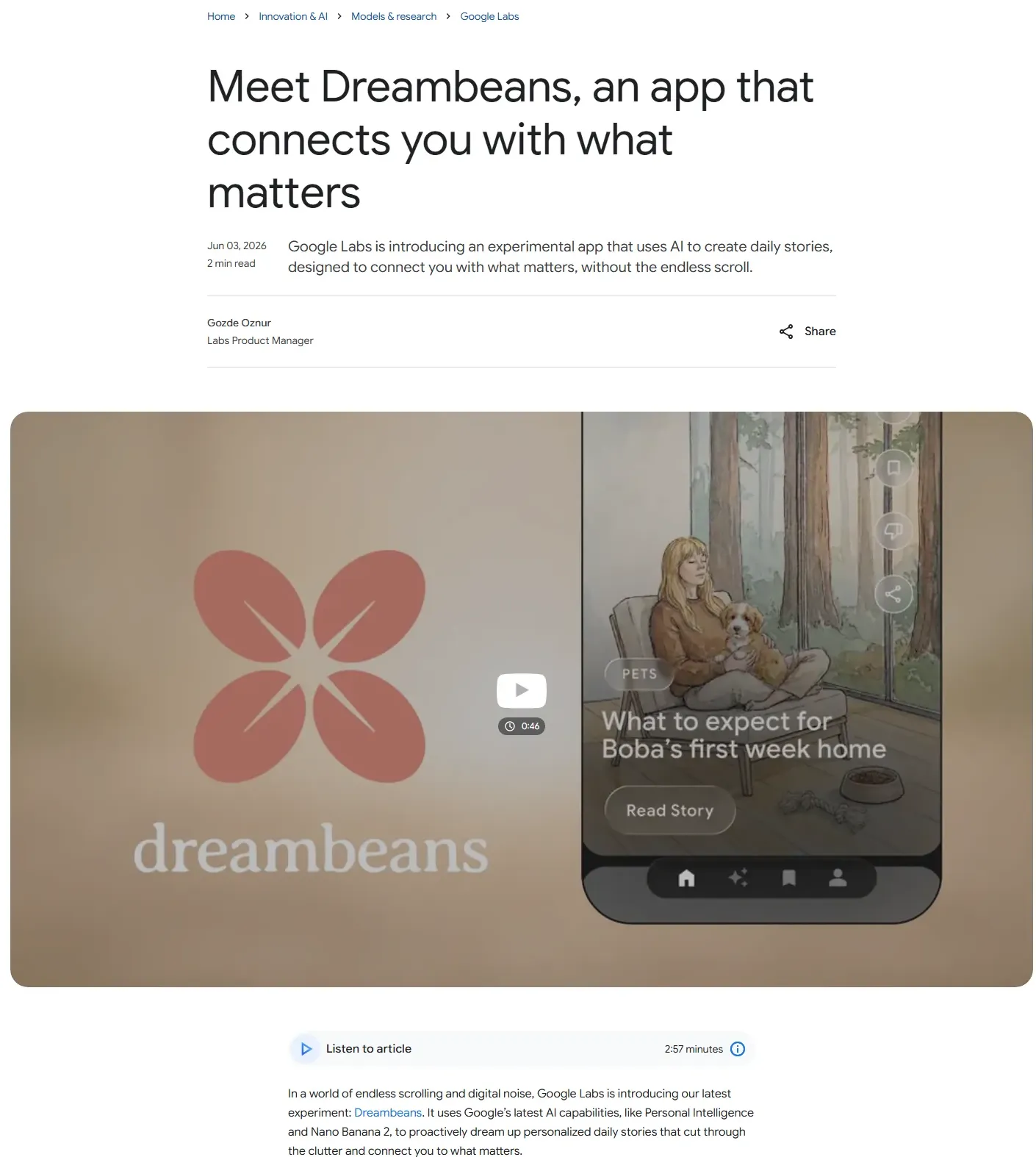
Google launched Dreambeans in India on Monday, 2 November 2026. It is the first country outside the U.S. to get the experimental Google Labs app, which writes and illustrates short stories about your own life from your Google data, with no prompt. The Indian version speaks English plus 13 Indian languages, including Hindi, Punjabi, Tamil, Telugu and Bengali, on Android and iOS.
The news came through TechCrunch's report of 2 November, written by Jagmeet Singh after a Google press briefing. We read it next to Google's own launch post from 3 June and the U.S. expansion post from 10 September. Google has built a story machine with no author in it, and the U.S. download numbers suggest people are not sure they want one. If you make films or animation with AI, that matters more than the language count.
What Dreambeans does
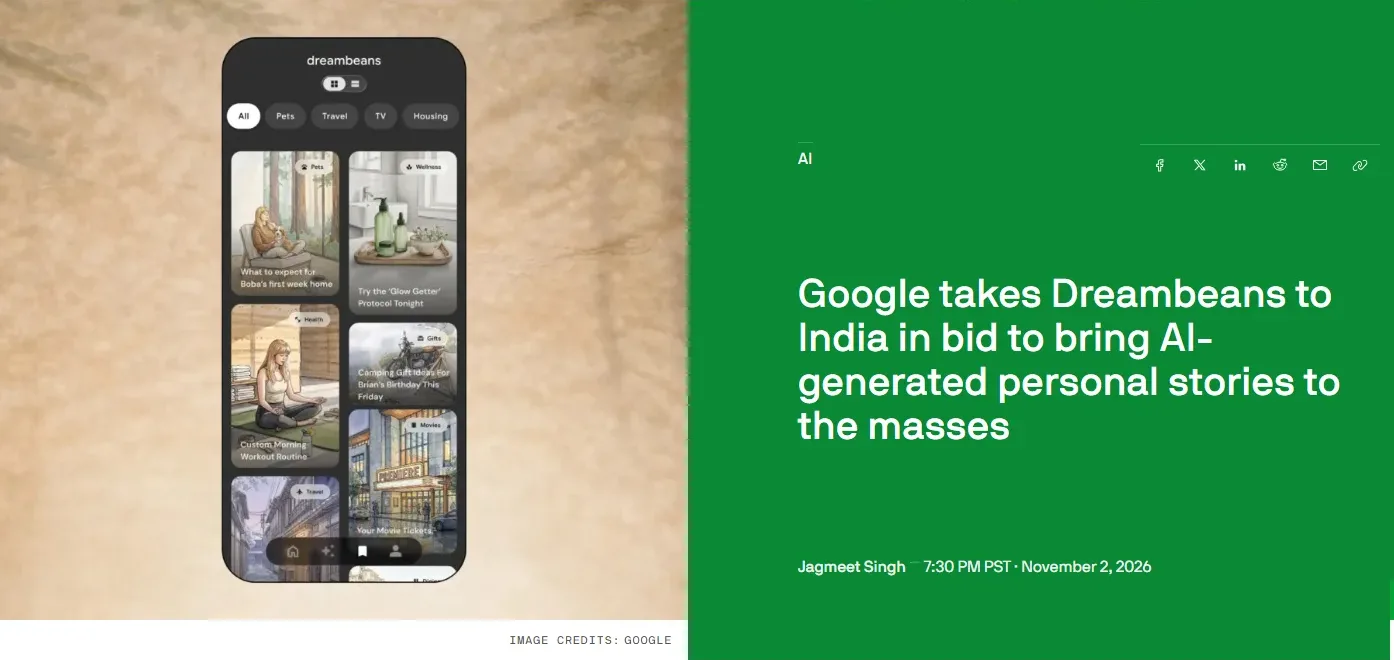
You connect your Google apps: Gmail, Calendar, Photos, YouTube, Search history and, since September, Gemini. Google's Personal Intelligence layer reads them and produces a daily collection of short stories about your interests and your week. Google's June post gives its own example: a Gmail receipt for puppy treats turns into a story with training tips, and a Calendar reminder about a visiting friend turns into dog-friendly restaurant ideas.
Each story comes with an illustration. Google's launch post names Nano Banana 2 as one of the models behind the app. If Google Photos is connected, your own face and the people close to you can appear in those pictures. According to TechCrunch, Google has since added a feature that uses Veo, its video model, to animate the images in some stories.
The collection is finite on purpose. Google's June post puts it this way: "The goal is not to scroll forever." You can save stories, give feedback, and tell the app to stop showing a subject. Changes apply to the next collection, not the current one.
What changes with the India launch
| U.S. | India | |
|---|---|---|
| Available since | June 2026 (AI Ultra), all eligible accounts from September | 2 November 2026 |
| Languages | English | English + 13 Indian languages |
| Platforms | Android, iOS | Android, iOS |
| Accounts | Personal Google accounts, 18+ | Personal Google accounts (no age rule stated for India) |
| Mixed-language stories | No | No, one language at a time |
| Visible to | Account holder only | Account holder only |
Gozde Oznur, the Google Labs product manager behind the app, told reporters that India was chosen for its strong interest from people asking for access and for the heavy overlap of Gemini, Gmail and Google Photos users there. TechCrunch lists five of the 13 languages, and none of Google's Dreambeans posts we read names the other eight.
The language limit is the detail I would watch. Stories come in one language at a time, and the app cannot mix them. TechCrunch points out that many Indians switch between Hindi and English in the same sentence. A story engine that has to pick one language will sound a little stiff to those readers.
The U.S. numbers behind the move
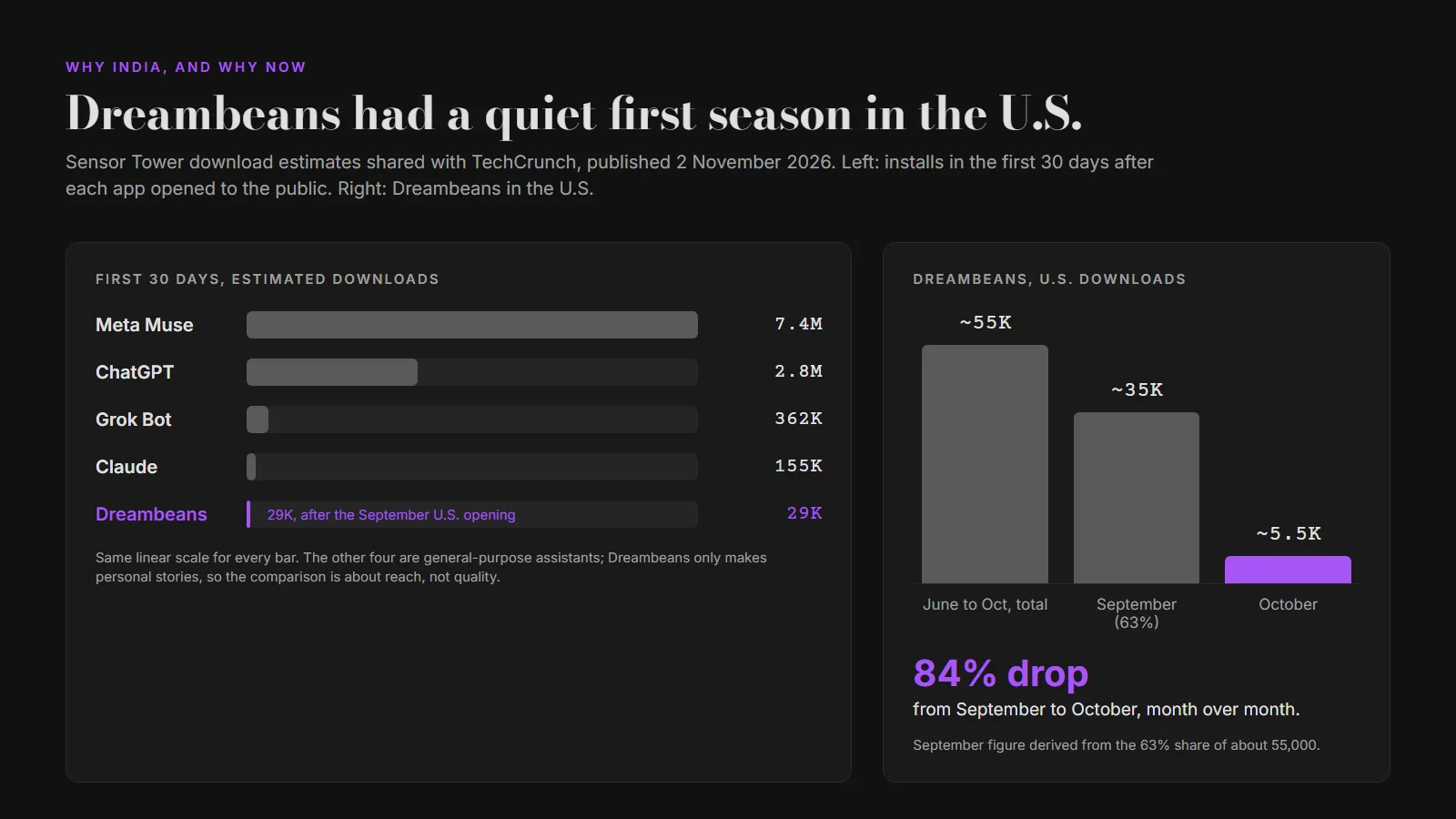
Sensor Tower estimates, shared with TechCrunch, show about 55,000 U.S. downloads since June. Around 63% of them arrived in September, when Google opened the app to every eligible adult. In October, downloads fell 84% month over month, to about 5,500.
In its first 30 days of open U.S. access, Dreambeans got an estimated 29,000 downloads. Meta's Muse got 7.4 million in its first 30 days, ChatGPT 2.8 million, Grok Bot 362,000 and Claude 155,000. TechCrunch notes the obvious caveat: those are general assistants, and Dreambeans only makes stories. Still, a Google app with Google's distribution landing at 29,000 is a weak start. India, where Google says Gemini, Gmail and Photos users overlap heavily, is a second attempt at an audience, with 13 languages added in one go.
Try it free
Try ScreenWeaver for free on your script
It is free. Import your existing project, get a clearer view of your outline, and regain control of your story structure in minutes.
Start FreeWhat this says about AI stories
Dreambeans tests one idea: that people will read stories nobody wrote. The software picks the topic, writes the text and draws the picture. You only react.
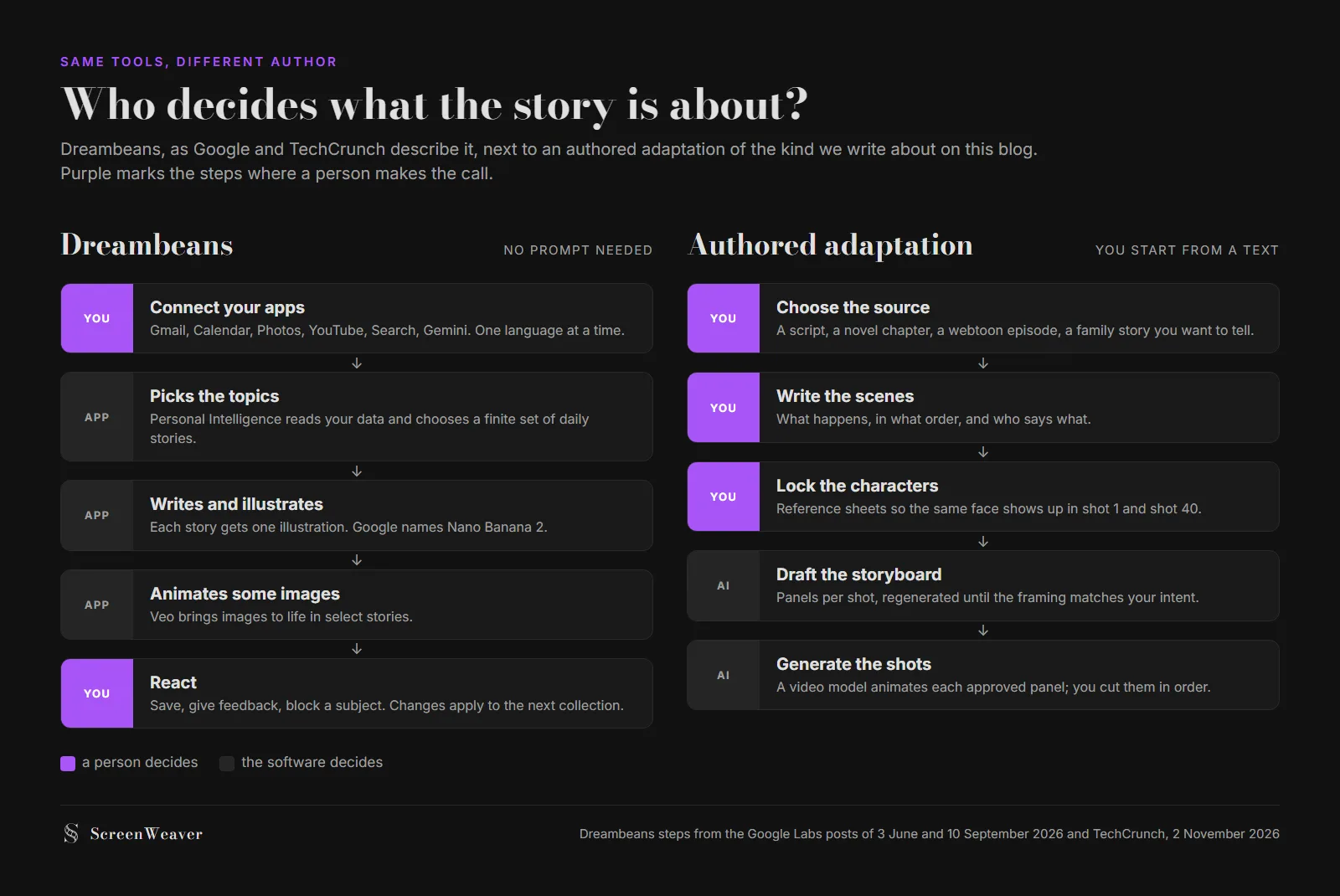
I co-founded ScreenWeaver, so take my reading with that in mind. The tools in the two columns above are close cousins: an image model for the pictures, a video model for motion. The difference is who holds the story. In Dreambeans the app decides what your day is about. In an adaptation, you decide what happens, in what order and who says what, and the models draw what you already chose. I wrote more about that split in AI copywriting versus AI storytelling.
There is a practical side for anyone animating their own stories. Each Dreambeans story gets one illustration, and Veo animates some of them. Real faces can come from Google Photos, but nothing in Google's description covers keeping an invented character the same from one image to the next. That is fine for a daily card about puppy treats. It breaks down as soon as you want a sequence where the same grandmother appears in shot 1 and shot 40, which is the problem we cover in character drift in AI video. The usual fix is to lock reference images for each character before generating anything, then draw the storyboard first so every shot has an approved frame before it moves.
If the Indian launch works, it will show there is demand for illustrated, animated stories in regional languages. That demand would not stop at personal feeds. Writers who want to adapt a Tamil short story or a Bengali family tale into an animated short will need the authored version: a script, a cast that stays consistent, and a storyboard built from that script.
What we don't know yet
- The full list of 13 languages. TechCrunch names five.
- Whether the Veo animation feature is live in India on day one. TechCrunch mentions it for the app in general.
- An age rule for India. The U.S. version is for adults 18 and over.
- Pricing. Neither Google post nor TechCrunch mentions a price. The September post lists consumer accounts next to Google AI Plus, Pro and Ultra.
- Whether mixed-language stories are coming. Oznur only said the app can't generate them for now.
Privacy remains the open issue. Dreambeans reads your inbox, your calendar and your photos to build its stories. According to TechCrunch, Oznur said you choose which services to connect, can disconnect them and delete your Dreambeans data, and that deletions in connected services carry over to the app. TechCrunch also notes that the app could bring up stories about people who have died. Read those controls before you connect Photos.
FAQ
What is Google Dreambeans? An experimental Google Labs app that writes short illustrated stories about your interests and daily life from your Google data, such as Gmail, Calendar, Photos, YouTube and Search history. It needs no prompt and produces a finite daily collection.
When did Dreambeans launch in India? On Monday, 2 November 2026, according to TechCrunch. India is its first market outside the U.S., where it launched in June 2026 and opened to all eligible adults in September.
Which languages does Dreambeans support in India? English plus 13 Indian languages. TechCrunch names Hindi, Punjabi, Tamil, Telugu and Bengali. You pick one language at a time, and stories cannot mix languages.
Does Dreambeans make videos? Partly. Stories come with AI illustrations, and TechCrunch reports that Google added a feature using its Veo model to animate images in select stories. It does not produce full videos from a script.
Can I use Dreambeans to make an animated short from my own story? No. Dreambeans chooses its own topics from your data and you can only steer it with feedback. To adapt a story you wrote, you need a script, character references and a storyboard, then a video model for each shot.
How many people downloaded Dreambeans in the U.S.? About 55,000 since June, according to Sensor Tower estimates shared with TechCrunch. Downloads fell 84% in October to about 5,500.
From script to shots
Turn your script into a film, shot by shot
Write the scene, get its storyboard, then generate each shot with consistent characters. You direct every step.
Start your film free