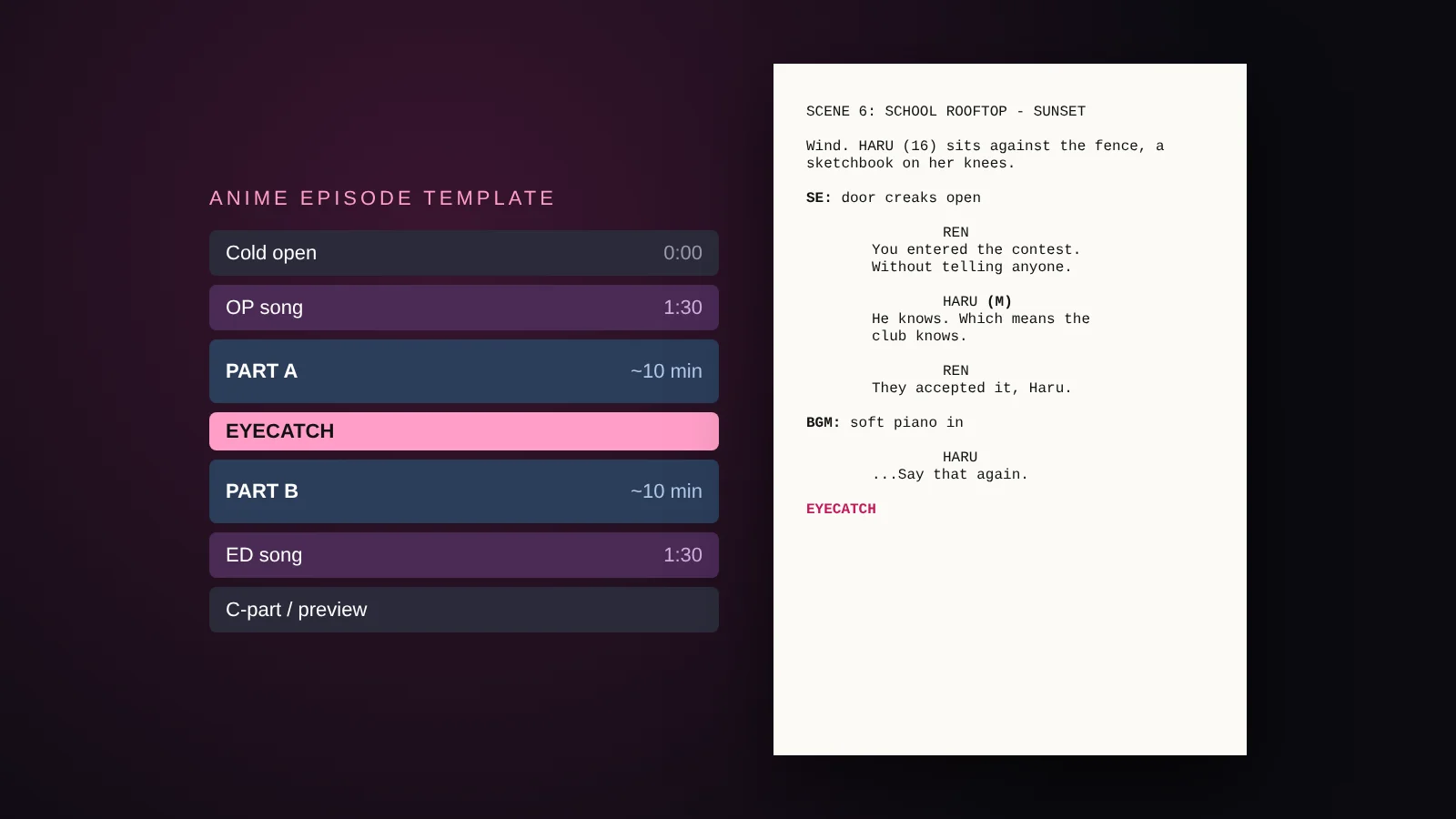

Short answer: an anime script for a TV episode follows the broadcast structure: an optional cold open, the opening song (about 90 seconds), Part A, an eyecatch, Part B, the ending song (about 90 seconds) and sometimes a C-part or a next-episode preview. That makes about 23 to 24 minutes in a half-hour slot. Each scene has a heading, sparse action, dialogue with (M) for inner monologue and (OFF) for a voice off screen, and SE and BGM cues. Camera work goes in the storyboard, not the script. The template and a worked example are below. Copy them and fill them in.
The codes themselves (M, OFF, SE, BGM, how a manga script differs) are explained in the specific codes of anime and manga scripts. This page gives you the blank pages.
The episode template
Copy this skeleton. The timings are typical for a half-hour TV slot. A web series or a short can drop the songs and keep the two-part shape.
EPISODE [NUMBER]: "[TITLE]"

[COLD OPEN]  0:00 - 1:30 (optional)
A hook scene. It ends on a question, then cut to the opening.

[OPENING]  about 1:30
OP song. Not written in the script: "OP" on one line.

[PART A]  about 9 to 10 minutes
Scene 1. Status quo of the episode, the problem appears.
Scene 2.
Scene 3. Part A ends on a turn: something the viewer did not expect.

[EYECATCH]  a few seconds
"EYECATCH" on one line. In a streaming cut it may be skipped.

[PART B]  about 9 to 10 minutes
Scene 4. Consequences of the turn.
Scene 5. Climax of the episode.
Scene 6. Resolution, and the hook for the next episode.

[ENDING]  about 1:30
ED song. "ED" on one line.

[C-PART / PREVIEW]  0:15 - 0:30 (optional)
A short after-credits scene or the next-episode preview.
The scene template
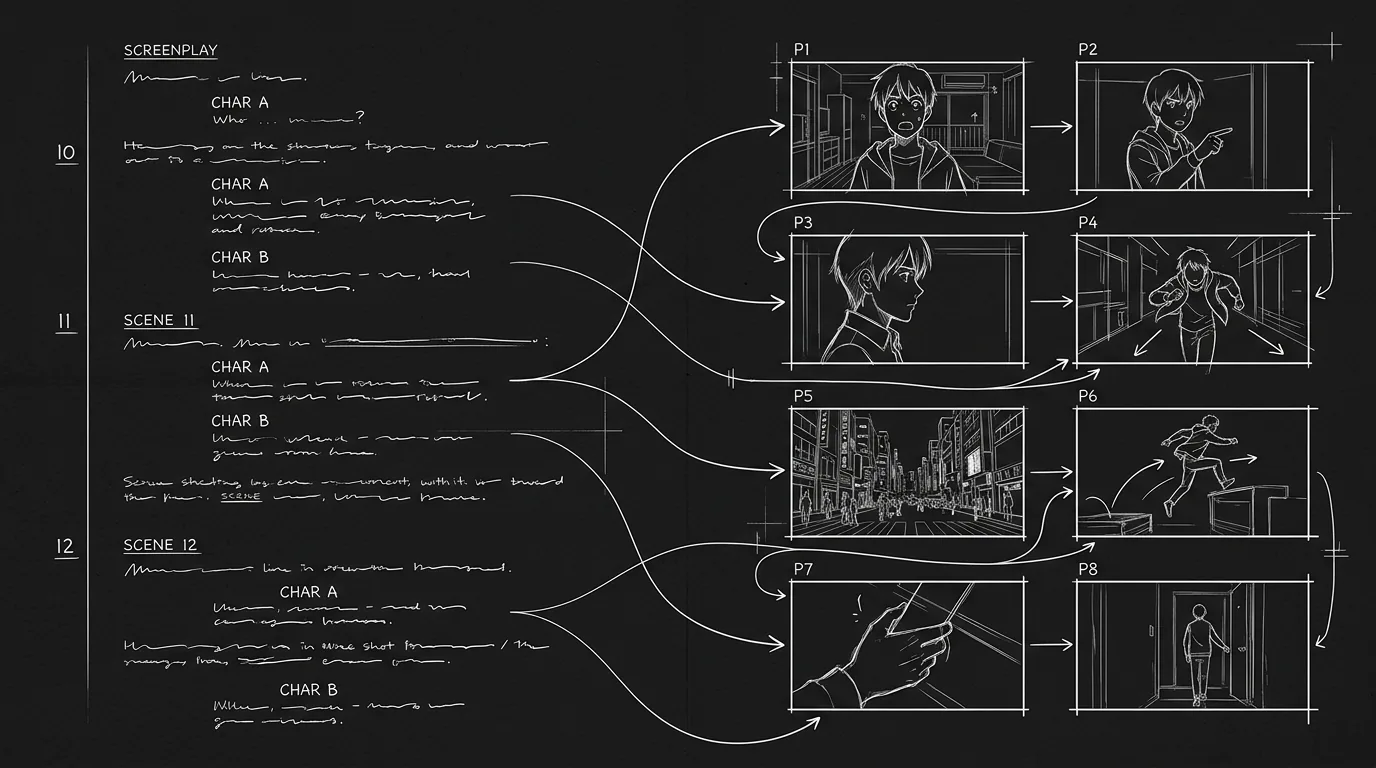
Each scene uses the same blocks. Keep the action short. The episode director decides the shots in the storyboard (e-konte).
SCENE [N]: [PLACE] - [DAY / NIGHT / SUNSET]

[Action: who is where, doing what. Two or three lines.]

[CHARACTER]
[Dialogue.]

[CHARACTER] (M)
[Inner monologue, heard but not spoken.]

[CHARACTER] (OFF)
[A voice from off screen.]

SE: [sound effect]
BGM: [music cue, or "BGM out"]
A worked example
This is a two-minute scene from the end of Part A. Use it to check your own density: about one page per minute.
SCENE 6: SCHOOL ROOFTOP - SUNSET

Wind. HARU (16) sits against the fence, a sketchbook on her knees. She erases the same drawing for the third time.

SE: door creaks open

REN (16) stands in the doorway, out of breath, holding a crumpled flyer.

REN
You entered the contest. Without telling anyone.

HARU
(not looking up)
There's nothing to tell yet.

REN
The deadline was yesterday.

Haru's pencil stops.

HARU (M)
He knows. Which means the club knows.

REN
They accepted it, Haru.

BGM: soft piano in

Haru finally looks at him. The flyer flaps in the wind between them.

HARU
...Say that again.

EYECATCH
What makes it work for animation: one location, two characters, a single turn ("They accepted it") placed right before the eyecatch, an inner line that the audience hears and Ren doesn't, and no camera directions. The storyboard artist chooses the angles.
Try it free
Try ScreenWeaver for free on your script
It is free. Import your existing project, get a clearer view of your outline, and regain control of your story structure in minutes.
Start FreeThe manga script template
A manga script is not divided into scenes. It is divided into pages and panels, and each line of dialogue belongs to a panel.
PAGE [N] ([number] panels)

PANEL 1
[What we see. One sentence.]
[CHARACTER]: [Balloon text.]
SFX: [onomatopoeia]

PANEL 2
[What we see.]
[CHARACTER] (thought): [Thought balloon.]

PANEL 3 (large)
[The page-turn image: the reveal or the cliffhanger of the page.]
Put the reveal on the last panel of a right-hand page, so the reader has to turn the page to see what happens next. That one rule decides more pacing than any other in manga. To turn a finished chapter into an animation storyboard, see manga to anime with AI.
From template to storyboard in ScreenWeaver
- Paste your scenes into the screenplay editor of a ScreenWeaver project. Scene headings, character cues and dialogue are recognised as script elements.
- Create the characters once as story elements, with a reference sheet each, so Haru and Ren keep the same face in every shot.
- Break each scene into shots in the storyboard and generate the panels in the project's art direction.
The anime script writing page shows the full workflow on a real episode opening, and the AI anime video generator covers turning the boards into motion.
Common mistakes in anime scripts
- Writing camera directions. "Close-up on Haru's eyes" belongs in the storyboard. Write what happens and what it means.
- Long monologues out loud. Anime uses (M) for thoughts. A character explaining their feelings out loud to someone else rarely plays.
- No turn before the eyecatch. Part A should end on a change, so the viewer comes back after the break.
- Forgetting the songs in the timing. The OP and the ED take about three minutes of a half-hour slot. Write about 20 minutes of story, not 24.
- Manga pages without a page-turn panel. Every right-hand page needs a reason to turn it.
FAQ
How long is an anime script for one episode? For a TV episode in a half-hour slot, about 20 minutes of story once the opening and ending songs are removed. At about one page per minute, that is roughly 20 to 25 pages in the format above.
What does (M) mean in an anime script? It marks an inner monologue: the character's voice is heard, but their lips don't move. (OFF) marks a voice from a character who is off screen.
Is an anime script written like a Hollywood screenplay? The blocks are similar (heading, action, character, dialogue), but an anime script has much sparser action and no camera directions, adds SE and BGM cues, and follows the OP, Part A, eyecatch, Part B, ED structure.
What is the difference between an anime script and a manga script? An anime script is divided into scenes in time. A manga script is divided into pages and panels, with each line of dialogue assigned to a panel and the reveal placed on the page turn.
Can I use this template for free? Yes. Copy it, adapt it and use it for any project, including commercial ones.
Writing is free
Get the format right from page one
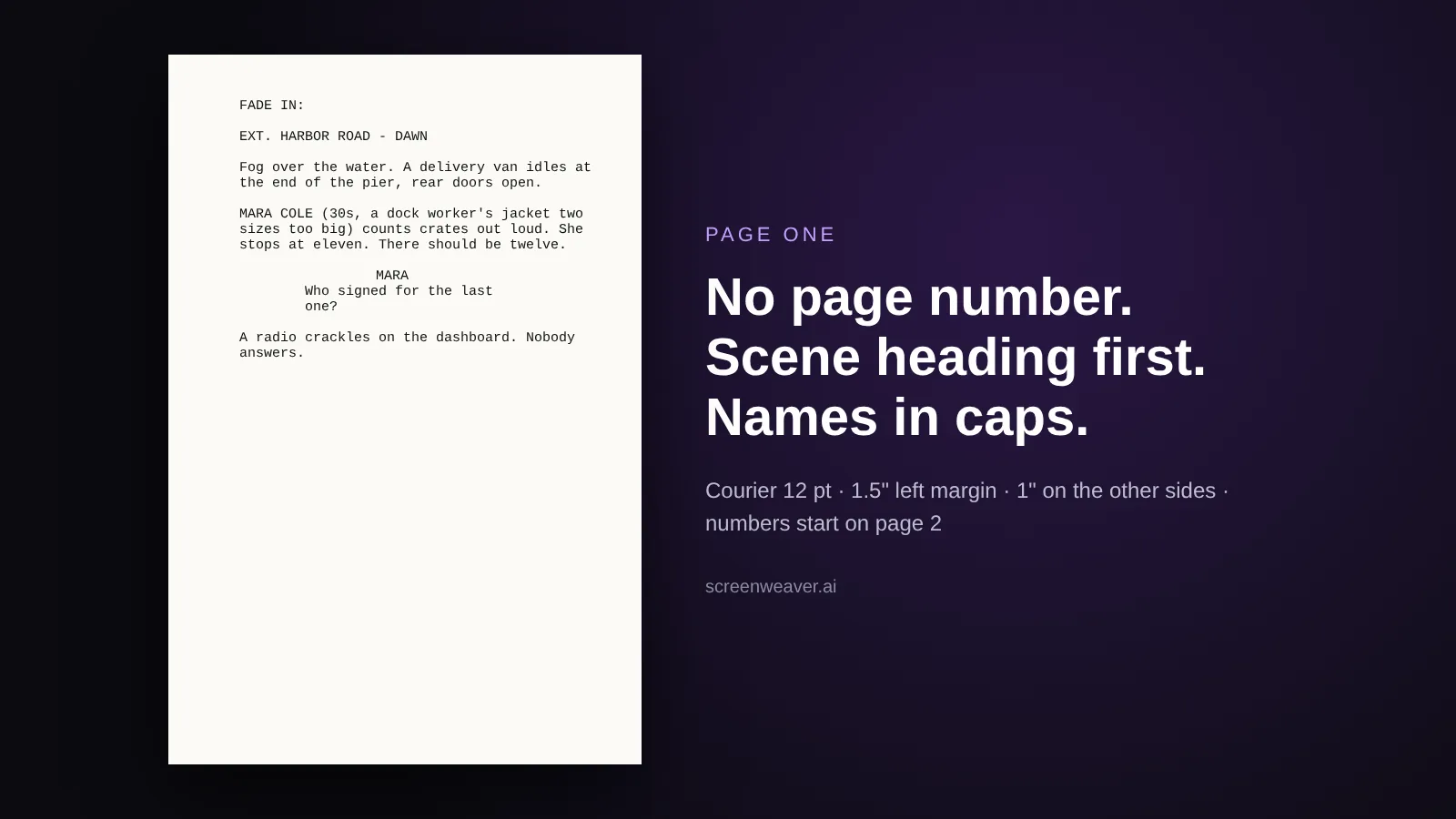
ScreenWeaver formats scene headings, action and dialogue as you type, and exports to PDF and Final Draft.
Start writing free